
What Are Chapters 1 to 5 in a Thesis?
Chapter 1 introduces the problem and states the objectives. Chapter 2 reviews related literature and studies. Chapter 3 sets out the research methodology. Chapter 4 presents and interprets the results. Chapter 5 gives the summary, conclusions and recommendations. Your school’s research manual is the final word on the exact requirements.

What does Chapter 1 contain?
Chapter 1 is the introduction, and it is where your study is defined. In most Philippine research manuals it contains the background of the study, the statement of the problem, the objectives, the hypotheses where applicable, the scope and delimitation, the significance of the study, and the definition of terms.
The statement of the problem is the heart of it. Everything you do for the rest of the thesis exists to answer the specific questions listed there. If your statement of the problem lists four questions, your panel will expect four answers in Chapter 4 — in the same order.
Chapter 1 is written before you collect any data. Expect to revise its scope and delimitation afterwards so that it describes what you actually did rather than what you planned in August.
What does Chapter 2 contain?
Chapter 2 is the review of related literature and studies — the RRL. Filipino research manuals usually distinguish between related literature (concepts, theories and published discussion) and related studies (actual research others have carried out), and many also ask you to separate local from foreign sources.
Chapter 2 also carries your theoretical framework and conceptual framework, and it must end by naming the gap your study fills. A chapter that summarises twenty studies and stops has not done its job. The gap is the bridge to Chapter 3 — it justifies why your method is the right way to answer a question nobody has yet answered.
What does Chapter 3 contain?
Chapter 3 is the methodology, and it is the most tightly structured chapter in the thesis. It normally covers the research design, the locale of the study, the population and sampling technique, the sample size, the research instrument, the validity and reliability of that instrument, the data gathering procedure, ethical considerations, and the statistical treatment of data.
The test to apply is reproducibility: could another student repeat your study using only Chapter 3? If they would have to ask you a question, something is missing. Panels probe this chapter harder than any other, because it is where a weak study is most easily exposed.
Chapter 3 is also written in the future or past tense depending on whether you are defending a proposal or a completed thesis — check which your school requires, because switching tenses halfway through is a common and easily avoided correction.
What does Chapter 4 contain?
Chapter 4 presents, analyses and interprets your data. It is normally organised in the exact order of the questions in your statement of the problem, with a table or figure for each, followed by the interpretation.
The distinction that decides your mark here is between presenting and interpreting. “Sixty-two percent of respondents agreed” is presentation. “This suggests that respondents perceive the policy as accessible, which is consistent with the findings of the studies reviewed in Chapter 2” is interpretation. A Chapter 4 that only presents is a report, not research.
Every table needs a number, a title, and a source note where required by your manual. Nothing should appear in Chapter 4 that was not promised in Chapter 1.
What does Chapter 5 contain?
Chapter 5 gives the summary of findings, the conclusions, and the recommendations. These three are different things and students routinely blur them.
The summary of findings restates what you found, briefly and without new interpretation. The conclusions answer the questions in your statement of the problem directly — one conclusion per question is the cleanest structure. The recommendations say what should be done, and by whom, based on those conclusions.
The most common Chapter 5 fault is a recommendation that does not follow from any finding. If you recommend a training programme, some finding must show that a skills gap exists. A recommendation with no evidentiary parent is the easiest thing for a panelist to attack.
What comes before Chapter 1?
The preliminary pages, and students consistently underestimate how much time they take to assemble.
A Philippine thesis normally opens with the title page, the approval or endorsement sheet, an acknowledgement, an abstract, the table of contents, and separate lists of tables and figures. Some manuals add a certification of originality or a declaration page, and graduate programs frequently require a signed approval sheet before the manuscript can be bound.
Two of these are timing traps. The approval sheet needs signatures from people who are not always available in submission week, so start collecting them earlier than feels necessary. And the lists of tables and figures must match the actual numbering inside Chapter 4 — a table renumbered late in revision breaks the list, and it is exactly the kind of small inconsistency a panelist notices while waiting for the defense to begin.
How do the five chapters connect?
This is what separates a thesis that passes cleanly from one that gets sent back, and it is worth stating plainly.
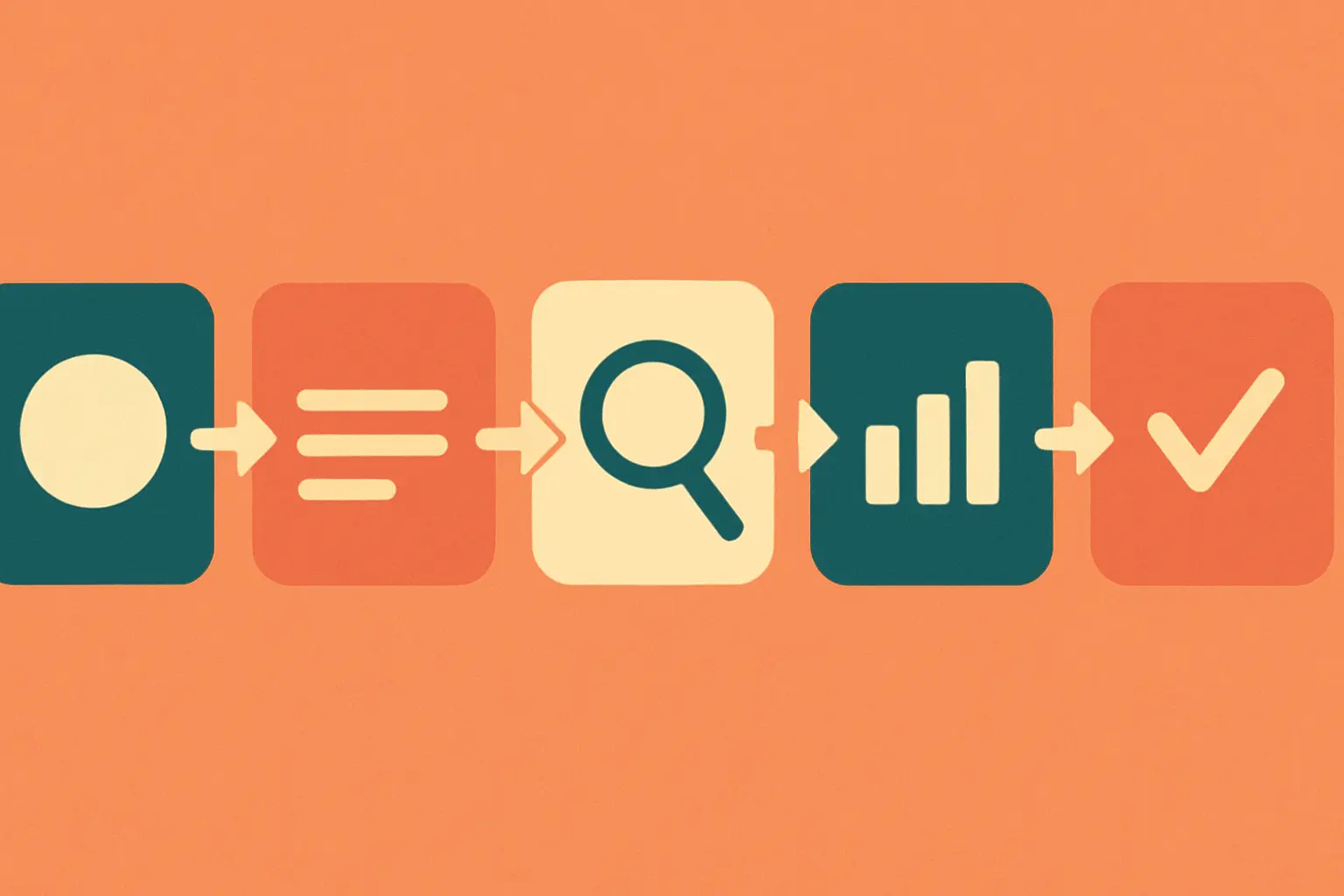
The chapters are not five separate documents. They form one chain: the problem in Chapter 1 creates the need for the literature in Chapter 2, which justifies the method in Chapter 3, which produces the results in Chapter 4, which are answered as conclusions in Chapter 5.
The joints are where theses fail. A panel that finds four research questions in Chapter 1, three sets of results in Chapter 4, and five conclusions in Chapter 5 does not need to read your analysis to know something is wrong. Before any defense, lay those three lists side by side and confirm they match in number, in order and in subject.
This alignment check takes about fifteen minutes and is the single highest-value thing you can do before submitting. It is also the check most groups skip, because each member wrote a different chapter and nobody read the whole document end to end in one sitting.
Is the five-chapter format required by CHED?
The five-chapter structure is the near-universal convention across Philippine higher education institutions, but the document that binds you is your school’s own research manual, and manuals differ in real ways.
Some programs split results and discussion into separate chapters, producing six. Some capstone and engineering programs use a different structure entirely, built around system design, development and testing. Some manuals require an ethics section in Chapter 3 while others place it elsewhere.
Get your manual, note its edition, and follow it wherever it differs from any general guide — including this one.
Frequently asked questions
What are Chapters 1 to 5 in a thesis?
Introduction, review of related literature, methodology, results and discussion, and summary with conclusions and recommendations.
Which chapter is the hardest?
Students usually find Chapter 2 the longest and Chapter 3 the most exacting. Panels most often send back Chapter 1, because a weak statement of the problem undermines everything after it.
How long should each chapter be?
There is no national page count, and any specific number you see is somebody’s school rule presented as universal. Chapters 2 and 4 are usually longest; Chapter 3 is often shortest.
What is the difference between related literature and related studies?
Related literature covers concepts, theories and published discussion. Related studies are actual research investigations others have conducted. Many Philippine manuals require both, separated.
Do I need local and foreign sources?
Many Philippine research manuals require both and some specify a balance. Check yours rather than assuming.
Where does the theoretical framework go?
Usually in Chapter 2, though some manuals place it at the end of Chapter 1. Follow your manual.
Where does statistical treatment go?
In Chapter 3, as its own section, naming each test and the research question it answers.
Can Chapter 4 include tables I did not mention in Chapter 1?
It should not. Results that answer no stated research question invite the question of why you collected that data.
What if my school uses six chapters?
Follow your school. Six-chapter formats usually split results from discussion, and the underlying logic is unchanged.
Do capstone projects use the same five chapters?
Often a modified version. Capstone documentation frequently replaces parts of the methodology with system design and testing sections.
The structure is the easy part to get right
Nobody fails a thesis for not knowing what belongs in Chapter 3. They lose months because the chapters were written as five separate assignments and only revealed their misalignment at defense.
Tesify builds your thesis as one connected document — objectives in Chapter 1 carried through to conclusions in Chapter 5, with citations attached as you write. It is 100% written by you, alongside 9,000+ students and 15,000+ chapters.