
Your system works. Your Chapter 2 is a page of headings. The adviser wants foreign and local studies, a review of related systems and a gap, and the deadline is not moving. This guide shows what a capstone Chapter 2 contains, where to find each part, how to compare existing systems in a table, and how to write the synthesis that turns a pile of summaries into a reason for your project.
Start your Chapter 2 on Tesify
What does an IT capstone Chapter 2 actually contain?
Many Philippine IT programs ask for four parts, though names vary by school, so check your manual:
- Related literature: concepts, technologies, standards and theories behind your project, such as web-based information systems, software quality models or e-government services.
- Related studies: published studies and earlier capstones about similar problems, split into foreign and local.
- Related systems: existing software that does something similar, compared feature by feature.
- Synthesis and gap: what these sources show together and what none of them provides for your users.
The difference matters because a thesis RRL reviews research, while a capstone also reviews products. The general method for organising a review, by theme and not by author, is in how to write a review of related literature. This guide adapts it to a system you built.
Where do you find foreign and local studies for a capstone?
Search for your problem, your system type and your users, in that order. For a barangay information system, for example, search the system type (“web-based information system”), the setting (“barangay”) and the quality or method you plan to use (“ISO 25010”). Good places to search:
- Crossref and Google Scholar for system development papers.
- Philippine E-Journals and the open-access journals listed in DOAJ for local studies.
- Your own college’s previous capstones, for format and for local precedent.
- Product pages and documentation for commercial or open-source systems, for the related systems part.
Where Philippine sources live, with their limits, is compared in where to find related literature for a Philippine thesis. As a working target, aim for a balanced set: a handful of foreign studies that show the wider field and a handful of local studies that show Philippine settings. Prefer recent work for systems and technologies, since software changes quickly, and keep older sources only for standards or methods that have not changed. Your research manual may set exact numbers and a date range, and it overrides this guide.
What does a real related study look like? Three examples
The three entries below describe real, published system development studies that were opened for this guide. They show the level of detail that is safe to include: what the study built, where, and what its abstract reports. Do not add claims beyond what you read.
- Local study. The study “Kabataan-Konek: A Barangay Web-Based Youth Information Management System with Data Analytics” (International Journal of Science and Applied Information Technology, 2025, volume 14, issue 3, pages 27 to 30) describes a web application for managing youth resident data in a barangay. Its abstract says the system includes a resident portal, a dashboard for officials, modules for announcements and certificate requests, a history log and QR code integration for clearance, and reports that testing met ISO 25010 software quality standards, with an average of 95.63 percent passed.
- Local study. Bondoc’s “Towards Digitization through e-Barangay: A Web-based Barangay Information System” (Journal of Humanities and Education Development, 2019, volume 1, issue 2, pages 88 to 91) is a short article on a web-based barangay information system. Cite the title and details, and read the full text before you describe its method or findings.
- Foreign study. Aini, Rindri and Zain’s usability evaluation of a web-based classroom and laboratory reservation system at an Indonesian polytechnic (Jurnal Teknologi Terpadu, 2026, volume 12, issue 1, pages 165 to 172) evaluates a system called SIRUANGKU using the System Usability Scale. Its abstract is in Indonesian, so read it carefully or ask for help before you summarise it.
A summary formula you can reuse: “[Author, year] developed [system] for [setting] using [method]. The study reported [result from the abstract or full text]. This relates to the present study because [one sentence of relevance].”
How do you write the related studies as prose?
A list of summaries is not a review. Group the studies by what they have in common and write one paragraph per group. An illustrative paragraph, built only on what the abstracts above state, would read: “Local studies on barangay systems show a move from manual records to web portals. Bondoc (2019) describes a web-based barangay information system, and a more recent system for youth data reports resident portals, dashboards, certificate requests and a history log, with testing against ISO 25010 (Kabataan-Konek, 2025). A foreign study evaluated the usability of a web-based reservation system using the System Usability Scale (Aini et al., 2026), which shows an evaluation approach the present study can adapt.” Notice that each claim is attached to a source and that the paragraph ends with a link to your own study. Write your own paragraphs from sources you opened, never from this example.
How do you review related systems?
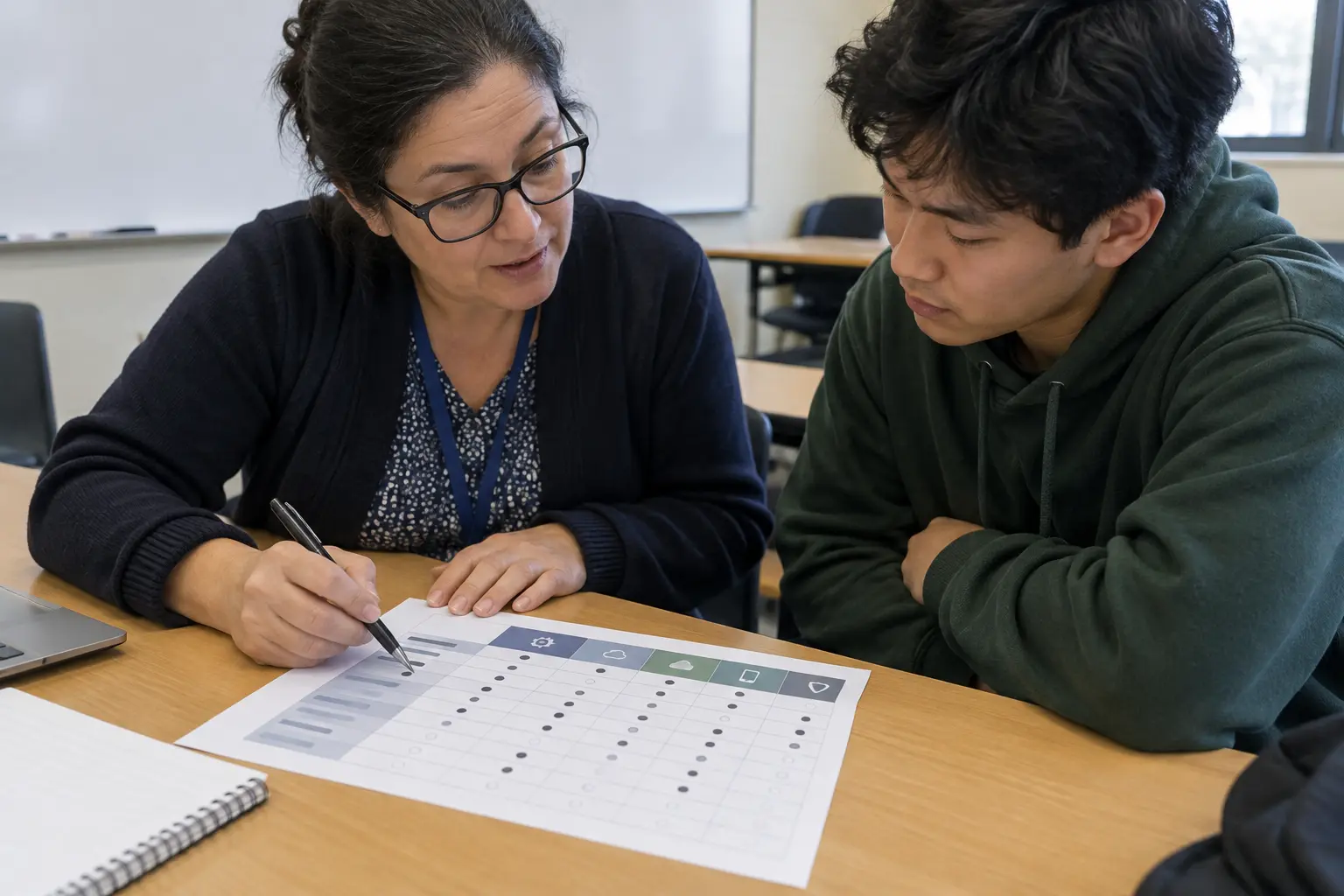
A related system is a product or existing system that does something close to yours. List three to six, then compare them in a table. Each feature you mark must come from something you verified: the product’s documentation, a demo, a screenshot in a paper or a visit to the office that uses it. An illustrative table for a barangay document request system:
| Feature | Existing manual process | System A (a published barangay system) | System B (a commercial tool) | Your proposed system |
|---|---|---|---|---|
| Online request by residents | No | Yes (verify) | Yes (verify) | Yes |
| Status tracking by requester | No | Not stated | Yes (verify) | Yes |
| Fits the barangay’s own forms | Yes | Partly (verify) | No | Yes |
| Offline logbook backup | Yes | Not stated | No | Yes |
| Local language option | Not applicable | Not stated | Partly (verify) | Yes |
The “(verify)” marks are a reminder, not part of the final table: replace each with a fact you confirmed, or write “not stated” if the source does not say. The table above is illustrative, with invented system labels. In your own thesis, name the real systems and cite where you learned each feature. After the table, write one short paragraph per system: what it does, who it serves, how you learned that, and what it does not provide for your users.

How do you write the synthesis and the gap?
A synthesis is not another summary. It is a paragraph that groups what the sources show. Try this sequence:
- Name the common ground: most reviewed systems provide online submission and a dashboard for officials.
- Name the differences that matter: they differ in whether residents can track a request.
- Name what is missing for your users: none of the reviewed systems fits the barangay’s own forms and offline routine.
- State the need: this capstone therefore develops [system] to provide [missing features] and evaluates it with [instrument].
That last sentence is your gap. It should match your statement of the problem and your objectives. If it does not, change one of them before your adviser notices.
What goes in related literature, besides studies?
Use this part for concepts and standards your system depends on, not for more studies. Typical topics:
- The domain: e-government, school management, inventory control, whichever your system serves.
- The method: your development approach, which is described in what method an IT capstone should use.
- The quality model and instrument for evaluation, compared in ISO 25010 vs SUS vs TAM for capstone evaluation.
- The framework you will draw in Chapter 1 or 2, explained in how to draw the IPO conceptual framework of a BSIT capstone.
How do you keep Chapter 2 honest and on schedule?
Set a small, strict routine. Spend the first hours collecting ten to fifteen sources, then stop searching. Read the abstract of each, open the full text for the ones you will cite, and write one log row per source: author, year, local or foreign, what was built, how it was evaluated, what you can use. Then write the section in the order of the log. Chapter 2 is slow when you search while writing, and fast when the log is finished first. Never cite a source you could not open. If you could not read the full text, cite only what the abstract states, or replace the source.
A simple plan for a tight week: on day one, search and log; on day two, read and mark the sources you will cite; on day three, write the related literature; on day four, write the related studies, foreign then local; on day five, build and write the related systems table; on day six, write the synthesis and gap and check them against your objectives; on day seven, fix the citations and ask your adviser to read it. If your deadline is shorter, shorten each step, but keep the order.
Chapter 2 sits between your manuscript’s background and your method, so it connects to documents you may already have. A practical way to reuse the artefacts you built is shown in capstone documentation from the artifacts you already built. Remember that a capstone builds and evaluates a solution, and that your program decides how much research a Chapter 2 must carry.
Frequently asked questions
What is the difference between related studies and related systems?
Related studies are research papers on similar problems or methods. Related systems are existing software or products that do something similar to yours, compared by features.
How many related systems should I review?
Enough to show the landscape, usually a small handful. Your adviser or research manual may set a number, so check it.
Do I need both foreign and local sources?
Most Philippine research manuals ask for both. Foreign studies show the wider state of the field, and local studies show how the problem looks in Philippine settings.
Can I review a commercial product I cannot access?
Only describe what you can verify from the product’s own documentation or a demo. State the source of every feature you list.
Where do I find related systems?
In published system development papers, in app stores and product pages for commercial tools, and in the systems the organisation already uses.
Is it acceptable to use an AI tool while writing Chapter 2?
Follow your school’s written policy and your adviser’s rules. Whatever tool you use, the sources must be real, opened and cited by you, and the writing must be yours.
What do I do with sources I cannot open in full?
Do not cite claims you cannot verify. Cite what the abstract states, ask your library for the full text, or choose another source.
How do I show the gap?
Compare the related systems and studies in a table, then state in one paragraph what none of them provides for your users, which is the need your capstone answers.
Get Chapter 2 out of the empty-page stage
Tesify helps you structure your Chapter 2 into related literature, related studies, related systems and a gap statement. Over 9,000 students have used Tesify across more than 15,000 chapters, and the thesis stays 100% written by you.