
Only 24 per cent of Filipino 15-year-olds reached Level 2 in reading and 16 per cent reached it in mathematics in PISA 2022, against mean scores of 347 and 355 that sit more than a hundred points below the OECD averages of 476 and 472 (OECD, 2023). That pair of figures is the citable Chapter 1 opening for more BEEd and BSEd thesis topics than any other dataset in the country, and it is only one of nine national figures an education thesis can lean on.
This roundup lists 25 education thesis topics that BEEd and BSEd students in the Philippines can carry out in one school, one district or one division, each with the research question written out in one line, and names for every cluster the national figure and the statute that make the problem citable in Chapter 1 — with the source and year in the row, because a panel that hears “studies show” without a year will ask for it.
The national figures a BEEd or BSEd Chapter 1 can cite
Every figure below was read from its publisher’s own page. Copy the source and year into your citation exactly as they appear here, and re-check the page before your final defense, because the World Bank and the OECD both revise.
| Indicator | Figure | Source and year | What it supports |
|---|---|---|---|
| PISA 2022 mean scores, Philippines | Mathematics 355 · Reading 347 · Science 356 | OECD, PISA 2022 Results, Philippines country note (2023) | Any achievement study in Grades 7 to 10 |
| PISA 2022 OECD averages | Mathematics 472 · Reading 476 · Science 485 | OECD (2023) | The gap sentence in the background of the study |
| Share of Filipino 15-year-olds at Level 2 or above | 16 per cent in mathematics · 24 per cent in reading | OECD (2023) | Reading and numeracy intervention studies |
| Learning poverty, Philippines | 90.9 per cent of children unable to read and understand a simple text by age 10 | World Bank, The State of Global Learning Poverty: 2022 Update (June 2022) | Early-grade reading studies, Grades 1 to 4 |
| SEA-PLM 2019, Grade 5 | 10 per cent at the minimum reading standard expected at the end of primary · 17 per cent in mathematics | UNICEF and SEAMEO, SEA-PLM 2019 Main Regional Report (2020) | Intermediate-grade reading and numeracy studies |
| Early-grade reading, Grades 1 to 3 | Over 50 per cent of Grade 1 to 3 learners not reading at grade level | DepEd Comprehensive Rapid Literacy Assessment, as cited by the Second Congressional Commission on Education | Remediation and phonics studies |
| Textbook procurement | 27 textbook titles procured since 2012 | EDCOM II Year One Report, Miseducation (2024) | Learning-materials studies |
| Child stunting | 26.7 per cent of children under five | As reported in the EDCOM II Year One Report (2024) | Feeding, attendance and readiness studies |
| MATATAG curriculum rollout | Kindergarten, Grades 1, 4 and 7 in SY 2024–2025 · Grades 2, 3, 5 and 8 in SY 2025–2026 · Grades 6, 9 and 10 in SY 2026–2027 | DepEd Order No. 010, s. 2024 | Curriculum implementation studies |
The statutes that turn a classroom problem into a legal basis
Philippine research manuals ask for a legal basis in Chapter 1 or Chapter 2. These six laws cover most BEEd and BSEd topics; each was read on the Lawphil archive, with the approval date as printed on the statute.
| Law | Approved | What it does | Topics it anchors |
|---|---|---|---|
| RA 10157, Kindergarten Education Act | 20 January 2012 | Institutionalises kindergarten in the basic education system | School readiness, early numeracy, kindergarten attendance |
| RA 10533, Enhanced Basic Education Act | 15 May 2013 | Establishes the K to 12 program and the curriculum framework | Any curriculum, senior high school or track study |
| RA 10627, Anti-Bullying Act | 12 September 2013 | Requires all elementary and secondary schools to adopt anti-bullying policies | School climate, bullying prevalence, policy implementation |
| RA 11510, Alternative Learning System Act | 23 December 2020 | Institutionalises ALS as a parallel pathway for out-of-school children in special cases and adults | ALS learners, re-entry, community learning centres |
| RA 11650, Inclusive Education Act | 11 March 2022 | Requires at least one Inclusive Learning Resource Center in every city and municipality and bars denial of admission on the basis of disability | Inclusion readiness, teacher attitudes, learners with disabilities |
| RA 12027 | 10 October 2024 | Discontinues mother tongue as the medium of instruction from Kindergarten to Grade 3, reverting to Filipino and English with regional languages as auxiliary media, and allows optional mother-tongue use in monolingual classes | Language of instruction, teacher readiness, comprehension by language |
Reading and literacy topics
The learning-poverty and early-grade reading figures make this the most citable cluster in the country.
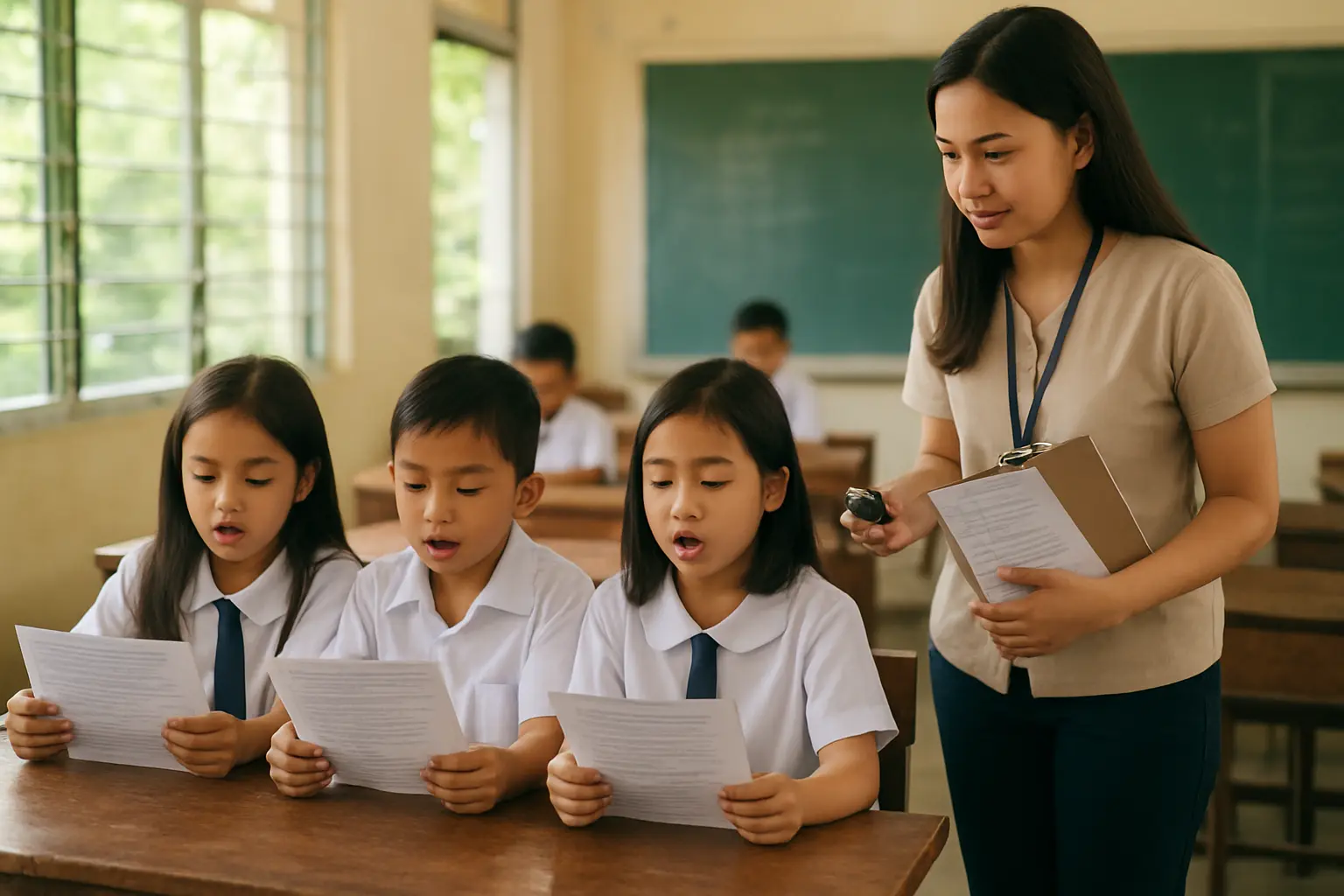
1. A structured phonics program and the oral reading fluency of Grade 2 pupils. Is there a significant difference in the oral reading fluency of Grade 2 pupils before and after a six-week structured phonics program?
2. Home literacy environment and the reading comprehension of Grade 4 pupils. Is the home literacy environment significantly related to the reading comprehension of Grade 4 pupils in one district?
3. How Grades 1 to 3 teachers remediate pupils reading below grade level. What remediation practices do Grades 1 to 3 teachers use for pupils reading below grade level, and what constraints do they report?
4. Reading habits and comprehension of Grade 10 students on a released PISA-type task. What is the relationship between self-reported reading habits and performance on a released PISA-type reading task among Grade 10 students?
5. Reading interest of Grade 6 pupils under a classroom library intervention. Does access to a classroom library for one grading period change the reading interest and the number of books read by Grade 6 pupils?
Numeracy and science topics
The 16 per cent Level 2 figure in mathematics is the sharpest number in PISA 2022.
6. Mathematics anxiety and the problem-solving performance of Grade 7 students. Is mathematics anxiety significantly related to problem-solving performance among Grade 7 students?
7. Manipulatives in teaching fractions to Grade 3 pupils. Is there a significant difference in fractions achievement between Grade 3 pupils taught with manipulatives and those taught conventionally?
8. An inquiry-based module and the science process skills of Grade 8 students. Does a four-week inquiry-based module significantly improve the science process skills of Grade 8 students?
9. Kindergarten attendance and Grade 1 numeracy. Is completion of kindergarten, as required under RA 10157, associated with the numeracy scores of Grade 1 pupils at entry?
Language of instruction topics
RA 12027 lapsed into law on 10 October 2024 and changed the medium of instruction in Kindergarten to Grade 3 for the first time since RA 10533; a policy that new has almost no Philippine literature yet.
10. Teacher readiness for the shift from mother tongue to Filipino and English in Grades 1 to 3. What is the level of readiness of Grades 1 to 3 teachers for the medium-of-instruction change under RA 12027, and what support do they identify?
11. Listening comprehension in the mother tongue versus Filipino among Grade 2 pupils in a monolingual community. Is there a significant difference in the listening comprehension scores of Grade 2 pupils when the same story is delivered in the mother tongue and in Filipino?
12. Code-switching in Grade 5 science classes. How and why do Grade 5 science teachers code-switch between English and Filipino, and how do pupils perceive it?
Curriculum and MATATAG topics
DepEd Order No. 010, s. 2024 phased MATATAG in by grade, which means every school year until 2026–2027 has a grade in its first year of the new curriculum.
13. Teachers’ experiences in the first year of MATATAG implementation in Grade 4. What are the experiences of Grade 4 teachers in the first year of MATATAG implementation, and what do they report as its gains and gaps?
14. Alignment of teacher-made tests with the revised Bloom’s taxonomy. To what extent are teacher-made English tests in Grade 8 aligned with the higher-order levels of the revised Bloom’s taxonomy?
15. Learning materials used in the absence of a textbook. What learning materials do Grade 5 teachers actually use when no textbook has been issued, and how do they judge their quality?
16. Time on homework and the mathematics performance of Grade 6 pupils. Is time spent on mathematics homework significantly related to the mathematics performance of Grade 6 pupils?
Teacher practice topics
These topics take the teacher as the unit of analysis, so the theory and the questionnaire have to be chosen together; the theories they draw on, with the source to cite for each, are in the companion answer on which theoretical framework an education thesis should use.
17. Differentiated instruction in mixed-ability Grade 3 classes. What is the extent of differentiated instruction practised by Grade 3 teachers, and what barriers do they identify?
18. TPACK and technology integration among junior high school teachers. What is the level of technological pedagogical content knowledge among junior high school teachers, and does it differ by years of service?
19. Teacher self-efficacy and classroom management in large classes. Is there a significant relationship between teacher self-efficacy and classroom management practices in classes of 45 pupils or more?
20. Challenges of pre-service teachers during teaching internship. What challenges do BEEd and BSEd pre-service teachers encounter during teaching internship, and how do they cope with them?
Inclusion, ALS and learners-at-risk topics
RA 11650 and RA 11510 are recent enough that implementation studies are still scarce.
21. District readiness to implement inclusive education under RA 11650. What is the level of readiness of schools in one district to implement inclusive education as required by RA 11650, in terms of personnel, facilities and materials?
22. Teachers’ attitudes toward learners with disabilities in general education classrooms. What are the attitudes of Grades 1 to 6 teachers toward inclusion, and do they differ by training received?
23. Why ALS learners left school and what brought them back. What factors led ALS learners in one community learning centre to leave formal school, and what motivated their re-entry under the Alternative Learning System Act?
24. School-based feeding, attendance and reading readiness in kindergarten. Is participation in a school-based feeding program associated with the attendance and reading-readiness scores of kindergarten pupils?
School climate topics
25. Bullying experiences of Grade 7 students and the school’s anti-bullying policy. What is the prevalence of bullying reported by Grade 7 students, and how do they perceive the implementation of the school’s policy under RA 10627?
The figures that do not exist as public datasets
An evidence-first Chapter 1 also says what cannot be cited.
School-level reading assessment results. The Comprehensive Rapid Literacy Assessment is administered nationally, but its results are not published as a downloadable dataset by school or division. Cite the national share as reported by EDCOM II, then generate your own school-level figures with a standardised oral reading measure.
A national dataset on bullying prevalence by school. None is published. Cite RA 10627 as the legal basis and the policy requirement, and treat your own prevalence survey as the primary data.
Classroom and teacher shortage counts. These appear in the EDCOM II reports and in budget hearings rather than in a maintained public table, and the numbers move every year. Cite the report by title and year and quote its figure rather than a rounded version heard in a news clip. The same discipline — indicator, year and the date the source was last updated — is explained in the guide to Philippine higher education statistics for Chapter 1.
How to pick one of the 25 and make it yours
Scope by grade, subject and one school or district; a topic that names Grade 2, oral reading fluency and one central school is defensible at title defense in a way that “reading performance of pupils” is not. Then check whether the exact combination has already been done, using the counting method in has your thesis topic already been studied, and write the significance section around the beneficiaries the national figure implies, following the structure in the answer on what the significance of the study should contain.
For the quantitative topics, the instrument decides the study; the item-writing and validation procedure for education respondents is set out in the guide to making a thesis questionnaire for a BEEd or BSEd study. If your course is not education, the same national-data approach is worked through in the roundup of nursing thesis topics and the data behind each one.
How to cite the sources in APA 7th
Three reference entries cover most of the table above; note the publisher without a location and the DOI without a trailing period.
OECD. (2023). PISA 2022 results (Volume I): The state of learning and equity in education. OECD Publishing. https://doi.org/10.1787/53f23881-en
World Bank. (2022). The state of global learning poverty: 2022 update. World Bank.
Second Congressional Commission on Education. (2024). Miseducation: The failed system of Philippine education (Year One report). EDCOM II.
Turn the topic into a Chapter 1 tonight
Tesify drafts the background of the study around the national figure you choose, writes the statement of the problem from the one-line research question, and builds the APA 7th entry for the OECD, World Bank or EDCOM source as you go — in the Chapter 1 to 5 structure Philippine schools require. Over 9,000 students have used it to write more than 15,000 chapters, and every word is still written by you.
Frequently asked questions
What are good thesis topics for BEEd and BSEd students in the Philippines?
Topics that name a grade, a subject and one school or district, and that connect to a national figure: early-grade reading interventions, mathematics anxiety, teacher readiness for RA 12027, first-year MATATAG implementation, inclusion readiness under RA 11650, ALS re-entry and bullying under RA 10627. The 25 topics above each come with a one-line research question.
What is the Philippines’ PISA 2022 score?
Mean scores of 355 in mathematics, 347 in reading and 356 in science, against OECD averages of 472, 476 and 485. Only 16 per cent of Filipino 15-year-olds reached Level 2 in mathematics and 24 per cent in reading, according to the OECD’s PISA 2022 results published in 2023.
What is learning poverty and what is the Philippine figure?
Learning poverty is the World Bank’s measure of the share of 10-year-olds who cannot read and understand a simple text. The Philippine figure in the World Bank’s 2022 update is 90.9 per cent.
What did RA 12027 change?
It discontinued the use of the mother tongue as the medium of instruction from Kindergarten to Grade 3, reverting to Filipino and English with regional languages as auxiliary media, and allowed optional mother-tongue instruction in monolingual classes under conditions. It lapsed into law on 10 October 2024.
Which grades are under the MATATAG curriculum in 2026?
Under DepEd Order No. 010, s. 2024, Kindergarten and Grades 1, 4 and 7 started in SY 2024–2025, Grades 2, 3, 5 and 8 in SY 2025–2026, and Grades 6, 9 and 10 in SY 2026–2027.