
Your title defense has a date on the department calendar, and your group still has no week-by-week plan connecting today to that date. A Legal Management thesis has one scheduling risk most other courses do not: the doctrinal step — reading the statute and its implementing rules closely enough to build a defensible Chapter 3 instrument — has to happen before data collection even starts, and groups that skip straight to drafting a questionnaire routinely have to redo it once the legal analysis catches a mismatch.
The Real Cost of Planning Backward From “Whenever We Get to It”
Without a written timeline, a Legal Management group’s default pace is Chapter 1 first, then whatever chapter feels most urgent that week — which means the doctrinal reading that should anchor the whole instrument often gets compressed into a rushed weekend right before Chapter 3 is due. The predictable result: a consistency matrix built from a paraphrased understanding of the statute rather than its actual text, caught at title defense, sent back, and redone under worse time pressure than if it had been done properly the first time. A missed title defense slot does not just cost a week — it can cost a full semester if the next available slot falls after the term’s academic calendar cutoff.
The Week-by-Week Plan, Working Backward From Defense Date
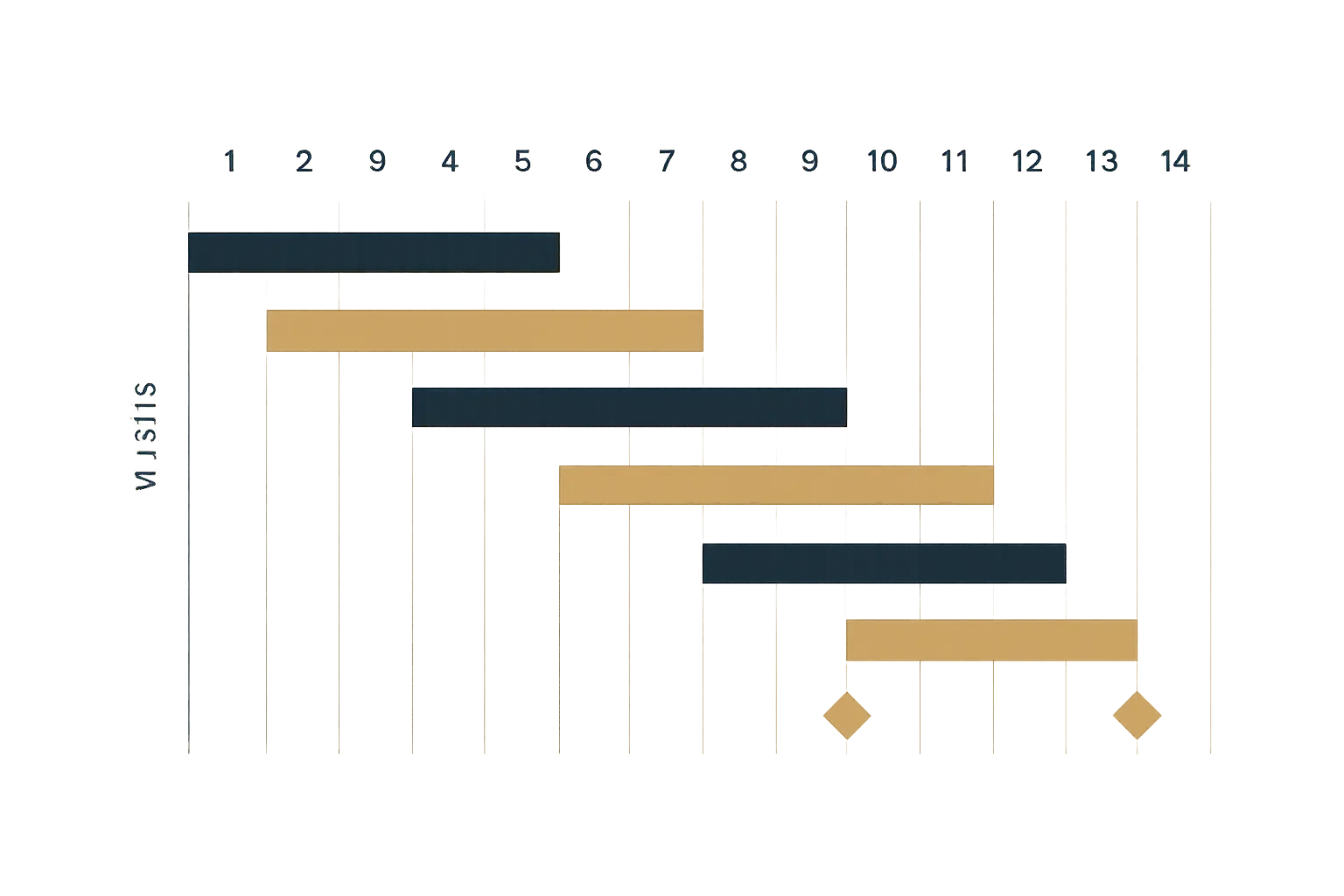
| Weeks Before Defense | Milestone | Legal-Management-Specific Note |
|---|---|---|
| 14–12 | Topic selection, statute identification, initial doctrinal reading | Read the actual Republic Act and its IRR before drafting anything — this is the step most groups compress and regret |
| 11–10 | Chapter 1 draft: background, statement of the problem, significance | Every legal citation here must match the same instrument used in Chapters 2 and 3 |
| 9–8 | Chapter 2 draft: legal lane and management lane, synthesis paragraph | The synthesis paragraph is where a Legal Management panel checks the hybrid identity is genuine |
| 7–6 | Chapter 3: instrument built from the statute’s specific provisions; validator requests sent | Validator turnaround is often the hidden bottleneck — request early, not the week the instrument is due |
| 5 | Proposal defense / title defense | The consistency matrix and the doctrinal citations are what a panel checks first |
| 4–3 | Ethics clearance (if required) and organization access negotiation; data collection begins | Business or regulator access can take longer to confirm than a student respondent pool — start this the moment the proposal clears |
| 2 | Data collection completed; Chapter 4 analysis begins | Build in a buffer here — access delays are the single most common reason this stage runs over |
| 1 | Chapter 5, full-manuscript review, defense rehearsal | Recommendations should be split into a policy recommendation and a practice recommendation, per the course’s own convention |
| 0 | Final defense | — |
An Illustrative Budget Worksheet
Every figure below is a fictional placeholder for shape only — costs vary widely by school, printer, and locale, and your own research office or previous cohort’s groups are the real source for current numbers.
| Category | What It Covers | Illustrative Share of Total Budget |
|---|---|---|
| Printing and binding | Proposal copies for panel, final manuscript copies, approval-sheet originals | Illustrative 25% |
| Transportation | Site visits for respondent access, meetings with the organization’s compliance officer or HR contact | Illustrative 20% |
| Respondent tokens | Small tokens of appreciation for organization respondents, where the school’s own policy permits them | Illustrative 15% |
| Software and reference tools | Reference manager, statistics software (where a paid option is chosen over a free one), printing of the statute and IRR text | Illustrative 15% |
| Data collection materials | Printed checklists, consent forms, informed-consent documentation | Illustrative 15% |
| Contingency | Reserved for the access delays or reprint needs that almost every group encounters somewhere in the process | Illustrative 10% |
Why the Doctrinal Step Cannot Be Compressed
Every other archetype on this site’s Legal Management coverage — the annotated thesis model, the thirty topics anchored in named statutes — assumes the same sequencing: read the Act and its implementing rules first, build the instrument from what those documents actually say second. A group that reverses this order, building a generic compliance checklist and only afterward checking it against the statute, routinely discovers a mismatch at exactly the point in the timeline above where there is no longer time to fix it without slipping the defense date.
What Happens During Each Chapter-Drafting Week
The timeline table above names milestones; the work inside each milestone follows the same citation and formatting conventions used across every other piece of Legal Management content on this site. Chapter 1 and Chapter 2’s legal citations should match the pattern set out in this site’s guide to citing Republic Acts and Supreme Court decisions in APA 7th, and the preliminary pages — title page, approval sheet, margins — follow the same APA 7 format guide every course on this site uses. Neither of these is a task to schedule separately; both should be handled correctly from the first draft of each chapter, which is faster than reformatting a finished manuscript at week 1.
Why Validator Turnaround Deserves Its Own Line in the Timeline
The table above books validator requests at weeks 7–6, deliberately earlier than most groups think to schedule them, because the instrument-validation process covered on this site depends on three validators — typically including at least one with legal or compliance expertise for a Legal Management instrument — whose own schedules the group does not control. A validator who takes two weeks to respond, which is common, can silently consume the entire buffer this timeline otherwise builds in elsewhere; requesting validation the moment a draft instrument exists, rather than waiting for a “final” version, is what keeps this stage from becoming the actual bottleneck.
Building the Timeline as a Group, Not Just an Individual Task
A shared timeline only works if every member of the group can see it and update it — a shared spreadsheet or calendar with the fourteen-week structure above, assigned owners for each milestone, and a standing weekly check-in where the group confirms whether that week’s milestone actually happened, catches drift early rather than discovering it three weeks before defense. The doctrinal-reading milestone in particular benefits from a shared owner: assigning one member to lead the statute-and-IRR reading, with the rest of the group reviewing their summary before Chapter 1 is drafted, is faster than every member reading the full text independently and produces a more consistent Chapter 2 synthesis paragraph.
An Illustrative Example: How One Fictional Group Divided the Week 7–6 Validator Push
The following group and names are entirely fictional, used only to show how the validator-request stage in the table above can be divided across a typical four-member group rather than left to whoever happens to be free that week. In this illustrative example, Group Alpha assigns one member to finalize the instrument draft from the statute-based consistency matrix by the Monday of week 7, a second member to compile the validator shortlist — a thesis adviser, a faculty member from the law lane, and a practitioner with relevant compliance experience — and send requests the same day rather than waiting for the instrument to be “perfect.” A third member tracks responses in a shared sheet and follows up with any validator who has not replied within five days, while the fourth member begins drafting Chapter 3’s narrative sections that do not depend on validator feedback, so the group is not idle while waiting. By staggering the request itself a full week ahead of when the instrument is actually due, this fictional group leaves room for at least one round of revision if a validator flags a mismatch between an item and its corresponding statutory provision — the single most common reason a Legal Management instrument goes back for a second validation pass.
Frequently Asked Questions
How much does Tesify cost for a Legal Management group splitting expenses?
Tesify has a free tier to start planning and drafting immediately; current paid-plan pricing in pesos is shown on the site at signup and is built to be split affordably across a group rather than priced for one person — check the live pricing page for today’s numbers before your group finalizes its budget.
Is using an AI tool to help plan the timeline or draft sections considered academic dishonesty?
Tesify is built to help your group draft its own research faster and stay organized, not to write the thesis or fabricate legal citations for you — whether and how AI assistance needs to be disclosed is set by your school’s own academic-integrity policy, so confirm your program’s specific rule before you start using any tool.
Is data shared with an organization respondent or with Tesify kept private?
Never enter an organization’s confidential internal data, actual compliance records or personally identifiable respondent information into any drafting tool, AI or otherwise — your thesis should work from de-identified or aggregated data your instrument itself collects, consistent with the Data Privacy Act obligations already covered across this site’s Legal Management content.
What happens if the ethics-clearance step takes longer than the two weeks budgeted above?
This is common enough that the contingency line in the budget worksheet and a documented backup organization at the proposal stage both exist specifically for this scenario — a group whose primary organization access is delayed should have a second, less time-sensitive respondent group or organization ready rather than losing weeks waiting on a single point of failure.
Can the fourteen-week timeline above be compressed for a shorter term?
Yes, proportionally, but the doctrinal-reading step and the validator-turnaround step should never be the ones compressed — those are the two stages most likely to resurface as a defense-day correction if rushed, while chapter-drafting time is comparatively more elastic.
How is this timeline different from a generic thesis timeline used by other courses on this site?
The overall fourteen-week shape is similar to any other course’s timeline, but two stages are specific to this hybrid course and should not be borrowed from a generic template: the doctrinal-reading window before Chapter 1 is drafted, and the organization-access negotiation, which behaves more like the institutional access a Criminology or Social Work thesis needs than like the individual-respondent recruitment a straightforward business or education thesis relies on.
What if the group’s chosen statute turns out to be superseded partway through the semester?
Check the statute’s current status again at the doctrinal-reading stage and once more immediately before Chapter 3 is finalized — Philippine law changes on a real schedule, and a group that verifies currency only once, early on, risks citing a superseded provision by the time the manuscript is actually defended; re-checking costs a few minutes and avoids a defense-day correction.
Does the budget need formal approval from the school before spending starts?
Most programs do not require formal budget pre-approval for a student thesis, but many do require documentation of expenses if the group is requesting any departmental research support or reimbursement — check your own research office’s specific requirement before assuming either way.
Should the timeline account for a possible failed title defense and resubmission?
Yes — most programs schedule a short window between title defense and the start of data collection specifically to accommodate revisions, and a group whose proposal passes cleanly simply uses that window as extra buffer rather than losing it; planning for the revision scenario from the start is safer than assuming a first-pass approval and having no slack if it does not happen.
Should group members contribute equally to the budget regardless of how much drafting work each one does?
Most groups split shared costs — printing, binding, transportation to a shared site visit — equally regardless of who drafted which chapter, while treating individual costs like a member’s own transcript requests separately; deciding this rule explicitly at the start, alongside the timeline, avoids the awkward conversation that otherwise surfaces right before a printing deadline.
Turning the week-by-week plan and budget above into your own group’s real schedule — built around your actual defense date, your actual statute and your actual organization access — is exactly the kind of section-by-section planning Tesify is built to help a Legal Management group work through, starting today.