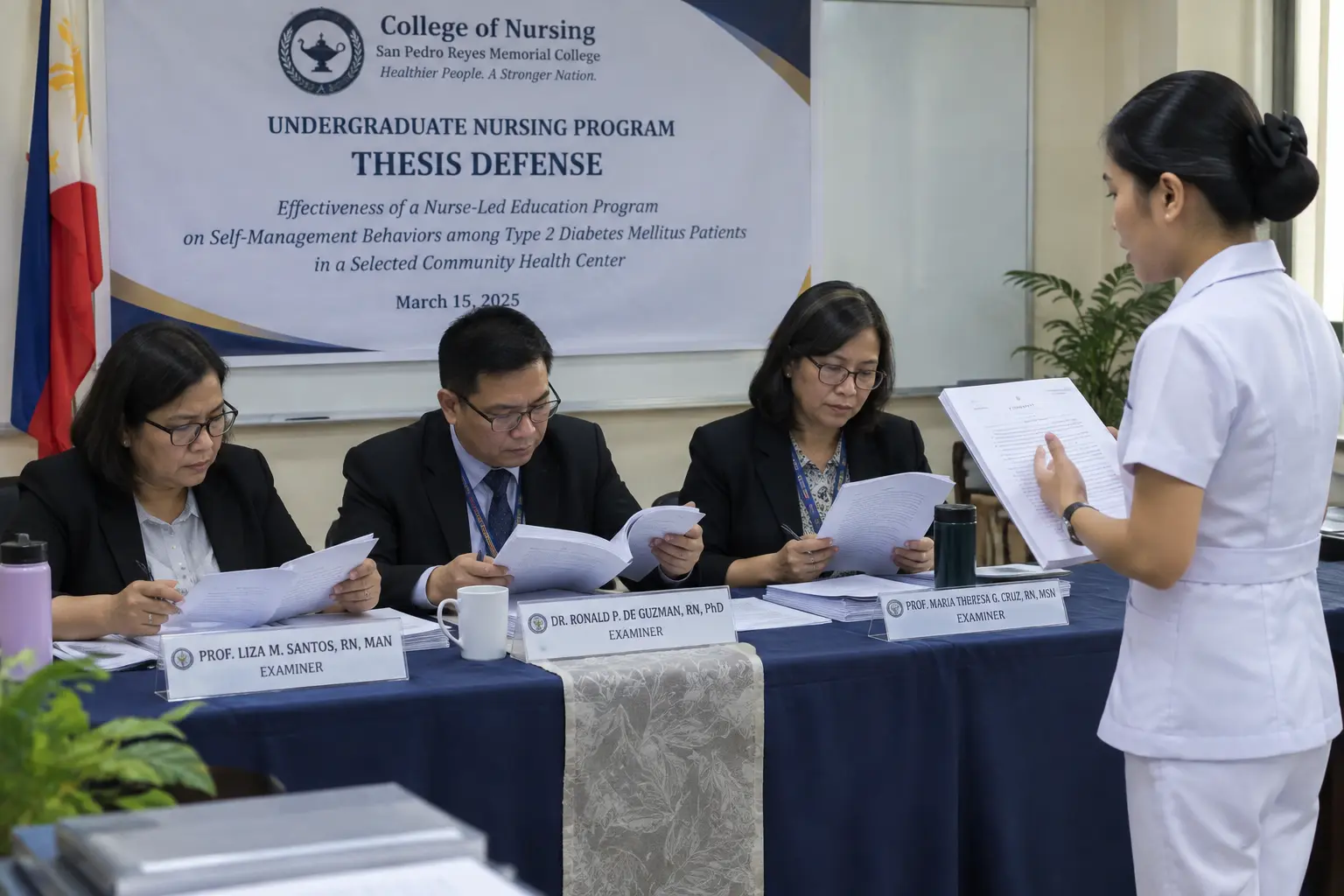
Nursing theses get sent back most often for a small, repeatable set of objections: a statistical test that does not match the design, an instrument with no reported validity or reliability, a sample that cannot support the claim being made, and an ethics section that names a committee but skips what it actually approved. None of these are writing problems. Every one is fixable once you know which objection you are looking at.
What is the single most common objection nursing panels raise?
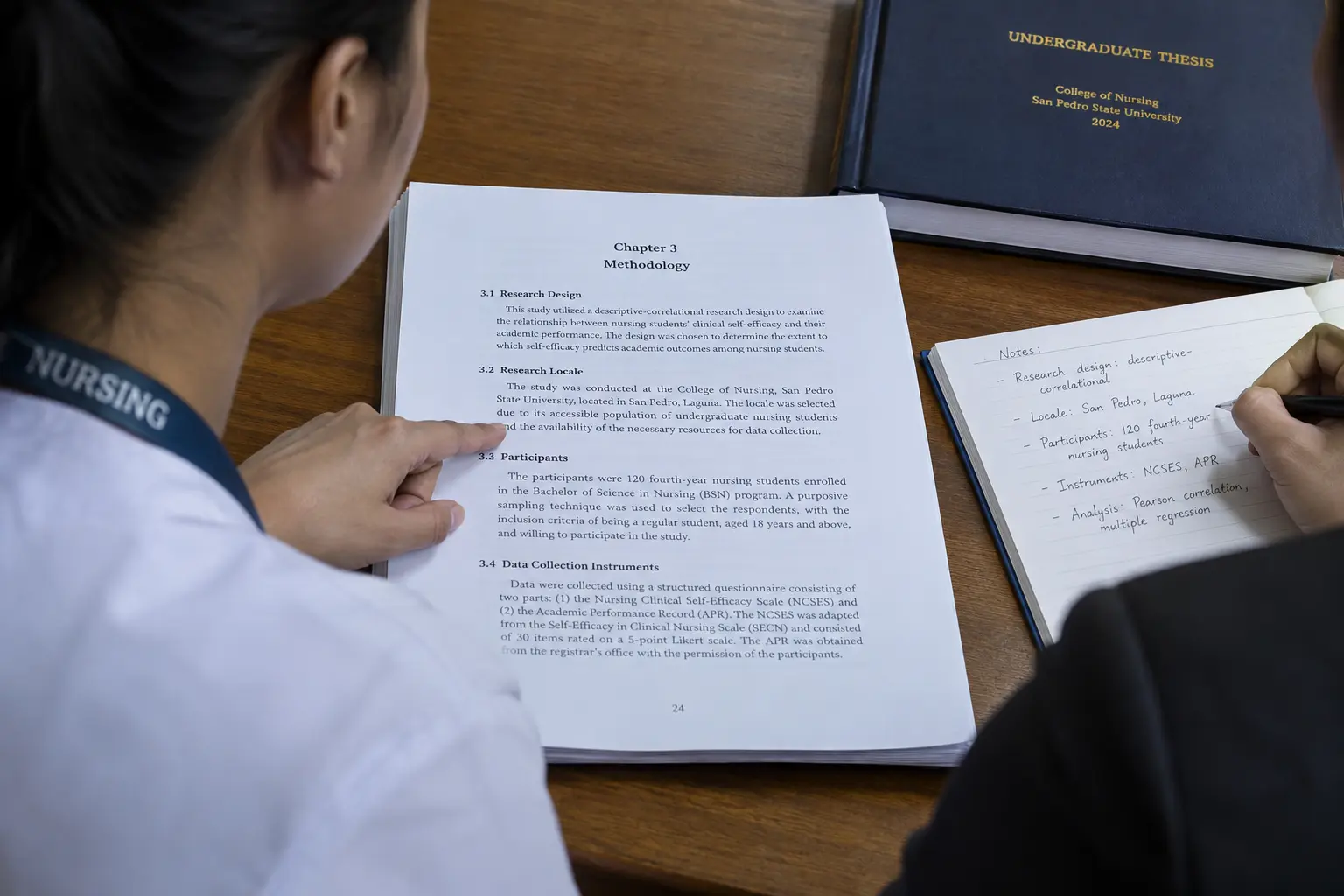
A mismatch between the stated design and the statistical test actually run. A nursing thesis that calls itself descriptive-correlational but reports only frequencies and means, with no correlation coefficient anywhere in Chapter 4, has not tested the relationship its own title promises. The fix is not a better write-up; it is running the test the design already commits you to, or renaming the design to match what was actually done. Which test a given nursing design actually needs — a paired t-test versus Wilcoxon for a pre-test/post-test, McNemar for a paired yes-or-no outcome, Spearman rho for a KAP relationship question — is laid out fully in which statistical test a BSN nursing thesis needs.
Why does the panel keep asking about the instrument’s validity?
Because a nursing instrument measuring knowledge, attitude or practice has to be shown to measure what it claims to measure before its scores mean anything. A Chapter 3 that names a scale — the Newcastle Satisfaction with Nursing Scales, a knowledge-attitude-practice questionnaire, a researcher-made tool — without reporting content validation by expert validators and a reliability coefficient from an actual pilot test is presenting an unvalidated measurement as if it were established. Panels ask for the number of validators, their qualifications, and the Cronbach’s alpha from the pilot, not a general statement that “the instrument was validated.”
Where the instrument is adapted from a published scale rather than built from scratch, the objection shifts: did the adaptation change the item count or the response scale in a way that was never re-tested? A nursing panel with an instrumentation background checks the original scale’s structure against what actually appears in the appendix. The full validation procedure — how many validators, what the validation sheet covers, how the pilot test is run and reported — is set out in the site’s general guide to research instrument validation for a Philippine thesis, and the nursing-specific worked example of turning validated variables into a Chapter 3 table is in the nursing thesis consistency matrix.
What sampling objections come up in nursing theses specifically?
Three, most often. First, a convenience sample presented as if it were representative of an entire hospital or municipality’s nurse or patient population, with no stated limitation. Second, a sample size with no computation shown — a number the group settled on without Slovin’s formula, a power analysis, or a stated rule of thumb behind it. Third, inclusion and exclusion criteria that are either missing or so loose that the sample could include respondents the study’s own variables cannot meaningfully apply to — for example, a study on postoperative pain management that never excludes patients on long-term opioid therapy, whose baseline pain response differs enough to distort the findings.
The fix for all three is the same habit: state the population, show the sample-size computation or the justification for a non-probability approach, and write inclusion/exclusion criteria specific enough that another researcher could replicate the selection.
What ethics-section objections does a nursing thesis face?
A named committee with no description of what it actually approved. Nursing research routinely touches patient data, vulnerable populations or clinical settings, and a panel expects the ethics section to state which body reviewed the protocol, what informed consent procedure was used, how anonymity or confidentiality was protected, and — where the study involves a clinical site — what the site’s own research office required before data collection began. A single sentence naming an institutional ethics review board without any of that detail reads as a formality rather than a completed step, and the panel will ask for the specifics on the spot.
A related, narrower objection appears in intervention studies: a nursing thesis testing an educational intervention, a care protocol or a bedside practice change needs to state explicitly what happened to the comparison or control group, since leaving a patient population without an established standard of care raises a distinct ethical question a panel will not let pass silently.
What discussion-chapter objections come up most in nursing theses?
Findings restated as conclusions without being connected to prior nursing literature, and clinical implications that overreach what the data actually supports. A Chapter 4 that reports a weighted mean of “moderate awareness” and a Chapter 5 that recommends a hospital-wide policy change based on one ward’s convenience sample is a mismatch in scale the panel will flag immediately. The discussion has to compare findings against named prior studies — where they agree and where they diverge — and any recommendation has to be scaled to what the sample and design can actually support: a pilot recommendation for further study, not an institution-wide mandate, unless the design genuinely supports that reach.
What citation and related-literature objections show up in nursing theses?
Two, most consistently. The first is a review of related literature that summarizes studies one at a time without ever synthesizing them into what is known, what is contested and what the gap actually is — a panel reading ten one-paragraph summaries in a row will ask where the synthesis is. The second is citing a superseded clinical guideline or a nursing organization’s older position statement as current, which matters more in nursing than in most fields because protocols genuinely change: a standard-of-care citation from a source more than a few years old needs a check for whether a newer version exists before it goes into Chapter 2.
A related, narrower objection: naming a nursing theory in Chapter 1 — Orem’s Self-Care Deficit Theory, Roy’s Adaptation Model, Watson’s Theory of Human Caring — and then never actually operationalizing its constructs into the study’s variables in Chapter 3. A theory that appears once in the introduction and nowhere else is decoration, not a framework, and the panel’s question is always the same: where in your variables does this theory actually show up?
How should a nursing group prepare for these objections before the defense?
Run a dry check against each objection above before the actual defense date, treating it as a checklist rather than waiting for the panel to raise it first:
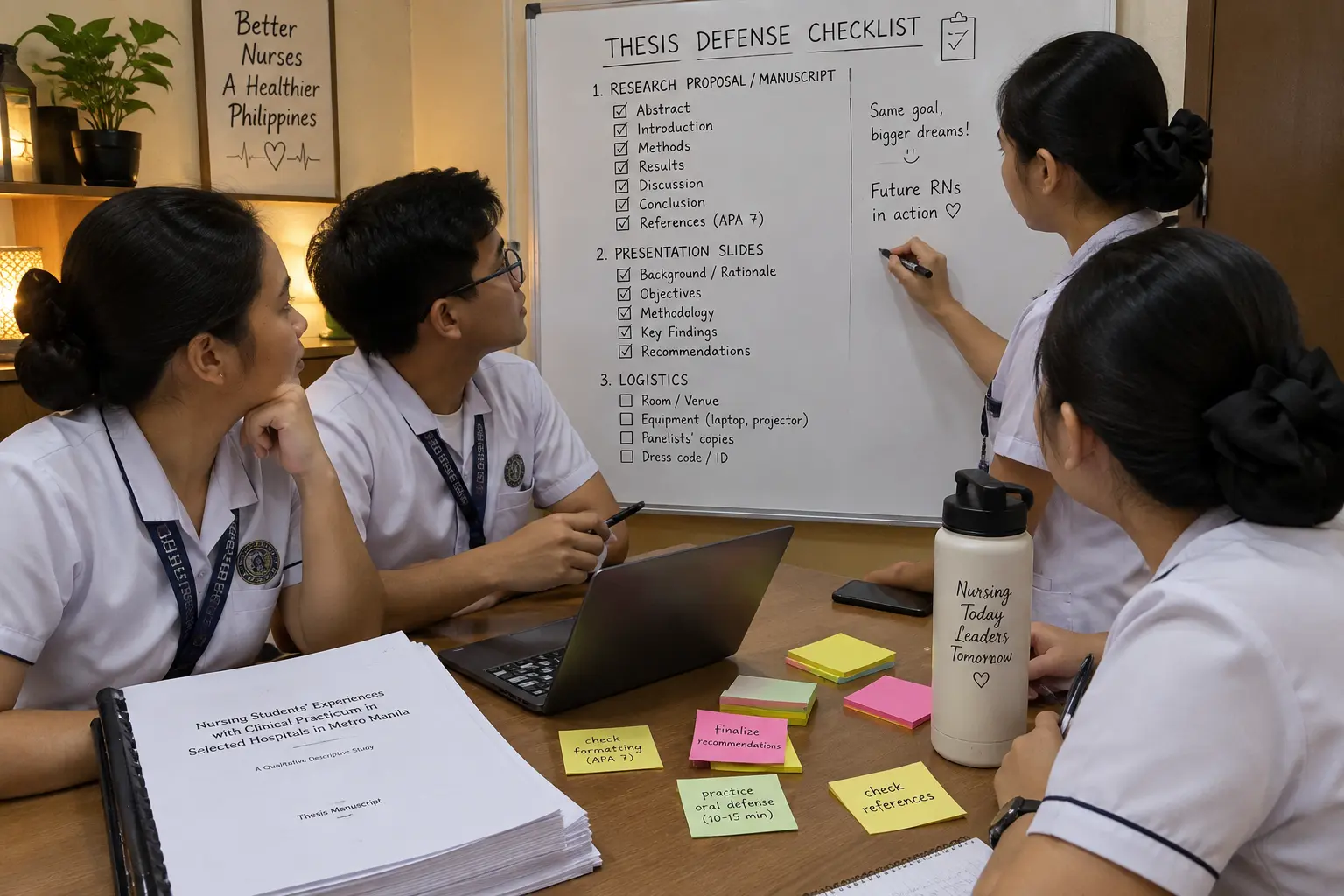
- Does the statistical test in Chapter 4 match the design named in Chapter 1 and Chapter 3?
- Does the instrumentation section report validators, a pilot test and a reliability coefficient?
- Is the sample-size computation shown, and are inclusion/exclusion criteria specific?
- Does the ethics section name the reviewing body and describe what it approved, not just that it exists?
- Do the recommendations in Chapter 5 stay within the scale the sample and design can support?
A group that can answer all five with a page number to point to walks into the defense with the panel’s most predictable questions already closed. Seeing where each of these sections sits inside a complete, passing manuscript helps more than the checklist alone — the sample BSN nursing thesis from Chapter 1 to 5 shows the instrumentation, sampling and ethics sections in context, chapter by chapter.
What should a nursing group actually do once the panel raises an objection?
Write down the objection in the exact words the panel used before the meeting ends, not a paraphrase from memory afterward — the precise wording usually points to which of the objections above is actually in play, and a paraphrase drifts toward whichever fix is easiest rather than the one the panel meant. Then take the objection to the adviser before making any change, since a revision that satisfies the panel’s literal comment but contradicts the adviser’s own prior guidance creates a second round of objections at the next defense.
Where the objection requires re-running an analysis — switching from an independent to a paired test, adding a validity paragraph, recomputing a sample size — do the recomputation before touching the prose around it. Groups that rewrite the surrounding paragraphs first and patch the numbers in afterward are the ones who leave a stray old figure in a table caption or an FAQ answer that no longer matches Chapter 4, which reads to a panel as carelessness rather than as a genuine fix.
Finally, keep a one-page revision log: the objection, the section affected, what changed, and the page number of the fix. A panel that raised an objection at the title or proposal defense will check, at the final defense, that it was actually addressed rather than quietly dropped — a log with page numbers answers that check in one line instead of a search through the whole manuscript.
Frequently asked questions
Can a nursing thesis pass with a convenience sample?
Yes, provided the limitation is stated explicitly in Chapter 1 and the findings are framed as applying to the sampled group rather than generalized to a wider population the sampling method cannot support.
Does every nursing instrument need a pilot test?
A researcher-made or adapted instrument does; a widely used, already-validated scale used without modification still needs its original validity and reliability reported, but a fresh pilot is less commonly required — check with your adviser and research manual, since practice varies by school.
What if our clinical site has its own ethics requirements beyond our school’s?
Meet both. A hospital or clinical facility’s own research office approval is separate from, and in addition to, your school’s ethics review, and a panel will ask whether the site itself signed off before data collection.
Is a weighted mean enough for a descriptive nursing thesis?
For a purely descriptive design with no stated relationship or difference question, yes — the objection only arises when the title or research questions promise a relationship, difference or effect that the statistical treatment never actually tests.
How specific do inclusion and exclusion criteria need to be?
Specific enough that another researcher reading only your criteria could replicate your selection decisions — vague criteria such as “adult patients in good health” invite the panel to ask what “good health” excludes.
Can Chapter 5 recommend a policy change from a single-ward study?
Frame it as a basis for further study or a pilot recommendation rather than an institution-wide mandate, unless your sample and design genuinely support that scale — matching the recommendation’s reach to the study’s actual reach is what the panel checks.
Do these objections differ between a title defense and a final defense?
The design-test mismatch and sampling objections usually surface earliest, at the title or proposal defense, since they can be caught before data collection even starts. Instrumentation, ethics-section and discussion-chapter objections more often surface at the final defense, once the actual instrument, the completed ethics process and the finished Chapter 4 and 5 are all on the table for the panel to check against what was proposed.
What if the adviser already approved a section the panel then objects to?
Raise the discrepancy with the adviser directly rather than choosing between the two on your own — advisers and panels occasionally disagree on a convention, and the adviser is usually the one who resolves it, either by explaining the reasoning to the panel or by agreeing the section needs the revision the panel asked for.
Close the gaps a nursing panel checks first
Tesify helps you structure your instrumentation, sampling and ethics sections around the objections nursing panels actually raise, and keep your statistical treatment aligned with the design you name in Chapter 1. Over 9,000 students have used it to write more than 15,000 chapters, and every word is still written by you.