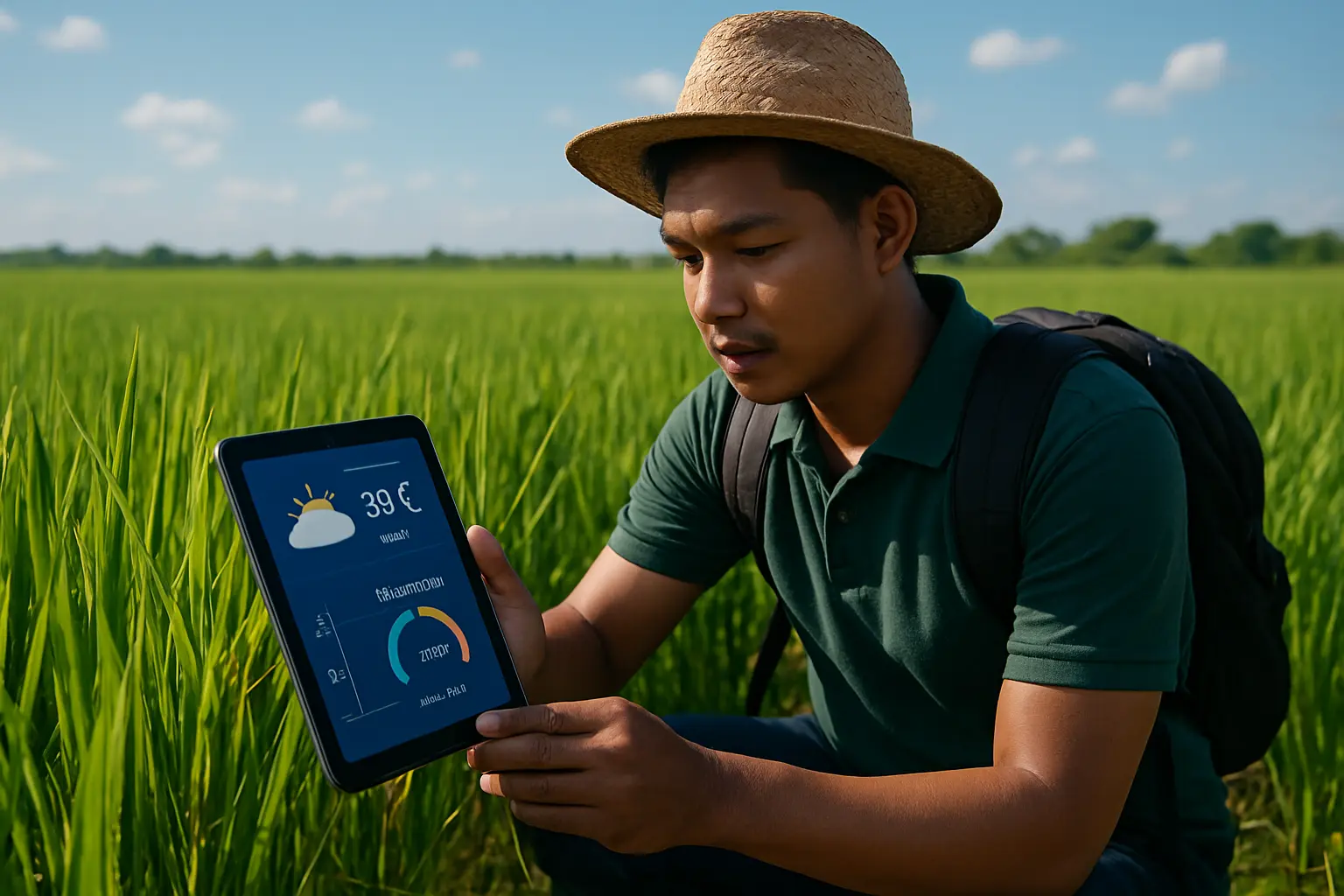
Eighteen BS Agriculture thesis topics scoped to one lens — climate-smart and sustainable farming — each anchored in a named Philippine government program so the rationale in your Chapter 1 has a real policy or research context behind it, not a generic climate-change opening paragraph. Every topic below states its one-line research question and the kind of data it actually needs.
The programs this topic list is anchored to
Four Department of Agriculture (DA) program names carry the topics below, read directly from the DA’s own published program descriptions. The Adaptation and Mitigation Initiative in Agriculture (AMIA) is the DA’s framework for climate adaptation and mitigation strategy across the agriculture sector — it is the program most directly relevant to crop-level climate-resilience topics, such as drought-tolerant variety adoption or water-saving irrigation. The National Organic Agriculture Program (NOAP) implements Republic Act No. 10068, the Organic Agriculture Act of 2010 (amended by Republic Act No. 11511 in 2020, which added a Participatory Guarantee System route to certification for small farmers), which defines organic agriculture in Section 3(b) as agricultural systems that promote ecologically sound, socially acceptable, economically viable and technically feasible production while reducing external chemical inputs — this is the program to cite for any topic on organic certification, low-input farming or consumer demand for organic produce. The National Agriculture and Fisheries Modernization and Industrialization Plan (NAFMIP) 2021–2030 is the DA’s broader modernization framework incorporating sustainability principles, and is the correct anchor for post-harvest technology, value-chain and digital-adoption topics. The National Convergence Initiative for Sustainable Rural Development (NCI-SRD) covers the rural-development and extension side — farmer field schools, youth engagement, and LGU-level support mechanisms.
A thesis that names the correct program for its specific practice, rather than a generic “climate change is a global problem” opening, signals to a panel that the researcher actually read the policy landscape before choosing a topic. Naming the wrong program — citing NOAP for a topic that has nothing to do with organic certification, for instance — is a fault a panel member familiar with these programs catches immediately, so match the topic to the program column below rather than picking whichever name sounds most authoritative. None of these four names is a research-methods theory; they are policy anchors, and the thesis still needs its own theoretical framework — a diffusion-of-innovation or technology-adoption model fits most of the topics below — argued separately in Chapter 1.
Eighteen topics, by category
Crop production and climate adaptation (anchor: AMIA)
- Adoption level of AMIA-promoted climate-resilient rice varieties among farmers in [Province] — what factors predict adoption versus continued use of conventional varieties?
- Farmer knowledge and practice of water-saving irrigation techniques (alternate wetting and drying) in a named irrigation service area — does training exposure predict actual field practice?
- Crop diversification as a climate-risk response among smallholder farmers in a drought-prone municipality — what crops are being substituted, and why?
- Perceived effectiveness of DA-distributed weather advisories among rice farmers — does advisory use correlate with reported yield stability across two cropping seasons?
Organic and low-input farming under RA 10068 (anchor: NOAP)
- Barriers to organic certification among smallholder vegetable growers in [Province] — which certification requirements under RA 10068 as amended are hardest to meet, and does the Participatory Guarantee System route change that?
- Cost-benefit comparison of organic versus conventional input use for a named crop over one cropping cycle, using farm-level cost records.
- Consumer willingness to pay a premium for certified organic produce in a local public market — what factors predict willingness to pay more?
- Farmer-to-farmer knowledge transfer of organic soil-fertility practices in a barangay with an active organic-farming cooperative — how is knowledge actually spreading, and through whom?
Livestock and aquaculture under a sustainability lens (anchor: AMIA / NOAP)
- Adoption of climate-resilient backyard poultry or swine housing designs among smallholder raisers — what design features are actually being adopted, and what is left out?
- Feed-cost and sustainability trade-offs of a locally sourced alternative feed ingredient for tilapia aquaculture, compared to commercial feed, over one growout cycle.
- Farmer perception of mangrove-adjacent aquaculture regulation and its effect on pond management decisions in a named coastal municipality.
Post-harvest, value chain and modernization (anchor: NAFMIP)
- Post-harvest loss reduction from a specific NAFMIP-aligned storage or drying technology, compared to a farmer’s traditional method, measured over one harvest.
- Digital marketplace adoption among smallholder vegetable farmers as a NAFMIP modernization indicator — what barriers explain low or high adoption in a specific municipality?
- Value-chain mapping of a named crop from farmgate to local market, identifying where climate-related loss is concentrated.
Rural development and extension (anchor: NCI-SRD)
- Effectiveness of a farmer field school or extension program in transferring a specific climate-smart practice, measured by a pre- and post-training knowledge assessment.
- Youth engagement in climate-smart farming as a rural-development indicator — what factors predict a young farmer’s intention to continue in agriculture rather than migrate for other work?
- Women’s role and decision-making authority in household adoption of a specific sustainable farming practice, in a named agricultural community.
- Local government unit (LGU) support mechanisms for climate-smart agriculture adoption — what a specific municipal agriculture office actually provides, against what NCI-SRD’s convergence model intends.
What each topic category needs in Chapter 3
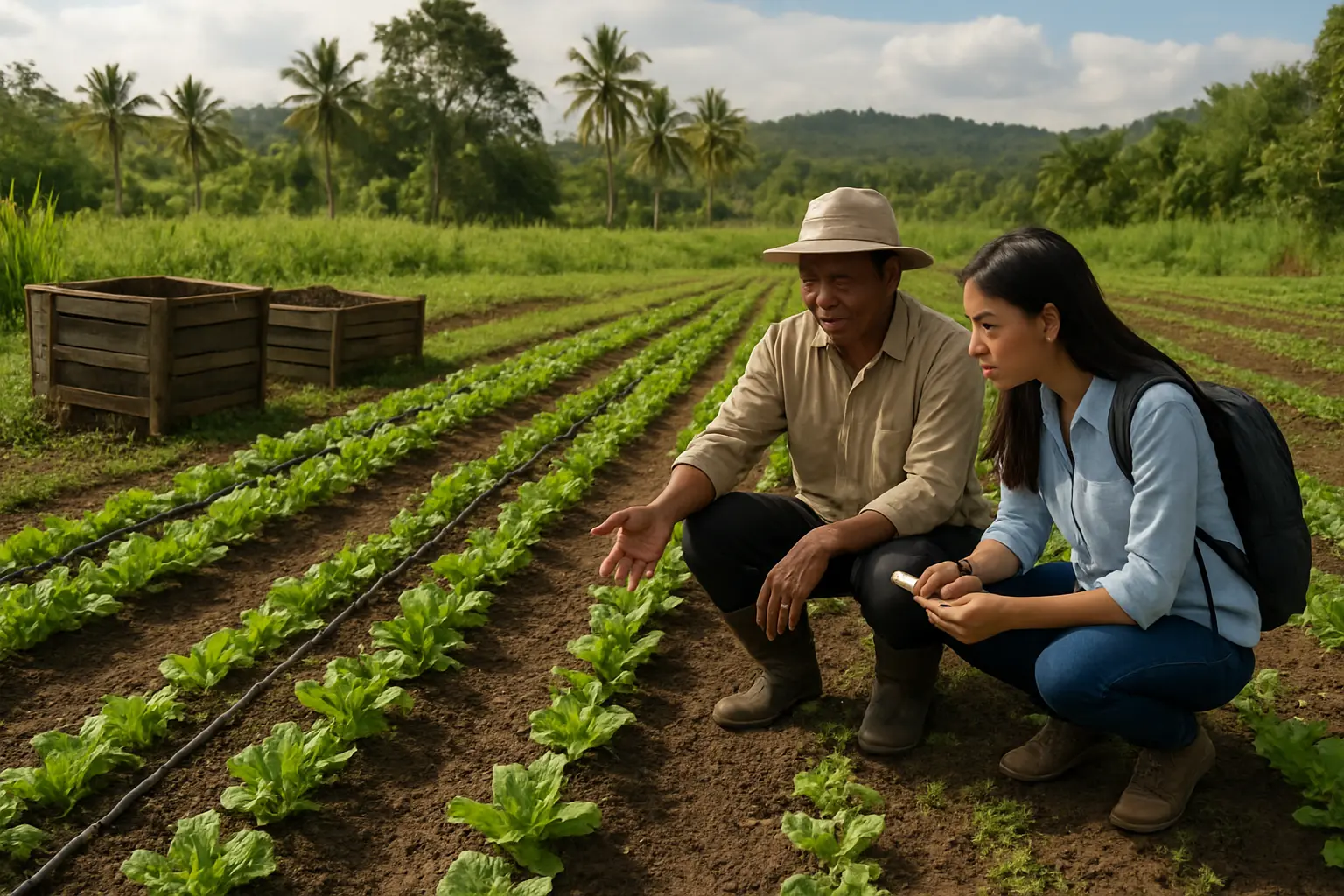
The eighteen topics fall into three research-design families, and matching the right one avoids a common Chapter 3 fault — treating an adoption-perception study and an actual field trial as if they needed the same statistical treatment. Adoption and perception topics (1–4, 7, 9, 11, 16–17) are descriptive-correlational: a structured questionnaire measuring awareness, perceived barriers and self-reported practice, analyzed with weighted means and, where a predictive relationship is claimed, chi-square or logistic regression against demographic or farm-size predictors. Comparative field, cost or pre/post topics (6, 10, 12, 15) are quasi-experimental or comparative: a farmer’s own plot or cost record, or a trainee group’s knowledge score, compared against a control or baseline condition (conventional input, traditional storage method, pre-training assessment) over one growing, storage or training cycle, analyzed with a paired or independent t-test depending on whether the same farmers are compared before and after or two separate groups are compared. Barrier, knowledge-flow and value-chain mapping topics (5, 8, 13, 14, 18) are qualitative or mixed-methods: key-informant interviews with farmers, cooperative officers or LGU agriculture staff, analyzed thematically rather than statistically, often paired with a smaller quantitative barrier-ranking exercise.
Choosing between these eighteen: what actually decides feasibility
Three constraints filter this list fast, and a strong proposal states which constraint applies before the panel has to ask. First, access: a topic studying farmer adoption or perception needs a cooperating barangay, cooperative or farmer association willing to be surveyed or interviewed — confirm this before defending the title, not after. Second, timeline: any topic measuring an outcome across a full cropping season (post-harvest loss, yield comparison, feed trial) needs the season’s calendar to fit inside the thesis timeline, which usually means starting fieldwork at planting rather than waiting for the proposal to clear first. Third, data availability: topics built on DA program reports or PSA agricultural statistics as secondary data are faster to execute than a fresh field survey, but only where the specific municipality or crop actually has published figures — a national aggregate figure cannot substitute for a local one the study claims to describe. A fourth, quieter constraint worth naming: seasonal weather risk itself. A field trial planned around one cropping season with no contingency for a delayed planting date or an unusually dry or wet season is a schedule the panel will probe at the proposal stage, so state a fallback plan — a second nearby site, or a shortened comparison window — rather than assuming the season will cooperate.
Checking a topic is not already studied
Climate-smart and organic-agriculture topics are a growing area in Philippine undergraduate theses, and there are fewer existing studies on specific program-and-practice combinations than on a saturated topic like rice yield under conventional practice — but a specific municipality, crop and practice combination should still be checked before committing. The site’s own guide on checking whether a topic has already been studied covers the search strategy for this; run it against your specific locale and crop combination, not just the general topic name.

From topic to Chapter 1
Once a topic is chosen, the background of the study should open with the named program (AMIA, NOAP, NAFMIP or NCI-SRD) and the specific gap your locale represents within it, not a general statement about climate change as a global phenomenon — the site’s own Chapter 1 guide covers the funnel structure this rationale should follow, and the limitations and delimitations that a field-based agriculture study typically needs to state up front are covered in the site’s agriculture limitations guide, built around exactly this kind of field-trial and farmer-access constraint. For the title itself, keep the program name out of the title if it makes the wording clunky — a working title reading “Adoption of Climate-Resilient Rice Varieties Among Farmers in [Municipality]: Basis for an Extension Program” reads better at title defense than one that tries to fit “AMIA” into the sentence itself; the program belongs in the background paragraph, not necessarily the title.
Turn your chosen topic into a full Chapter 1
Tesify drafts the background, statement of the problem and significance of your agriculture thesis from the specific program, locale and practice you choose — grounded in the policy context, not a generic climate paragraph. Over 9,000 students have used it to write more than 15,000 chapters, and every word is still written by you.
Frequently asked questions
Why the climate-smart lens specifically, and not just general agriculture topics?
A generic agriculture topic list would risk overlapping with any future general topics piece on this site. The climate-smart and sustainability lens is the differentiator: every topic here is scoped to a named adaptation, mitigation or organic-farming program, not just any agriculture theme.
Do I need to survey farmers for all of these topics?
No. Several topics above can be answered from secondary data (DA program reports, PSA agricultural statistics) or an experimental field trial rather than a farmer survey; the topic description and the Chapter 3 section above note the kind of data each category actually needs.
Is AMIA a funding source I can apply to as a student?
No. AMIA is a Department of Agriculture program framework, not a research grant facility for students; citing it establishes that your topic sits inside a real national policy context, which is what a panel is checking for, not a funding pathway.
Can I study a climate-smart practice my own province has not adopted yet?
Yes, and that gap is often the strongest rationale — a study assessing readiness, barriers or potential for adoption of a practice not yet used locally is a legitimate and common BS Agriculture thesis angle.
Should the exact program name appear in my thesis title?
Not necessarily. It usually reads better in the background of the study than forced into the title itself; a clear, locale-specific title with the program cited properly in Chapter 1 satisfies a panel just as well as one that tries to fit an acronym into the sentence.