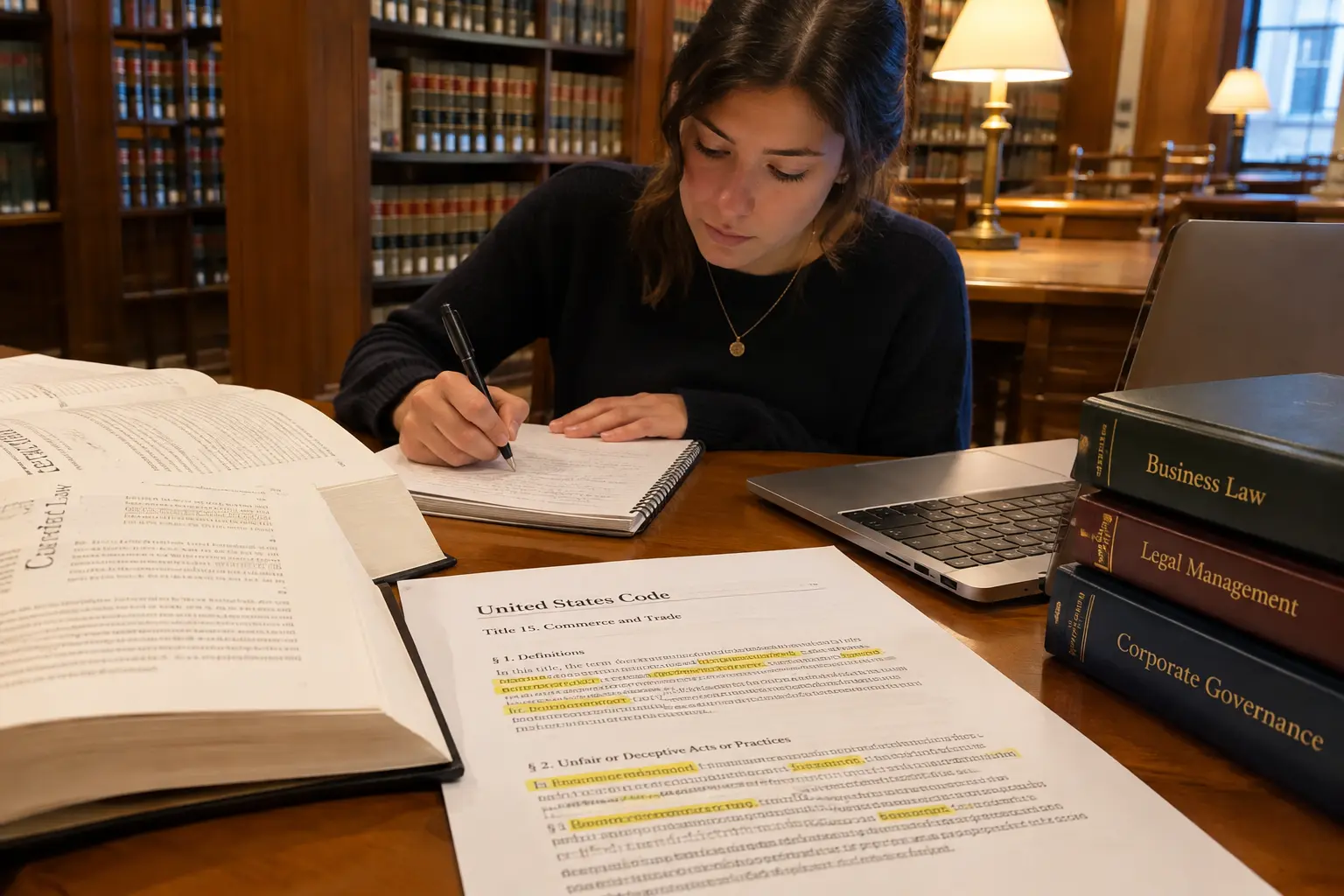
A Legal Management thesis is read by a panel that includes law-trained faculty, and it is judged partly on whether it sounds like it was written by someone who understands how legal writing actually works — not by someone imitating a courtroom drama. Here is how to write in that register without either drowning the reader in Latin or sliding into casual prose a legal panel will flag.
Step 1: Understand what “the language lawyers use” actually means
It does not mean archaic phrasing such as “the party of the first part” or stacking Latin maxims to sound authoritative. Good modern legal writing favors precise, unambiguous statements over ornate ones. What actually marks legal register in a Legal Management thesis is: exact statutory and case citation, consistent use of defined terms, careful distinction between mandatory and permissive language, and a formal but readable tone that never lapses into contractions or conversational filler.
Expected output of this step: one sentence you can hold yourself to — write clearly and precisely first, and add the formal conventions below on top of clarity, never instead of it. Seeing this register applied across a full manuscript helps more than the rules alone — the annotated Legal Management thesis worked example shows the citation and terminology discipline in context, chapter by chapter.
Step 2: Cite statutes and cases the way a legal document does, every time
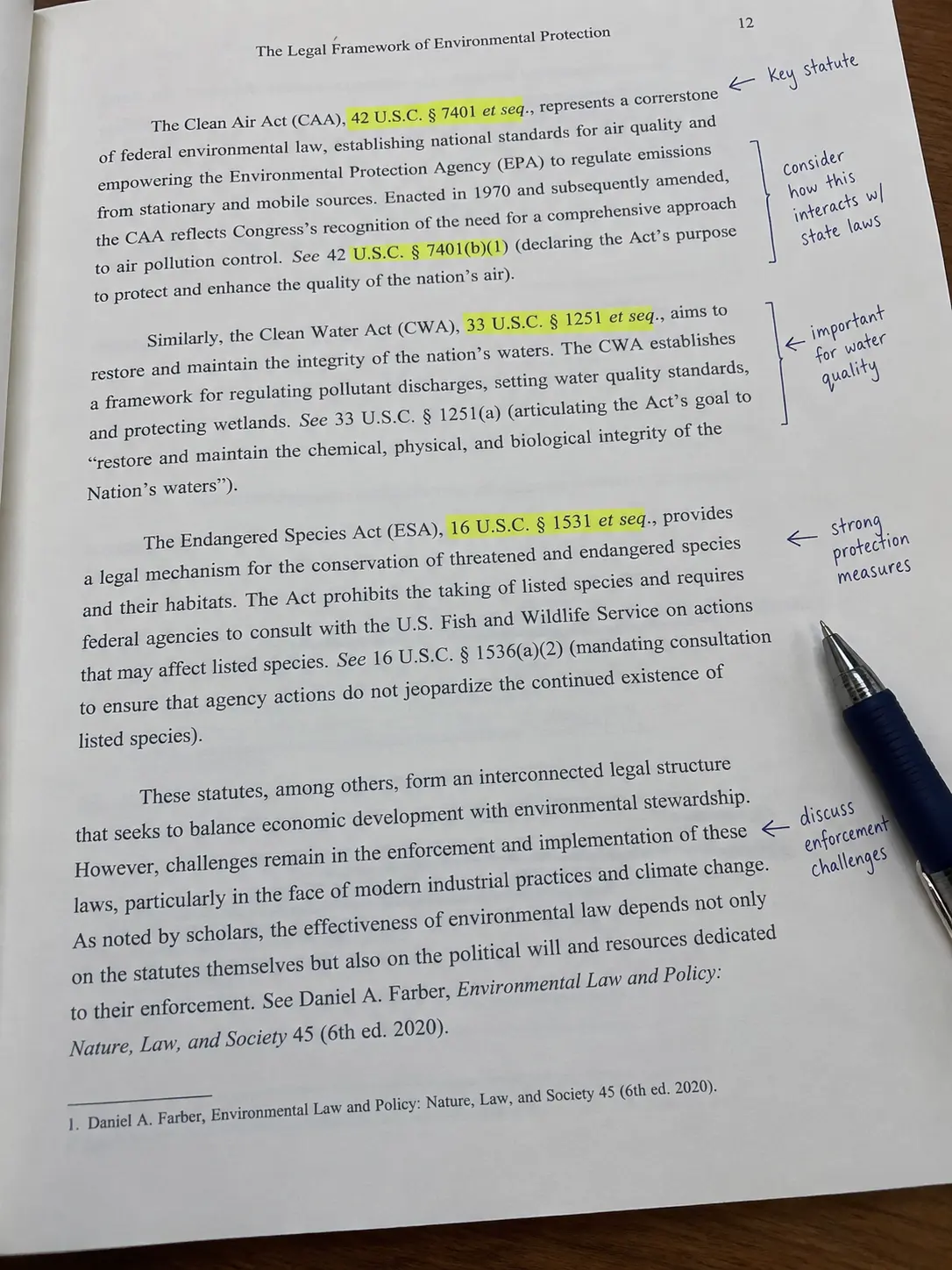
A Legal Management thesis that mixes citation styles across chapters — “the Data Privacy Act” in one paragraph, “RA 10173” in another, “R.A. No. 10173 (2012)” in a third — reads as inconsistent rather than rigorous. Pick one full form on first mention and one short form after, and hold it for the whole manuscript:
- First mention: “Republic Act No. 10173, otherwise known as the Data Privacy Act of 2012, …”
- Subsequent mentions: “RA 10173” or “the Data Privacy Act” consistently — not both interchangeably in the same section.
- Case citations: full case name in italics on first mention with the G.R. number and date — Ang Tibay v. Court of Industrial Relations, G.R. No. L-46496 (1940) — then the short case name (Ang Tibay) afterward.
- Section references: “Section 4” or “Sec. 4” — again, pick one and hold it; “Section” spelled out reads slightly more formal and is the more common choice in Philippine legal-academic writing.
Expected output of this step: a one-line citation-style note you keep open while drafting — full form, short form, section abbreviation — so every chapter matches without you having to remember it. The general APA 7th mechanics this sits on top of — margins, headings, the title page a Philippine research manual expects — are covered separately in APA 7 format for a Philippine thesis; this guide adds only the legal-citation layer specific to Legal Management.
Step 3: Use defined terms deliberately and capitalize them consistently
Legal writing treats a defined term as a fixed label, not a word you can vary for style. If your thesis defines “the Data Subject” in its operational definitions, every later reference to that party should read “the Data Subject,” not alternate between “the person,” “the individual,” “the respondent’s data owner” and “the Data Subject” across four paragraphs. This is not pedantry; a legal panel reads inconsistent terminology as a sign the writer does not actually understand the concept being labeled.
The same discipline applies to statutory terms you did not personally define — if RA 10173 defines “personal information controller,” use that exact phrase rather than paraphrasing it as “the company that owns the data” once you have introduced the statutory term.
Step 4: Preserve the statute’s own “shall,” “must” and “may”
In Philippine statutes, “shall” and “must” generally signal a mandatory obligation and “may” signals a discretionary power. A Legal Management thesis analyzing a statute’s requirements should mirror the statute’s own choice of verb rather than substituting a looser one: if the section says “shall” or “must,” your paraphrase or analysis should preserve that mandatory sense, not soften it into “should” or “is expected to,” which changes the legal weight of the statement.
Worked example (APA 7th in-text citation combined with legal register):
Section 20(a) of Republic Act No. 10173 (2012) provides that the personal information controller must implement reasonable and appropriate organizational, physical and technical measures intended for the protection of personal information — a mandatory obligation, not a recommended practice, and the distinction matters directly to the compliance-gap analysis in Chapter 4 of this study.
Notice the sentence does two things at once: it cites the statute in APA 7th style (author-date, in this case the Republic Act as the authoring body) and it keeps the statute’s own verb while naming its legal weight, which is the kind of sentence a legal-trained panelist reads as evidence the writer understands what they are analyzing.
Step 5: Keep Latin sparing, and gloss it the first time you use it
A handful of Latin terms are standard in Philippine legal writing — in pari delicto, caveat emptor, ultra vires, res judicata — and using the right one precisely signals familiarity with the field. Stacking Latin phrases that are not doing real analytical work, or using one incorrectly, has the opposite effect. Two rules keep this safe: use a Latin term only when the English equivalent is genuinely less precise, and gloss it in plain English the first time it appears, even if your reader is presumed to know it.
Worked example: The doctrine of ultra vires — acts beyond the scope of a corporation’s stated powers — is directly relevant to the third research question, since the respondent cooperatives’ minutes record at least two resolutions arguably outside their registered purpose.
Step 6: Avoid the register mistakes that read as either too casual or too theatrical
Two failure directions, both common in undergraduate Legal Management theses:
- Too casual — contractions (“doesn’t,” “it’s”), rhetorical questions used as transitions (“So what does this mean for the company?”), and hedging filler (“basically,” “kind of,” “sort of”) all read as conversational rather than academic-legal. Replace them with direct statements.
- Too theatrical — courtroom-drama phrasing borrowed from television (“the defendant stands accused,” “beyond a shadow of a doubt” used loosely, “the law is clear on this matter” as an unsupported assertion) reads as imitation rather than command of the register. State the legal basis and let the citation carry the authority, rather than declaring certainty in dramatic language.
The fix for both is the same: write the plainest sentence that states the legal point precisely, cite its source, and stop. Legal register is achieved through precision and consistency, not through vocabulary that sounds impressive. Where the topic itself, rather than the register, still needs settling, a set of thirty Legal Management thesis topics each anchored in a named statute is in Legal Management thesis topics for 2026, and once the topic is fixed, the weeks a legal-focused thesis actually needs for statutory research and drafting are mapped in the Legal Management thesis timeline and budget.

Step 7: Run a register check before you submit
- Does every statute and case follow the same first-mention/short-form pattern throughout?
- Are your defined terms capitalized and used identically every time they appear?
- Does your paraphrase of a statutory requirement preserve its “shall,” “may” or “must”?
- Is every Latin term glossed on first use, and none used decoratively?
- Search your own document for contractions and courtroom-drama phrasing, and remove both.
Run this check chapter by chapter rather than only once at the end — a register slip caught in Chapter 2 while you are still writing Chapter 3 is a five-minute fix; the same slip found across five chapters during a final read-through, the week before binding, is an evening’s work you did not budget for. Building the check into your weekly writing routine, rather than treating it as a pre-submission task, keeps the final revision small.
Frequently asked questions
Is it acceptable to use “he/she” or must I use a specific gender convention for statutory subjects?
Follow the statute’s own convention where it is quoted directly, and use gender-neutral phrasing (“the personal information controller,” “a data subject”) in your own analysis — most Philippine statutes are already drafted in gender-neutral or dual-gender terms, and your thesis should match that register rather than defaulting to “he” as a generic pronoun.
Should I write “Republic Act No. 10173” or “R.A. 10173” or “RA 10173”?
Any of the three is defensible; the requirement is consistency, not a single correct form. Pick one on first mention, note it, and use the same form throughout every chapter, including your reference list entry.
Can I use the word “the accused” in a Legal Management thesis that is not about criminal law?
Only where the term is actually accurate — “the accused” refers specifically to a person facing criminal charges. A civil, administrative or regulatory study should use “the respondent,” “the party” or the statute’s own term for the person or entity involved, rather than borrowing criminal-law vocabulary for effect.
How formal does the tone need to be in the discussion chapter?
Slightly less rigid than Chapter 2’s statutory analysis, since the discussion chapter connects findings to implications, but the same discipline — no contractions, consistent defined terms, precise verbs — still applies; a shift to casual register in Chapter 5 after a formal Chapter 2 reads as inconsistency, not relief.
Do I need a law degree’s worth of Latin to write a Legal Management thesis?
No. A small, correctly used set of terms relevant to your specific topic is enough, each glossed on first use. A long list of Latin maxims that do not connect to your actual analysis adds nothing and risks a misused term undermining your credibility.
What if my adviser prefers a different citation convention than the one described here?
Follow your adviser’s and your school’s research manual’s convention over any general guide, including this one — the requirement that matters most is internal consistency within your own manuscript, and your adviser’s preference is the final word on which specific form that takes.
Is it wrong to quote a statute’s exact wording instead of paraphrasing it?
Direct quotation is often the safer choice for a Legal Management thesis specifically because paraphrasing risks softening or distorting a mandatory obligation into a discretionary one. Quote the operative section verbatim in quotation marks with its citation, then analyze it in your own words afterward — the combination reads as more rigorous than paraphrase alone, not less.
Should implementing rules and regulations be cited differently from the statute itself?
Yes — name the implementing rules separately on first mention (“the Implementing Rules and Regulations of Republic Act No. 10173”) and use a distinct short form for it afterward, since conflating a statute with its own implementing rules in citation is a common error a legal-trained panel catches immediately; the two are different instruments with different legal weight.
Write in a register your Legal Management panel will trust
Tesify helps you keep citation form, defined terms and the statute’s own mandatory-versus-discretionary verbs consistent across your statutory analysis from the first paragraph. Over 9,000 students have used it to write more than 15,000 chapters, and every word is still written by you.