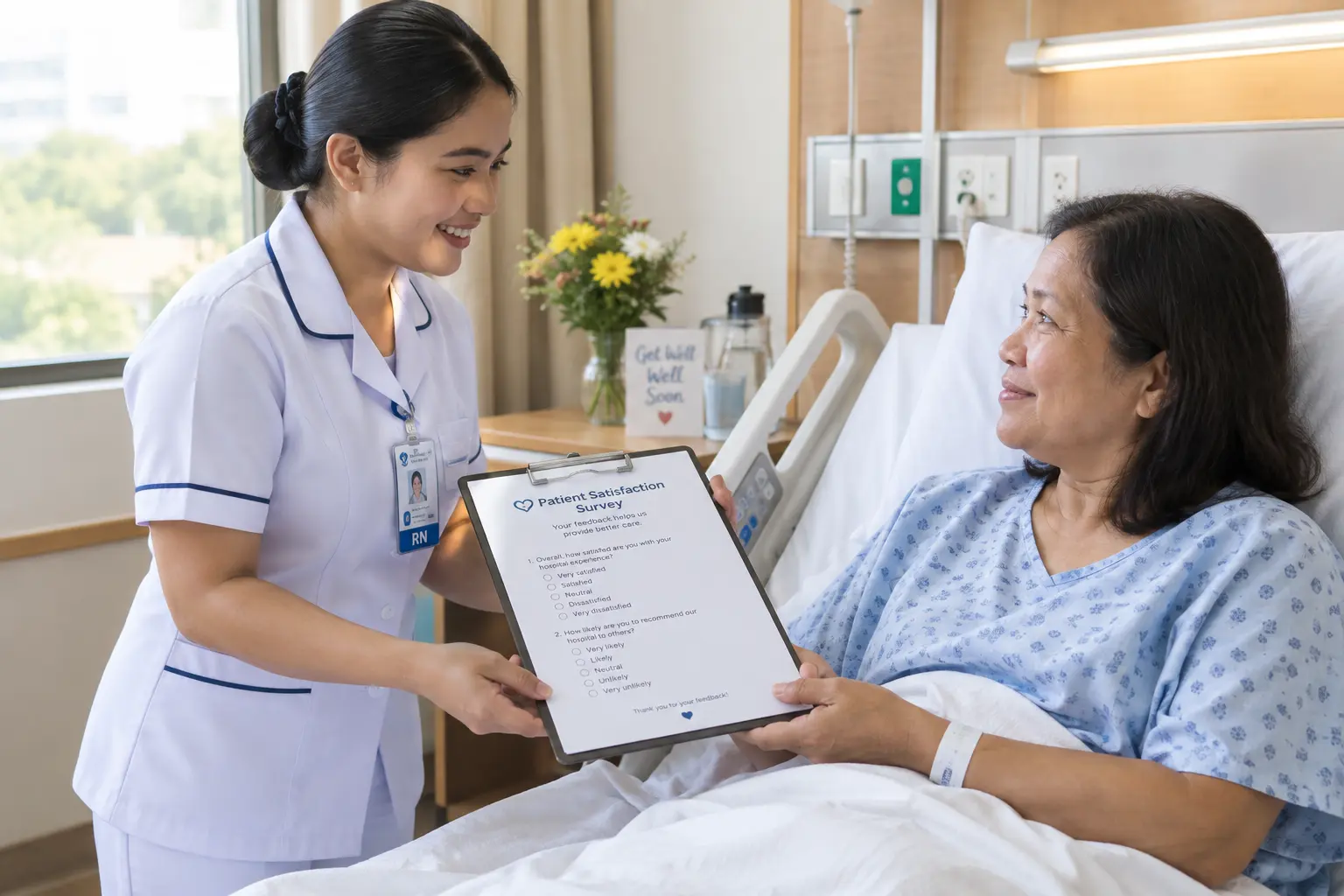
A nursing thesis measuring patient satisfaction has three realistic instrument options: adopt a published, validated scale built specifically for nursing care, adapt a general service-quality framework to a hospital setting, or build a researcher-made checklist and pilot-test it yourself. The comparison below covers what each actually measures, how many items you are committing to code and analyze, and which one a Philippine nursing panel is most likely to accept without extra justification.
| Instrument | Items / structure | What it measures | Licence | Verdict |
|---|---|---|---|---|
| Newcastle Satisfaction with Nursing Scales (NSNS) | Two scales: Scale A (Experience of Nursing Care, 26 items rated on a 7-point scale) and Scale B (Satisfaction with Nursing Care, 19 items rated on a 5-point scale) | Patient-reported experience and satisfaction specifically with the nursing care received, not the hospital overall | Developed by Thomas and colleagues (1996) for academic and clinical quality-assessment use; cite the original publication and follow your school’s standard permission-seeking process for the source journal | Best fit when your research question is specifically about nursing care, not general hospital service |
| SERVQUAL adapted to a healthcare setting | Typically 20 to 22 items across five dimensions: tangibles, reliability, responsiveness, assurance, empathy | General service-quality gap between patient expectations and actual experience, adaptable to a nursing unit or hospital department | Parasuraman, Zeithaml and Berry’s (1988) original framework is widely published and commonly adapted in academic research; the specific wording of your adapted items should still be pilot-tested for the clinical context | Good when your thesis frames satisfaction as a service-quality gap rather than a nursing-specific experience |
| Researcher-made checklist | Flexible, commonly 15 to 25 items built around your own unit’s specific care processes | Whatever your research question defines as satisfaction — communication, wait time, pain management, discharge instructions | No licence needed, but requires its own content-validity review and pilot test before use | Only worth building from scratch when neither published option fits your specific research question or setting |
Why the Instrument Choice Matters More Than It Looks
“Patient satisfaction” is not one construct — a hospital-wide amenities survey and a nursing-specific care-experience survey ask genuinely different questions, and a panel will ask which one your research question actually calls for. If your thesis title or statement of the problem says “nursing care,” the Newcastle scales map onto that claim directly; if it says “quality of service” or “patient experience” more broadly, a SERVQUAL adaptation or a researcher-made checklist covering non-nursing touchpoints (admission, billing, food service) may fit better. State this reasoning explicitly in Chapter 3 rather than picking whichever instrument you found first.
A Ready-to-Adapt Item Bank Built From the NSNS Structure
The table below groups illustrative item themes by the two NSNS scales, written to show the kind of statement each scale captures — adapt the wording to your own unit and always consult the original 1996 publication and your adviser before finalizing items for a real data-collection instrument; do not copy this table’s wording directly into your own questionnaire without checking it against the source.
| NSNS scale | Construct | Illustrative item theme |
|---|---|---|
| Scale A: Experience of Nursing Care | Information and explanation | How clearly nurses explained procedures and medications before performing them |
| Scale A: Experience of Nursing Care | Availability and responsiveness | How quickly a nurse responded when called for assistance |
| Scale A: Experience of Nursing Care | Technical competence | Confidence in the nurse’s skill during a procedure such as an injection or dressing change |
| Scale B: Satisfaction with Nursing Care | Overall evaluation | General satisfaction with the nursing care received during the entire stay |
| Scale B: Satisfaction with Nursing Care | Emotional support | Whether nurses showed care and concern beyond the technical task at hand |
These five rows are illustrative theme groupings only, not the verbatim items of the published scales (26 experience items and 19 satisfaction items) — treat them as a starting map of what each scale covers, then request or purchase access to the actual instrument through your library or the original publisher before administering anything to real respondents.
Adapting SERVQUAL Without Losing Its Structure
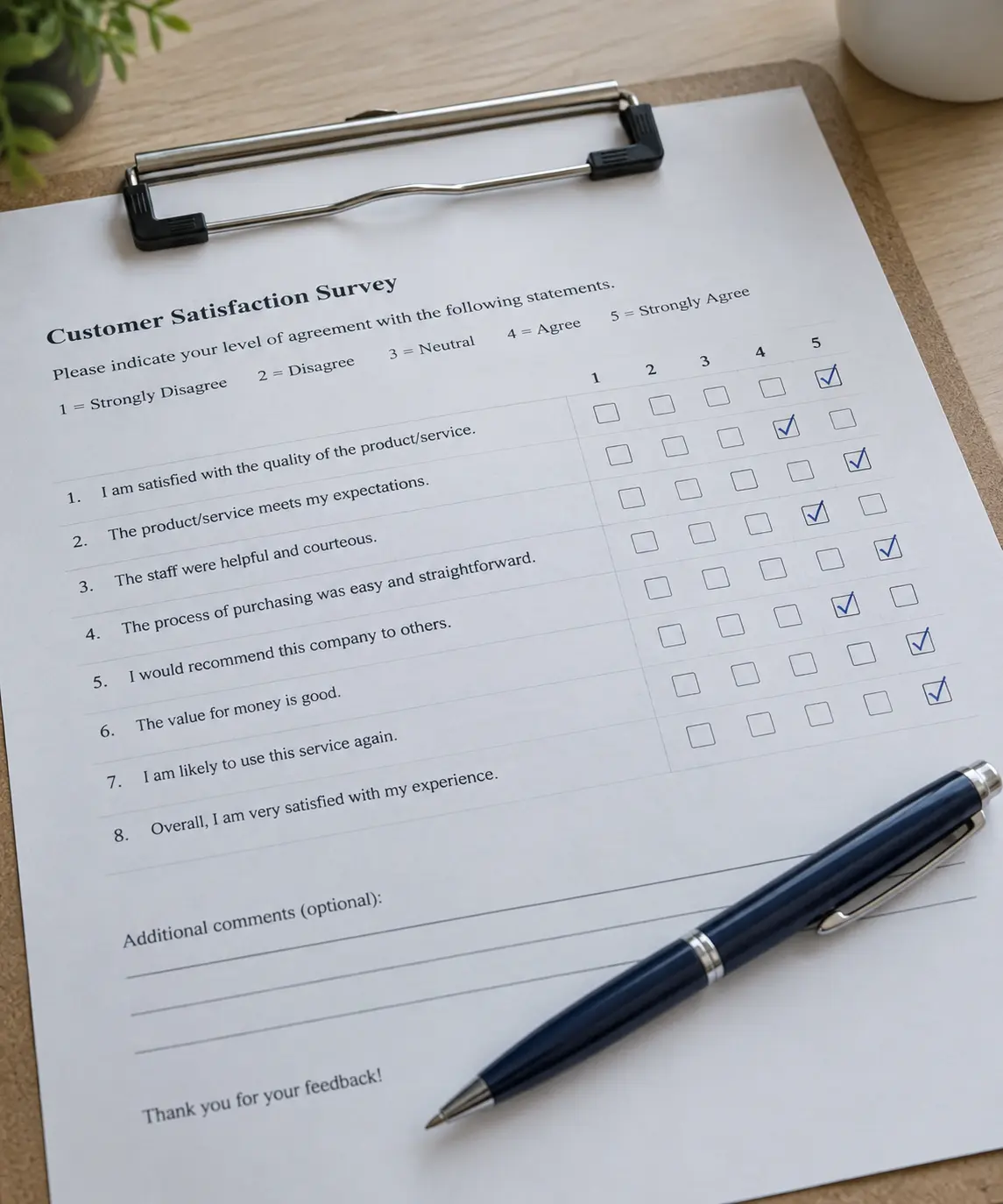
If your thesis uses the SERVQUAL framework, keep all five original dimensions (tangibles, reliability, responsiveness, assurance, empathy) even when you reword individual items for a nursing unit — dropping a dimension without justification weakens the instrument’s published validity argument, since the five-dimension structure is the part of SERVQUAL that has been most extensively tested. A typical adaptation reworks “tangibles” from retail cleanliness and equipment appearance to ward cleanliness and visible availability of nursing supplies, and reworks “empathy” from individualized customer attention to individualized patient attention — the underlying dimension label stays the same, only the wording of each item changes to fit a hospital ward.
When to Administer the Survey: Timing Changes What You Measure
A satisfaction survey given at discharge captures a patient’s overall impression of the full stay, including moments they may have already started to forget or reframe positively now that they are going home. A survey given during the stay, a day or two after admission, captures a more immediate, in-the-moment impression but risks a patient understating dissatisfaction out of concern it could affect their ongoing care — a real and frequently cited limitation in patient-satisfaction research generally. State clearly in Chapter 3 when your survey was administered and name this trade-off as a limitation regardless of which timing you chose, rather than presenting your chosen timing as if it had no drawbacks.
The original NSNS validation study is useful here: Thomas and colleagues surveyed 2,078 patients on 20 general medical and surgical wards in five hospitals in north-east England, and found no significant difference in experience or satisfaction scores between questionnaires completed before leaving hospital and those completed at home — although the home questionnaires came back at a lower response rate. That is a citable reason to prefer collection before discharge when your main concern is response rate.
Language and Cultural Considerations for a Filipino Setting
Most published satisfaction instruments, including the Newcastle scales and SERVQUAL, were developed and validated in English-language, Western clinical settings. A Philippine nursing thesis administering either instrument should consider whether a bilingual English-Filipino version, or a fully Filipino translation with back-translation to confirm meaning was preserved, better fits the actual reading comfort of the ward’s patient population. This is not optional politeness — an item whose English wording is not fully understood by a respondent produces a response that reflects confusion, not satisfaction, and quietly degrades your reliability figures without anyone realizing why. If you translate or bilingualize items, describe the back-translation process in Chapter 3, since a panel increasingly expects to see this step named explicitly rather than assumed.
Sample Size for a Satisfaction Survey
Sample size for a satisfaction survey follows the same logic as any other quantitative nursing thesis: a defined population (patients discharged from a specific unit within a stated period) narrowed by an appropriate formula such as Slovin’s for a finite, known population, or a purposive/convenience approach with a clearly stated rationale when the population is less well-defined. What is specific to satisfaction research is the value of also reporting a response rate, since satisfaction surveys distributed at discharge often see lower completion than surveys administered with a nurse present to explain and collect them on the spot — note your actual response rate in Chapter 4, since a very low rate is itself a limitation worth naming in Chapter 5.
Reliability Testing: What Your Chapter 3 Should Report
Whichever instrument you choose, run a pilot test with respondents outside your main sample and report Cronbach’s alpha per subscale, not just an overall figure — a published instrument adapted to a new setting can behave differently than in its original validation study, and a panel expects to see that you checked rather than assumed the original reliability figures still hold. If any subscale’s pilot alpha falls notably below 0.70, say so explicitly and explain what you did about it (dropped or reworded a weak item, consulted your statistician, or proceeded with a noted limitation) rather than omitting the number.

Where This Fits With the Rest of Your Thesis
Once your instrument is chosen, the sampling and matrix sections around it follow the same house structure used across the site’s nursing content: our statistical treatment guide for a BSN nursing thesis compares which test fits a satisfaction-comparison design (paired t-test, Wilcoxon, chi-square), and the nursing thesis consistency matrix shows how patient satisfaction as a variable would be operationalized alongside its indicators and instrument items in a Chapter 3 table. If you are still shaping your overall thesis structure, the sample BSN nursing thesis from Chapter 1 to 5 shows where an instrument section like this one sits inside the full paper, and if patient satisfaction is one of several topic options you are still weighing, nursing thesis topics backed by national data lists others worth comparing it against. The same service-quality reasoning behind the SERVQUAL adaptation above is explored from a different discipline’s angle in our tourism thesis survey instrument comparison, useful background if your own program also touches hospitality-style service metrics.
Where Tesify Fits
Once you have chosen and cited your instrument, Tesify turns your reliability results, item structure and adaptation rationale into a properly formatted instrumentation section for Chapter 3.
Turn your chosen instrument into a written Chapter 3 instrumentation section
Tesify drafts the instrument description, validity and reliability reporting, and adaptation rationale for your nursing thesis in proper APA 7th format — over 9,000 students have used it to write more than 15,000 chapters, and every word is still written by you.
Frequently Asked Questions
- Can I use the Newcastle Satisfaction with Nursing Scales for free?
- Access and permission requirements vary by publisher and journal; check with your library or the original 1996 publication’s journal for the current process, and always cite Thomas and colleagues as the original authors regardless of how you obtained the item wording.
- Is SERVQUAL specifically designed for healthcare?
- No. SERVQUAL was originally developed for general service industries by Parasuraman, Zeithaml and Berry in 1988. It is widely adapted to healthcare settings in academic research, but the adaptation and its wording should be your own pilot-tested version, not the unmodified retail-service original.
- How many respondents do I need to pilot-test a patient satisfaction instrument?
- There is no universal fixed number, but a pilot sample of 20 to 30 respondents outside your main study sample is common in Philippine nursing theses for computing a preliminary Cronbach’s alpha. Confirm your program’s specific expectation.
- Should I combine NSNS and SERVQUAL in one questionnaire?
- It is possible but adds length and analysis complexity; most undergraduate nursing theses choose one primary instrument that matches their exact research question rather than combining two full scales, unless your design specifically calls for comparing two constructs.
- Do I need permission to adapt a published instrument’s wording?
- Best practice is to check the original publisher’s or journal’s permission policy and to cite the source clearly regardless. Some instruments are freely available for academic, non-commercial use; others require a formal request. Confirm before finalizing your data-collection tool.
- What if my pilot test shows a low Cronbach’s alpha on one subscale?
- Report the figure honestly, review the specific items in that subscale for wording problems, and either revise the weak items with your adviser’s guidance or proceed with a clearly stated limitation — do not omit or quietly round up a low reliability figure.
- Should I survey patients or their family members if the patient cannot respond themselves?
- State this decision explicitly as part of your inclusion criteria. A proxy respondent (family member or primary caregiver) answers from a different vantage point than the patient, and mixing proxy and direct-patient responses in the same dataset without noting which is which weakens your results’ interpretability.
- Is it better to survey inpatients or outpatients for a nursing satisfaction thesis?
- This depends on your research question and the unit you have access to. Inpatient satisfaction typically reflects a longer, more continuous nursing relationship; outpatient or same-day-procedure satisfaction reflects a shorter, more transactional one. State which population you studied and avoid generalizing your findings to the other without qualification.