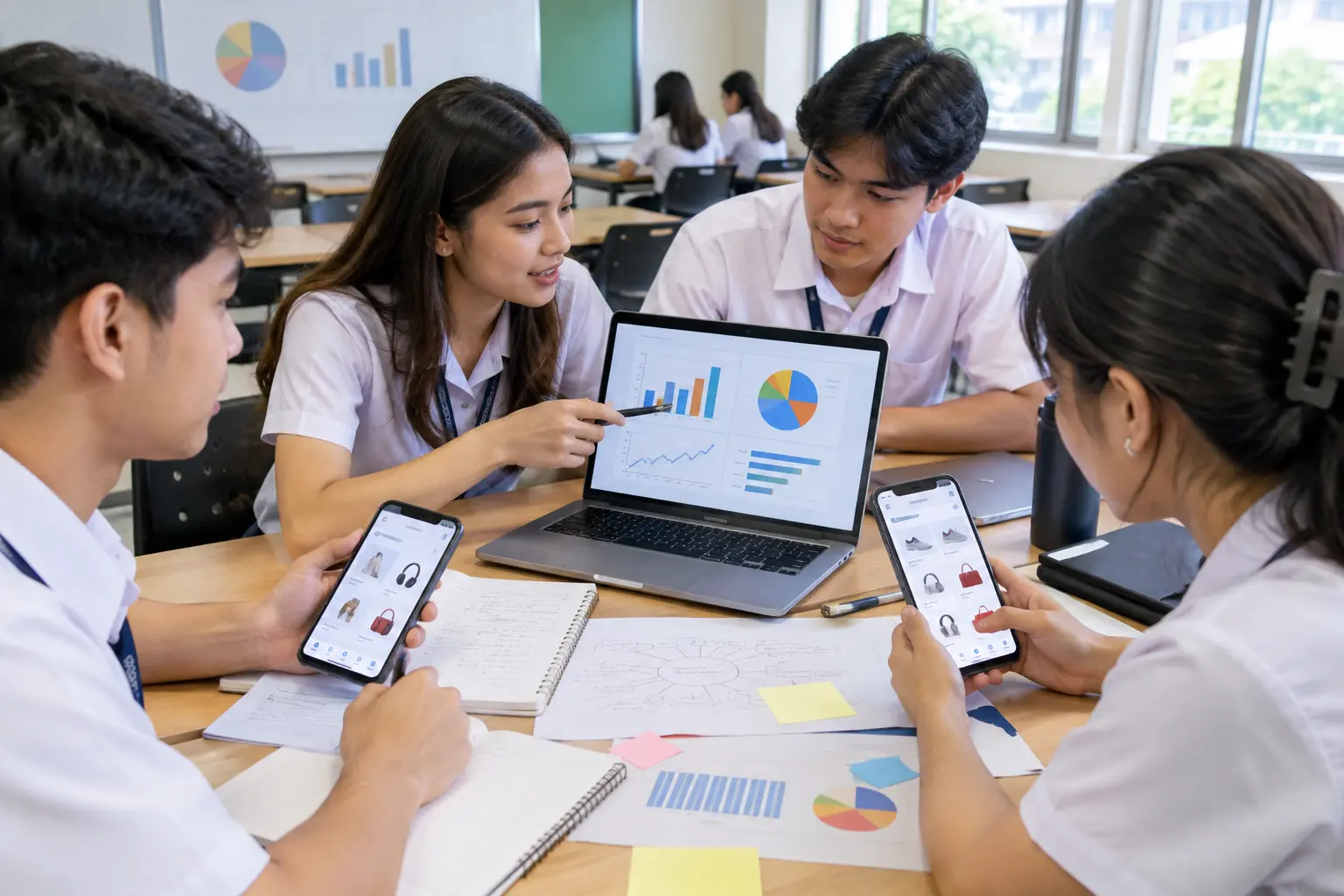
Your title says “consumer buying behavior.” The panel asks which product, which consumers, which theory, and what exactly you will measure. If you cannot answer in one sentence, the title goes back. A purchase intention thesis is easy to start and easy to get wrong, because it sounds simple. This guide gives you the definition, the theory, the scale and the variable pairings that survive a panel, so that Chapter 1 and Chapter 2 stop being the part you avoid.
Start your Chapter 1 on Tesify
What is purchase intention, in terms a panel accepts?
Purchase intention is a consumer’s stated likelihood or willingness to buy a particular product or service. It is not the purchase itself. That difference is the first thing a panel checks, because a questionnaire can measure intention but cannot prove that anyone bought anything. In the theory most Philippine theses lean on, the theory of planned behavior, intention is described as the immediate antecedent of behavior: the stronger the intention, the more likely the behavior, provided the person has real control over performing it.
Write your conceptual definition from a published source and then your operational one from your instrument. An illustrative operational definition: “Purchase intention refers to the respondent’s mean rating on three items stating how likely they are to buy [product] from [platform] within the next 30 days, on a five-point scale where a higher mean means a stronger intention.” Notice that it names the product, the setting and the time window. Without those three, two respondents can answer the same item and mean different things.
Which theories frame a purchase intention study?
You need a theory that explains why your predictors should lead to intention. Four are standard in business theses:
- Theory of planned behavior (TPB). Ajzen’s “The theory of planned behavior” (Organizational Behavior and Human Decision Processes, 1991, volume 50, issue 2, pages 179 to 211) holds that attitude toward the behavior, subjective norm and perceived behavioral control shape intention. It maps neatly to a conceptual framework with three predictor boxes and one outcome box. Ajzen’s own page offers a guide to constructing a TPB questionnaire, which is the safest place to learn how to write the items.
- Technology acceptance model (TAM). Davis’s “Perceived usefulness, perceived ease of use, and user acceptance of information technology” (MIS Quarterly, 1989, volume 13, issue 3, pages 319 to 340) fits studies of buying through apps and online platforms, where usefulness and ease of use are the predictors.
- TAM with trust and risk. Pavlou’s “Consumer acceptance of electronic commerce: integrating trust and risk with the technology acceptance model” (International Journal of Electronic Commerce, 2003, volume 7, issue 3, pages 101 to 134) is the usual source when your study adds perceived risk and trust for online buying.
- Perceived value. Dodds, Monroe and Grewal’s “Effects of price, brand, and store information on buyers’ product evaluations” (Journal of Marketing Research, 1991, volume 28, issue 3, pages 307 to 319) is widely used when price, brand and store cues are your predictors.
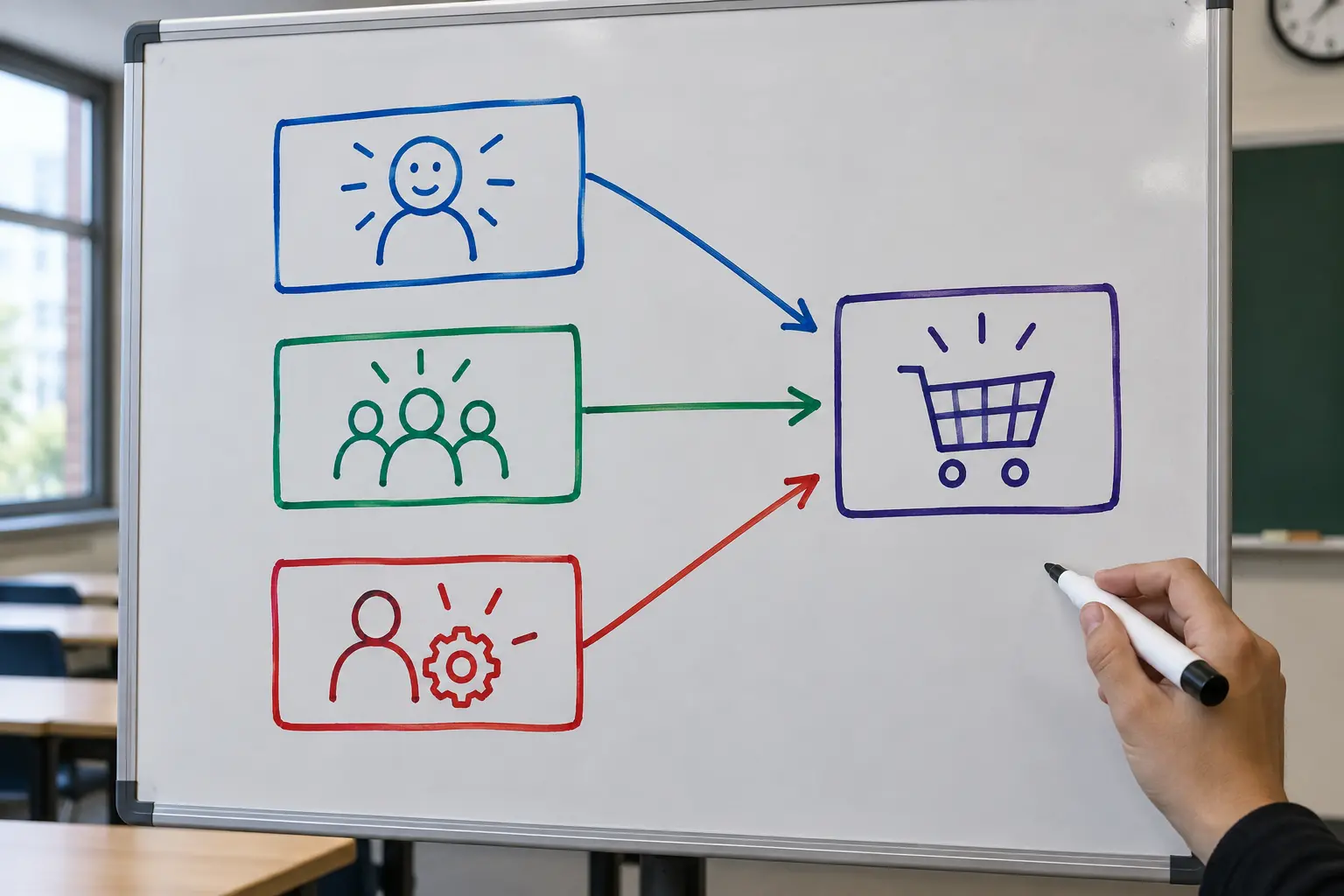
Pick the one whose mechanism matches your predictors, then write the justification paragraph linking theory to variables. Examples of that paragraph for other courses are in theoretical framework examples by course, and the diagram steps are in how to make a conceptual framework.
How do you build the purchase intention scale?
Do not invent items from nothing. Two defensible routes exist.
Route 1: build TPB items. Ajzen’s construction guide says the behavior must first be defined in terms of its target, action, context and time, and that the direct measures are attitude, subjective norm, perceived behavioral control and intention, usually on seven-point scales, with items worded to match the behavior exactly. Applied to your thesis, an illustrative intention item reads: “I intend to buy [product] from [platform] within the next 30 days,” rated from strongly disagree to strongly agree. The matching attitude item would ask whether buying it is bad or good, and the control item whether the respondent is confident they could buy it. Every item uses the same target, action, context and time.
Route 2: adapt a published scale. Find the studies your related literature already cites, trace each scale to its original article, and rewrite the product and context. Record the source and any permission. Then validate the adapted version with experts and a pilot, as explained in research instrument validation for a Philippine thesis. Whichever route you pick, three to four items per construct is a workable size for a Likert section, but the final number is your instrument’s design choice and your adviser’s call.
Which variables pair with purchase intention?
| Predictor | Fits which theory | Typical respondent group | Risk to avoid |
|---|---|---|---|
| Attitude toward the product or brand | TPB | Consumers of one named product | Vague “brand” with no product |
| Social media advertising exposure | TPB or attention models | Active users of one platform | Too many platforms at once |
| Influencer credibility | Source credibility, TPB norm | Followers of named type of influencer | Naming real individuals |
| Perceived usefulness and ease of use | TAM | Users of an app or website | Ignoring non-users |
| Trust and perceived risk | TAM with trust | Online shoppers | Mixing trust with satisfaction |
| Price perception and perceived value | Perceived value | Buyers in one price tier | Reporting peso prices without a date |
| Online reviews and ratings | Information adoption | Shoppers who read reviews | No way to verify reading |
Two sibling guides help with the marketing side: variables and hypotheses for a marketing management thesis and digital marketing thesis topics for BSBA students. If you also want a variable that sits on the employee side, read the job satisfaction thesis guide.
How do you write the conceptual framework and the problem statement?
Take a TPB-based illustrative study on “intention to buy locally made snacks through a mobile app among young adults.” The framework in words: attitude toward buying local snacks, subjective norm and perceived behavioral control are the independent variables, and purchase intention is the dependent variable. In the input-process-output format, the inputs are the three predictor scores and the respondent profile, the process is data gathering through the questionnaire followed by statistical analysis, and the output is a set of recommendations for local snack sellers. The statement of the problem then follows the same order:
- What is the profile of the respondents in terms of age, sex and monthly online spending?
- What is the level of attitude, subjective norm and perceived behavioral control toward buying local snacks?
- What is the level of purchase intention?
- Is there a significant relationship between each predictor and purchase intention?
- Which predictor best explains purchase intention?
Each question maps to a statistical test and to one box of the framework. If a question has no matching test or no matching box, rewrite one of the two before your adviser reads the draft.
What design, sample and statistics fit?
- Design: quantitative descriptive-correlational is the usual choice. A causal claim needs an experimental design, so word hypotheses as “relationship” or “influence” carefully.
- Sample: a complete list of consumers does not exist, so many theses use purposive sampling with stated inclusion criteria, for example “aged 18 to 35, has bought [product] online in the past six months.” Slovin’s formula needs a known population, so use it only if you have one. Your Chapter 3 should also say how respondents are reached and how consent is obtained.
- Statistics: weighted mean and verbal interpretation for each variable, Pearson or Spearman correlation for relationships, and multiple regression if you test several predictors together. More advanced models such as structural equation modelling are optional and depend on your adviser.
- Reliability: report Cronbach’s alpha for each construct from your pilot, and say plainly which constructs fell short and what you changed.
Which 10 titles can you adapt?
These are illustrative titles. Each names the predictor, the outcome, a specific product or setting and a population:
- Social Media Advertising and Purchase Intention for Local Coffee Brands Among Young Adults in [City]
- Influencer Credibility and the Purchase Intention of Skincare Products Among Female College Students
- Perceived Usefulness and Ease of Use on Intention to Buy Groceries Through Mobile Apps
- Trust, Perceived Risk and Purchase Intention in Online Shopping Among Working Professionals
- Price Perception and Purchase Intention of Locally Made Fashion Among Gen Z Consumers
- Online Reviews and Purchase Intention for Electronics Sold Through E-Commerce Platforms
- Live Selling Features and Purchase Intention Among Facebook Marketplace Buyers in [City]
- Green Packaging Attitudes and Purchase Intention for Personal Care Products
- Subjective Norms and Purchase Intention of Electric Motorcycles Among Commuters
- Brand Image and Purchase Intention for Fast-Food Delivery Among Students
If a panel has already rejected your title, revise it by naming the predictor, the product and the population, rather than starting over from a new topic.
What objections will a panel raise?
- “Intention is not behavior.” State in your limitations that you measured stated intention and not actual purchase.
- “Which product?” Name the product or category and the platform in the title.
- “Why this theory?” Write the justification paragraph and link each box of your framework to a theory construct.
- “Where did the items come from?” Cite the source scale, or show your TPB item-construction steps, plus expert validation and a pilot.
- “Why these respondents?” State inclusion criteria and the sampling method and admit its limit.
Work through these five questions in writing before the title defense. A thesis that has a written answer to each one rarely gets sent back for the reasons above, and the answers can be pasted into Chapter 1, Chapter 3 and your limitations section almost unchanged.
Frequently asked questions
Is purchase intention the same as buying behavior?
No. Intention is a stated likelihood to buy, while behavior is the actual purchase. Measure the one in your title, and avoid claiming that intention proves buying.
Can I study purchase intention without a specific product?
It is risky. Define a specific product or category, a platform or setting, and a time window so respondents answer the same question.
Which sampling method suits online consumers?
Many theses use purposive sampling of people who have bought or considered the product, because a complete list of consumers does not exist. State the criteria and the limitation.
Do I need structural equation modelling?
Not for most undergraduate theses. Correlation and multiple regression answer typical objectives, and your adviser decides if a more advanced model is expected.
Can I adapt a scale from a published study?
Yes, with attribution and any permission required. Rewrite items for your product and context, then validate and pilot the adapted version.
What makes a purchase intention title get rejected?
A title with no product, no population or no clear relationship between variables. Name all three and the panel can see what you will measure.
Is it acceptable to use an AI tool for my thesis?
Follow your school’s written policy and your adviser’s instructions. A tool should help you structure and revise your own work, and any rule on disclosure must be followed.
How do I protect respondents’ privacy in a consumer survey?
Collect only what you need, avoid names and contact details unless essential, explain the purpose, get consent, and store the data securely in line with the Data Privacy Act of 2012.
Get your purchase intention chapters moving this week
Tesify helps you structure your statement of the problem, framework and Chapter 3 so you can reach the data-gathering stage sooner. Over 9,000 students have used Tesify across more than 15,000 chapters, and the thesis stays 100% written by you.