
A theoretical framework grounds a psychology thesis in an established theory that already explains the relationship between your variables, rather than leaving the study to argue from common sense alone. Filipino BS Psychology panels expect the framework to name a specific theory, credit its original author, and connect each construct of that theory to a variable already sitting in your conceptual framework — not a paragraph that summarises a theory and then quietly drops it. This guide walks through choosing the theory, writing the justification paragraph, building the framework diagram, and citing the source correctly, with a worked example at each step.
Step 1: List your variables before you look for a theory
Write out your independent, dependent and any moderating or mediating variables exactly as they appear in your statement of the problem — for example, social media use (independent) and self-esteem (dependent) among senior high school students. A theory search that starts from the topic title alone (“social media and self-esteem”) turns up dozens of loosely related theories; a search that starts from the specific variables and the population narrows the field to the two or three theories actually built to explain that relationship.
This step also has to happen before, not after, the conceptual framework diagram, following the same variable-first logic covered in how to make a thesis conceptual framework — the theoretical framework and the conceptual framework are built from the same variable list, in that order.
Step 2: Match your variables to a theory built to explain that relationship
The theories below recur across Philippine BS Psychology theses because each was built to explain a specific mechanism, not a general topic area. Pick the one whose mechanism actually matches your variables — not the one that sounds most familiar from an introductory course.
| Theory | Original author(s) and year | What it explains | Fits variables like |
|---|---|---|---|
| Social Cognitive Theory (self-efficacy) | Albert Bandura, 1977 / 1986 | How observed models and mastery experiences shape a person’s belief in their own capability | Self-efficacy, academic performance, career decision-making, health behaviour change |
| Cognitive Theory of Depression | Aaron T. Beck, 1967 / 1979 | How negative automatic thoughts and cognitive distortions sustain depressive symptoms | Depression, cognitive distortion, negative self-schema, rumination |
| Self-Determination Theory | Edward Deci and Richard Ryan, 1985 / 2000 | How autonomy, competence and relatedness drive intrinsic motivation | Motivation, engagement, wellbeing, burnout |
| Ecological Systems Theory | Urie Bronfenbrenner, 1979 | How nested environmental systems (family, school, community, culture) shape development | Family functioning, school climate, community influence on a child or adolescent outcome |
| Attachment Theory | John Bowlby, 1969; Mary Ainsworth, 1978 | How early caregiver bonds shape later relationship patterns and emotional regulation | Parenting style, romantic relationship quality, emotional regulation |
| Diathesis-Stress Model | Zubin and Spring, 1977 | How a predisposition (diathesis) combines with a stressor to produce a disorder | Vulnerability to a mental health condition triggered by a life event |
| Erikson’s Psychosocial Development Theory | Erik Erikson, 1950 / 1968 | How a person resolves a specific identity-related crisis at each life stage | Identity formation, career indecision in emerging adults, adolescent development |
A theory is the wrong fit when its mechanism does not touch your actual variables — Erikson’s theory explains identity-stage resolution, not social media habits, even though both can be discussed in the same paragraph about adolescents. If two theories both plausibly fit, a thesis can use one as the primary lens and cite the second briefly as a supporting perspective, but the framework diagram and hypotheses should still trace back to one primary theory.

Step 3: Write the theory-to-variable justification paragraph
The justification paragraph does three things in order: names the theory and its author, states the theory’s core mechanism in one or two sentences, and then explicitly maps that mechanism onto your own variables. A worked example, for a study on social media use and self-esteem among senior high school students:
“This study is anchored on Bandura’s (1986) Social Cognitive Theory, which holds that individuals develop beliefs about their own capabilities through observed comparisons with others and through feedback received from their social environment. Applied to this study, senior high school students who spend more time on social media are exposed to more frequent social comparison cues from curated peer content, which the theory predicts will influence their self-evaluated capability and worth — operationalised in this study as self-esteem. The theory therefore supports the hypothesised relationship between social media use intensity and self-esteem tested in Chapter 4.”
Notice what the paragraph does not do: it does not summarise Bandura’s entire body of work, and it does not stop at “Bandura’s theory explains self-efficacy” without connecting that mechanism to the specific variables being tested. The panel is checking for that connection, not for theory recall.
A second worked example, for a study on academic engagement and intrinsic motivation among college freshmen: “This study is anchored on Self-Determination Theory (Deci & Ryan, 1985; 2000), which holds that intrinsic motivation is sustained when a person’s needs for autonomy, competence and relatedness are satisfied within their environment. Applied to this study, freshmen who perceive greater autonomy support from instructors and stronger peer relatedness in their program are expected to report higher intrinsic motivation, which the theory predicts translates into deeper academic engagement — the outcome measured in Chapter 4. The theory therefore justifies testing autonomy support and relatedness as predictors of academic engagement rather than treating the relationship as an unexplained correlation.” The same three-part structure — name the theory, state the mechanism, map it onto the variables — carries across sub-fields; only the theory and the variables change. A related worked example for a different discipline’s education-major variables is set out in what theoretical framework a BEEd or BSEd education thesis should use, and the same construct-to-instrument discipline applies when the variable is measured with a published scale, covered in how to choose and adapt a standardized scale for a psychology thesis.
Step 4: Build the framework diagram (paradigm) around the theory
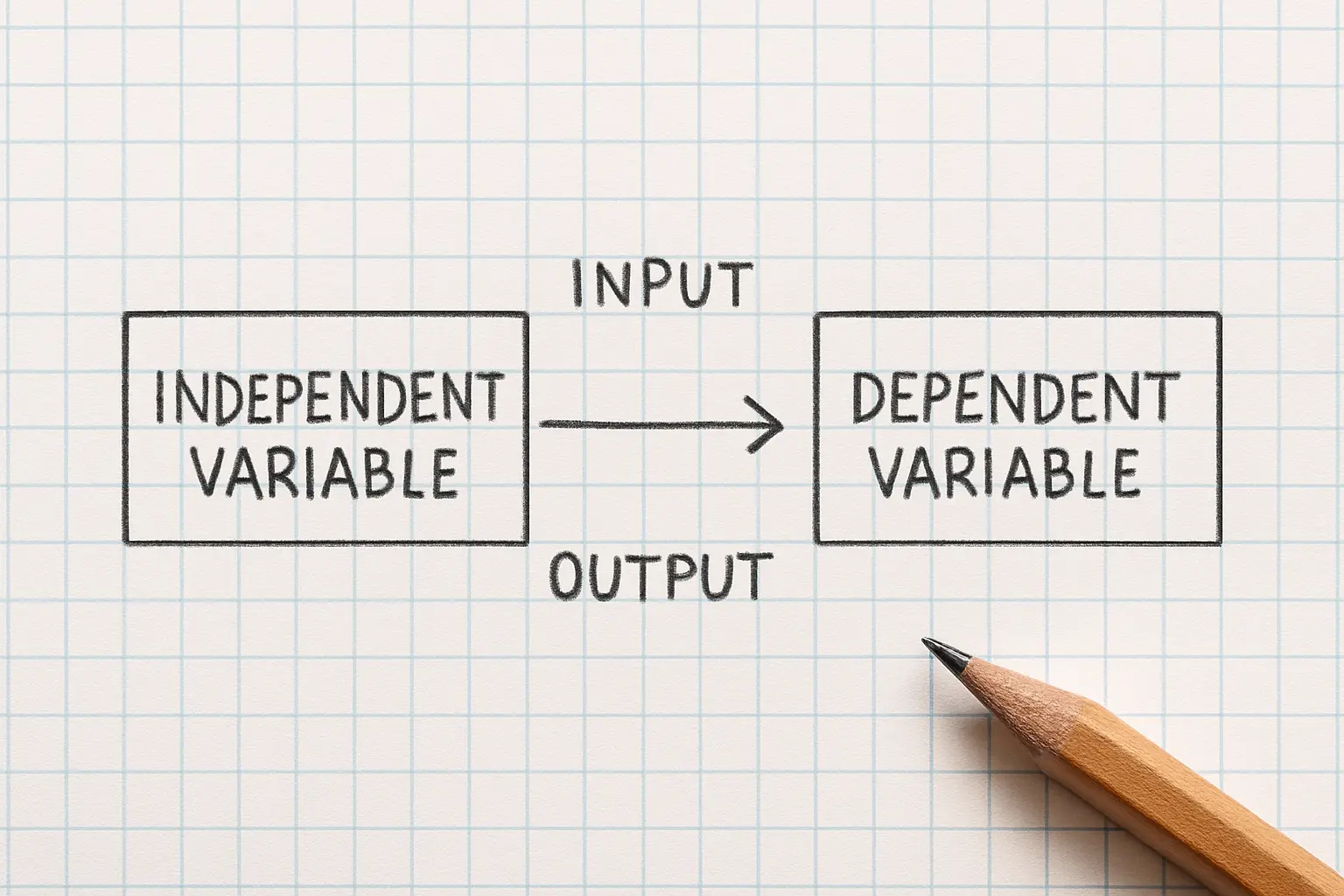
Most Philippine psychology theses render the theoretical framework as a simple input-process-output (IPO) or box-and-arrow diagram: the independent variable box, an arrow labelled with the theory’s mechanism, and the dependent variable box. Label the arrow itself with the mechanism name — “social comparison” or “observational learning,” not a bare arrow — because that label is what shows the panel the theory is doing analytical work rather than sitting in the text as decoration.
Where the study has more than one independent variable or a moderating variable, add each as its own box with its own labelled arrow back to the theory’s mechanism, and keep the diagram on one page — a framework diagram that needs two pages to read is usually a sign the study has too many variables for one thesis.
Step 5: Cite the original theorist correctly in APA 7th
Cite the theory to its originating source, not to a textbook that merely mentions it, wherever the original is reasonably accessible. In-text: (Bandura, 1986) for a direct citation, or Bandura (1986) proposed that… when the author’s name starts the sentence. In the reference list: Bandura, A. (1986). Social foundations of thought and action: A social cognitive theory. Prentice-Hall. If only a secondary source was actually read, cite it as a secondary source explicitly — (Bandura, 1986, as cited in Santos, 2021) — rather than citing the original as if it were read directly; panels ask this at defense, and misattributing a secondary source as primary is one of the fastest ways to lose credibility on an otherwise solid framework.
Step 6: Avoid the objections panels raise most often
A theory chosen because it is famous, not because its mechanism fits the variables — the fix is Step 1 and Step 2 done in that order, every time. A framework paragraph that explains the theory but never explicitly connects it to the study’s own variables — reread your paragraph and confirm every sentence after the first mentions your variables, not just the theory’s general content. A hypothesis in Chapter 1 that does not obviously follow from the theory named in the framework — the theory should predict the direction or existence of the relationship the hypothesis states, and if it does not, either the theory or the hypothesis needs to change. And a theory used uncritically despite being contested or outdated in contemporary psychology — Freudian psychosexual stages, for instance, are still taught historically but are rarely defensible as the sole framework for a 2026 empirical thesis without a critical note acknowledging the theory’s contested status.
These are exactly the kind of questions a panel raises at the thesis defense, and the same theory-to-variable discipline strengthens the significance of the study, in the structure described in what the significance of the study should contain.
Match your variables to a theory and draft the framework paragraph
Tesify drafts the theoretical framework section from the variables in your conceptual framework, suggesting theories whose mechanism actually fits, building the theory-to-variable justification paragraph, and formatting the APA 7th citation for the original source. Over 9,000 students have used it to write more than 15,000 chapters, and every word is still written by you.
Draft your psychology thesis theoretical framework on Tesify
Frequently asked questions
Can a psychology thesis use more than one theory?
Yes, but one theory should be the primary lens that the hypotheses trace back to; additional theories can be cited as supporting perspectives, usually where the study has more than one dependent variable that no single theory fully explains.
What is the difference between a theoretical framework and a conceptual framework?
The theoretical framework is the established theory and its author that explains the relationship being studied; the conceptual framework is the study’s own diagram of its specific variables, built after the theoretical framework and informed by it, as covered in how to make a thesis conceptual framework.
Is it acceptable to use a Filipino researcher’s theory instead of a Western one?
Yes, and it can strengthen a study’s local relevance — Filipino psychology (Sikolohiyang Pilipino) concepts such as Virgilio Enriquez’s kapwa-based framework are valid theoretical anchors for studies where the cultural construct is central to the variables being measured.
Do I need to explain the entire theory or just the relevant part?
Just the mechanism relevant to your variables. A full theory often covers more constructs than a single thesis tests; explain the parts that map onto your own variables and note in one sentence that the theory covers more than what this study applies.
What if no single theory fits my variables well?
Reconsider whether the variables themselves are too loosely related before assuming no theory exists — a mismatch this severe often means the conceptual framework needs revision, not that psychology lacks a relevant theory. A thesis adviser or a broader literature search targeted at the specific variable pairing usually surfaces a fit.
Can I critique the theory I chose as my framework?
Yes, and a brief critical note (a theory’s cultural origin, a documented limitation, a more recent refinement) shows deeper engagement than presenting the theory uncritically, as long as the critique does not undermine your own use of it as the study’s anchor.
How long should the theoretical framework section be?
Typically one to two pages for an undergraduate thesis: a paragraph introducing the theory and author, the justification paragraph connecting it to your variables, and the framework diagram with its caption.
Where does the theoretical framework go in the Chapter 1 to 5 structure?
In Chapter 1 or Chapter 2 depending on the school’s research manual, immediately before or alongside the conceptual framework — check your specific manual’s placement, since schools vary on this more than on the content itself.