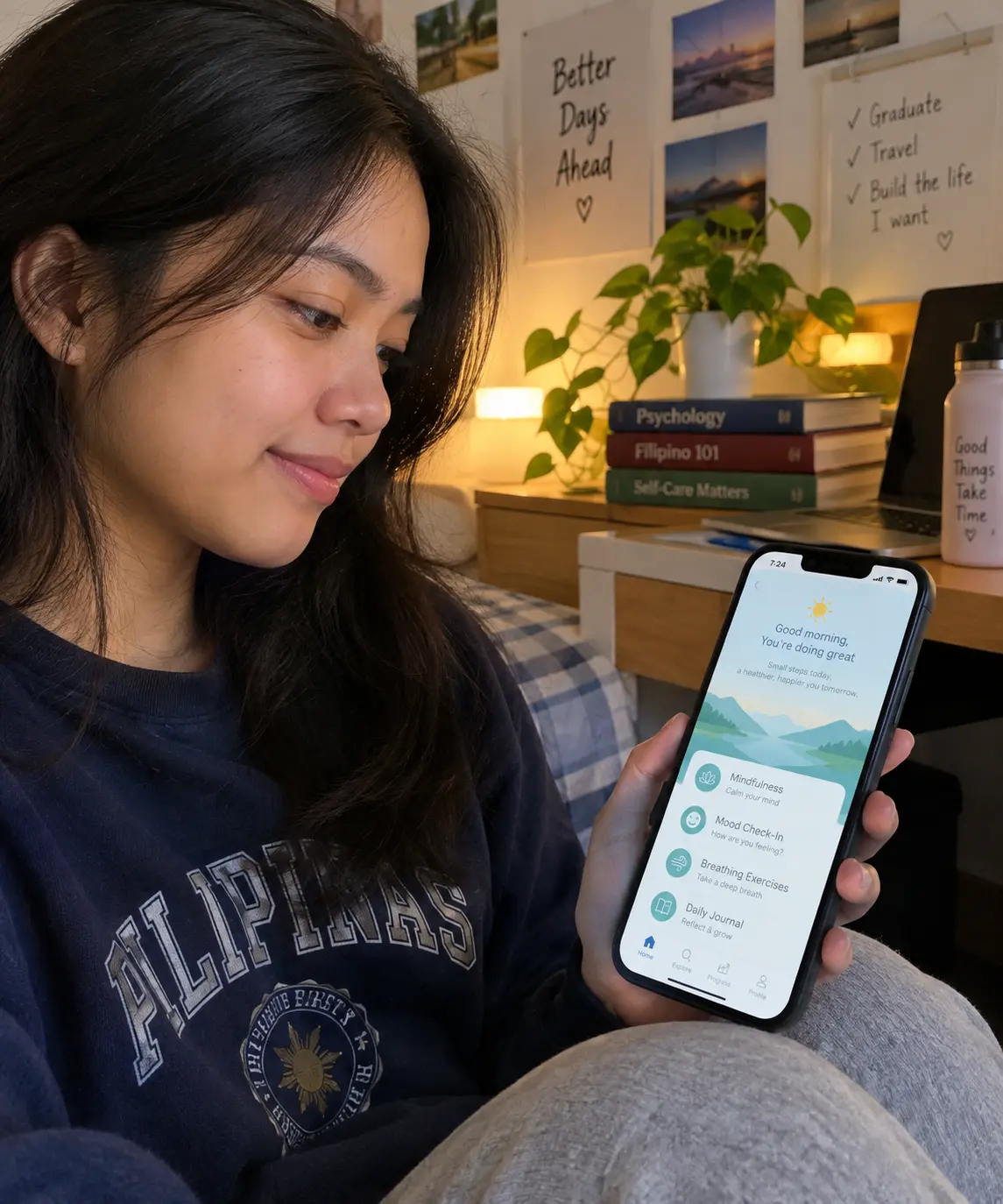
A psychology thesis on AI and mental health is a topic more and more Filipino psychology students are bringing to their advisers — and one of the fastest-rejected topics at proposal defense, because “AI and mental health” on its own is a headline, not a research question. Your adviser wants to know what specifically about AI, measured how, in whom. This guide turns the trending topic into a defensible Chapter 1, using the Philippines’ actual Mental Health Act as the local anchor a generic version of this topic usually lacks.
Why “AI and Mental Health” Gets Sent Back for Revision
The phrase covers at least four genuinely different studies: how people feel about AI chatbots as a mental health support tool, whether AI-assisted screening tools are accurate, how social media algorithms affect mental wellbeing, and how mental health professionals themselves are adopting AI in practice. A panel that hears “AI and mental health” without a sharper angle will ask you to pick one — better to arrive at your proposal defense having already picked, with a stated reason why.
Four Defensible Angles, Narrowed From the Trend
- Acceptance angle: Filipino college students’ willingness to use an AI mental health chatbot (such as a wellness app with a conversational AI feature) as a first point of contact before seeking a human counselor.
- Trust and disclosure angle: how comfortable students are disclosing sensitive mental health information to an AI system versus a human counselor, and what predicts the difference.
- Professional-practice angle: how licensed psychologists or guidance counselors in a specific setting describe using AI tools (screening questionnaires, documentation assistants) in their own practice, and where they draw an ethical line.
- Risk-perception angle: what safety concerns students or practitioners associate with AI mental health tools (data privacy, misdiagnosis, over-reliance) and how these concerns relate to actual usage intention.
Each of these is a real, narrow, measurable question — “AI and mental health” is not a topic until it becomes one of these.
The Philippine Anchor Most Versions of This Topic Skip
The Philippine Mental Health Act (Republic Act No. 11036, 2018) is the actual national policy your thesis should sit inside, not a generic “mental health is important” opening paragraph. The law affirms every Filipino’s basic right to mental health and commits the state to accessible, affordable, culturally appropriate services delivered in the least restrictive environment, with psychologists and other qualified professionals named among recognized mental health service providers. Note explicitly in your Chapter 1 that RA 11036 does not itself contain AI-specific provisions — that absence is worth stating directly, since it means your study is examining a practice (AI use in mental health contexts) that existing policy has not yet caught up with, which is itself part of your significance of the study.
A Worked Statement of the Problem (Illustrative)
Illustrative example, not a real study: “While Republic Act No. 11036 affirms Filipinos’ right to accessible mental health services, the extent to which university students would actually use an AI-based mental health chatbot as a first point of contact — and what factors predict that willingness — remains unexamined in a Philippine context. This study measured psychology students’ acceptance of AI mental health tools using the Technology Acceptance Model, examining perceived usefulness, perceived ease of use, and trust as predictors of intention to use.” This paragraph does three things a generic version does not: names the actual law, states the specific unmeasured gap, and names the theoretical framework and variables.

Which Theoretical Framework Fits This Topic?
The Technology Acceptance Model (Davis, 1989) is the framework most directly built for exactly this question — predicting whether people adopt a new technology based on perceived usefulness and perceived ease of use — and it is already well established in this site’s own theoretical framework guide for a psychology thesis. If your angle is more about disclosure comfort or trust rather than adoption intention specifically, a trust-in-automation or therapeutic-alliance framework from counseling psychology literature may fit better — state clearly which construct (adoption, trust, or risk perception) your framework is built to explain, since using TAM to explain a disclosure-comfort question is a framework-construct mismatch a panel will flag.
What Variables and Instrument Should I Use?
For an acceptance-angle study: perceived usefulness, perceived ease of use, trust, and behavioral intention to use, typically measured with adapted TAM survey items on a Likert scale, pilot-tested for the specific AI mental health tool you are studying (name the actual app or tool type, do not leave it generic). For a professional-practice angle: a qualitative interview guide exploring how practitioners describe their current AI use, their stated ethical boundaries, and their unmet needs — closer to the thematic analysis approach in our six-phase thematic analysis worked example, adaptable from a communication-thesis context to a psychology one. Whichever instrument you adapt, pilot-test it and report reliability, following the same standard covered in our standardized scale adaptation guide for a psychology thesis.
Ethical Considerations Specific to This Topic
A study about AI and mental health carries a heightened ethical duty most other thesis topics do not: if your survey or interview touches respondents’ own mental health experiences, even indirectly, treat it with the same confidentiality and referral-resource protocol a mental-health-adjacent study requires — provide a list of real, current mental health resources (a university counseling office, the National Center for Mental Health hotline) to every respondent regardless of their answers, and clear your instrument with your institution’s ethics review board before distributing it. This is separate from, and does not replace, standard informed consent.

What Sample and Setting Actually Work for This Topic?
An acceptance or trust-angle study realistically draws its sample from psychology or a related program’s own student population, since access is straightforward and the population understands the survey constructs without extensive explanation — a convenience or purposive sample of 100 to 200 respondents is common at undergraduate scale, though check your own program’s expectations rather than treating that as a rule. A professional-practice angle needs access to licensed psychologists or guidance counselors, which is harder to arrange and usually means a smaller purposive or snowball sample of 8 to 15 interview participants rather than a large survey — state this access reality honestly in Chapter 3 rather than assuming a large practitioner sample is achievable on an undergraduate timeline.
How Do I Avoid Overclaiming What My Study Actually Shows?
A study measuring willingness to use an AI mental health chatbot does not establish that the chatbot works clinically, and a study should not imply otherwise in its conclusions. Keep your claims scoped to what you actually measured: attitudes, intentions, or self-reported practice, not clinical efficacy, unless your design specifically includes an outcome measure tied to actual mental health improvement, which is a substantially more complex and ethically heavier study most undergraduate theses are not positioned to run. State this scope limitation explicitly in your significance of the study section, since a panel increasingly checks whether a thesis’s conclusions overreach beyond its actual measured variables.
Don’t Confuse This With “Using AI to Write My Thesis”
A thesis studying AI and mental health is not the same question as whether you are allowed to use AI tools while writing your own thesis — that separate, purely academic-integrity question is covered in our guide on how to declare and cite ChatGPT and other AI in a Philippine thesis. Keep the two clearly separate in your own writing: your research object is AI’s role in mental health services; your own use of AI tools to draft or edit your paper is a methodology-and-integrity disclosure, addressed elsewhere.
Where This Fits With the Rest of Your Thesis
Once your angle is chosen, the discussion-chapter conventions for a psychology thesis are covered in writing Chapter 4 for a psychology thesis, and if you are still finalizing your exact title, 40 examples with research questions are in thesis title examples for psychology and criminology students.
Your defense is coming and “AI and mental health” is still just a headline
Tesify turns a narrowed angle like the ones above into a fully structured statement of the problem, objectives, and significance of the study — in your own words, cited properly, ready for your adviser’s next review. A free tier is available to start drafting before you decide whether to upgrade. Over 9,000 students have used Tesify to write more than 15,000 chapters, and every word is still written by you, never generated wholesale in your place.
Frequently Asked Questions
- Is “AI and mental health” too broad or too trendy for a serious psychology thesis?
- The trend itself is not the problem — the lack of a narrowed, measurable angle is. Any of the four angles above (acceptance, trust/disclosure, professional practice, risk perception) turns the trend into a legitimate, specific research question a panel will accept.
- Does using Tesify to help structure my proposal count as academic dishonesty?
- No, when used as intended: Tesify drafts structure and prose around decisions and content you provide — your research question, your variables, your findings — the same way a human research assistant might help organize a chapter. Always disclose AI tool use per your specific university’s policy, and never submit AI-generated content as your own original analysis without disclosure where required.
- How much does Tesify cost, and is there a free option?
- Tesify offers a free tier so you can start drafting before deciding whether to upgrade to a paid plan; check the current pricing and feature breakdown on the Tesify site, since plans and features are updated from time to time.
- Will my data be private if I use an AI thesis tool for a topic about mental health?
- Read the specific privacy policy of any tool you use, including Tesify, before entering identifiable respondent data. Best practice for a mental-health-adjacent thesis is to keep raw respondent data (especially anything identifiable) out of any third-party AI tool entirely, and use such tools only for structuring and drafting your own written analysis.
- Do I need a licensed psychologist to supervise a thesis about AI mental health tools?
- Standard thesis advisership rules apply as they would for any psychology thesis at your institution; confirm your program’s specific requirement, since some ethics boards apply extra scrutiny to any study touching mental health content even when it studies attitudes rather than providing treatment.
- Can I study a real, named AI mental health app, or should I keep it generic?
- Naming a real, specific app or tool type (rather than a vague AI chatbot) makes your study more concrete and citable, provided you are transparent that you are studying user perceptions or professional use, not endorsing or evaluating the app’s clinical efficacy, which is a different and more specialized research question.
- What if a respondent discloses a genuine mental health crisis while answering my survey?
- Have a referral protocol ready before you distribute anything: a printed or digital resource list with your university counseling office’s contact details and a national hotline, given to every respondent regardless of their answers, and a clear plan (agreed with your adviser and ethics board in advance) for what you personally do if a response raises immediate concern.
- Is a quantitative or qualitative design better for this topic?
- It depends on your specific angle: acceptance and trust angles are usually quantitative (a TAM-based survey); the professional-practice angle is usually qualitative (interviews). A mixed-methods design combining both is possible but adds real time and complexity — confirm your timeline can support it before committing.