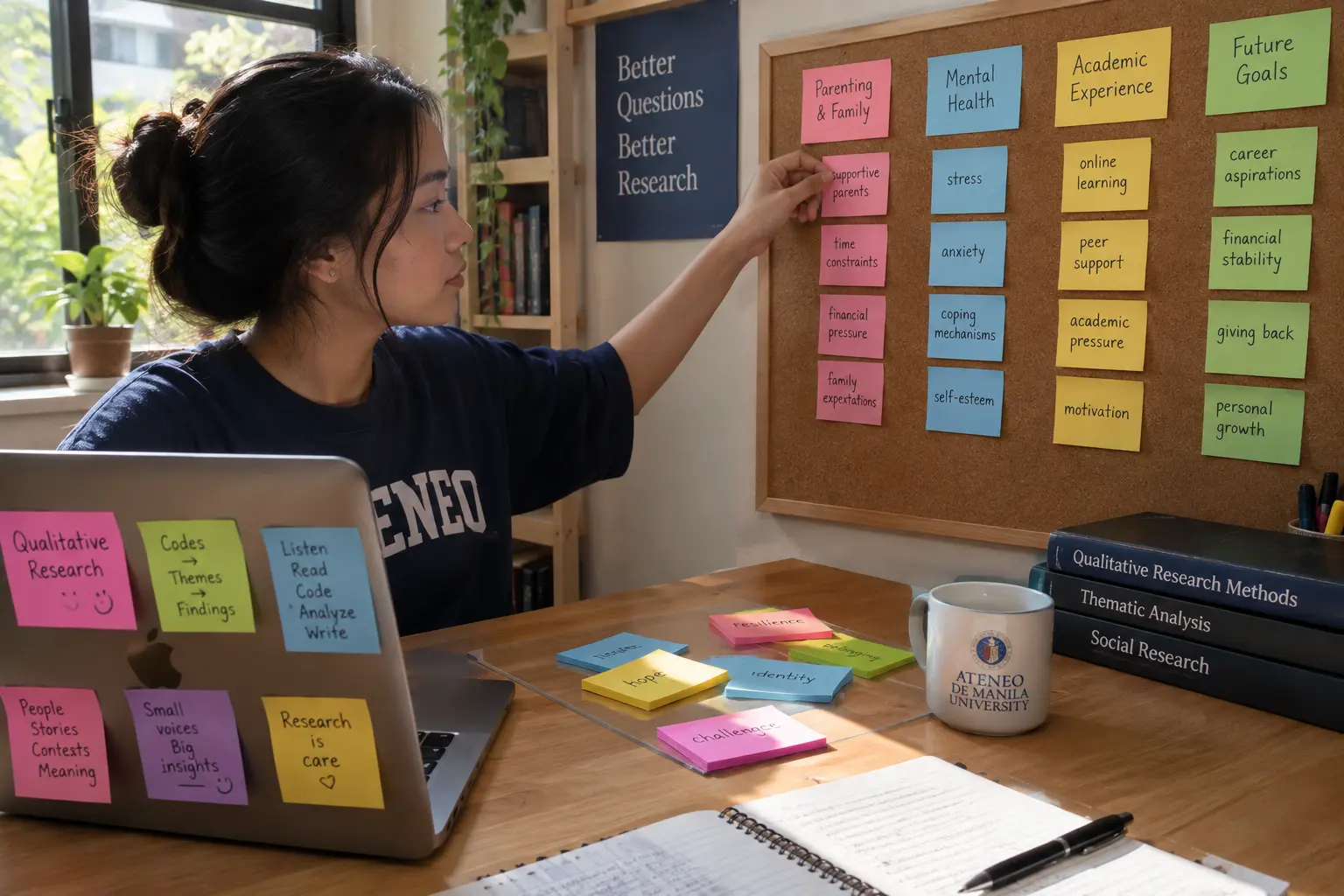
A thematic analysis turns hours of interview transcripts or focus-group recordings into a set of named, defensible themes your panel can follow on a slide. For a communication or journalism thesis — audience-reception studies, newsroom ethnographies, social-media discourse projects — it is usually the right choice when your data is qualitative and your question is “what patterns of meaning show up across my participants,” not “how many people agree with a statement.” This guide walks through the six-phase framework most Philippine communication programs point students to, with a worked example from a fictional, illustrative study on Filipino Gen Z TikTok news consumption.
Why Thematic Analysis Fits a Communication Thesis
Communication research is full of interview- and text-heavy designs: audience reception, media framing, organizational communication, campaign message analysis — the kind of study that usually needs its own communication-specific data, covered separately in the site’s guide to where communication and journalism students find data for a Philippine thesis. Thematic analysis is method-neutral — it does not assume a particular theoretical lens the way discourse analysis or narrative analysis does — which is exactly why advisers accept it across such a wide range of communication topics. The trade-off is that “method-neutral” does not mean “loose.” A thematic analysis without a clearly stated approach (inductive or deductive, semantic or latent) is the single most common reason panels send Chapter 3 back for revision.
The version taught in most methodology classes today follows the six-phase framework Virginia Braun and Victoria Clarke published in 2006 in Qualitative Research in Psychology. It was written for psychology, but communication scholars adopted it quickly because the phases map cleanly onto interview and text-based data of any kind. The six phases, in their own terms, are: (1) becoming familiar with the data, (2) generating initial codes, (3) generating (searching for) themes, (4) reviewing themes, (5) defining and naming themes, and (6) producing the report.
Step 1: Decide Inductive or Deductive, Semantic or Latent — Before You Code Anything
State this decision in Chapter 3 explicitly, because your panel will ask for it at the proposal defense.
- Inductive coding lets themes emerge from the data itself — appropriate when little prior research exists on your specific angle (say, barangay-level disaster communication on Facebook).
- Deductive coding starts from an existing framework or theory (uses and gratifications, framing theory, agenda-setting) and codes the data against it — appropriate when you are testing or extending a known model.
- Semantic themes stay at the surface, explicit content of what participants said. Latent themes interpret underlying assumptions and ideas — a heavier analytical claim that needs more justification in your methodology chapter.
Worked example (illustrative, not real data): a thesis on how Filipino Gen Z university students evaluate the credibility of TikTok news content states its approach as “inductive, semantic thematic analysis, since no local framework yet describes credibility heuristics on short-form video platforms specifically.”
Step 2: Transcribe and Familiarize Yourself With the Data
Transcribe every interview or focus-group recording verbatim, including filler words and false starts if you plan any latent-level interpretation — trimmed transcripts lose the hesitations that often carry meaning. Read the full data set at least twice before coding a single line, noting first impressions in a reflexive memo. Expected output of this step: a clean transcript file per participant, plus a one-page memo of initial impressions you can quote later when you justify your codes.
Step 3: Generate Initial Codes Systematically
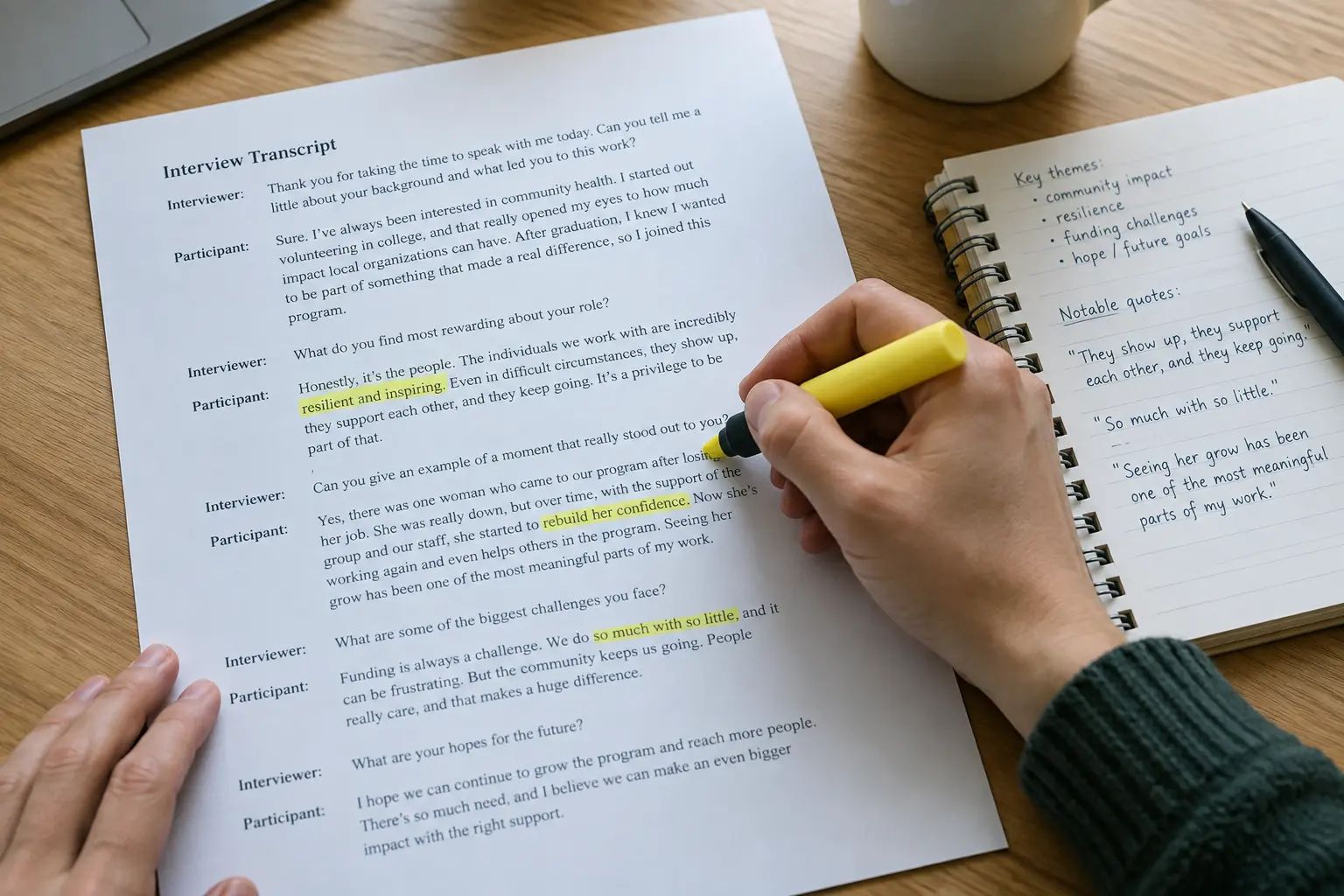
Code line by line or sentence by sentence, applying a short descriptive label to any segment relevant to your research question. Work through the entire data set before you try to group anything — premature grouping is how students lose codes that turn out to matter. Free tools like Taguette or spreadsheet-based manual coding both work at undergraduate thesis scale; paid tools such as NVivo add speed at a licence cost most single-adviser groups do not need. A fuller side-by-side of what each coding option costs and who it actually suits is in our software and analysis tools comparison for a communication thesis.
Worked example continued: two early codes from the fictional TikTok study: “checks the comment section before trusting a claim” and “distrusts videos with heavy background music or effects.” Both are semantic — they describe what participants said, not an interpretation of why.
Step 4: Search for Themes by Grouping Related Codes
Once the full data set is coded, print or export every code and physically sort them into candidate theme piles. A theme is a pattern that captures something important about the data in relation to the research question — not simply a topic that came up. “Comments as a credibility check” is a candidate theme; “TikTok” is not a theme, it is the platform you are studying.
Step 5: Review Your Candidate Themes Against the Full Data Set
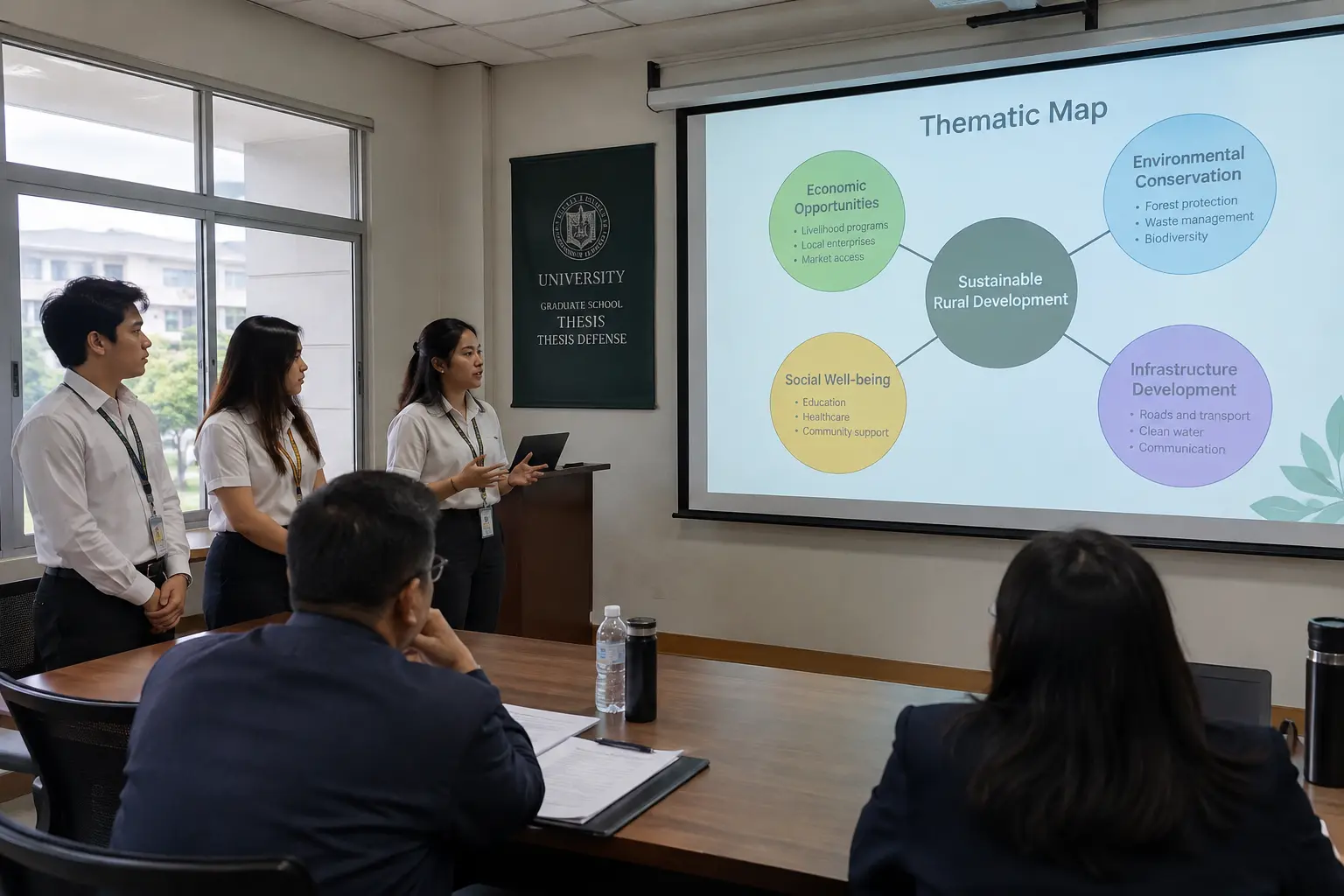
Braun and Clarke describe two review levels: check each theme against its own coded extracts first, then check the whole set of themes against the entire data set. A theme survives only if it has enough distinct data to support it and is clearly different from its neighboring themes. This is the step where most first-time thematic analyses in communication theses run into trouble — a table with lots of quotes underneath one theme label can still be two themes wearing one name. Expected output: a working thematic map with two to six main themes plus sub-themes, revised at least once before you write it up.
Step 6: Define, Name, and Write Up Each Theme
For each surviving theme, write a short definition of what it captures and why it matters to your research question, choose a theme name your panel will understand without your slide deck (“Comments as a Trust Signal,” not “Theme 3”), and select two or three direct, illustrative participant quotes per theme for Chapter 4. Keep every quote’s exact wording; thematic analysis loses credibility fast when a quoted line does not match the transcript.
A Worked Chapter 4 Excerpt (Illustrative, Fictional Data)
| Theme | Definition | Sample illustrative quote |
|---|---|---|
| Comments as a trust signal | Participants check the comment section before accepting a TikTok news claim, treating visible pushback as a credibility filter. | “Kapag may nagko-comment na ‘fake news ito,’ doon ko na hina-hindi. Kung wala, medyo okay na.” |
| Production polish as suspicion | Heavily edited videos with music or effects are read as entertainment first, news second, lowering perceived credibility. | “Kapag ang gaganda ng effects, para siyang gawa lang para mag-viral, hindi para mag-inform.” |
| Cross-checking on a second platform | Participants describe a habitual second look on Facebook or a news outlet’s own account before sharing. | “Bago ko i-share, tinitignan ko muna kung meron din sa Facebook page ng ABS-CBN o GMA.” |
Every quote and every participant statement above is fictional and illustrative, built only to show how a completed theme table should look — never lift the wording of a real published thesis into your own paper.
Reporting Rigor: What Your Methodology Chapter Should State
Beyond the six phases, panels increasingly expect a short statement on how you handled trustworthiness: who did the coding (one researcher or two, with an inter-coder discussion), how you kept an audit trail of code changes, and whether you returned to participants to check your interpretation (member checking) — optional in most undergraduate designs but worth naming even to say why you skipped it (time, access, or ethics-board constraints). Write this section the way the site’s Chapter 3 methodology guide lays out the rest of the chapter, so the qualitative-analysis section reads as one continuous methodology rather than a bolted-on appendix.
If your design also asks how many interviews or focus groups are “enough,” that question is answered by data saturation, not a sample-size formula — the site’s guide on how many respondents a qualitative thesis needs walks through the reasoning your Chapter 3 should cite. And where your study also produces a variables or constructs table for Chapter 1, the worked examples in operationalization of variables, filled in for six studies show the format a panel expects, even though a purely qualitative thematic analysis will use it more sparingly than a survey-based design.
A Note on Reflexivity for Communication Researchers
Communication theses often study audiences or media the researcher is personally close to — a fellow student researching campus press freedom, a former call-center agent researching workplace communication culture, a heavy TikTok user researching TikTok news consumption. Braun and Clarke’s later writing on the method (published after the original 2006 paper) stresses that thematic analysis is not a neutral, purely technical procedure — the researcher’s own position shapes which codes stand out and which themes feel meaningful. Philippine communication panels increasingly expect a short reflexivity note in Chapter 3: one or two paragraphs naming your own relationship to the topic and how you tried to keep your coding grounded in what participants actually said rather than what you expected to hear. This is not a confession of bias to be apologized for; it is a transparency statement that strengthens, rather than weakens, the credibility of an interpretive method.
A practical way to build this in without derailing your timeline: keep a short reflexive journal alongside your coding work from day one, noting moments where you caught yourself assuming a code before checking the actual transcript line. Two or three sentences drawn from that journal, quoted in Chapter 3, does more for a panel’s confidence in your analysis than a paragraph asserting objectivity a purely interpretive method cannot honestly claim.
Where Tesify Fits Into This Process
Tesify will not code your transcripts for you — coding qualitative data is the part of the thesis that has to stay yours, and every panel knows it. What it speeds up is everything around the analysis: turning your six-phase write-up into properly structured, APA 7th-formatted prose for Chapter 3, and building a clean, correctly formatted reference list with the Tesify Automatic Bibliography tool once you have the sources you actually read.
Draft your Chapter 3 methodology write-up around the analysis you already ran
Tesify turns a finished six-phase thematic analysis — your coding decisions, your themes, your rationale — into properly structured, APA 7th-formatted Chapter 3 prose, and builds your reference list automatically. Over 9,000 students have used it to write more than 15,000 chapters, and every word is still written by you.
Frequently Asked Questions
- Do I need two coders for a thematic analysis in an undergraduate communication thesis?
- No. Two independent coders with an inter-coder reliability check strengthen a graduate or published study, but a single-researcher thematic analysis with a clearly documented audit trail is standard and accepted for most Philippine undergraduate theses. State clearly in Chapter 3 that one researcher coded the data.
- How many participants do I need for a thematic analysis?
- There is no fixed number — thematic analysis is guided by information power and data saturation, not a formula. Undergraduate communication theses commonly interview 8 to 15 participants or run 3 to 5 focus groups, but check your own adviser’s and department’s expectations before finalizing your sample.
- What is the difference between thematic analysis and content analysis?
- Content analysis is usually more structured and often produces frequency counts of pre-defined categories, sometimes with statistical treatment. Thematic analysis is more interpretive and flexible, producing named themes rather than counts, and does not require a coding scheme fixed in advance.
- Can I use thematic analysis with survey open-ended responses instead of interviews?
- Yes. Braun and Clarke’s framework works on any textual data — open-ended survey responses, social media comments, or interview transcripts — as long as you are looking for patterns of meaning rather than counting occurrences.
- Is thematic analysis considered a qualitative or mixed-methods approach?
- It is a qualitative analysis method. It becomes part of a mixed-methods design only when you pair it with a quantitative strand, such as a survey with descriptive statistics, in the same study.
- What software do communication students actually use for thematic analysis in the Philippines?
- Free tools such as Taguette or a well-organized spreadsheet are common at undergraduate level. Programs with a heavier budget sometimes split the cost of NVivo across a research group, but it is not required to pass a thesis built on thematic analysis.
- Do I quote participants by name in my Chapter 4 results?
- No. Use pseudonyms or participant codes (P1, P2) agreed with your research ethics committee, and remove any detail that could identify a specific person, especially in small communities or organizations.
- How is a theme different from a code?
- A code is a short label attached to a small segment of data. A theme is a broader pattern built by grouping related codes together, capturing something meaningful about the research question rather than just tagging content.