
Chapter 3 is the chapter your panel can audit. Chapters 1 and 2 can be argued about; methodology either reconciles or it does not, and a panelist with a calculator can settle it in a minute. This guide walks the nine sections most Philippine research manuals require, in order, with filled-in template text you can adapt and a Slovin’s formula computation worked all the way through.
One caution before you start: your school’s research manual overrides everything below. Manuals at UP Diliman, Ateneo de Manila, De La Salle and UST differ in section names and ordering, and some departments require sub-sections others do not. The nine below cover the union of what Philippine manuals typically ask for. If yours lists seven, delete two rather than inventing them; if yours renames “Locale of the Study” to “Research Setting”, use its wording.
Step 1: Write the chapter introduction
Expected output: two or three sentences, no more.
Name the sections the chapter contains, in the order it contains them. Do not define what research methodology is. Do not quote a dictionary.
Template: “This chapter presents the methods and procedures used in the conduct of the study. It discusses the research design, the locale of the study, the respondents of the study, the sampling technique, the research instrument, its validity and reliability, the data gathering procedure and the statistical treatment of data.”
Step 2: State the research design
Expected output: one named design plus one justification tied to your statement of the problem.
The failure mode here is naming a design and then justifying it with “because it is widely used”. Justify it against what your problems actually ask.
Template: “This study employed a descriptive-correlational research design. The descriptive component was used to characterize the respondents’ level of X, as required by Problems 1 and 2, while the correlational component was used to determine the relationship between X and Y, as required by Problem 3. The design was appropriate because the study measured existing conditions at one point in time without manipulating any variable.”
If you have not yet settled whether your study is quantitative or qualitative, settle that first — it determines every remaining section. The trade-offs are laid out in the guide to choosing between quantitative and qualitative research.
Step 3: Describe the locale of the study
Expected output: a named setting and a reason it fits the problem.
Philippine manuals almost always ask for this section and students almost always pad it with the institution’s history. The panel does not want the history. It wants to know why this setting can answer your problem.
Template: “The study was conducted at the College of Business Administration of [Institution], located in [City]. The locale was selected because it offers the [programme] under study and enrols a population large enough to yield the required sample, and because the researchers had documented access through the College Dean.”
Step 4: Define the respondents and the population
Expected output: a population figure with a named source and a stated inclusion boundary.
A population without a number makes every section after it unverifiable. Get the figure from a named office and say which office.
Template: “The respondents of the study were the 2,450 officially enrolled fourth-year students of the College for Academic Year 2026-2027, as certified by the Office of the University Registrar in June 2026. Students enrolled in fewer than twelve units and those on leave of absence were excluded.”
Where your framing needs national rather than institutional figures, take them from a named published source with its year attached — the figures and their provenance are set out in the guide to Philippine higher education statistics for Chapter 1.
Step 5: Compute the sample size and show every step
Expected output: a named formula, your own numbers substituted, and the arithmetic carried to a whole number.
“A sample of 344 was selected” is not an answer. This is the single most tested part of a Philippine methodology chapter, because it is the only part a panelist can independently verify while you are standing there.
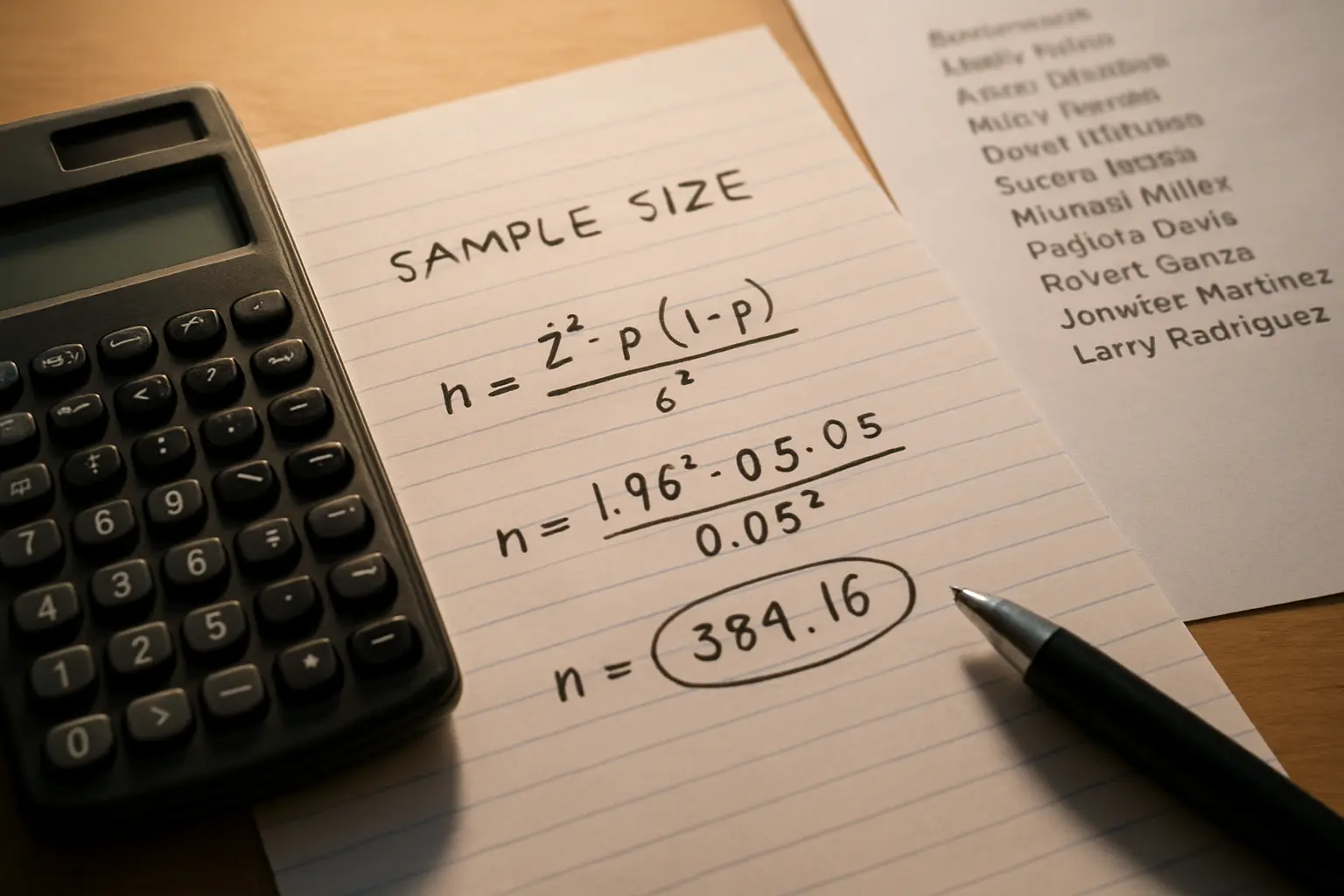
The formula Philippine departments overwhelmingly use is Slovin’s formula:
n = N / (1 + Ne2), where n is the sample size, N is the population and e is the margin of error, conventionally 0.05.
Worked example, using the population from Step 4:
- N = 2,450 and e = 0.05, so e2 = 0.0025.
- Ne2 = 2,450 × 0.0025 = 6.125.
- 1 + Ne2 = 7.125.
- n = 2,450 ÷ 7.125 = 343.86.
- Rounded up, n = 344 respondents.
Template: “Using Slovin’s formula at a 0.05 margin of error, n = 2,450 / (1 + 2,450(0.05)²) = 2,450 / 7.125 = 343.86, rounded to 344 respondents.”
Two rules. Round up, never down — 343.86 becomes 344, because you cannot survey a fraction of a person and a short sample invites a question. And your sample can never exceed the population you declared in Step 4; that error is caught instantly and it undermines everything downstream.
Step 6: State the sampling technique accurately
Expected output: the technique named correctly, plus the mechanism by which respondents were actually selected.
Do not call convenience sampling random. If you cannot describe how every member of the population had a known chance of being chosen, it was not random, and a panel that spots the mislabel will distrust the rest of the chapter.
Template (stratified random, the commonest in Philippine theses): “Stratified random sampling was used, with the four programme majors serving as strata. The 344 respondents were allocated proportionally to the size of each major, and within each stratum names were drawn from the Registrar’s list using a random number generator without replacement. The allocation was: Marketing 112, Accountancy 98, Management 76 and Entrepreneurship 58.”
Make the allocation figures sum to your sample size and say so. In the example above, 112 + 98 + 76 + 58 = 344.
Template (purposive, and entirely defensible when justified): “Purposive sampling was used. Respondents were selected on the basis of having completed at least one on-the-job training placement, because Problem 2 concerned the transfer of workplace competencies.”
Step 7: Describe the research instrument
Expected output: instrument type, number of parts, number of items per part, response scale, and its origin.
Template: “The study used a researcher-made survey questionnaire consisting of three parts. Part I gathered the respondents’ profile in five items. Part II measured the level of X through fifteen items, and Part III measured Y through twelve items. Parts II and III used a four-point Likert scale interpreted as 4 = Strongly Agree, 3 = Agree, 2 = Disagree and 1 = Strongly Disagree. The instrument was adapted from Santos and Cruz (2024), with items reworded to fit the local setting and with the permission of the authors.”
If you adapt an instrument, say whose it was and what you changed, and cite it properly. In APA 7th, that reference entry reads:
Santos, M. A., & Cruz, R. B. (2024). Workplace competency transfer among business graduates. Philippine Journal of Business Education, 12(3), 45–67. https://doi.org/10.xxxxx/xxxxx
In text, that is (Santos & Cruz, 2024) in parentheses or Santos and Cruz (2024) in narrative form. Note the ampersand inside parentheses and the word “and” outside it; that distinction is the single most common APA error in Philippine theses.
Attach the full instrument as an appendix. A panel that cannot see it will assume it does not exist.
Step 8: Establish validity and reliability
Expected output: a validation route with named validators, and a reliability coefficient with the test that produced it.
These are two different things. Validity asks whether the instrument measures what it claims. Reliability asks whether it measures consistently.
Template (validity): “The instrument underwent face and content validation by a panel of three experts: the research adviser, a faculty member of the Department of Statistics and a practitioner from the industry concerned. Their comments resulted in the rewording of four items and the deletion of two ambiguous items.”
Template (reliability): “Reliability was established through a pilot test administered to thirty students from a comparable college who were not part of the study sample. Cronbach’s alpha was computed at 0.87 for Part II and 0.82 for Part III, both interpreted as good internal consistency.”
Never report a Cronbach’s alpha you did not compute. If you did compute one, be ready to say on what software, on how many items and on what pilot sample — and if the software was SPSS or Excel, know which, because you will be asked. The differences between them are covered in the comparison of SPSS and Excel for thesis statistics.
Step 9: Write the data gathering procedure and the statistical treatment
Expected output for the procedure: permissions, dates, administration method and retrieval rate.
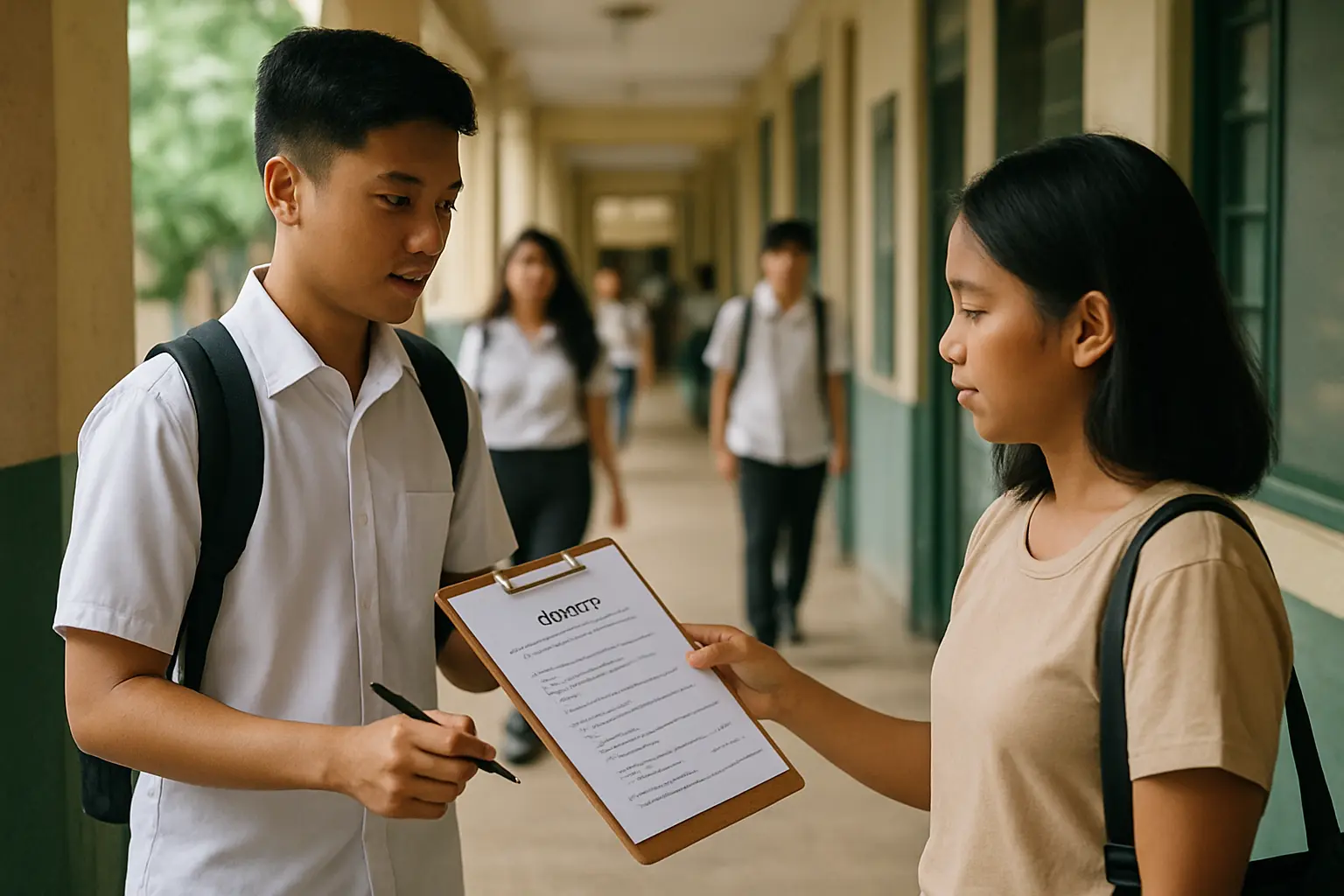
Template: “A letter of request was submitted to and approved by the College Dean on 5 June 2026. The researchers personally administered the questionnaire from 10 to 21 June 2026 during class breaks, with informed consent obtained from each respondent. Of the 344 questionnaires distributed, 331 were retrieved and 326 were completely accomplished and used in the analysis, for a retrieval rate of 94.8 per cent.”
The 326 you state here must be the same 326 that appears in Chapter 4 and in your abstract. Mismatched respondent counts across chapters are the defect panels find first.
Expected output for the statistical treatment: one tool matched to each specific problem, with the decision rule stated.
Template: “Frequency and percentage were used to describe the respondents’ profile under Problem 1. Weighted mean was used for Problems 2 and 3, with a criterion mean of 2.50 on the four-point scale. Pearson’s r was used to determine the relationship under Problem 4, tested at the 0.05 level of significance. All computations were performed using SPSS.”
State the decision rule explicitly, and do not name software you did not use. Which statistic answers which kind of problem is covered in full in the guide to the statistical treatment of data in a thesis.
The four reconciliation checks to run before you submit
- Population ≥ sample. 2,450 ≥ 344. Check it; this fails more often than you would believe.
- Stratum allocations sum to the sample. 112 + 98 + 76 + 58 = 344.
- Retrieved ≤ distributed, and used ≤ retrieved. 326 ≤ 331 ≤ 344.
- Every problem in your SOP has a statistical tool. Four problems, four tools.
Then run the cross-chapter check. The sample size here, the N in your Chapter 4 tables and the figure in your abstract must be one number. And your operational definitions here must match the ones you set in Chapter 1, while any adapted instrument must trace to a study you genuinely reviewed in your review of related literature. How the five chapters fit together is summarised in the overview of Chapters 1 to 5.
Draft Chapter 3 without losing a week to the format
Tesify structures your methodology chapter section by section in the order your research manual expects, keeps your citations attached to the sources you actually read, and leaves every decision about design, sample and instrument with you. Over 9,000 students have used it to write more than 15,000 chapters, and every word is still written by you.
Frequently asked questions
How many respondents are needed for a thesis in the Philippines?
There is no fixed number. The answer comes from your population and your margin of error through Slovin’s formula. A population of 2,450 at a 0.05 margin of error gives 344; a population of 500 gives 222. What matters to a panel is that you can show the computation.
What is Slovin’s formula?
n = N / (1 + Ne²), where n is the sample size, N is the population and e is the margin of error, conventionally 0.05. It is the sample-size formula Philippine research manuals most commonly prescribe.
Should I round the sample size up or down?
Up. A computed 343.86 becomes 344. Rounding down leaves you below your own stated requirement, which is exactly the kind of small inconsistency a panel notices.
How long should Chapter 3 be?
Most Philippine undergraduate methodology chapters run eight to fifteen pages. Length follows from how many sections your manual requires, not from a page target. A documentary or secondary-data study is legitimately shorter.
What tense should Chapter 3 be in?
Past tense in the final manuscript, because you are reporting what you did. The proposal version is in future tense, and forgetting to convert it is among the most common adviser corrections.
Can I use a researcher-made questionnaire?
Yes, and most Philippine undergraduate theses do. It simply carries a heavier validation burden: you must show face and content validation by named experts and report a reliability coefficient from an actual pilot test.
Do I need ethics clearance?
It depends on your school and your respondents. Studies involving minors, patients, clinical records or identifiable personal data usually require review. Ask your adviser early, because clearance takes weeks and cannot be obtained after the fact.
What if my retrieval rate was low?
Report it honestly and discuss it under limitations. A stated 78 per cent retrieval rate that you can explain is far stronger than a 100 per cent rate a panel does not believe.
What is the difference between the locale of the study and the research setting?
Nothing substantive; they are two names for the same section, and manuals differ on which they use. Follow your own manual’s wording exactly.
Can I change my methodology after the proposal defense?
Yes, with your adviser’s approval, and it happens constantly when field access proves harder than planned. Document what changed and why, and make sure every downstream section, including the statistical treatment, reflects the change.