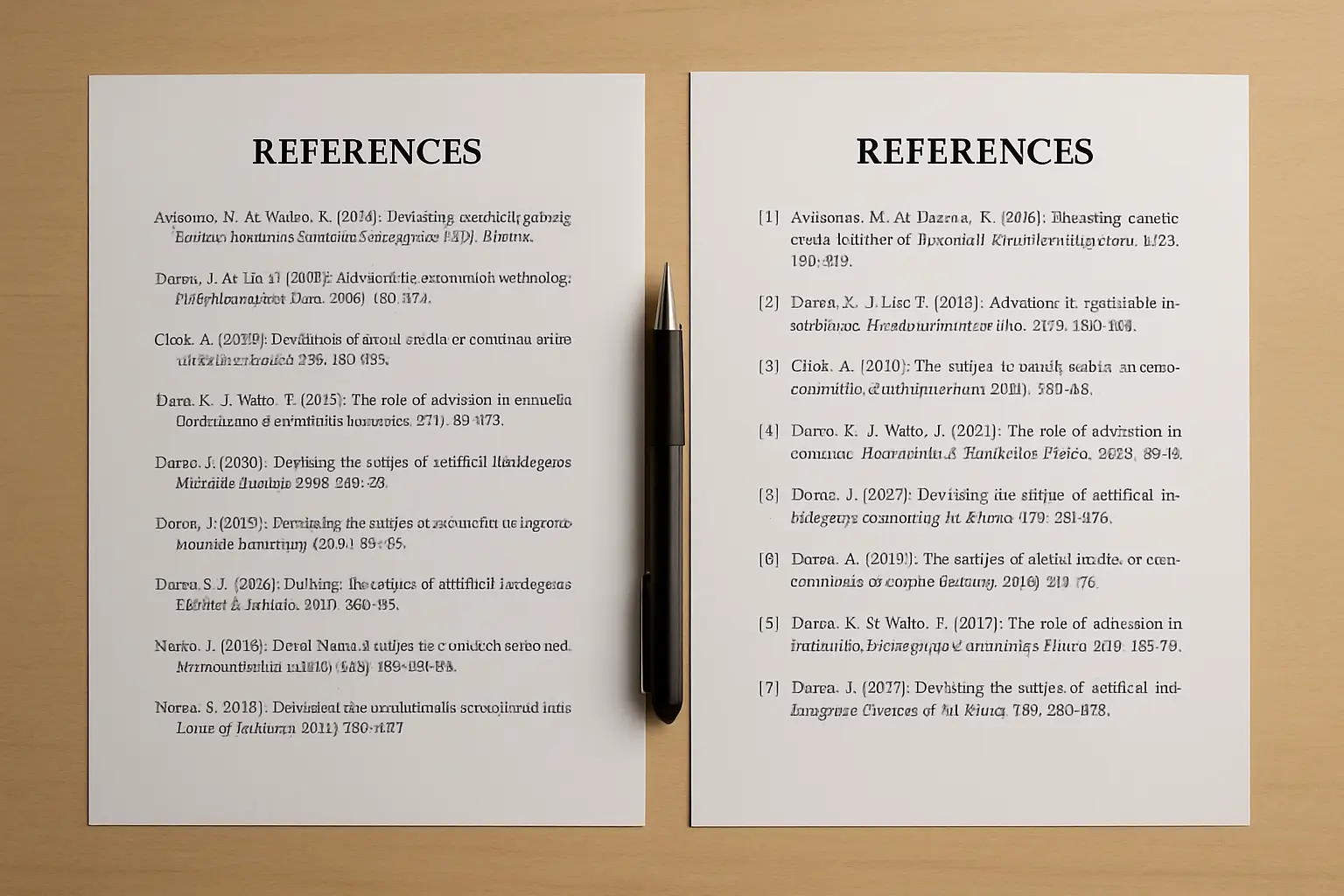
| Feature | APA 7th | IEEE |
|---|---|---|
| In-text citation | Author–date: (Guest et al., 2006) | Bracketed number on the line: [4] |
| Reference list order | Alphabetical by author surname | Order of first appearance in the text |
| Author name form | Surname first, then initials: Guest, G. | Initials first, then surname: G. Guest |
| Author cut-off | List up to 20 authors | Up to six names, then et al. |
| et al. in text | From three or more authors | From three or more names |
| Article title | Sentence case, no quotation marks | In quotation marks |
| Periodical name | Full name, italicised | Abbreviated |
| Publisher location | Never included | Required — city, US state where applicable, country |
| Year position | In parentheses after the authors | At the end of the reference |
| End of reference | No period after a DOI or URL | Period at the end, including after a DOI |
Every IEEE rule above is quoted from the IEEE Reference Guide, version 11.12.2018, © 2018 IEEE, downloaded from the IEEE Author Center on 18 August 2026. Every APA rule is from APA’s own 7th edition Reference Guide for Journal Articles, Books, and Edited Book Chapters. Both are free downloads. Where this article states no rule, none could be verified at source.
The one difference that reverses between the two styles
Look at the publisher-location row again, because it is the clearest illustration of why you cannot half-convert a reference list.
APA’s reference guide is explicit: include the name of the publisher, followed by a period, and do not include the publisher location. This was a change in the 7th edition, and it is the single most common carry-over error in Philippine manuscripts, because older theses and older generators still emit “New York, NY: Wiley”.
IEEE requires the opposite. Its book format is:
J. K. Author, "Title of chapter in the book," in Title of His Published Book, xth ed. City of Publisher, (only U.S. State), Country: Abbrev. of Publisher, year, ch. x, sec. x, pp. xxx–xxx.
And the guide’s own worked example:
B. Klaus and P. Horn, Robot Vision. Cambridge, MA, USA: MIT Press, 1986.
So the piece of information APA tells you to delete is the piece IEEE tells you to supply, with the country as well as the city. A student who “converts” a list by changing the in-text markers and leaving the entries alone has produced something that is wrong in both styles.
The same source, written twice
Here is one journal article formatted both ways, so you can see every difference at once.
APA 7th:
Guest, G., Bunce, A., & Johnson, L. (2006). How many interviews are enough? Field Methods, 18(1), 59–82. https://doi.org/10.1177/1525822X05279903
IEEE, following the guide’s periodical format — J. K. Author, "Name of paper," Abbrev. Title of Periodical, vol. x, no. x, pp. xxx-xxx, Abbrev. Month, year.:
[1] G. Guest, A. Bunce, and L. Johnson, “How many interviews are enough?,” Field Methods, vol. 18, no. 1, pp. 59–82, Feb. 2006.
Six things changed: the initials moved in front of the surname, the ampersand became “and”, the title acquired quotation marks, the volume and issue became labelled fields, the year moved to the end with an abbreviated month, and the whole entry acquired a bracketed number that fixes its position in the list.
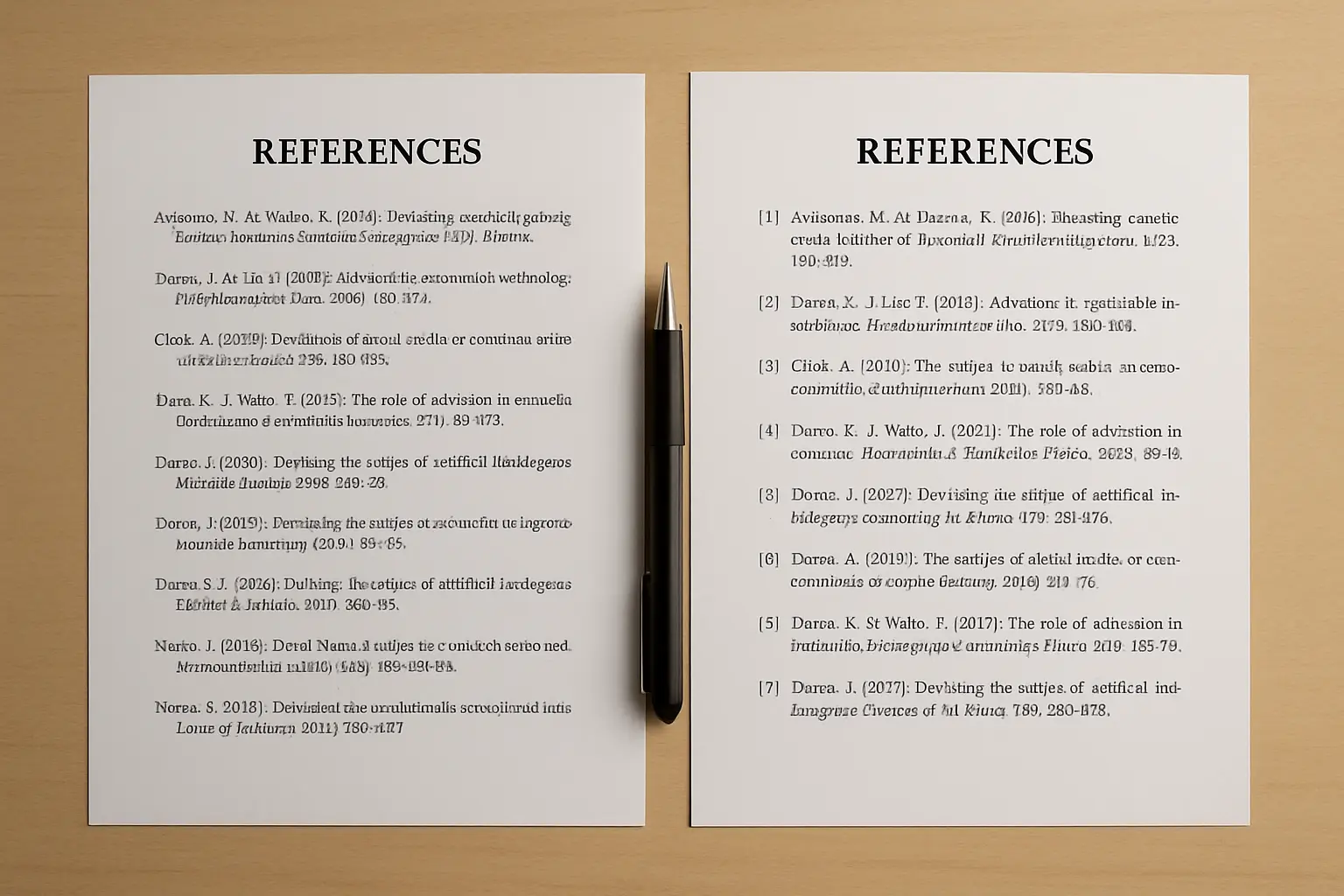
That last point has a consequence students underestimate. In IEEE the number is the reference’s identity, so inserting a new source into the middle of your Chapter 2 renumbers everything after it. Doing that by hand at 2 a.m. is how numbering errors get into submitted documents.
How IEEE in-text citations actually behave
Three rules from the guide, quoted, because all three surprise people coming from APA.
The brackets sit inside the punctuation and on the line. The guide states that references “appear on the line, in square brackets, inside the punctuation”, and that grammatically “they may be treated as if they were footnote numbers”. They are not superscript.
You can cite ranges and lists. The guide’s own examples: as shown by Brown [4], [5]; as mentioned earlier [2], [4]–[7], [9]; Smith [4] and Brown and Jones [5]; Wood et al. [7]. Note the en dash inside the range and the repeated brackets rather than [4, 5].
One number, one reference. The guide is blunt: “Do not combine references. There must be only one reference with each number.” If you cite the same source in Chapter 2 and again in Chapter 5, it keeps its original number both times — it does not get a second one.
There is also a rule with no APA equivalent at all: “References need not be cited in the text.” IEEE tolerates a reference list entry that is never cited. APA does not, and neither do most Philippine research manuals, so do not read that as permission — read it as a sign that the two styles come from different publishing traditions.
Which one governs your capstone?
Your programme’s manual, and nothing else. This is the part where students lose a weekend for no reason.
Most Philippine social science, education, business and nursing programmes use APA 7th. Engineering and computing programmes frequently require IEEE. But the governing document is your own department’s manual, and one university can publish different manuals for different colleges — a capstone project in an IT department may be governed by a completely different manual from the thesis handbook the same university issues to its college of education.
Three practical steps, in order:
- Find the manual, in writing. Not what a batchmate said, not what last year’s group used. The document.
- Check whether it names an edition. “APA” without a number is ambiguous, and 6th-edition habits produce exactly the publisher-location error above.
- If your adviser and your manual conflict, get the resolution in writing before you format sixty entries twice.
The governance question — which document wins when two disagree — is covered further in the guide to APA citation generators and what to fix before you submit. This article is about what the two styles actually look like once that is settled.
What to use to produce each style
Ranked for a Philippine capstone group, on the criterion that matters: can it produce your required style correctly, and can it renumber for you?
1. A reference manager with style switching
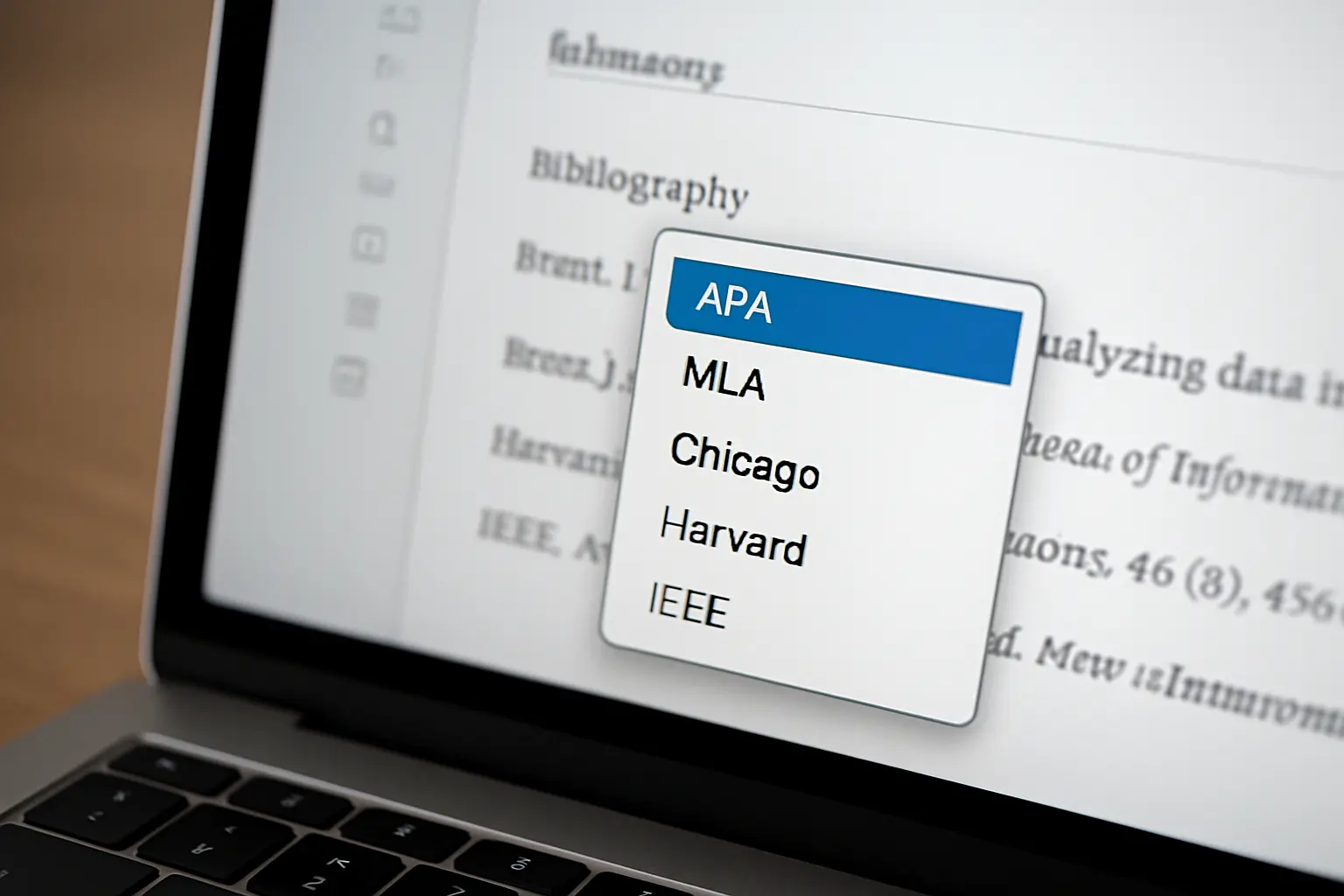
This is the recommendation, and it is not close. A manager stores each source once as structured data — authors, title, journal, volume, year — and renders it into whichever style you select. Switching from APA to IEEE becomes a dropdown rather than a rewrite, and it handles IEEE’s renumbering automatically when you insert a source mid-document.
Where it falls short: it renders whatever metadata you gave it, so a record imported with a missing volume number produces a defective reference in both styles. Check the record, not just the output.
Which manager to pick, and how group libraries work for a team splitting costs, is covered in the ranking of AI and academic writing tools for Philippine thesis groups.
2. IEEE’s own Reference Preparation Assistant
IEEE’s Author Center points authors to a Reference Preparation Assistant that formats a reference list in IEEE style. If your capstone is IEEE and you only have a handful of sources, this is a reasonable second option, and it comes from the style’s own publisher rather than a third party.
Where it falls short: it does one style, so it is useless the moment your programme turns out to want APA, and it does not live inside your document.
3. Free web citation generators
Ranked last, for capstone work specifically. They are convenient, and they routinely produce the errors listed here — publisher locations in APA 7th, hyphens where an en dash belongs, a trailing period after a DOI.
Where it falls short: their IEEE support is markedly weaker than their APA support, and they cannot renumber a document. If you use one, treat its output as a draft to correct rather than a reference to paste.
Two details IEEE users get caught on
Spelling and grammar authorities. The IEEE Editorial Style Manual states that IEEE uses The Merriam-Webster Dictionary for spelling, and directs authors to The Chicago Manual of Style for guidance on grammar and usage its own manual does not cover. That means American spelling in an IEEE-styled document, which is worth knowing if your manuscript is otherwise in British-influenced Philippine academic English.
The guide has a version number. The copy used for this article is version 11.12.2018. Style guides are revised, and a rule quoted here is a rule from that version. If your department requires a specific edition, download the current guide from the IEEE Author Center yourself rather than relying on any secondary account — including this one.
The recommendation
Find your programme’s manual, install one reference manager, enter every source as a structured record the first time you open it, and let the manager render the style.
That single decision removes both of the failure modes described here: it prevents the half-converted list, and it makes the APA-or-IEEE question a two-second change rather than a weekend. It costs nothing, and it is the same recommendation whichever style your department turns out to require.
On the tightest budget, or if you have already written everything by hand: convert the list once, entry by entry, against the source guide rather than from memory, and check the four things the two styles reverse — name order, list order, publisher location and where the year sits.
Keep every source as a record, not a retyped line
Tesify keeps each citation attached to the source you actually opened while you draft, so the reference list is built from records rather than reassembled at the end. Over 9,000 students have used it to write more than 15,000 chapters, and every word is still written by you.
Frequently asked questions
Should a Philippine capstone project use APA or IEEE?
Whichever your programme’s manual requires. Computing and engineering programmes frequently require IEEE while most social science, education, business and nursing programmes use APA 7th, but the manual governing your specific programme is the only authority, and one university can issue different manuals to different colleges.
What is the biggest difference between APA 7th and IEEE?
The reference list order. APA alphabetises by author surname; IEEE numbers entries in the order they first appear in your text. That single difference makes converting between them a restructuring job rather than a reformatting one.
Does IEEE put citation numbers in superscript?
No. The IEEE Reference Guide states that references appear “on the line, in square brackets, inside the punctuation”, and may be treated grammatically as if they were footnote numbers.
How many authors does IEEE list before et al.?
IEEE publications must list all authors up to six names; beyond six, the primary author’s name is followed by et al. In text, et al. is used when three or more names are given.
Do I include the publisher’s city in APA 7th?
No. APA’s own reference guide says plainly not to include the publisher location. IEEE requires the opposite for books, including the country, so this is the field to check first when converting.
Can I mix APA and IEEE in one document?
No. Pick the one your manual requires and apply it consistently, including in figure and table source notes. A mixed document reads as carelessness even where each individual entry is correct.
What happens if I insert a new source into an IEEE list?
Every subsequent number changes, in the list and in every in-text bracket. This is the strongest practical argument for using a reference manager on an IEEE document rather than numbering by hand.
Does IEEE allow uncited references in the list?
The guide states that references need not be cited in the text. Most Philippine research manuals expect every listed source to be cited anyway, so follow your manual rather than treating this as permission.
Which style do I use for the software and datasets in my capstone?
Both styles have specific formats for software, manuals, standards and datasets — IEEE’s guide has separate sections for each. Look up the exact category rather than forcing a piece of software into the book format.
Does the referencing style affect my similarity score?
Only in that a bibliography left inside the check will match other bibliographies, which is meaningless overlap. The style itself does not change what a checker finds.
Where does the reference list sit in a capstone document?
After Chapter 5 and before the appendices in the standard five-chapter arrangement, which is set out in the overview of Chapters 1 to 5. How capstone documentation differs from a thesis overall is covered in the comparison of a thesis and a capstone project.