It is the night before submission, your adviser has returned the manuscript with “fix the references” written across the bibliography page, and the free generator you used produced sixty entries that all look slightly wrong. This is the single most avoidable delay in a Philippine thesis, and it costs groups a submission window every semester.
Here is what free citation generators still get wrong, checked line by line against the American Psychological Association’s own 7th edition reference guide, and how to stop rebuilding the list at midnight.
Keep your references correct from the first source
Tesify attaches each citation to the source you actually read as you draft, so the reference list is built as you write instead of reconstructed the night before. Over 9,000 students have used it to write more than 15,000 chapters.
Why free generators produce wrong APA 7th references
Two structural reasons, and neither is going away.
First, most free generators were built for APA 6th and patched for 7th. The two editions differ in ways that are invisible unless you know to look — the publisher location rule alone changed completely — so a patched tool produces output that reads as APA and fails a careful check.
Second, a generator can only format the metadata it is given. If the source page has no DOI in its metadata, the generator will not invent one; if the journal name is stored in all capitals, it comes out in all capitals. The tool is doing exactly what it was asked. The judgement is yours.
That is why the fix is not “find a better free generator”. It is knowing the seven checks below well enough to run them over any output in ten minutes.
The seven errors, checked against APA’s own reference guide
The rules below come from the American Psychological Association’s Reference Guide for Journal Articles, Books, and Edited Book Chapters, the association’s own instructional aid, last updated 23 March 2026.
1. The publisher location — the single most common carry-over error
APA 7th says of book references: include the name of the publisher followed by a period, and do not include the publisher location. Where there are multiple publishers, separate them with a semicolon.
Wrong (APA 6th habit): Reyes, A. B. (2024). Organisational behaviour in Philippine firms. Quezon City: Rex Publishing.
Right: Reyes, A. B. (2024). Organisational behaviour in Philippine firms. Rex Publishing.
If your reference list still carries city names, your generator is emitting 6th edition output and every book entry needs the same fix.
2. Article titles in title case
For a journal article title, APA 7th says to capitalise only the first letter of the first word; for a two-part title, also capitalise the first word of the second part, plus any proper nouns. The title is not italicised.
Wrong: Santos, M. A. (2024). Study Habits And Academic Performance Among Senior High School Students.
Right: Santos, M. A. (2024). Study habits and academic performance among senior high school students.
Note that “Philippine”, “Filipino” and any institution name stay capitalised — they are proper nouns.
3. Italics in the wrong places
This is the detail generators most often mangle, and APA is precise about it. Capitalise all major words in the periodical name and italicise the periodical name — but not the comma after it. Italicise the volume number. Do not italicise the issue number or its parentheses, and leave no space between the volume number and the opening parenthesis.
Right: Santos, M. A., & Cruz, R. B. (2024). Study habits and academic performance among senior high school students. Philippine Journal of Education Research, 12(3), 45–67.
The italics run from the journal name through the comma and the volume number, then stop before the issue number.
4. Hyphens where an en dash belongs
APA specifies an en dash for the page range, with no spaces around it. Almost every free generator emits a plain hyphen.
Wrong: 45-67 Wrong: 45 – 67 Right: 45–67
Fix all of them at once with a find-and-replace at the end, then check that you have not converted a hyphenated surname by accident.
5. Missing or badly formatted DOIs
APA is unambiguous: include a DOI for all works that have one, formatted as a full https://doi.org/ link, and do not put a period after the DOI. Generators routinely drop the DOI when the source page hides it, and routinely add a closing full stop.
If a work has a DOI and your entry does not show it, add it. A DOI also has a second use worth knowing: resolving a citation by DOI is self-verifying, which is exactly how you check that a reference you were given actually exists.
6. Database names on entries that should not carry them
APA 7th says not to include a URL or database information for works obtained from academic research databases; include a URL only for ebooks from other websites. So an article you downloaded through a university subscription database should carry its DOI, not the database name.
Wrong: … 45–67. Retrieved from EBSCOhost database.
Right: … 45–67. https://doi.org/10.xxxxx/xxxxx
7. Ampersand versus “and” in the text
Not a reference-list rule, but the error that appears most often in Philippine manuscripts. Inside parentheses, use an ampersand: (Santos & Cruz, 2024). In narrative text, spell out the word: Santos and Cruz (2024) found that… Generators format the reference list correctly and leave your in-text citations entirely to you, which is where the inconsistency creeps in. This matters most in the chapter with the highest citation density, which is why it is worth checking as you build your review of related literature rather than afterwards.
The three patterns you should be able to recognise on sight
Straight from APA’s own guide, these are the three structures that cover the overwhelming majority of entries in an undergraduate thesis.
| Source type | Pattern |
|---|---|
| Journal article | Author, A. A., & Author, B. B. (Year). Title of the article. Name of the Periodical, volume(issue), #–#. https://doi.org/xxxx |
| Book | Author, A. A., & Author, B. B. (Copyright Year). Title of the book (7th ed.). Publisher. DOI or URL |
| Chapter in an edited book | Author, A. A., & Author, B. B. (Copyright Year). Title of the book chapter. In A. A. Editor & B. B. Editor (Eds.), Title of the book (2nd ed., pp. #–#). Publisher. DOI or URL |
Two details inside the chapter pattern that generators frequently miss: the editors’ names are not inverted — initials first, then surname — and the edition and page range sit together inside one set of parentheses, edition first, separated by a comma.
APA notes that variations not covered by this guide — in-press articles, articles with article numbers, articles without DOIs, titled volumes, audiobooks — are handled in sections 10.1 to 10.3 of the Publication Manual of the American Psychological Association (7th ed.) and in the Concise Guide to APA Style (7th ed.). If your source does not fit one of the three patterns, that is where to look rather than guessing.
Does your school even require APA?
Check before you spend a night on this. Most Philippine social science, education, business and nursing programmes use APA 7th, but engineering and computing programmes frequently require IEEE instead, and a capstone project in an IT department may be governed by a completely different manual from the thesis handbook the same university publishes for its education college. The wider differences between the two formats are set out in the comparison of a thesis and a capstone project.
Your school’s research manual overrides everything in this article. Where its instruction differs from APA’s, follow the manual and say so if asked.
The real fix: stop generating references at the end
Every problem above comes from the same workflow: read sources for weeks, then reconstruct a reference list from browser history the night before. The metadata is degraded by then, half the DOIs are gone, and you are formatting sixty entries under time pressure.
The alternative is to capture each source once, at the moment you read it, and let the citation travel with the sentence it supports. Concretely:
- Capture the source the first time you open it, with its DOI. Not later.
- Write the two-sentence note immediately — what the study did, and what it did not do. Those notes become your review of related literature.
- Cite as you draft, so no paragraph exists without a traceable source. This matters in every chapter, including the methodology, where an adapted instrument has to trace to a real study — the section-by-section requirements are in the guide to writing Chapter 3.
- Run the seven checks once at the end, over a list that is already 90 per cent correct.
This is what Tesify is built to do. It keeps each citation attached to the source you actually opened while you draft the chapter, so the reference list assembles itself as a by-product of writing rather than as a separate ordeal. You still choose the sources, still read them and still write the argument; what disappears is the reconstruction.
It also removes the failure mode that no formatting check can catch: a reference that does not exist. If every entry in your list traces to a source you opened, there is nothing for an adviser to fail to find. And because the citations are attached from Chapter 1 onward, the promises you make in the significance of the study stay tied to literature you can actually point to.
Build the reference list as you write, not the night before
Tesify drafts your chapters around the sources you actually read and keeps the citation trail intact, so “fix the references” stops being a submission-week emergency. Over 9,000 students have used it to write more than 15,000 chapters, and 100 per cent of the work is still written by you. Current pricing, including what you can do before paying anything, is listed on the Tesify site.
Frequently asked questions
What does Tesify cost in pesos?
Pricing changes and this article does not quote a figure it cannot verify at source. Check the current plans on the Tesify site before you decide, and if you are working in a thesis group, check the terms on account sharing there too rather than assuming.
Is using a citation tool against my school’s academic integrity policy?
Citation formatting tools are standard practice and no Philippine research manual treats correct referencing as misconduct — the opposite, in fact. Policies vary far more on AI-assisted drafting, so read your own school’s rules and ask your adviser directly if anything is unclear. The distinction that matters is whether the research and the argument are yours.
What happens to my thesis data?
Read the privacy terms of any tool before uploading unpublished work, and check whether your school or ethics committee restricts where research data may be stored — this applies to free generators as much as to paid tools. If your study involves identifiable respondent data, that restriction is usually explicit in your ethics approval.
Which free APA citation generator is most accurate?
None is reliably correct without checking, because the errors above are structural rather than tool-specific. Use whichever you like and then run the seven checks. Accuracy comes from the check, not from the tool.
Does APA 7th still require a hanging indent?
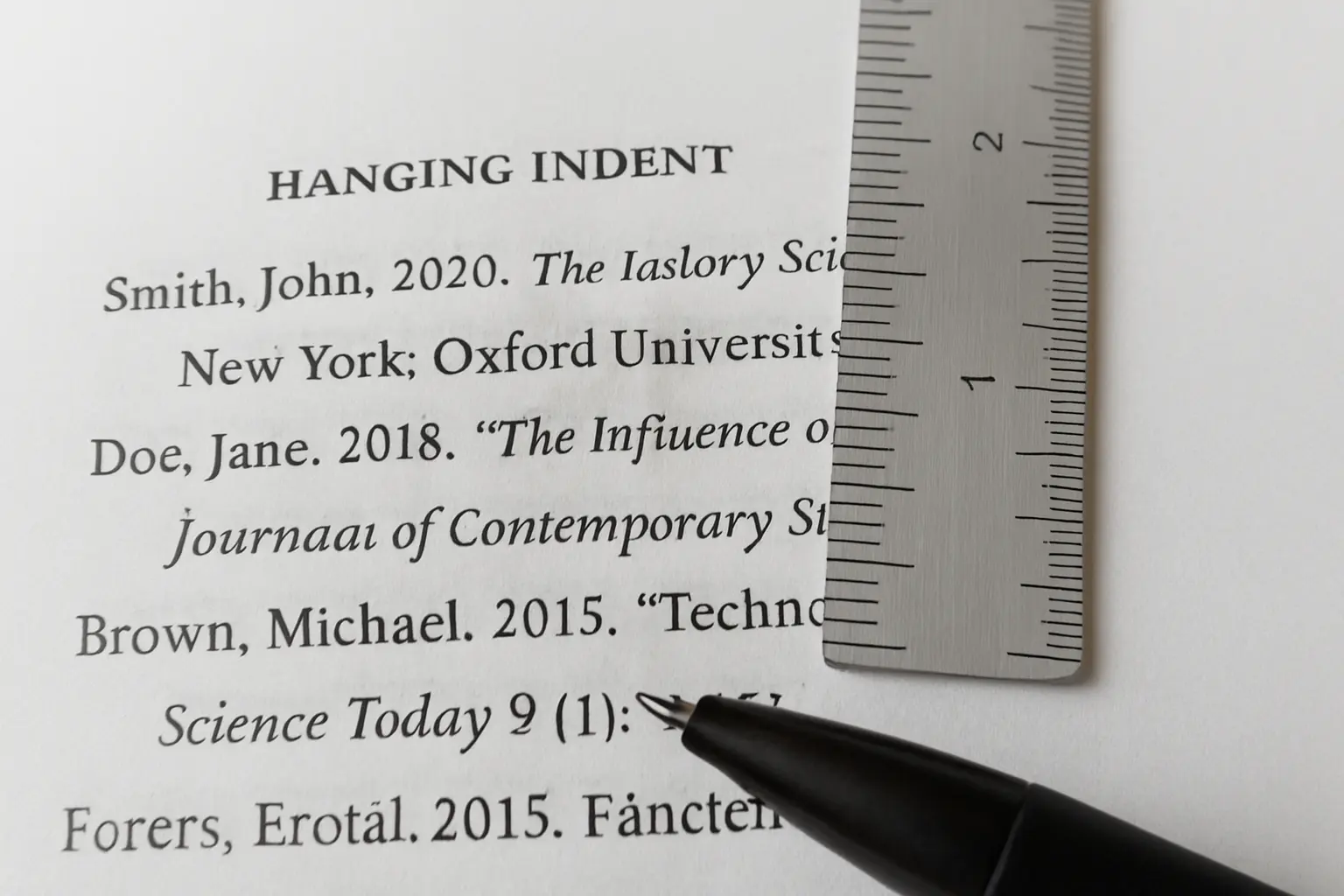
Yes. Every reference entry carries a hanging indent, the list is alphabetical by the first author’s surname and it is double-spaced throughout, like the rest of the manuscript.
How do I cite a Philippine journal with no DOI?
Format it as a normal journal article and simply omit the DOI. APA’s guide says a missing issue number is acceptable too — follow the volume number with a comma and carry on. Do not invent a DOI or substitute a database name.
How do I cite an unpublished thesis from my university library?
This is one of the variations not covered by the basic reference guide; the Publication Manual (7th ed.) handles it. Ask your librarian for the department’s preferred form, because many Philippine research manuals prescribe their own.
My adviser wants APA but my capstone manual says IEEE. Which wins?
The manual that governs your programme, and if the two genuinely conflict, ask your adviser to confirm in writing before you format sixty entries twice.
How many references does an undergraduate thesis need?
There is no national rule; departments set their own expectations, and quality of fit matters more than count. What a panel actually tests is whether each reference is real, relevant and correctly used — and how the whole document fits together is summarised in the overview of Chapters 1 to 5.
What if my reference list is already finished and wrong?
Work through the seven checks in order rather than entry by entry. Publisher locations, en dashes and database names are all find-and-replace fixes across the whole list, which turns a night’s work into about twenty minutes.