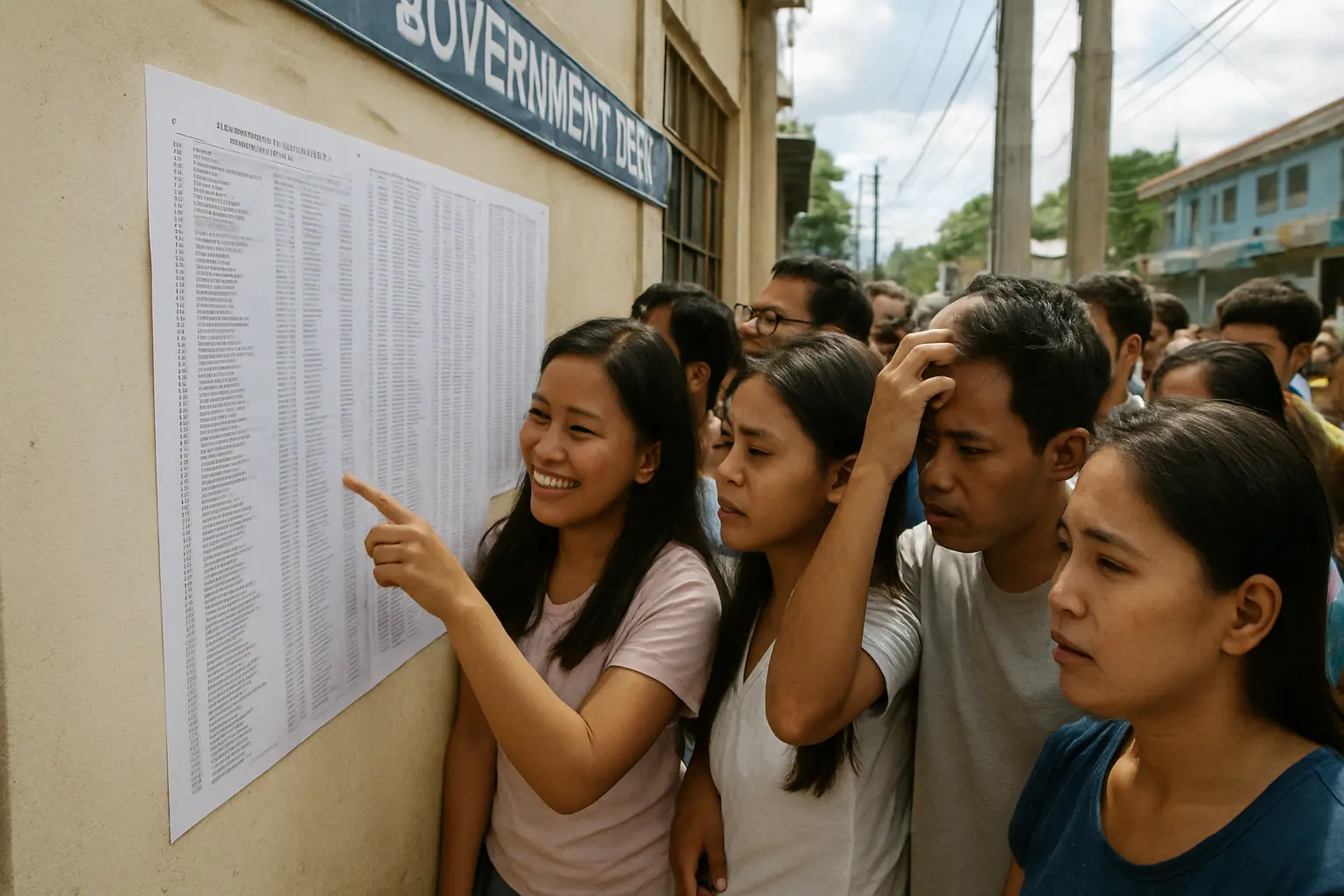
There is no single Philippine board exam passing rate. Across seven licensure examinations whose results the Professional Regulation Commission released between May and August 2026, the pass rate ranged from 36.95 per cent to 91.27 per cent. Anyone quoting “the board exam passing rate in the Philippines” as one number is quoting something that does not exist.
The 2026 figures, board by board
Every row below was taken from the individual result announcement published on the Professional Regulation Commission’s own website, opened directly on 14 August 2026. The pass rate column is computed from the two figures the Commission itself published.
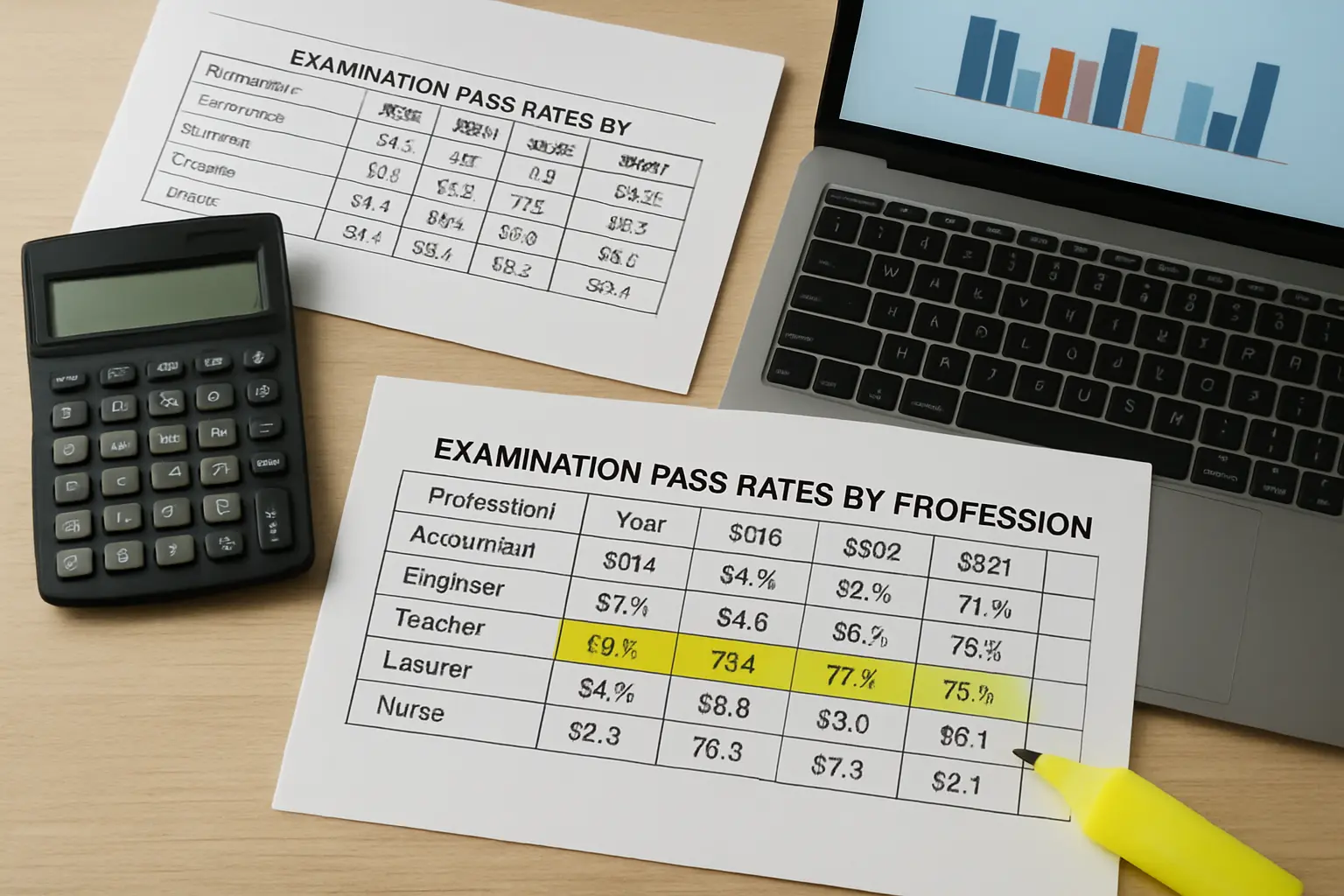
| Licensure examination | Month | Passed / examinees | Pass rate | Results released in |
|---|---|---|---|---|
| Landscape Architects (computer-based) | July 2026 | 115 / 126 | 91.27% | 1 working day |
| Interior Designers | July 2026 | 381 / 432 | 88.19% | 13 working days |
| Master Plumbers | July 2026 | 4,907 / 6,237 | 78.67% | 3 working days |
| Certified Plant Mechanics (computer-based) | August 2026 | 109 / 142 | 76.76% | 4 working days |
| Real Estate Appraisers | July 2026 | 1,060 / 1,456 | 72.80% | 2 working days |
| Mechanical Engineers | August 2026 | 1,362 / 3,686 | 36.95% | 4 working days |
Source: Professional Regulation Commission, individual licensure examination result announcements, prc.gov.ph, accessed 14 August 2026.
The spread is the finding. Mechanical Engineers and Landscape Architects sat examinations in the same season under the same regulator, and their pass rates differ by more than fifty percentage points. A sentence in your Chapter 1 that treats these as instances of one national phenomenon is simply wrong.
Why the rates differ so much
Three structural reasons, and it is worth naming them rather than speculating.
Cohort size. The Landscape Architects examination had 126 examinees; Master Plumbers had 6,237. A small, specialised cohort that has self-selected into a narrow profession behaves nothing like a mass examination, and a percentage computed on 126 people is far more volatile year to year.
Board composition and scope. Each examination is set by its own professional board under its own syllabus. The Board of Mechanical Engineering and the Board of Landscape Architecture are separate bodies setting separate examinations; there is no common difficulty calibration across boards and none is claimed.
Examination format. Two of the six above were computer-based examinations, which is also visible in the release turnaround — the Landscape Architects results came out in one working day against thirteen for Interior Designers.
Trap 1: never pool special professional licensure examinations with domestic sittings
This is the trap most likely to wreck an otherwise sound Chapter 4, and it is invisible unless you read the announcement rather than the headline.
The Commission also administers Special Professional Licensure Examinations for Filipinos abroad, and their cohorts are tiny. The May 2026 Real Estate Appraisers SPLE recorded 2 passers out of 2 examinees — a 100 per cent pass rate. The May 2026 Radiologic Technologists SPLE, given in Singapore and Taipei, recorded that none passed out of 2 examinees — a 0 per cent pass rate.
Both figures are real and both are useless as evidence about anything. A dataset that averages a 2-examinee sitting with a 6,237-examinee sitting produces a number with no meaning. If your study touches licensure outcomes, state explicitly whether SPLE sittings are included, and give the denominator for every rate you report.
Trap 2: the pass rate is not a school performance measure
Students routinely reach for national pass rates as a proxy for institutional quality, and it does not work that way. A national rate aggregates every school, every repeat taker and every first-timer into one figure.
The Commission does publish a “Performance of Schools” listing alongside each examination result, which is the correct instrument if your research question is about institutions. Use that rather than deriving an institutional claim from a national number — and if you use it, say whether you are reading first-time takers or all takers, because the two produce different rankings.
Trap 3: quoting a rate without its month, its board and its denominator
“The board exam passing rate is 78 per cent” is not a citable statement. “The July 2026 Master Plumbers Licensure Examination recorded 4,907 passers out of 6,237 examinees, a pass rate of 78.67 per cent (PRC, 2026)” is.
Three elements are non-negotiable: the examination, the month and year, and the denominator. Drop any one and a panel can ask a question you cannot answer, which is exactly the situation described in the guide to writing Chapter 3, where every figure has to trace to a named source.
What else the result announcements tell you
Two operational facts worth having if your study touches the licensure pathway.
Release turnaround is now measured in working days and published. Across the six examinations above it ranged from one to thirteen working days, and the Commission states the figure in the announcement itself. If your research design assumes a months-long wait between examination and registration, it is out of date.
Registration is moving online. For the August 2026 Mechanical Engineers cohort, the Commission announced that registration for the Professional Identification Card and the Certificate of Registration would be done online starting 15 October 2026. That is a procedural change worth flagging in any study of the transition from graduation to practice.
Each announcement also names the members of the board that set the examination — the Board of Mechanical Engineering examinations in August 2026 were given by Engr. Rodulfo L. Tablante as Chairman with Engr. Manuel L. Paulino and Engr. Ramon F. Solis as members. If your study concerns board policy rather than outcomes, that is where the accountable names are published.
How to build these figures into a thesis
- Pick the boards your study is actually about. A study of nursing graduates has no use for the Master Plumbers figure. Comparison across unrelated professions is rarely a research question; it is usually a padded background section.
- Go to the individual result announcement, not to a news summary. The announcement carries the passer count, the examinee count, the examination centres and the board members, and a summary drops at least one of them.
- Compute the rate yourself and show the division if you report a percentage the Commission did not state. 1,362 ÷ 3,686 = 36.95 per cent is reproducible; a rate with no denominator is not.
- Say which examinations you excluded and why. Excluding SPLE sittings is a defensible methodological choice, but only if you state it.
Where your study needs the population that sits these examinations rather than the outcomes, the enrolment and completion picture is in the guide to Philippine higher education statistics for Chapter 1, and what happens to graduates afterwards is covered in the tracer study data on Filipino graduates. The cost side — including the fact that the free tertiary education law explicitly reaches review class fees — is set out in the article on what RA 10931 actually covers.
Keep every figure attached to its source
Tesify drafts your chapters with citations attached to the sources you actually opened, so a figure in your background section still reconciles with its origin months later when a panelist asks where it came from. Over 9,000 students have used it, and every word is still written by you.
Frequently asked questions
What is the board exam passing rate in the Philippines?
There is no single figure. Across six PRC licensure examinations whose results were released between July and August 2026, pass rates ranged from 36.95 per cent for Mechanical Engineers to 91.27 per cent for Landscape Architects.
Which 2026 board exam had the highest pass rate?
Of those examined here, the July 2026 Landscape Architects computer-based licensure examination, with 115 passers out of 126 examinees, or 91.27 per cent.
Which had the lowest?
The August 2026 Mechanical Engineers Licensure Examination, with 1,362 passers out of 3,686 examinees, or 36.95 per cent.
Where do I find the official result for my own board?
On the Commission’s own results section, where each examination has its own announcement carrying the passer count, the examinee count and the examination centres. Navigate to it from the site rather than guessing a URL.
What is an SPLE and why does it matter for my data?
A Special Professional Licensure Examination administered to Filipinos abroad. Its cohorts can be as small as two examinees, so its percentages are extremely volatile and must never be pooled with domestic sittings without saying so.
How quickly are results released now?
Between one and thirteen working days across the examinations above, and the Commission publishes the turnaround in each announcement.
Can I use pass rates to compare universities?
Not from national figures. Use the Commission’s Performance of Schools listing for that, and state whether you are reading first-time takers or all takers.
Do I need to compute the percentage myself?
Often yes, because the announcements report counts rather than rates. Show the division in your manuscript so a reader can reproduce it.
Are these figures usable for a thesis in any field?
Only if licensure outcomes are genuinely part of your problem. Padding a background section with unrelated professions’ pass rates is the kind of detail a panel asks about and you then have to defend.
How current will these numbers be when I submit?
New results are released continuously, so check for a more recent announcement for your board before you cite. If a newer one exists, cite that one and give its own month and denominator.