Your defense is tomorrow, and the panel includes a PNP officer, a BJMP representative and a criminology faculty member who has failed a title before for a weaker access plan than yours. You have the slides. You have the tables. What you do not have is a rehearsed answer for the questions this specific panel — not a generic thesis panel, a criminology panel — is going to ask. They are not the same questions a psychology or business panel asks, and walking in prepared for the wrong set is how a passable study turns into a rough hour.
Here are the questions Philippine criminology panels actually ask, in the order they usually come up, with what a strong answer sounds like for each. If you have not yet locked in a research design, the choices this panel is about to test you on are covered directly in what research design a criminology thesis should use in the Philippines.
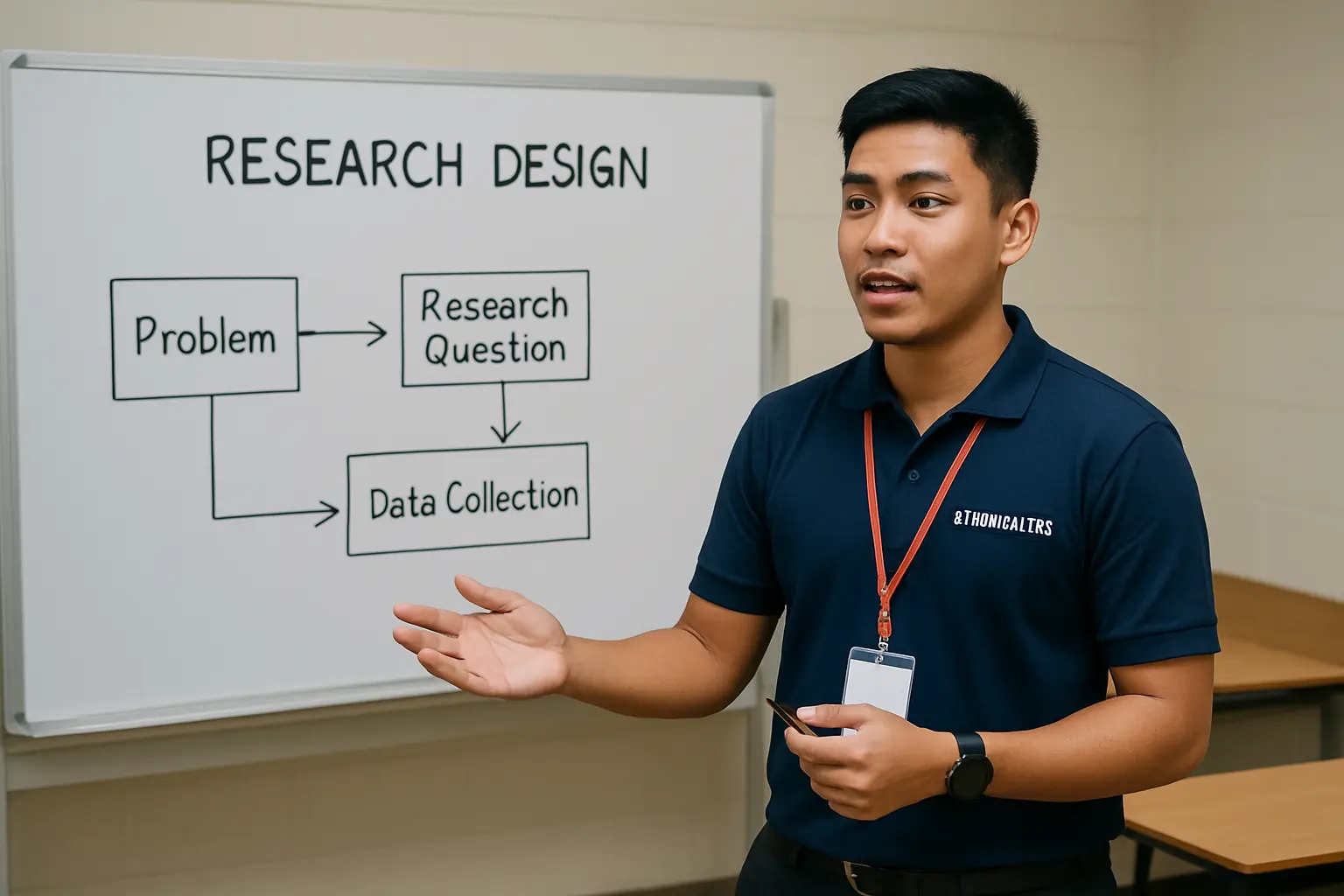
Why did you choose this research design, and not an experimental one?
Almost every undergraduate criminology thesis in the Philippines uses a descriptive-correlational or descriptive-comparative design, because the respondents available — PNP and BJMP personnel, barangay officials, residents of a specific community — suit a survey design and rarely suit anything else; a true experiment with random assignment is almost never realistic given the population and the one-semester timeline. The strong answer names the design, states why the alternative (experimental, longitudinal) was not feasible given the respondents and timeline, and connects the design directly to the sub-problems in Chapter 1: “This study used a descriptive-correlational design because the sub-problems ask whether a relationship exists between [variable] and [variable] among [the specific respondent group], which a correlational design is built to test, and because random assignment to conditions was not ethically or practically available with active-duty personnel as respondents.”
How did you gain access to PNP or BJMP personnel, and what clearance did you secure?
This is the question that separates a well-prepared defense from a shaky one, because access to law enforcement or detention personnel is not casual — it usually requires a formal request letter to the station commander or facility head, sometimes routed through a regional office, plus the school’s own research ethics clearance. State the actual chain: who the letter was addressed to, what it authorised, and any condition attached (a staff member present during survey administration, restricted access to certain records, a time window for data collection). A vague “I asked permission and they said yes” answer signals the access was not properly documented, and panels ask follow-up questions specifically to test whether the paperwork exists.
How do you protect respondent confidentiality, given how sensitive this population’s data is?
Data from PNP or BJMP personnel, or from residents discussing crime victimisation, is sensitive under the Data Privacy Act of 2012 (RA 10173), and a panel expects a specific, not generic, confidentiality answer: how questionnaires were coded rather than named, where raw data is stored, who has access to it, and how long it will be retained before secure disposal. “We assured them of confidentiality” is not a complete answer; “responses were coded by number rather than name, the master list linking codes to respondents is stored separately and only the researchers have access, and all data will be securely deleted after the thesis is graded and archived” is.
Why is your sample limited to one station, city or facility, and how does that limit your findings?
Almost every undergraduate criminology thesis is scoped to one station, one city, or one facility, because that is what a semester and a research-group’s access actually allows — this is not a weakness to hide, it is a delimitation to state plainly. The strong answer names the scope honestly and states what it means for how the findings should be read: “This study’s findings describe [the specific station or city] and should not be generalised to PNP personnel or facilities nationally without further study across additional sites; a different region with different caseloads or resources could show a different pattern.” Naming this limitation yourself, clearly, before the panel raises it, is one of the fastest ways to shorten this line of questioning.
How did you validate your questionnaire, if it was researcher-made?
Where the study used a researcher-made instrument rather than an adopted validated scale, expect a direct question about pilot testing and reliability: how many respondents were in the pilot, separate from the main study sample, and what reliability statistic (commonly Cronbach’s alpha) resulted. If a validated instrument was adapted instead, expect a question about what was changed and why, and whether the adaptation was re-piloted. Either way, have the specific number ready — “the pilot alpha was [your actual result]” — rather than a vague claim that the instrument was tested.
What theory explains why these variables should be related, and who wrote it?
Criminology panels expect a named criminological theory — Routine Activity Theory (Cohen and Felson), General Strain Theory (Agnew), Social Disorganization Theory (Shaw and McKay), Rational Choice Theory, or a similarly established framework — connected explicitly to the study’s own variables, the same theory-to-variable discipline covered generally in what theoretical framework a BEEd or BSEd education thesis should use. A common follow-up question tests whether the student can explain the theory’s actual mechanism, not just its name — be ready to state in one or two sentences what the theory predicts and why it applies to your specific variables, not only that it was cited.
What was your response rate, and did non-response bias your results?
Where surveys were distributed to a larger group than actually responded, expect a question about the response rate and whether non-respondents differ systematically from respondents in a way that could bias the findings — a common issue when surveying on-duty personnel who may skip a survey during a busy shift. State the actual response rate and, if you have any information about it, whether non-respondents appear similar to respondents on the characteristics you can observe (rank, years of service, assignment). If some questionnaires came back incomplete rather than fully unreturned, the panel is also checking whether you handled that honestly rather than quietly padding the dataset, the same issue covered in what to do if your questionnaires come back incomplete.
What statistical test did you use, and why that one specifically?
Expect a direct question naming your test — chi-square, Pearson’s r, a t-test, ANOVA — and asking why it fits your specific variables and their scale of measurement, not a general “it’s the standard test” answer. Be ready to state in one sentence what the test actually checks and why your data qualifies for it (two categorical variables for chi-square, two continuous variables for Pearson’s r, and so on), following the same test-to-variable matching logic covered in what statistical treatment of data a thesis needs. A panel that senses the test was chosen because a classmate used it, rather than because it fits your variables, will keep probing until the mismatch becomes obvious.
How do these findings apply, practically, to the agency or community you studied?
Criminology theses are expected to end with practical, not only academic, implications, and panels often close with a question about what the studied agency or community should actually do differently based on the findings. Prepare one or two concrete, specific recommendations tied directly to the results — not a generic “more training is needed” line, but a recommendation that follows from what the data actually showed. If your findings point toward a specific policy or procedural gap, name it directly rather than gesturing at a vague improvement: “agencies similar to the one studied should review [the specific procedure] given the [specific finding] observed here” reads as a researcher who understood their own results, while a generic call for more resources or more awareness reads as a closing paragraph written to fill space.
Panel members sometimes also ask what surprised the researcher most in the findings, or where the results ran counter to what the literature review predicted — a question testing genuine engagement with the data rather than a scripted conclusion written before the results came in. Answer honestly if a finding was unexpected, and explain what you think accounts for the difference; a defensible, reasoned explanation for an unexpected result reads better to a panel than pretending every finding matched the hypothesis perfectly.
Rehearse your defense answers tonight
Tesify helps you draft clear, specific answers to the access, confidentiality, validity and generalisability questions a criminology panel actually asks, grounded in what your own study actually did — not generic talking points. It has a free tier so you can try it on tonight’s prep, and every answer stays yours to say in your own words at the defense. It supports honest thesis writing, not a script to read from the panel.
Frequently asked questions
Will the panel ask about my research design if I already explained it in Chapter 3?
Yes, almost always, because the panel is testing whether you can explain your own methodological choices out loud, not just whether the chapter reads correctly on paper.
What if I cannot remember my exact Cronbach’s alpha value during the defense?
Bring a printed one-page summary of your key statistics — sample size, response rate, reliability coefficient, key p-values — to glance at if needed; panels generally accept a brief look at your own notes for a specific number, as long as you can explain what it means.
Do all criminology defense panels include a PNP or BJMP representative?
Not always, but many programs invite a practitioner panel member for studies involving law enforcement or corrections respondents specifically, and their questions tend to focus more on access, ethics and practical relevance than a purely academic panel’s.
How do I answer if the panel says my sample size is too small?
State the sample size, the sampling method used to arrive at it, and — if applicable — cite the formula or rationale from Chapter 3 that justified it, then acknowledge honestly if it is a genuine limitation on statistical power rather than arguing it is not.
Is Tesify’s help with defense prep allowed under academic integrity rules?
Tesify drafts answers from your own study’s actual data and decisions — it does not fabricate results or invent access approvals you did not obtain. Check your specific school’s AI policy and disclose assistance where required; using a tool to organise and rehearse your own work’s explanation is different from having someone else answer for you.
How much does Tesify cost?
Tesify has a free tier for students to try before committing to a paid plan; check current pricing in pesos on the Tesify site, since it is adjusted periodically and this article does not repeat a figure that could go stale.
What if the panel asks a question about my topic I genuinely do not know?
Say so honestly rather than guessing — “That is outside what this study measured, but based on the literature I reviewed, I would expect…” is a stronger answer than an invented certainty, and panels generally respect an honest boundary more than false confidence.