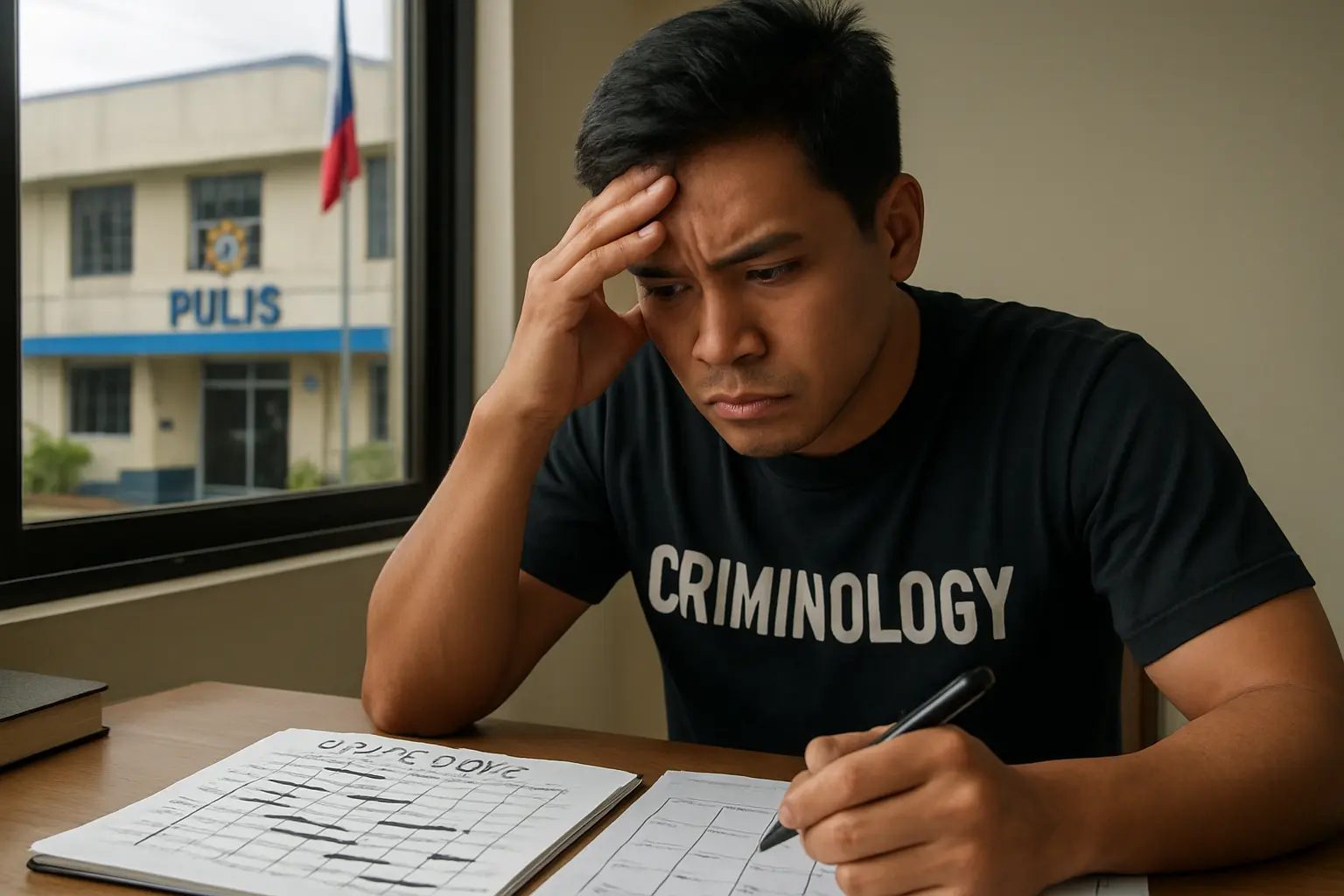
A criminology thesis timeline fails for one predictable reason more than any other: it never accounts for how long PNP, BJMP or barangay clearance actually takes, and by the time the request is filed, the defense date is already too close to survive a delay. Here is a week-by-week schedule built backward from your defense date with that clearance step given real room, plus an illustrative budget worksheet for the costs a criminology thesis specifically runs into.
Why a generic thesis timeline template does not work for criminology
Most generic thesis Gantt templates give data collection one or two weeks, which is realistic for a thesis surveying classmates or an accessible community sample, but not for a criminology thesis whose respondents are PNP or BJMP personnel, barangay officials, or residents of a specific jurisdiction. The site’s own criminology research design guide already establishes why: most BS Criminology theses draw their sample from PNP and BJMP personnel or barangay officials specifically because that is who is available, and access to any of them runs through a formal request letter, an internal approval process, and — this is the step a generic template misses entirely — real institutional processing time that a research office, not the researcher, controls. A timeline that treats this step the same as handing out a survey to classmates is the single biggest reason criminology theses run over schedule.
The timeline, working backward from your defense date
Count backward from the defense date your school has set, not forward from today — working backward is what surfaces whether the plan is actually feasible before it is too late to change course.
- Weeks -16 to -14 (earliest possible start): Finalize the specific station, jurisdiction or facility your study needs, and draft the formal request letter with your adviser’s and, where required, your department’s endorsement attached. A request letter without proper institutional endorsement is one of the most common reasons a clearance request sits unanswered rather than being formally rejected.
- Weeks -14 to -10 (clearance window — the step to protect): Submit the request and wait. This is the step with the least researcher control and the most variance, so it gets the longest buffer in the plan, not the shortest. Follow up politely at a reasonable interval rather than assuming silence means rejection or approval.
- Weeks -10 to -8: Once clearance is granted, finalize and pilot-test your instrument (following the general standard the site’s instrument validation guide covers) so the version that actually goes into the field has already been checked for confusing items.
- Weeks -8 to -6: Data collection itself. Build in a specific contingency day or two for a scheduling conflict on the agency’s side — a training, an operation, a leave period — that can push a planned data-collection day without warning.
- Weeks -6 to -4: Data encoding, cleaning and statistical analysis.
- Weeks -4 to -2: Drafting Chapters 4 and 5, adviser review and revision.
- Weeks -2 to -1: Final formatting, plagiarism and AI-use check, manuscript submission to the panel ahead of the defense per your school’s own lead-time requirement.
- Week 0: Defense.
Sixteen weeks is the illustrative full runway; a criminology thesis with a shorter available window can compress the analysis and drafting phases somewhat, but the clearance window itself is the one phase that should never be the one shortened to make an aggressive schedule fit, since it is the phase over which the researcher has the least direct control. Write the actual calendar dates, not just week numbers, into your own copy of this plan the moment your defense date is confirmed — a plan expressed only in relative week numbers is easy to quietly let slip; one anchored to real dates on a real calendar is not.
If your design is qualitative instead of a survey
A qualitative criminology thesis built on key-informant interviews rather than a questionnaire shifts the timeline’s shape but not its core lesson: the clearance step still comes first and still needs the longest buffer, since an interview request through an agency’s chain of command typically takes at least as long to clear as a survey request, sometimes longer because a specific individual’s schedule now has to be coordinated on top of the institutional approval itself. Where the design also includes a focus group with community members rather than agency personnel, the scheduling constraint shifts to finding a date when enough participants are simultaneously available, which is its own source of delay worth padding for separately from the clearance step.
What to do the moment clearance looks like it will be late
Do not wait until the clearance window has already closed to raise the issue. The moment a follow-up goes unanswered past a reasonable interval, or a contact signals the request is stuck in an internal review queue with no clear timeline, bring it to your adviser immediately — most programs would rather adjust scope early (a smaller respondent group, a different but still accessible jurisdiction, or a design that needs less formal access) than watch a defense date get missed entirely over a clearance delay nobody flagged in time. A criminology thesis that pivots its scope in week six looks far better at defense than one that arrives at week fourteen with no data and an unanswered request letter as its only explanation, the same triage discipline covered in the site’s adviser-deadline triage guide for a different kind of last-minute pressure.
An illustrative budget worksheet
The worksheet below deliberately gives no peso amounts — it shows the categories a criminology thesis typically has to plan for, not a verified national average. Get real quotes from your own local printer, transport provider and any other line item and fill in the last column yourself.
| Category | What it covers | Amount (₱) — from your own quotes |
|---|---|---|
| Request letter and documentation | Printing, notarization if required, photocopies for institutional file | [get a local quote] |
| Transportation to the station or facility | Multiple visits: request submission, follow-up, data collection, possibly a courtesy post-defense visit | [depends on distance and frequency] |
| Respondent tokens | A small token of appreciation where your ethics committee and agency contact consider it appropriate | [confirm what is appropriate first] |
| Printing and reproduction | Questionnaires, consent forms, the manuscript itself across multiple drafts | [get a local printer quote] |
| Statistical software or a paid consultation | If your school does not provide free SPSS or equivalent access | [check your school’s own access first] |
The categories, not the numbers, are the useful part of this table: a criminology thesis specifically needs to budget for repeated institutional visits and possible tokens in a way a classmate-sample thesis usually does not, and forgetting that category is what turns an otherwise-planned budget into a mid-semester scramble. Split the budget by group member from the start rather than assuming one person will cover costs and get reimbursed later — an unclear cost-sharing arrangement is a common source of group friction on a criminology thesis specifically, because the transportation and token costs above tend to be less evenly distributed than costs on a thesis with a simpler, single-visit data collection.

Confidentiality costs, and where they show up in the budget and the timeline both
PNP and BJMP respondents are typically assured confidentiality under the Data Privacy Act, the same standard the site’s criminology defense questions guide covers in the ethics and consent section a panel actually asks about. That assurance has a real cost, not just a legal one: secure storage for any identifying data (a locked drawer, an encrypted file, not a shared class group chat), and a coding system that separates names from responses as soon as data collection ends. Neither is expensive, but both need to be planned before data collection starts, not improvised the night before encoding begins. Build a specific line into the timeline — even fifteen minutes at the end of each data-collection day — to code and file that day’s responses immediately rather than letting a stack of identifiable forms accumulate until the end of the collection period.
Build your timeline and your chapters from your own clearance status
Tesify drafts your background, methodology and defense-prep sections from where you actually are — waiting on clearance, mid-data-collection, or drafting Chapter 5 against a tight deadline — so the plan and the manuscript stay realistic together. Over 9,000 students have used it to write more than 15,000 chapters, and every word is still written by you.
If your defense date genuinely cannot move
Where the sixteen-week runway above is not available because the defense date is closer than that already, the honest triage is: talk to your adviser this week, not next week, about whether the original respondent group is still realistic, and be ready to accept a scope that is smaller but genuinely completable over one that is ambitious but depends on an approval that may not land in time. A criminology panel has seen both outcomes many times — a modest, fully executed study defends far better than an ambitious one still waiting on data the week of the defense.
Frequently asked questions
How long does PNP or BJMP clearance actually take?
It varies by station and by how busy the office is, and no fixed national processing time is published for a thesis request specifically, which is exactly why it needs a buffer rather than a fixed date in your plan; ask the specific station directly and build your timeline around their answer, not a generic assumption.
What if my defense date is fixed and clearance is delayed?
Talk to your adviser as soon as a delay looks likely, not after it happens; many programs allow a scope adjustment (a smaller or different accessible respondent group) rather than a full timeline extension, but that decision needs to be made with enough runway to still execute it.
Do I need to pay respondents or give tokens?
Not always required, but a small token of appreciation (school supplies, a snack, a modest gift certificate) is common practice for PNP, BJMP or barangay respondents giving their time during work hours; check what your ethics committee and your specific agency contact consider appropriate before budgeting for it.
Are there official budget figures for a criminology thesis?
No. This article deliberately gives no peso amounts — the worksheet shows the categories a criminology thesis budget typically has to plan for, not a verified national average; get actual quotes for printing, transportation and any other line item from your own local providers before finalizing your budget.
Can I start drafting my manuscript while still waiting on clearance?
Yes, and you should — Chapters 1 to 3 (background, review of related literature, methodology) can all be drafted before a single respondent is reached, so the clearance wait is not dead time if you use it to get the rest of the manuscript ahead of schedule.