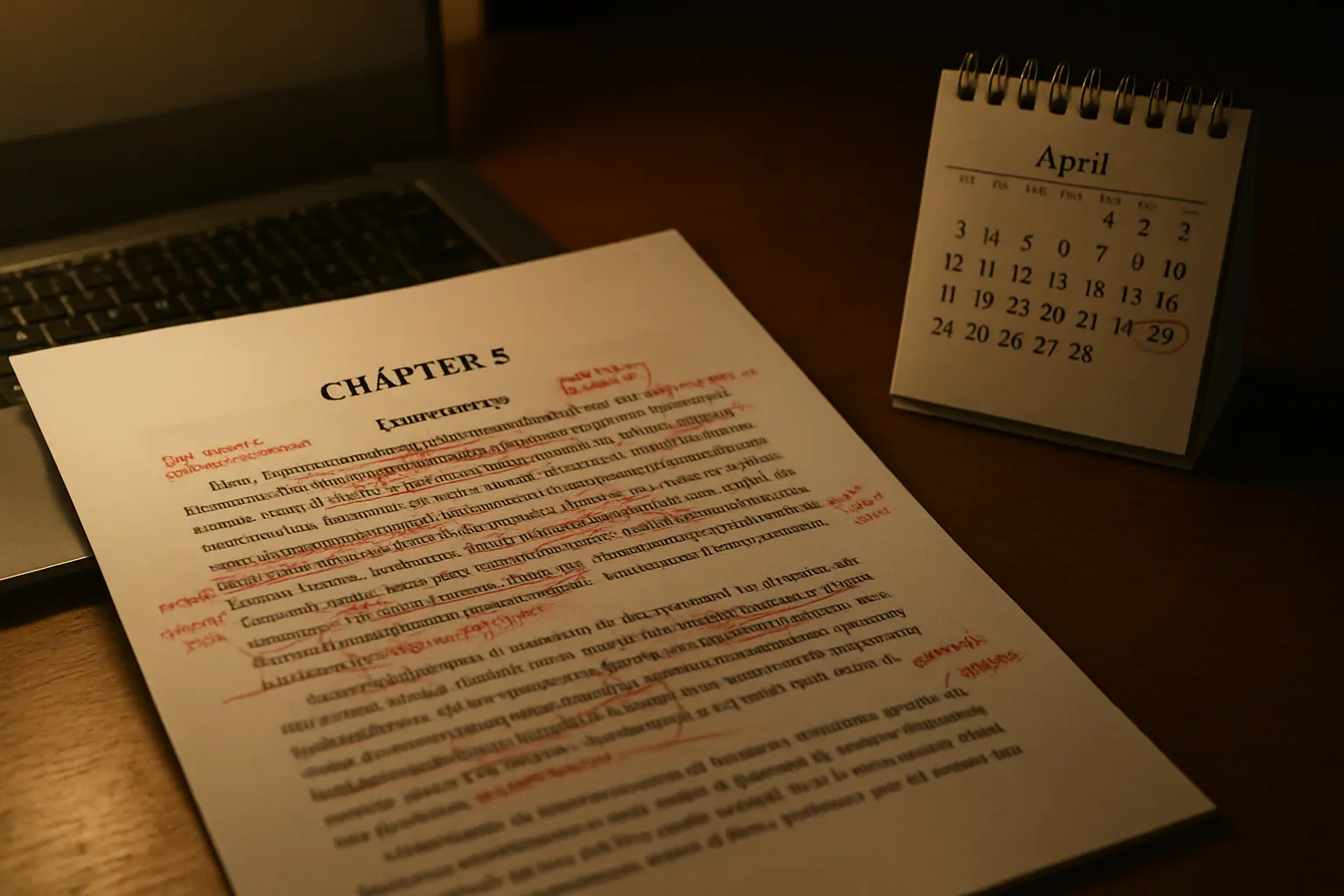
It is Friday afternoon. Chapter 4 comes back from your adviser with comments down every page, a note at the top that says “revise and resubmit”, and a deadline of Monday. The analysis is done. The tables exist. And somehow the chapter is still wrong.
The instinct is to open the file and start fixing things from the top. Do not. A weekend is enough time to rewrite a results chapter properly, but only if you spend the first half hour deciding what actually has to change — because adviser comments on a Chapter 4 fall into four categories that cost wildly different amounts of time, and one of them can eat the entire weekend on its own.
First: triage, before you edit anything
Take the marked-up copy and a blank page. Write every comment down as a single line, then tag each one with the category it belongs to. Thirty minutes, no editing, no defending.
You are looking for one thing above all: is there a comment that requires you to re-run the analysis? If there is, it goes first, because everything else in the chapter depends on numbers that are about to change. Rewriting an interpretation paragraph on Friday night and then re-running the test on Saturday means writing that paragraph twice.
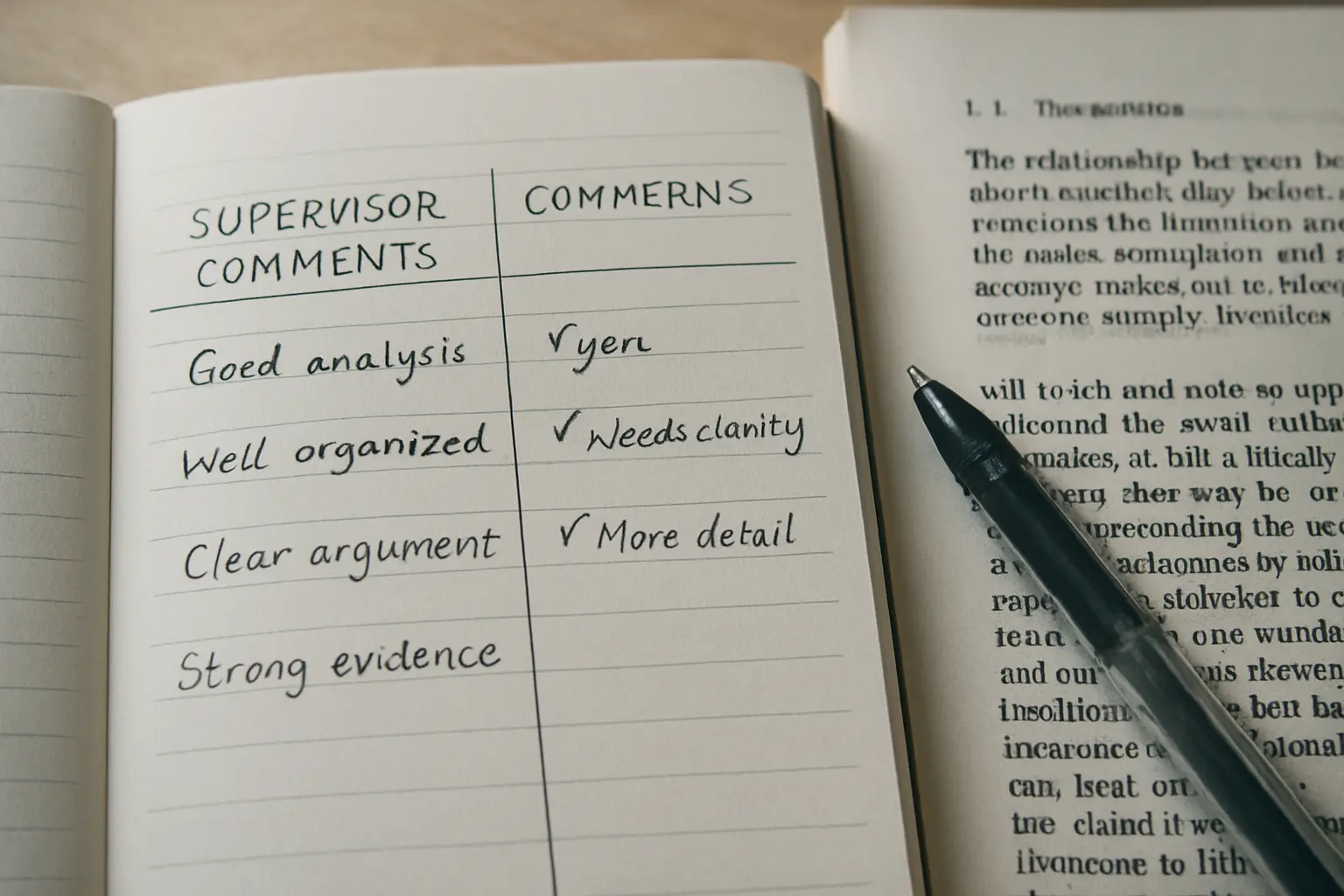
The four kinds of comment, and what each one costs
1. Presentation fixes — minutes each, and there will be many
Decimals, italics, table titles, a missing standard deviation, a leading zero that should not be there. These are the comments students find most demoralising and they are the cheapest to clear. Most of them come from a small set of rules that APA publishes: means and standard deviations from an integer scale such as a Likert questionnaire go to one decimal place, correlations and inferential statistics to two, and a statistic that cannot exceed 1 — a p value, a correlation, a proportion — takes no leading zero. So r = .42 and p = .03, never 0.42.
Clear these in one pass with find-and-replace where you can. Do not do them one at a time as you scroll.
2. Interpretation gaps — an hour each, and this is usually the real complaint
“So what?” in the margin. “Expand.” “Where is the discussion?” These mean the paragraph under the table describes the table instead of interpreting it. The fix is structural rather than cosmetic: every paragraph under a table needs three moves — state the finding, say what it means in your setting, then connect it to one named study from Chapter 2.
The third move is the one that is almost always missing, and it is why an adviser says a discussion is “thin”. The full pattern, with a worked paragraph, is in the guide to writing Chapter 4 table by table.
3. Reconciliation defects — quick to fix, fatal if left
Your respondent count reads 326 in Chapter 3 and 331 in a table header. A tool appears in Chapter 4 that your statistical treatment section never named. A table has no number, or is never referred to in the text.
Each of these takes minutes, and each of them is the kind of thing a panel finds in the first ten seconds. Fix the source of truth first — usually Chapter 3 — then propagate. If a tool changed, Chapter 3 has to change with it, not just Chapter 4.
4. Re-run the analysis — half a day, and it goes first
“Did you test for normality?” “Why a t-test here?” “This should be Spearman.” These are not writing comments. They send you back to your data file.
The good news is that the substitutions are mechanical once you know which one you need: Mann-Whitney U for an independent-samples t test, Kruskal-Wallis for a one-way ANOVA, Spearman’s rho for Pearson’s r. Which applies, and how to read the normality output that decides it, is set out in what to do when your data is not normally distributed, and the menu paths are in the guide to analysing thesis data in SPSS step by step.
Re-running a test takes ten minutes. Rewriting everything downstream of it takes the rest of the day, which is exactly why it goes first.
The weekend, in the order that works
- Friday, one hour. Triage. Then, if an analysis has to be re-run, open the data file and re-run it. Do not write anything yet.
- Saturday morning. Rebuild any table whose numbers changed, then fix all the reconciliation defects. Fix the N everywhere it appears, including the abstract.
- Saturday afternoon. The interpretation paragraphs, one table at a time, three moves each. This is the slowest work and it deserves your best hours, not your last ones.
- Sunday morning. Presentation pass. Decimals, italics, table anatomy, leading zeros, every table referred to in the text.
- Sunday afternoon. Read the chapter aloud once, end to end, then answer your own triage list line by line and mark each comment addressed.
The last step is not optional and it is the one groups skip. An adviser who finds three of their comments unaddressed stops reading and sends it back, and you have spent the weekend to buy another week of delay.
Where an AI thesis editor genuinely helps, and where it does not
This is worth being precise about, because the honest boundary is narrower than the advertising and wider than most advisers assume.
It cannot do the part that matters most. It cannot know why your lowest-rated indicator is lowest, because that answer lives in your setting — your College’s practicum sequencing, your barangay, your respondents. Move two of the interpretation paragraph is yours and nobody else can write it. It also cannot tell you which study from your Chapter 2 to compare a finding against, because it has not read your Chapter 2 the way you have, and a fabricated citation in a revision is far worse than the original defect.
It also cannot re-run your analysis. Your numbers come from your data file. Anything that hands you statistics you did not compute is handing you a problem you will meet again at the defence, when you are asked what software produced them.
What it is good at is structure and consistency — holding the chapter in the shape your research manual expects, keeping each citation attached to the source you actually opened, and making sure the respondent count and the tool names stay identical everywhere they appear. That is precisely the category-three work above, and it is the work that is boring, mechanical and easy to get wrong at midnight.
The distinction between a tool that structures your writing and one that claims to produce the manuscript for you is set out at length in the guide to what an AI thesis maker can and cannot do, and what your school says about it. Whatever you use, check your own institution’s policy first and declare use where it is required.
The reply to send when you resubmit
Do not resubmit the file on its own. Send it with a short note that maps your changes to the comments, because it converts a re-read into a check.
“Good morning [adviser]. Attached is the revised Chapter 4. Summary of changes: the test for Problem 3 was re-run as Mann-Whitney U after the Shapiro-Wilk result, and Table 5 and its discussion are rebuilt accordingly; the respondent count is now 326 throughout, including the abstract; each table now carries a discussion paragraph comparing the finding with a study from Chapter 2; and the decimal and p-value formatting follows APA 7th throughout. The two comments I was unsure about are noted at the end of the file. Thank you.”
Three sentences, no defensiveness, and it names the changes in the order the adviser will look for them. If you disagreed with a comment, say so there in one line with a reason, rather than silently ignoring it and hoping.
And keep the triage list. The same comments recur in Chapter 5, and several of them will come back as questions at the defence — the standard inventory is in the guide to what panels ask during a thesis defense.
Turn a weekend of revisions into an evening
Tesify holds your chapters in the structure your research manual expects and keeps every citation attached to a source you actually opened, so a respondent count changes in one place and a rebuilt table does not break the three chapters around it. Over 9,000 students have used it to write more than 15,000 chapters, and every word is still written by you.
Frequently asked questions
My adviser wants Chapter 4 rewritten by Monday. Is that realistic?
Usually yes, if you triage first. Presentation fixes take minutes, interpretation paragraphs take about an hour per table, and only a re-run of the analysis is genuinely expensive. Identify which category each comment belongs to before you edit a single line.
What does my adviser mean by “expand the discussion”?
Almost always that the paragraph under the table describes the numbers instead of interpreting them, and that it never compares the finding with a study from Chapter 2. Add the comparison and the comment usually disappears.
Do I have to re-run my statistics if the adviser questions the test?
If the question is about an assumption you never checked, yes — and do it before rewriting anything, because every paragraph downstream depends on the result. The substitution itself is mechanical and takes minutes in SPSS.
Can an AI thesis editor rewrite Chapter 4 for me?
It should not, and the parts that matter most it cannot. Interpreting a finding in your own setting and choosing which study to compare it against require knowledge of your data and your Chapter 2. Use a tool for structure, consistency and citation integrity, and write the interpretation yourself.
What if I disagree with one of the comments?
Say so in one line when you resubmit, with a reason. Advisers accept a reasoned disagreement far more readily than a comment quietly ignored, and an unaddressed comment is the fastest route to a second round of revisions.
What should I fix first if I only have one evening?
Reconciliation defects. A respondent count that differs between chapters, or a tool in Chapter 4 that Chapter 3 never named, costs you credibility on everything else and takes only minutes to correct.
How many decimal places should the numbers have?
One for means and standard deviations from a Likert scale, two for correlations and inferential statistics, and two or three for an exact p value, with p < .001 below that. Statistics that cannot exceed 1 take no leading zero.
Should I resubmit only the chapter or the whole manuscript?
Send what your adviser asked for, but check the rest of the manuscript for anything your revision changed. A corrected respondent count that appears in Chapter 3 and the abstract has to be corrected there too, even if only Chapter 4 was returned.
My groupmates are not responding. Do I rewrite it alone?
Do the work that cannot wait, keep a record of who did what, and tell your adviser the truth about the division of labour if asked. What you should not do is let the deadline pass while waiting for a reply in a group chat.
Is a rewrite request a bad sign?
No. Advisers return chapters they intend to approve. A chapter that comes back with detailed comments is one somebody read carefully, and detailed comments are far easier to act on than “needs work”.