The covered-transaction threshold that triggers a Philippine bank’s anti-money-laundering report was lowered from four million pesos to five hundred thousand pesos by Republic Act No. 11521 in 2021 — a fact that dates any forensic accounting thesis still citing the older four-million threshold from the original 2001 law. The topics below are built around the current version of every statute and framework named, each phrased as a researchable question with a suggested design.
The Legal Framework Every Topic Below Sits Inside — Current as of This Writing
| Law | Year | What it currently does |
|---|---|---|
| RA 9160, Anti-Money Laundering Act | 2001 | Original law; created the Anti-Money Laundering Council (AMLC), chaired by the BSP Governor with the Insurance Commissioner and SEC Chairman as members |
| RA 10365 | 2013 | Expanded predicate crimes (intellectual property violations, photo voyeurism, child pornography, wildlife offenses) and covered persons (jewelry dealers, company service providers); confirmed lawyers and accountants acting as independent legal professionals remain excluded from disclosure duties that would compromise client confidences |
| RA 11521 | 2021 | Current covered-transaction thresholds: ₱500,000 general threshold, ₱5,000,000 for casinos, ₱7,500,000 for real estate; added real estate developers/brokers and offshore gaming operators as covered persons (offshore gaming was later banned outright by Executive Order No. 74 in 2024 and the Anti-POGO law of October 2025); added tax crimes with deficiency basic tax exceeding ₱25,000,000 as a predicate offense |
Every topic naming AMLA below assumes the RA 11521 thresholds above, not the original 2001 figures — a thesis that cites “four million pesos” as the current covered-transaction threshold is citing a superseded law, and a panel that has read the amendment will catch it immediately.
30 Forensic Accounting Thesis Topics, Grouped by Research Angle
AMLA compliance and covered-institution behavior (RA 9160, RA 10365, RA 11521)
- How do rural banks in a specific province implement the ₱500,000 covered-transaction reporting threshold introduced by RA 11521, compared to their reporting practices under the original 2001 threshold?
- What compliance gaps exist among newly covered real estate developers and brokers under RA 11521’s expanded covered-persons list?
- How has the addition of large-scale tax deficiency (above ₱25,000,000) as a predicate crime under RA 11521 changed internal audit practice in accounting firms serving high-net-worth clients?
- What is the awareness level of the lawyer-accountant privileged-communication exception under RA 10365 among newly licensed CPAs?
- How do cooperatives, which are not always classified as AMLC-covered institutions, manage money-laundering risk in the absence of a direct RA 9160 reporting obligation?
Fraud theory and detection (Cressey’s fraud triangle, COSO)
- To what extent does Cressey’s (1953) fraud triangle — pressure, opportunity, rationalization — explain employee-perpetrated asset misappropriation in Philippine small and medium enterprises?
- How does the adoption of the COSO Internal Control–Integrated Framework relate to the incidence of reported internal fraud in Philippine cooperative banks?
- Which element of the fraud triangle (pressure, opportunity, or rationalization) is most frequently cited by internal auditors as the primary driver in documented fraud cases within a specific industry?
- How effective are whistleblower mechanisms, as a COSO monitoring-component control, in surfacing fraud in Philippine local government units?
- What internal-control weaknesses recur most often in COA-flagged local government audit findings, mapped against the five COSO components?
Government audit and public-sector accountability (Commission on Audit)
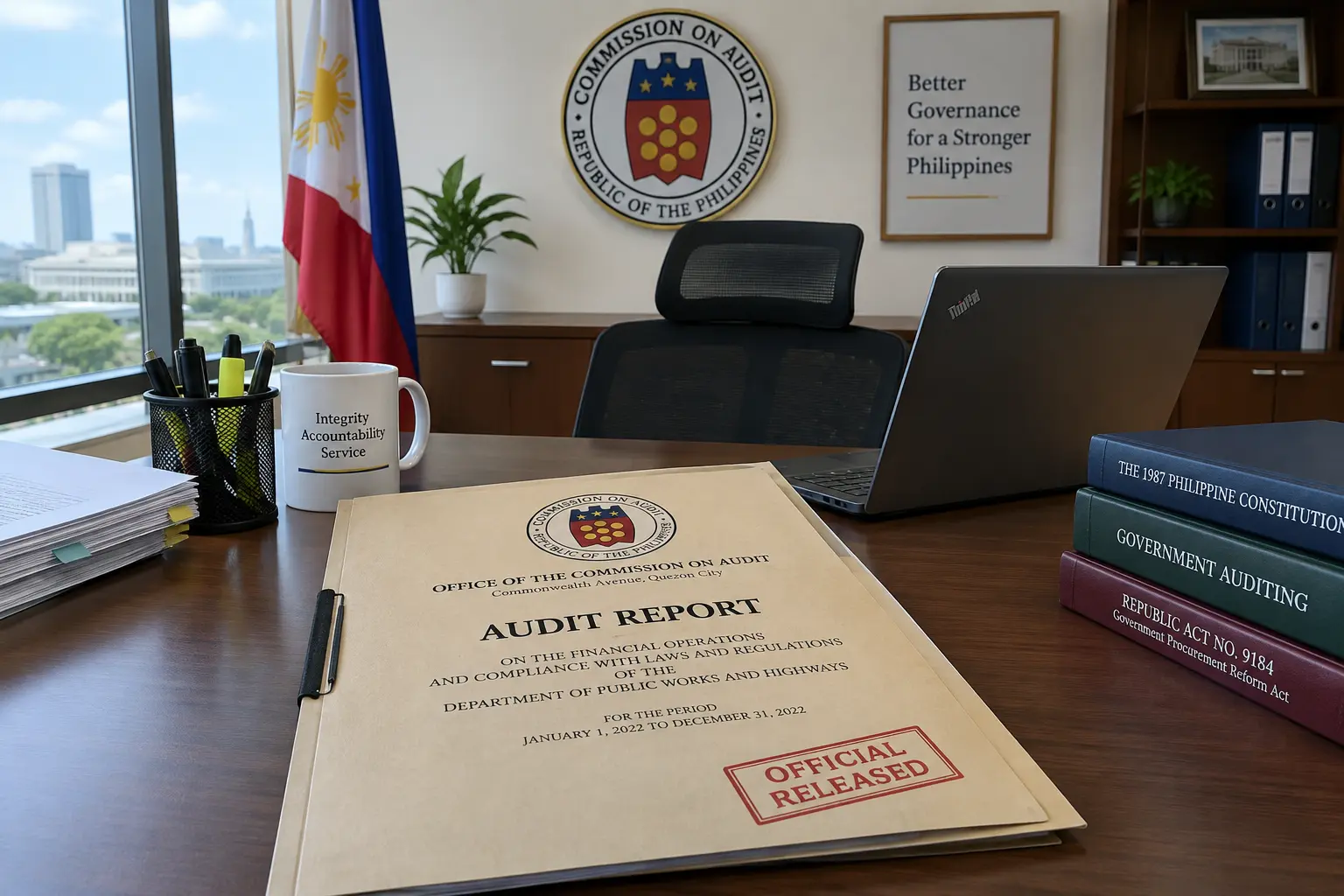
- What categories of audit observations recur most frequently in the Commission on Audit’s annual audit reports for a specific class of local government unit?
- How do local government units respond to COA disallowances over a multi-year period, and what factors predict a disallowance being lifted on appeal?
- What is the relationship between a local government unit’s internal audit function maturity and the number of COA findings it receives?
- How does RA 3019 (Anti-Graft and Corrupt Practices Act) liability exposure factor into a public accountant’s professional judgment when certifying government financial statements?
- What forensic accounting techniques are most commonly applied by COA auditors when investigating a flagged irregularity, based on published COA circulars and audit methodology guidance?
Digital forensics and financial technology fraud
- What data-recovery and chain-of-custody procedures do Philippine forensic accountants apply when investigating fraud committed through e-wallet or online banking platforms, and how do these align with RA 10173 (Data Privacy Act) requirements?
- How has the growth of QR-code-based payment fraud changed the skill set forensic accounting practitioners report needing?
- What red flags in transaction-pattern data are most associated with layering behavior in digital remittance channels, based on published AMLC typology reports?
- How prepared are small accounting firms to investigate cryptocurrency-related fraud, given the absence of cryptocurrency-specific predicate crime language in RA 11521?
- What role does data privacy compliance under RA 10173 play in constraining or enabling a forensic accountant’s digital evidence-gathering process?
Professional practice, ethics, and CPA licensure
- How prepared do newly licensed CPAs in the Philippines feel to conduct a forensic accounting engagement, based on their board-exam and university curriculum exposure to fraud examination?
- What ethical dilemmas do practicing forensic accountants report when a client relationship conflicts with a suspicious-transaction reporting obligation?
- How does exposure to forensic accounting coursework at the undergraduate level relate to career interest in fraud examination as a specialization?
- What continuing professional education gaps exist among practicing CPAs regarding the RA 11521 amendments, five years after the law’s passage?
- How do external auditors distinguish their statutory audit responsibilities from a forensic accounting engagement when a client requests both, and where does confusion between the two roles most often occur?
Sector-specific and comparative studies
- How does fraud risk differ between listed and non-listed Philippine companies, based on publicly available Securities and Exchange Commission enforcement actions?
- What internal control weaknesses are most associated with cooperative fund misappropriation cases reported to the Cooperative Development Authority?
- How do microfinance institutions balance financial inclusion goals against the compliance burden of AMLA covered-transaction reporting for small, frequent transactions?
- What forensic accounting practices are used by Philippine insurance companies to detect fraudulent claims, and how do these relate to Insurance Commission reporting requirements?
- How did the offshore gaming sector’s covered-person status under RA 11521, followed by the 2024 executive ban and the 2025 Anti-POGO law, change the anti-money-laundering and audit work of accounting firms that had serviced the sector?
How to Turn One of These Into a Real Chapter 1
Each topic above is written as a research question, not a finished thesis — your Chapter 1 still needs a specific locale, timeframe, and population before it is defensible. A topic like #7 (“COSO adoption and internal fraud incidence in cooperative banks”) becomes concrete once you name the specific cooperative banks or region you can actually access, the specific years of audit data you can obtain, and whether your access is through published COA reports, a survey of internal auditors, or both. Never present a topic from this list as pre-approved by any institution; it is a starting point for your own statement of the problem, scoped to what you can realistically investigate and access.
Sample Size and Access: The Question That Kills More Forensic Accounting Topics Than Any Other
Before committing to a topic above, ask a blunt access question: who will actually respond to your survey or agree to an interview, and how many of them realistically exist within reach of your timeline? A topic naming “internal auditors in Philippine cooperative banks” sounds specific until you try to find a sampling frame — there may be no public directory, and cooperative banks may treat internal audit staffing as sensitive information they will not release to a student researcher. Where a full population count is not publicly available, a purposive or snowball sampling approach with a clearly stated rationale is the realistic substitute, but say so explicitly in Chapter 3 rather than presenting an unreachable population as if a full census were attempted. Topics built entirely around published COA reports or public SEC enforcement actions (11, 12, 26) avoid this problem entirely, since the data source is already public and does not depend on a practitioner agreeing to be interviewed.
A Word on What This List Deliberately Avoids
None of the topics above assume access to real client names, real case files, or unpublished investigation details — forensic accounting theses at the undergraduate and most graduate levels work from published regulatory frameworks, publicly available enforcement actions and audit reports, and researcher-collected survey or interview data from practitioners, not from confidential client engagements you would need professional access to conduct. If your program expects an actual case-file-based forensic engagement, that access arrangement needs to come from your internship placement or a named cooperating firm, documented with its own consent and confidentiality agreement — a separate process from choosing a topic off a public list like this one.
Where This Fits With the Rest of Your Thesis
Once you have picked a topic, the Chapter 3 table structure that operationalizes your variables follows the same format shown in our BSA accountancy thesis consistency matrix, filled in, and the choice of statistical test for your specific hypothesis is covered in statistical treatment for a BSA accountancy thesis. If your topic touches multiple business disciplines at once — accounting fraud intersecting with criminology’s investigative angle — the criminology thesis topics guide covers the crime-data side of that intersection from the other discipline’s angle. And for the shared theoretical grounding many accountancy topics above draw on, theoretical framework examples by course shows how the fraud triangle and COSO framework are typically presented in a Philippine accountancy Chapter 2.
Where Tesify Fits
Once you have narrowed one of these topics to your own locale and access, Tesify turns your specific research question into a properly structured statement of the problem, objectives, and significance of the study.
Turn a topic from this list into a full Chapter 1
Tesify drafts your statement of the problem, objectives, and significance of the study once you have chosen and scoped your specific forensic accounting topic — over 9,000 students have used it to write more than 15,000 chapters, and every word is still written by you.
Frequently Asked Questions
- Is the AMLA covered-transaction threshold still four million pesos?
- No. RA 11521 (2021) changed the general threshold to ₱500,000, with separate thresholds of ₱5,000,000 for casinos and ₱7,500,000 for real estate transactions. A thesis citing the original 2001 figure is citing a superseded provision.
- Do I need access to real fraud case files to write a forensic accounting thesis?
- No. Most undergraduate and many graduate forensic accounting theses use published regulatory frameworks, public enforcement actions, COA audit reports, and researcher-collected survey or interview data from practitioners, rather than confidential client case files.
- Who created the fraud triangle theory?
- Donald R. Cressey, in his 1953 study of embezzlers, is credited with the fraud triangle theory (pressure, opportunity, rationalization) — not the AICPA, which later incorporated the concept into professional auditing standards.
- Can I study cryptocurrency fraud under the current AMLA framework?
- You can study it as a topic, but note in your thesis that RA 11521 does not yet contain cryptocurrency-specific predicate-crime language, which is itself a legitimate research angle — how existing law is or is not being applied to a newer transaction type.
- Are lawyers and accountants required to report suspicious transactions from their clients?
- RA 10365 confirms that lawyers and accountants acting as independent legal professionals are excluded from disclosure obligations that would compromise client confidences or the attorney-client relationship, within the scope the law defines — check the exact provision and consult your adviser on how it applies to your specific topic.
- What is the difference between a statutory audit and a forensic accounting engagement?
- A statutory audit expresses an opinion on whether financial statements are fairly presented according to accounting standards. A forensic accounting engagement investigates a specific suspected irregularity with a view toward evidence that could support legal or disciplinary action — a narrower, more investigative scope than a general audit.