| Tool | Free tier | Where it runs | Catches structural grammar | Catches Philippine academic register | Verified price |
|---|---|---|---|---|---|
| LanguageTool | Yes, and a free public checking API | Browser add-on, Word, Google Docs, LibreOffice, macOS, Windows | Yes — tested below | Almost none — tested below | Not readable at source |
| Grammarly | Yes — “Write without mistakes”, tone display, 100 AI prompts | Browser, desktop, mobile, Docs | Documented, not testable without an account | Not documented as a feature | €12 EUR/month Pro, quoted in euros |
| Microsoft Editor | Yes, inside Word and Outlook | Word, Outlook, Edge | Yes, plus a formality setting | No | Bundled with Microsoft 365 |
| Hemingway Editor | Web editor free; Plus is a paid trial | Web, desktop app | Readability and sentence length, not grammar rules | No, but it exposes padding | Not readable at source |
| ProWritingAid | Limited free checks | Browser, Word, Docs, Scrivener | Yes, with long reports | No — now positioned for fiction | Not readable at source |
| Tesify | Yes | Web, inside the chapter you are writing | Yes | Partly — it works on the section, not the sentence alone | See the Tesify site |
Feature columns read from each tool’s own published pages on 23 August 2026. The “Philippine academic register” column for LanguageTool was measured directly against its public API on the same day; every other tool in that column is marked from documentation, because none of the others exposes a public endpoint that can be tested without an account.
The recommendation, stated plainly: install LanguageTool, because it is free, works offline-friendly through an add-on and catches real agreement errors. Then stop expecting any of these tools to fix the marks your adviser actually writes. The measurement below is why.
The test, and what it found
LanguageTool publishes a free proofreading endpoint at api.languagetool.org/v2/check, documented as the only public endpoint, rate-limited to 20 requests per IP per minute and 20KB per request, with the warning that “this is a free service, thus there are no guarantees about performance or availability”. Twelve sentences of the kind that appear in Philippine thesis drafts were sent to it on 23 August 2026, with language=en-US.
| Sentence sent | What the checker returned |
|---|---|
| “The respondents was composed of 210 senior high school students.” | Caught. Agreement error, suggested “were”. |
| “The study will discuss about the effect of time management…” | Caught. Collocation error, suggested “discuss the”. |
| “Based on the data gathered, majority of the respondents is female.” | Half caught. Flagged the missing article and suggested “the majority of” — and said nothing about “is”, which is the actual error. |
| “The researchers were able to cope up with the demands of the study.” | No match. |
| “The findings result to a significant improvement in engagement.” | No match. |
| “As per the research manual, the questionnaire will be validated…” | No match. |
| “The researcher conducted the study last May 2026…” | No match. |
| “…the relationship of the said variable to their academic performance.” | No match. |
| “Kindly refer to Table 4 for the summary of the weighted means.” | No match. |
| “According to Dela Cruz (2023), she stated that engagement was moderate.” | No match on the error. The only flag was the surname, marked as a spelling mistake. |
| “The result of the study will be beneficial to the students, teachers and future researchers.” | No match. |
| “This study will determine the level of… and it will also determine the relationship of the said variable…” | No match. |
The two caught sentences matter as much as the ten misses: they prove the endpoint was live and responding at the moment of the test. A table of ten silent results with no positive control would prove nothing at all.
Why the misses are all the same kind of miss
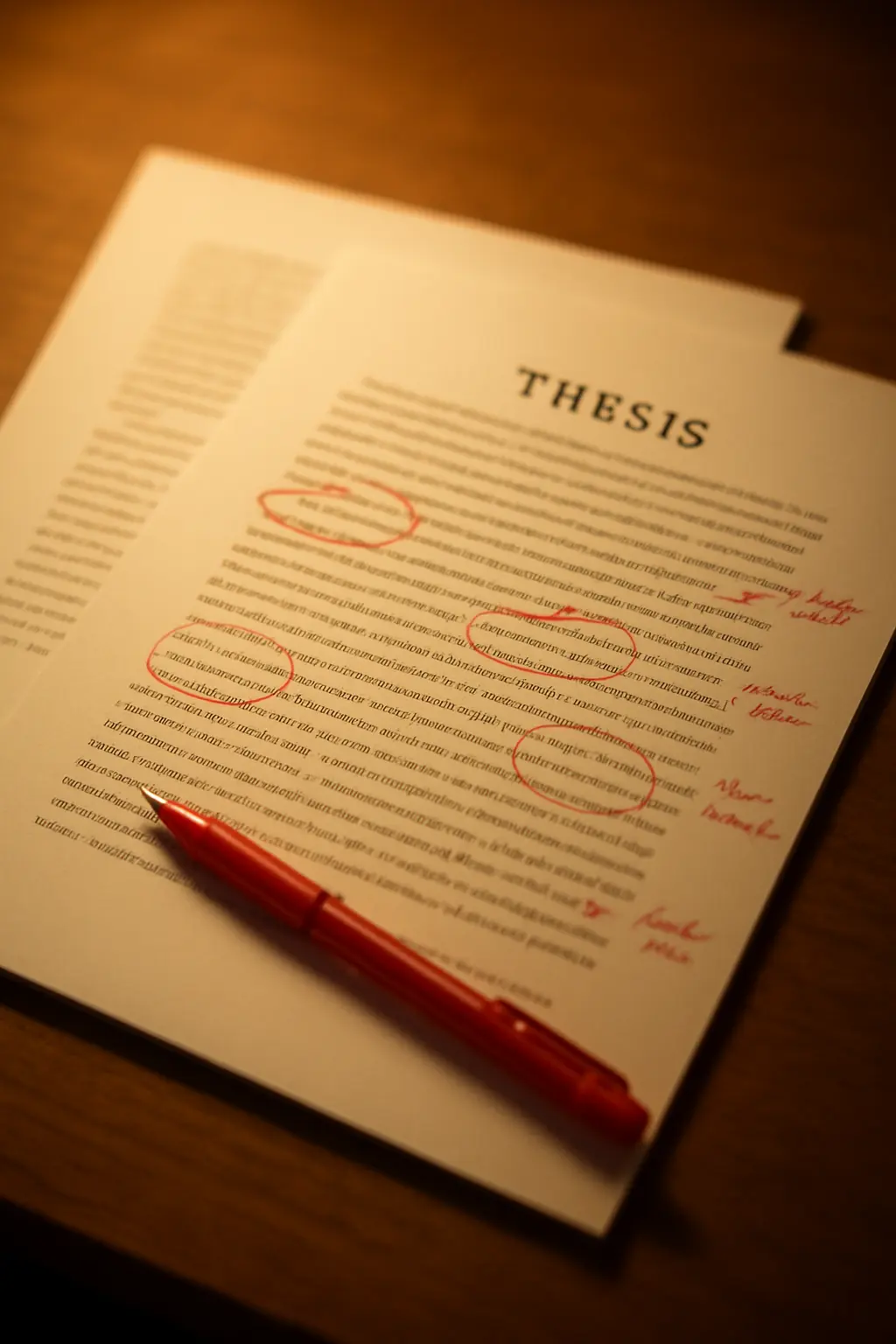
Look at what got through. “Cope up with”, “result to”, “as per”, “last May 2026”, “the said”, “kindly” — every one of them is a well-formed English sentence. There is no grammatical rule being broken. What is wrong is the register: these are constructions of Philippine English that belong to speech, to office memos and to school circulars, and a research manuscript is none of those.
A grammar checker checks grammar. Your adviser is checking register. Those are two different jobs, and only one of them has been automated.
The inventory: what to search for yourself
Since no tool in the table will find these, use the Find function. Each of these takes under a minute and each removes a mark a panel would otherwise make.
| Search for | Why it is flagged | Replace with |
|---|---|---|
| cope up with | Standard academic English is “cope with” | cope with, manage, handle |
| result to | Results are in outcomes; things lead to them | result in, lead to |
| discuss about, emphasise on, comprise of | Extra preposition | discuss, emphasise, comprise |
| as per | Commercial and bureaucratic register | according to, following, under |
| kindly | Correspondence register; a thesis does not address the reader | delete, or rewrite as a statement |
| the said, the aforementioned | Legal register; usually replaceable by “this” or “the” | this, the |
| last May 2026, last semester | “Last” plus a named month is Philippine and Indian English | in May 2026, during the second semester of 2025–2026 |
| majority of | Missing article, and the verb after it usually disagrees | the majority of… are, or most of… are |
| equipments, personnels, researches, literatures, staffs | Uncountable nouns pluralised | equipment, personnel, research, literature, staff |
| every now and then, a lot of, big number of | Conversational | occasionally, many, a large number of |
| ma’am, sir, respondents were requested to kindly | Spoken deference carried into the manuscript | delete |
| According to X (2023), he said that | Two reporting frames in one sentence | X (2023) reported that |
That last row is worth its own pass. Which reporting verb to use once you have removed the duplicate frame is set out in the guide to choosing reporting verbs for Chapter 2.
The ranked shortlist
1. LanguageTool — install this one
Free, with browser add-ons for Chrome, Edge, Firefox, Safari and Opera, plugins for Word, Google Docs, Apple Pages and LibreOffice, and desktop apps for macOS and Windows. Premium advertises “more than 20,000 additional checks”, up to 150,000 characters per text field, AI paraphrasing and a custom Style Guide. On 23 August 2026 the premium page returned “There was an issue displaying the prices. Please try again later.” rather than a figure, so no peso price is quoted here.
Two caveats worth knowing before you build a workflow around it. The public API documentation says plainly: “Do not send automated requests”, and warns that the deployed version may change without notice. And the free service caps suggestions at 30 misspelled words per check, which a full chapter will exceed.
2. Microsoft Editor — already installed, and quietly the best fit for register
If your group is writing in Word, Editor is already there and costs nothing extra. It is the only mainstream tool in the table with an explicit formality setting, which is the closest any of them gets to the register problem. It will not catch “cope up with”, but it will flag contractions and casual phrasing that a research manual forbids.
3. Grammarly — good free tier, priced in the wrong currency
The free plan, as published on 23 August 2026, offers “Write without mistakes”, tone display and 100 AI prompts. Pro adds full-sentence rewriting, tone adjustment, unlimited suggestions, plagiarism and AI detection, and 2,000 prompts.
A word on the plagiarism and AI detection bundled into Pro: it is not the check your research office runs, and a clean result there is not a prediction of your official score. What each checker is actually comparing your manuscript against is set out in the guide to plagiarism checkers compared for Filipino students.
Two things a Philippine thesis group should weigh. The plans page quoted €12 EUR per month — the pricing served is not in pesos, and card and conversion charges land on top of whatever figure you see. And the tone and rewriting features are the ones a research office is most likely to consider heavy AI assistance, which is a question of school policy rather than of value; the boundary is discussed in the guide to what an AI thesis tool can and cannot do under your school’s rules.
4. Hemingway Editor — not a grammar checker, and useful anyway
It measures sentence length, passive voice and adverb density rather than applying grammar rules. Paste a Chapter 1 paragraph in and the padding becomes visible: “The result of the study will be beneficial to the students, teachers, parents, school administrators and future researchers” is not ungrammatical, it is just empty, and this is the only tool in the list that makes that obvious. The free web editor is enough; Plus is a paid trial.
5. ProWritingAid — thorough, and no longer aimed at you
Its reports are the most detailed of any tool here. But its own front page on 23 August 2026 leads with “The Complete Toolkit for Storytellers” and features called Story Canvas, Plot Analysis, Creative Nudges and Writing Sprints. It has repositioned toward fiction, and a thesis group splitting a subscription should know that before paying.
Two things nobody in the table does
They do not know what section they are in. “This study will determine” is correct in a proposal and wrong in a defended manuscript, and no sentence-level checker can tell which document it is looking at. That conversion is set out in the guide to what tense each chapter should be written in.
They do not read your data. A checker will happily pass “the findings prove that time management improves academic performance” over a correlational study. The grammar is perfect and the claim is indefensible.
The workflow that actually works
- Draft the chapter without any checker running. Suggestions during drafting cost more attention than they save.
- Run LanguageTool or Editor once the section is complete. Accept the agreement and punctuation fixes; ignore the style nags.
- Run the Find list above. This is the pass that removes the marks your adviser writes.
- Paste one paragraph into Hemingway to check whether you are padding.
- Read the section aloud. Register problems are audible long before they are visible.
Step 3 is the one nobody does, and it is the only step in the list that is specific to writing academic English in the Philippines. None of this touches the tools you use for citations, statistics or the draft itself — those are ranked separately in the roundup of the best AI tools for thesis writing in the Philippines.
Fix the register where the section is, not one sentence at a time
Tesify works on the chapter you are actually writing, so a suggestion knows whether it is looking at a proposal or a finished methodology — which is the one thing a sentence-level checker can never know. Over 9,000 students have written more than 15,000 chapters with it, and every word is still written by you. Current plans and peso pricing are on the Tesify site.
Frequently asked questions
What is the best grammar checker for a Philippine thesis?
LanguageTool, because it is free, has add-ons for Word, Google Docs and every major browser, and catches genuine agreement and collocation errors. Microsoft Editor is the best second choice if your group already writes in Word, since it has an explicit formality setting.
Will a grammar checker fix my adviser’s comments?
Mostly not. In a test of twelve typical Philippine thesis sentences run against LanguageTool’s public API on 23 August 2026, ten returned no match — including “cope up with”, “result to”, “as per”, “last May 2026” and “the said variable”. None of those is a grammar error; all of them are register errors.
Why did the checker not flag “cope up with”?
Because it is grammatically well formed. “Cope up with” is a Philippine English construction, not a broken sentence, so a rule-based checker has nothing to object to. Standard academic English is “cope with”, and you have to find it yourself.
Is Grammarly free enough for a thesis?
The free plan covers spelling, grammar and a tone display, which is enough for a clean draft. Pro adds sentence rewriting and tone adjustment, features some research offices treat as substantive AI assistance, so check your school’s policy before relying on them.
How much does Grammarly cost in pesos?
No peso figure is readable at source. The plans page served €12 EUR per month for Pro on 23 August 2026, and card and conversion charges apply on top. Check the price your own card is billed before committing a group budget.
Is LanguageTool safe to use on unpublished research?
Its checks are sent to a server, as are Grammarly’s and ProWritingAid’s. If your data or your instrument is confidential, run the check on your finished prose only, or use Word’s built-in Editor, which is the only option here that works without sending your text out.
Can I use LanguageTool’s API to check my whole thesis?
Not really. The public API is limited to 20 requests per IP per minute and 20KB per request, offers suggestions for only the first 30 misspelled words, and the documentation asks users not to send automated requests. Use the add-on instead.
Is Hemingway Editor worth using for academic writing?
For one specific job: exposing padding. It is not a grammar checker and will flag academic constructions that are perfectly acceptable in a thesis, so use it on a paragraph at a time rather than a chapter and ignore its readability grade.
Should our thesis group share one subscription?
Check the terms before you do. Every tool here licenses per named user, and the practical risk is not enforcement but lock-out: one shared account signed in on five laptops the week before submission is a bad place to discover a device limit.
Do these tools count as cheating?
Spelling and grammar correction is ordinary editing and is accepted everywhere. Full-sentence rewriting sits closer to the line, and some Philippine research offices now require a declaration of AI assistance. Your school’s academic integrity policy is the document that decides it.
What is the fastest single pass before submission?
Use Find to search for these twelve strings: cope up with, result to, discuss about, as per, kindly, the said, last May, majority of, equipments, researches, according to, and is significant. That pass takes about twenty minutes and removes most of the corrections a Philippine panel writes on language.