| Tool | What it compares against | Student papers in its corpus? | Who normally runs it | Free access |
|---|---|---|---|---|
| Turnitin | Student submissions, current and archived web pages, premium publisher articles across 170 languages | Yes — stated on its own product page | Your research office or adviser, through the institution | No student-side free tier |
| Consumer web checkers | Publicly reachable web content | No | You, before submission | Usually a limited free tier |
| QuillBot | Bundled plagiarism checker alongside a paraphraser, grammar checker, AI detector and citation generator | Not stated | You | Free tier |
| Grammarly | Language and mechanics; plagiarism detection is a separate paid feature | No | You | Free tier for grammar |
| Your own citation discipline | Nothing — it prevents the problem instead of measuring it | n/a | You, while drafting | Free |
Capability details verified at each vendor’s own pages on 14 August 2026. No price is quoted here that could not be verified at source.
The one fact that changes how you read every result
A free checker and your university’s research office are not comparing your manuscript against the same thing, and the difference is not marginal.
Turnitin describes its own comparison database on its product page: a submission is compared “against a vast collection of student submissions, premium publications, and 20+ years of internet content”, and elsewhere on the same page, against “an unparalleled repository of student papers, current and archived web pages, and premium subscription articles from top publishers across 170 languages”.
Consumer checkers, by contrast, search publicly reachable web content. They have no access to the manuscripts other students have submitted to institutions.
The consequence is direct. A passage that exists only inside another student’s submitted thesis is invisible to every free checker and visible to the institutional one. If a batchmate used the same source paragraph last semester, or if a passage travelled through a shared group drive, a clean free result tells you nothing about it.
Why two checks on the same file return different numbers
Even between two institutional checks, the number moves — and this surprises students who assume a similarity score is a fixed property of their document.
Turnitin lets institutions “exclude templates (e.g. a cover sheet or instructions, questions, and tables in an assignment) from the Similarity Report” through its integration settings. So two departments running the identical file with different exclusion settings will report different percentages, and neither is wrong.
Three other things move the number legitimately: whether the bibliography is excluded, whether quoted material is excluded, and whether small matches below a word threshold are filtered. Ask your research office what its settings are before you interpret any figure it gives you.
What the percentage does and does not mean
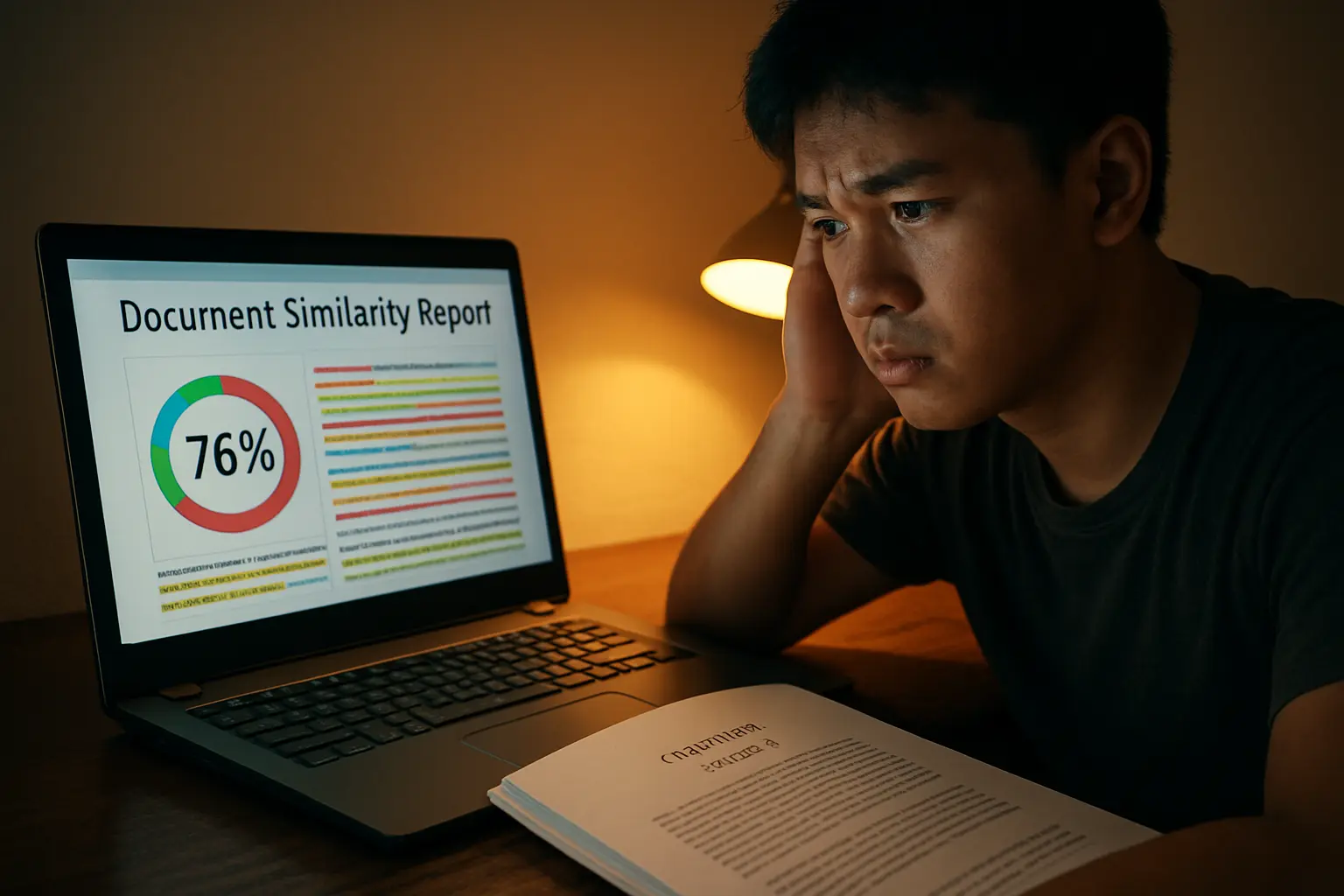
A similarity score measures overlap with other text. It does not measure dishonesty, and the vendor says so more plainly than most advisers do — Turnitin frames its Similarity Report as something instructors use to “review and filter matches”, not as a verdict.
Practically, that produces two situations students find counter-intuitive.
A high score can be innocent. A methodology chapter quoting a standard instrument, a legal studies chapter quoting statute text, or a manuscript whose bibliography was not excluded can all show substantial overlap while being entirely properly cited. What matters is whether each match is attributed.
A low score can hide a real problem. A properly paraphrased passage from an uncited source may match nothing at all and still be plagiarism, because plagiarism is presenting someone else’s ideas as your own — not merely reusing their words.
This is why “what percentage is allowed?” is the wrong first question. Ask your department what it actually does with the report.
The checkers, ranked for a Filipino thesis student
1. Your citation discipline while drafting
Ranked first, and it is not a tool. Every problem a checker detects was created earlier, when a passage entered your draft without its source attached. Capture each source the first time you open it, write your note immediately, and cite as you draft. Nothing downstream is as effective, and it costs nothing.
This is also the only approach that protects you against the failure no checker catches: a reference that does not exist. The mechanics, including the seven formatting errors free tools introduce, are in the guide to APA citation generators and what to fix before you submit.
2. Turnitin, through your institution
It is the one that counts, because in most Philippine universities it is the one your research office runs. There is no student-side free tier and no way to replicate its student-paper corpus from outside.
What you can do is ask your adviser whether a pre-submission check through the institution is available to you. Many Philippine departments allow one draft submission before the final one specifically so students can act on the report. That single request is worth more than any consumer tool.
3. A consumer web checker, used for what it is good at
Free web checkers are genuinely useful for one job: catching passages you pasted from a website and forgot to cite. That is a real and common error, and a web-only corpus catches it perfectly well.
Use one for that. Do not use its number as a prediction of your institutional result, and do not treat a low score as clearance.
4. QuillBot, with a warning
QuillBot’s homepage, checked on 14 August 2026, lists a plagiarism checker alongside a paraphraser, grammar checker, AI detector, summariser, translator, citation generator and an “AI Humanizer”.
The summariser and citation generator are useful. The paraphraser is where students get into trouble, and the reason is worth stating: rewording someone else’s argument does not make it yours. An uncited paraphrase is still uncited.
The “AI Humanizer” category deserves a direct warning. Tools that rewrite text specifically to change how it is classified are aimed at defeating a check rather than improving a manuscript, and detection has moved to meet them — Turnitin states that its Flags Panel highlights “potentially manipulated text such as replaced or hidden characters”. Being asked to explain that in a defense room is not a position you want.
5. Grammarly
Grammarly’s core value is language, not integrity. Its plagiarism feature sits behind a paid tier and searches web content; the free tier is a grammar tool. Treat it as a final language pass over a finished chapter, which is a real contribution to a manuscript written in English by a student who thinks partly in Filipino.
How to read your similarity report in fifteen minutes
- Ignore the headline number first. Open the match list instead and work down it.
- Sort by size. One 400-word block matters enormously more than forty six-word matches, which are usually common phrasing.
- For each substantial match, ask one question: can I attribute this? If it is a quotation with a citation, it is fine. If it is your own instrument, your own consent form or a standard heading, it is fine. If you cannot say where it came from, fix it now.
- Check whether the bibliography is included. If it is, a large share of your percentage is your reference list matching other reference lists, which is meaningless.
- Look for matches inside Chapter 2. That is where uncited paraphrase concentrates, because that is where you were summarising other people’s work under time pressure — the safe method is in the guide to writing a review of related literature.
The recommendation
Ask your research office for a pre-submission check, and build the citation trail while you draft so the report has nothing to find. Use a free web checker as a supplementary sweep for pasted material, not as a verdict.
What no tool on this list will tell you is your department’s threshold, because Philippine institutions set their own and they differ. Ask; do not assume a number you read online applies to you.
And keep the two questions separate. Similarity is about overlap with existing text. Whether AI-assisted drafting is permitted at all is a different policy question your school answers separately, covered in the article on what an AI thesis maker can and cannot do. A tool being permitted does not make an uncited passage acceptable, and a passage being original does not make a prohibited tool permitted.
Build the citation trail while you write
Tesify keeps every citation attached to the source you actually opened as you draft your chapters, so a similarity report has nothing unattributed to find and an adviser has nothing to fail to locate. Over 9,000 students have used it to write more than 15,000 chapters, and every word is still written by you.
Frequently asked questions
What is an acceptable similarity percentage for a Philippine thesis?
There is no single national figure. Institutions and departments set their own thresholds and some set none at all, treating the report as evidence for a human judgement. Ask your research office directly rather than assuming any number you have read.
Can I use a free checker instead of Turnitin?
For catching pasted web content, yes. As a prediction of your institution’s result, no — free checkers do not have access to the student-paper corpus that Turnitin describes on its own product page.
Why did my score change between two checks?
Because settings differ. Turnitin allows institutions to exclude templates such as cover sheets, instructions, questions and tables, and exclusion of quotes and bibliographies also varies. Two correct checks can return two different numbers.
Does a low similarity score mean my thesis is clean?
No. A well-paraphrased uncited passage may match nothing at all and still be plagiarism, because the issue is attribution of ideas, not reuse of words.
Does quoting raise my score?
Yes, mechanically, unless quotes are excluded in the settings. That is not a reason to stop quoting. It is a reason to make sure every quotation is properly marked and cited so each match is explainable.
Will my thesis be added to a database if I run a free check?
Read the terms of the specific tool before uploading. Some services retain submissions, which matters if your work is unpublished or your ethics approval restricts where data may be stored.
Does a plagiarism checker detect AI-written text?
Not as part of similarity checking; AI detection is a separate feature offered separately, and Philippine research offices differ in whether they use it. The two measurements answer different questions.
What if my adviser finds a match I cannot explain?
Say so plainly, find the original source and cite it. Advisers deal with this constantly and respond far better to a student who fixes it than to one who argues about the percentage.
Do capstone projects get checked too?
Usually the documentation does, and code may be checked separately by different means. What else differs between the two formats is set out in the comparison of a thesis and a capstone project.
Which chapter usually produces the most matches?
Chapter 2, by a wide margin, because it is where you summarise other people’s work. Chapter 3 comes second when a standard instrument is reproduced — which is legitimate if you attribute it, as set out in the guide to writing Chapter 3.