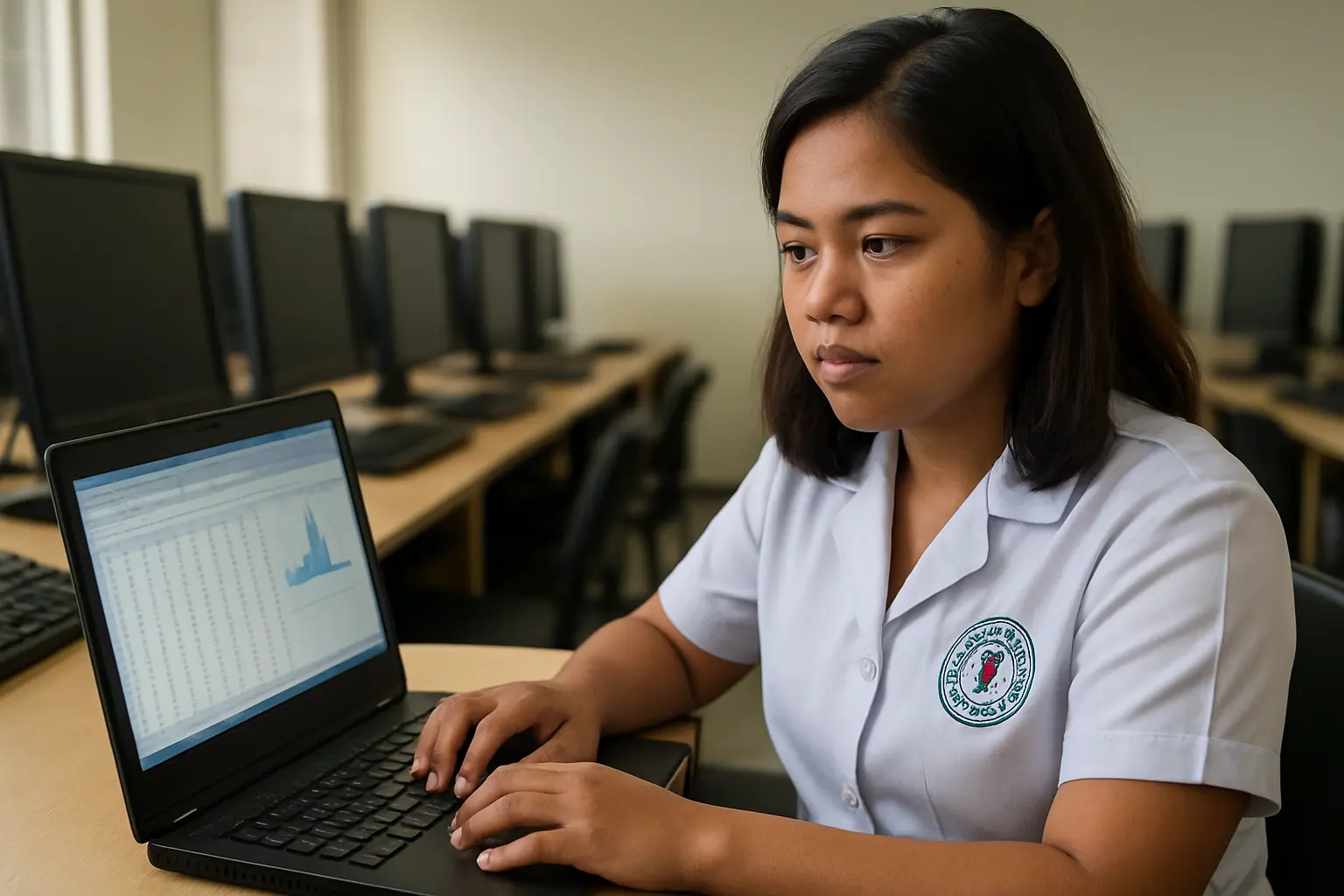
A Medical Technology thesis does not use the same tool stack as a business or education thesis, and treating it as though it does is the fastest way to lose a week re-doing Chapter 4. Laboratory-medicine data is overwhelmingly numeric, often paired (before/after, method A versus method B on the same specimens), and frequently non-normally distributed — which changes which statistics package actually fits, and which reference-management and instrument-documentation tools a BSMT panel expects to see cited by name in Chapter 3.
Every comparison below is scoped the same way the rest of this course-specific series is: what a BSMT group on a semester timeline, working from a single hospital or laboratory site, actually needs — not a general-purpose researcher’s toolkit, and not the enterprise software a hospital’s own IT department runs. Cost is quoted from the standpoint of a Filipino undergraduate splitting expenses across a small group, the framing this site’s tool-comparison strategy uses throughout.
Statistics Software: SPSS, Jamovi, R and Excel Compared
| Tool | Cost (Philippine student use) | Best for a BSMT thesis | Where it falls short |
|---|---|---|---|
| IBM SPSS | Paid; most schools license a computer-lab copy, no free personal tier | The software most BSMT panels expect to see named in Chapter 3 — paired t-test, Wilcoxon, chi-square, ANOVA, correlation, all menu-driven with no coding required | No home license for most students; lab access hours are often the real bottleneck, not the software itself |
| Jamovi | Free, open-source | Runs the same core tests as SPSS with a nearly identical spreadsheet-style interface, genuinely free to install on a personal laptop | Less commonly named in older Philippine BSMT research manuals, so some advisers ask for SPSS output specifically — confirm before switching entirely |
| R (with RStudio) | Free, open-source | Handles method-comparison statistics (Bland-Altman plots, Passing-Bablok regression) that SPSS and Jamovi do not offer out of the box — relevant for any thesis comparing two testing methods against each other | A real coding learning curve; not worth adopting for a single descriptive-quantitative thesis unless a method-comparison design specifically needs it |
| Microsoft Excel | Often already licensed via a school Microsoft 365 account | Frequency counts, percentages, basic charts, and — with the Analysis ToolPak enabled — a t-test and ANOVA | No built-in non-parametric tests (Wilcoxon, Kruskal-Wallis, Spearman rho), which a laboratory-medicine dataset needs more often than a normally-distributed one; this site’s SPSS-vs-Excel comparison covers exactly where Excel’s ToolPak stops for any course |
For the pre-analytical error and turnaround-time topic family covered elsewhere on this site, the practical answer is usually Jamovi or a lab-access copy of SPSS for the descriptive and ANOVA/Kruskal-Wallis work, with R reserved only for a method-comparison design that specifically needs Bland-Altman analysis — a combination that matches the worked BSMT proposal example on this site almost exactly.
Reference Management: Zotero, Mendeley and EndNote
A BSMT literature review pulls heavily from journals that use varying citation styles across publishers, which makes a reference manager worth the setup time even for a single-semester thesis. Zotero is free, open-source, and its browser connector captures a PubMed or ScienceDirect citation with one click — the strongest free option for a Philippine student without institutional software access. Mendeley is also free and adds built-in PDF annotation, useful for a literature review with dozens of full-text articles to mark up. EndNote is the one most likely to already be licensed through a university library account, and is the tool a program’s own librarians are most likely to offer training on directly — worth checking before installing anything else.
Laboratory and Instrument Documentation Tools
Two tools are specific to this course rather than shared across other majors. First, a digital lab notebook or even a structured Google Sheets log for recording specimen counts, rejection reasons and shift data as it is collected — built to match the exact columns the consistency matrix and Chapter 3 instrument define, not assembled after the fact from memory. Second, where a thesis compares two testing methods or two reagent lots, a method-comparison statistics calculator (built into R via the blandr or mcr packages, or a dedicated web calculator) for the Bland-Altman and Passing-Bablok analysis neither SPSS nor Jamovi runs natively.
Plagiarism and Grammar Checkers
The same plagiarism-checker comparison written for this site’s general audience applies without modification to a BSMT thesis — a pre-check before the adviser’s or the research office’s own Turnitin pass, never a substitute for it. The one BSMT-specific caution: method sections describing a standard laboratory procedure (a routine hematology analyzer protocol, for example) will often flag as similar to other theses using the same standard method, which is expected and not academic dishonesty — cite the method’s own source and move on rather than over-rewriting technical procedure language into something less precise.
Data-Collection Apps for Ward or Laboratory Rounds
Where a BSMT design calls for prospective, researcher-observed data collection rather than a retrospective log pull — the backup plan covered in this site’s proposal example when laboratory information system access is delayed — a mobile data-collection form beats a paper tally sheet for one specific reason: it timestamps each entry automatically, which matters when turnaround time is itself a variable being measured. Google Forms works for this on a phone browser with no app install, KoboToolbox (free, built for field research and usable offline in areas with poor hospital Wi-Fi) is the stronger option for a multi-day or multi-shift data-collection window, and a simple structured spreadsheet with dropdown validation is often enough for a single-site, single-shift-type study. Whichever is chosen, the form’s fields should be built directly from the Chapter 3 instrument’s indicators — the same rule that applies to the log-based instrument covered in the site’s proposal example — not assembled separately and reconciled afterward.
Citation Style: APA 7th Versus Vancouver
Most Philippine BSMT programs still require APA 7th campus-wide, matching every other course on this site, but it is worth knowing that many of the journals a BSMT literature review actually cites — Clinical Chemistry, the American Journal of Clinical Pathology, and most clinical-laboratory-medicine journals generally — publish in Vancouver (numbered) style themselves. This is not a contradiction: the researcher cites those sources in APA 7th format in the thesis regardless of how the original journal formats its own reference list, and a reference manager set to the right output style (Zotero and Mendeley both ship an APA 7th citation style by default) handles the conversion without manual reformatting. Confirm the required style with the adviser before the literature review is drafted, since converting a fully written Chapter 2 from one style to another late is far slower than setting the reference manager correctly from the first citation.
Choosing Tools as a Group, Not Individually
A BSMT thesis is almost always a group project, which changes the calculus on every tool above: a shared Zotero group library (free, built into the standard Zotero account) keeps every member’s citations synced without a paid team plan; a shared Google Sheets data-collection log avoids the version-conflict problem of four separate spreadsheets; and Jamovi’s free-for-everyone licensing means the whole group can run and re-check the same analysis independently rather than relying on whichever member happens to have lab access to the school’s SPSS seats that week. The one tool worth paying for as a group, where the budget allows, is a shared cloud storage plan large enough for raw specimen photos or scanned consent forms — a genuinely common bottleneck this course runs into that a business or education thesis group rarely does.
What This List Deliberately Leaves Out
A hospital’s own laboratory information system (LIS) is not a tool a student thesis selects or purchases — it is institutional infrastructure the researcher requests read or export access to, covered separately in this site’s proposal-example article rather than here, since it is an access question, not a shopping decision. The same is true of accreditation and quality-management software some hospital laboratories run for DOH or PhilHealth compliance reporting: genuinely useful as a data source if the hospital grants access, but never something a BSMT group installs or configures for the thesis itself.
One Clear Recommendation
For most BSMT undergraduate theses on a semester timeline: Jamovi for statistics (or lab-access SPSS if the adviser specifically requires SPSS output), Zotero for references, a structured spreadsheet log built directly from the Chapter 3 instrument for data capture, and this site’s plagiarism-checker guide for a pre-submission check. Reach for R only if the design specifically requires method-comparison statistics that the other tools do not offer.
Frequently Asked Questions
Does SPSS have to be purchased for a BSMT thesis, or is the school’s lab copy enough?
A school’s licensed lab copy is normal and sufficient for most BSMT theses — the constraint is usually lab access hours, not the software itself, which is exactly why Jamovi (free on a personal laptop) is worth adopting for students who need to work outside lab hours.
Is Jamovi accepted by BSMT panels, or do they expect SPSS specifically?
Most panels accept Jamovi output since the underlying statistics and the reported values are identical to SPSS for the tests a BSMT thesis typically runs — confirm with the specific adviser or research office early, since a minority of older manuals still name SPSS by brand.
What is Bland-Altman analysis, and does every BSMT thesis need it?
Bland-Altman analysis measures the agreement between two methods measuring the same thing — it is only needed for a method-comparison design (comparing a new test against a reference method, for example), not for a straightforward descriptive or correlational thesis like the workload-and-missed-care or turnaround-time examples covered elsewhere on this site.
Can Google Sheets replace a dedicated statistics package entirely?
For simple frequency and percentage reporting, yes — but Google Sheets has no built-in significance tests beyond basic correlation, so a thesis that needs a t-test, ANOVA or a non-parametric test still needs Jamovi, SPSS or R for that portion of Chapter 4.
Do reference managers work with the citation style a BSMT panel expects?
Yes — Zotero, Mendeley and EndNote all support APA 7th style output directly, which is the format most Philippine BSMT programs require; the researcher still has to spot-check the generated reference list against APA 7th’s own rules, since automated formatting is not always perfectly accurate.
Is KoboToolbox difficult to set up for a single undergraduate thesis?
The basic setup — one form, a handful of fields, deployed to a phone browser — takes under an hour for a group with no prior experience, well within what a single data-collection window justifies; the free tier’s submission limits are generous enough for a typical undergraduate sample size, and the form can be edited mid-collection if a field turns out to be missing.
Does the choice of statistics software affect what a panel can ask at the defense?
No — panels examine the results and the reasoning behind the chosen test, not the specific software brand that produced the output; being able to explain why a non-parametric test was chosen over a parametric one matters far more at defense than whether the number came from SPSS, Jamovi or R.
Once the tool stack is settled, turning raw laboratory data into a properly cited, correctly analyzed Chapter 3 and Chapter 4 is exactly the section-by-section work Tesify is built to move a Medical Technology group through.