
Medical Technology in the Philippines is not an informal title — it is a licensed profession created by statute. The Philippine Medical Technology Act of 1969 (Republic Act No. 5527) defines the practice as “an auxiliary branch of laboratory medicine which deals with the examination by various chemical, microscopic, bacteriologic and other medical laboratory procedures or technique which will aid the physician in the diagnosis, study and treatment of disease and in the promotion of health in general” (Section 2[a]), and Section 16 requires a completed four-year Bachelor of Science in Medical Technology (or Hygiene) before a graduate may even sit the board examination, which Section 19 sets at a general average of at least 75 percent with no rating below 50 percent in any major subject. Before that board exam, almost every BSMT program requires a fourth-year research proposal — the document a panel approves before a group is allowed to start data collection.
This is a section-by-section walkthrough of that proposal, nine steps, with a worked illustrative example at each step — turnaround time and pre-analytical error rates in a hospital clinical laboratory, one of the most heavily studied and readily accessible topics in the field precisely because pre-analytical error (sample collection, labeling, handling and transport, before a specimen ever reaches the analyzer) is well documented internationally as the largest single source of laboratory error. Every figure below is a fictional placeholder for shape only, not real hospital data.
Step 1: The Title
A BSMT proposal title names the variable, the setting and the population in one line — never just “a study on laboratory errors.” Worked example: “Turnaround Time and Pre-Analytical Error Rate of Routine Hematology Specimens in the Clinical Laboratory of [Named Hospital], [City]: A Descriptive Study.” The bracketed hospital name is filled in only once a research office has actually granted access — never assumed at the proposal stage.
Step 2: Background and Rationale
The background moves from the general to the specific: what pre-analytical error is, why it matters for patient safety (a mislabeled or hemolyzed specimen can trigger an unnecessary repeat draw or, worse, a wrong result acted on clinically), and then the specific gap — that the receiving hospital’s own pre-analytical error rate and its relationship to turnaround time has not yet been documented locally, even where the general phenomenon is well studied elsewhere.
Step 3: Statement of the Problem
Worked example (illustrative): This study sought to determine the turnaround time and pre-analytical error rate of routine hematology specimens processed at the laboratory of [Named Hospital], specifically: (1) What is the average turnaround time from specimen collection to result release? (2) What proportion of specimens are rejected or flagged for a pre-analytical error, and what are the most common error types? (3) Is there a significant relationship between shift (morning, afternoon, night) and the pre-analytical error rate?
Step 4: General and Specific Objectives
One general objective restates the problem as an action verb (“to determine”); the specific objectives restate each numbered question the same way. Panels in this course check that the objectives and the statement of the problem use identical wording for each variable — a proposal that introduces a new term in the objectives that never appeared in Chapter 1 gets sent back.
Step 5: Significance of the Study
Written to the audiences a hospital laboratory setting actually has: the laboratory’s own quality-management section (a direct, actionable audience — most BSMT proposals in a hospital setting can name this one specifically, which is what separates this course’s significance section from a generic one), the attending physicians who rely on the turnaround time, patients indirectly, and future researchers only as the last, smallest paragraph.
Step 6: Scope and Delimitation
States plainly what the study will and will not cover: routine hematology specimens only (not chemistry or microbiology), one hospital’s main laboratory over a stated data-collection window, pre-analytical error only (not analytical or post-analytical error, which are different, equally real categories the proposal explicitly sets aside). A reviewer should be able to tell from this section alone exactly what the eventual Chapter 4 tables will and will not contain.
Step 7: Outline of the Review of Related Literature
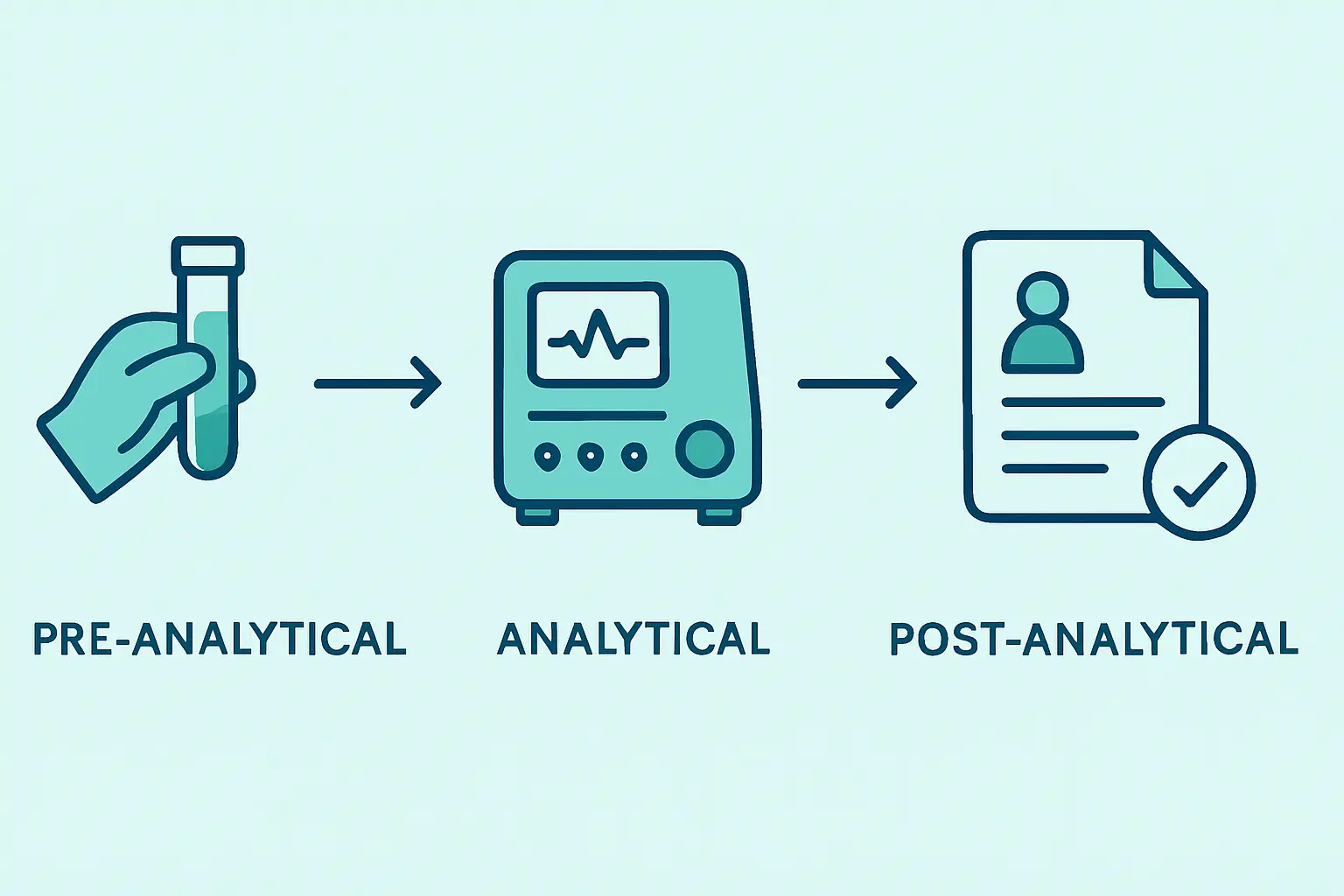
The proposal does not need the full Chapter 2, but it needs a working outline showing where the literature will come from: peer-reviewed laboratory-medicine journals (Clinical Chemistry, American Journal of Clinical Pathology and similar), professional body position statements, and — where a hospital keeps one — its own quality-assurance logs as primary local data once access is granted. The outline states the two or three theories or frameworks the proposal expects to use (commonly a total testing process model, distinguishing pre-analytical, analytical and post-analytical phases) rather than listing loose article titles.
Step 8: Outline of the Methodology
A BSMT proposal’s methodology outline states the design (commonly descriptive-quantitative, retrospective chart or log review, or prospective observational), the data source (laboratory information system logs or a researcher-made observation checklist), the sampling approach (often total enumeration of a stated period’s specimens rather than a Slovin’s-formula sample, since the population is a finite log of records, not a survey of people), and the planned statistical treatment (frequency and percentage for error rate and type; ANOVA or Kruskal-Wallis for the shift comparison, depending on whether turnaround-time data is normally distributed). This site’s full Chapter 3 guide walks through the complete version of every one of these sections once the proposal is approved and Chapter 3 itself is due.
| Proposal section | Worked illustrative content |
|---|---|
| Design | Descriptive-quantitative, retrospective laboratory-log review |
| Population | All routine hematology specimens processed over a stated 4-week window (illustrative total enumeration, not a sample) |
| Instrument | Laboratory information system turnaround-time log + a researcher-made rejection/error-type tally sheet |
| Statistical Treatment | Frequency and percentage (error rate, error type); one-way ANOVA or Kruskal-Wallis (turnaround time by shift) |
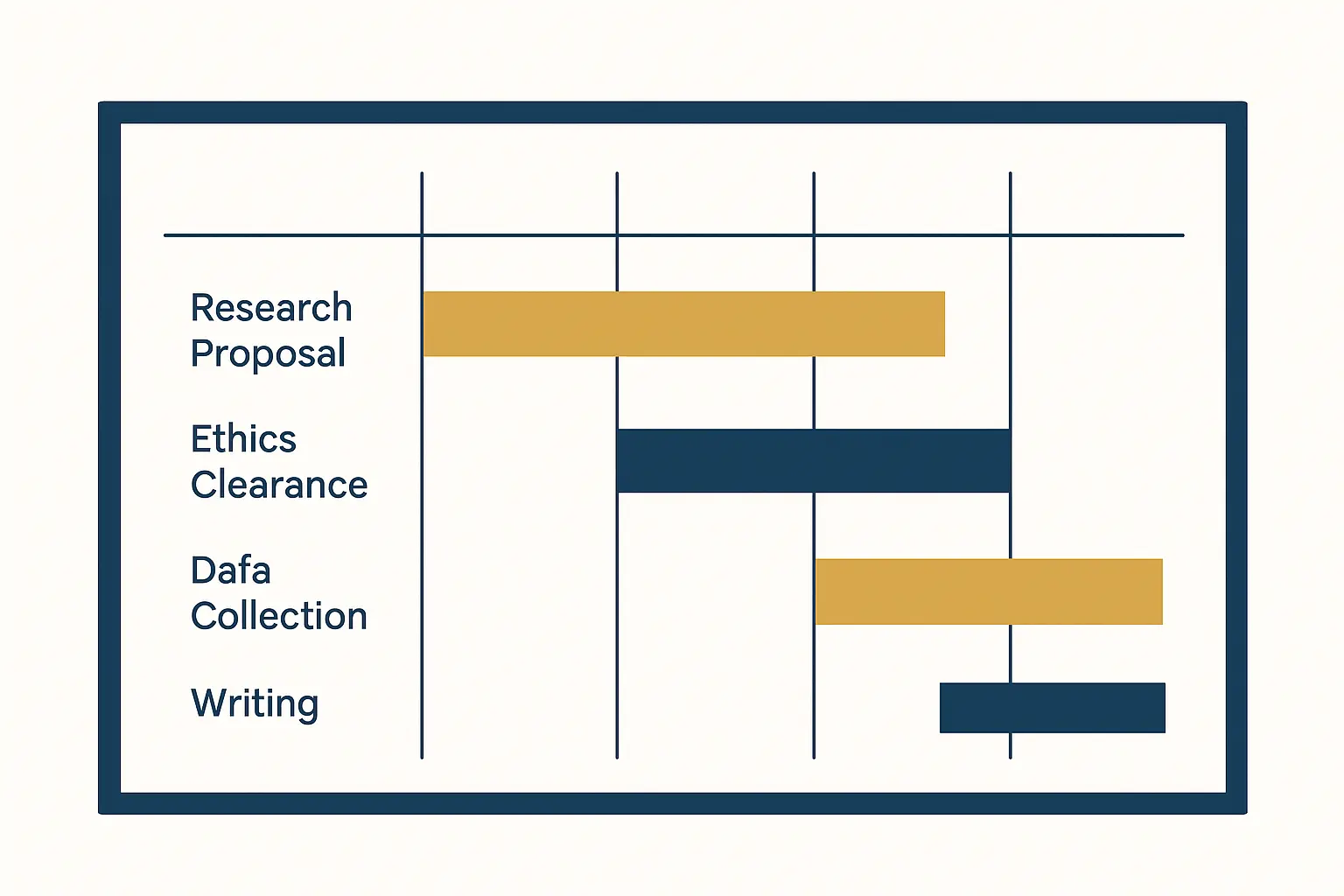
| Ethics Clearance Lead Time | Hospital research ethics committee review, illustrative 4–6 weeks before data collection may begin — confirm your own hospital’s actual timeline; it is not standardized nationally |
Step 9: Timeline
The proposal closes with a Gantt-style table mapping each remaining chapter and each ethics/access milestone to a week number, working backward from the group’s actual defense date rather than forward from “today” — the single most common scheduling mistake a BSMT panel flags, since hospital ethics review and data-access approval routinely take longer than a group budgets for.
Why This Topic Family Works So Well for a BSMT Proposal
Pre-analytical error and turnaround time share three properties that make them favorites for this course specifically: the data already exists inside a laboratory’s own information system (no new instrument has to be validated from scratch before data collection can start), the framework is internationally standard (the total testing process model is taught in every BSMT curriculum), and the significance section writes itself around patient safety — a genuinely strong angle for a licensed, patient-facing profession. The nine-step proposal shape above is not unique to laboratory medicine — a Civil Engineering group builds the same nine sections around a materials-testing question, worked through in full in this site’s civil engineering research-proposal example; only the discipline-specific content in Steps 2, 7 and 8 changes.
Other BSMT Proposal Topics That Work the Same Way
Four other topic families use the same nine-step shape and the same access logic — real institutional data, an internationally standard framework, and a patient-safety or quality angle a panel can immediately see the point of:
- Specimen rejection rate by collection site — comparing ward, outpatient and emergency-room draws, where the access point itself is often the strongest predictor of a rejected specimen.
- External quality assessment (proficiency testing) performance over time — trending a laboratory’s own EQA scores across testing cycles, a topic almost every accredited hospital laboratory already has the raw records for.
- Point-of-care testing accuracy against the central laboratory analyzer — a correlation design comparing a bedside glucometer or coagulation device against the gold-standard analyzer result for the same specimen.
- Blood bank component wastage — expired or discarded blood component rates against a hospital’s own inventory and transfusion logs, a resource-management angle rather than a diagnostic-accuracy one.
Whichever topic is chosen, the instrument still has to be built and validated before data collection — the same content-validity and pilot-test process covered in this site’s instrument-validation guide applies whether the instrument is a researcher-made tally sheet or a full questionnaire, and the same non-parametric substitution logic used in the health-science statistical-treatment comparison written for a BSN thesis carries over directly to a BSMT proposal’s turnaround-time data, which is almost never normally distributed in a real hospital dataset.
Frequently Asked Questions
Does a BSMT thesis proposal need PRC involvement before data collection?
No — the Professional Regulation Commission governs the licensure board exam under RA 5527, not the undergraduate thesis proposal itself; what a BSMT proposal needs before data collection is the receiving hospital’s own research ethics committee clearance and, where patient records are involved, compliance with the Data Privacy Act of 2012.
Can a BSMT proposal use a private laboratory instead of a hospital laboratory?
Yes — a stand-alone diagnostic or private clinical laboratory works the same way structurally; the access-and-ethics step simply routes through that laboratory’s own management rather than a hospital research office.
What is the difference between pre-analytical, analytical and post-analytical error?
Pre-analytical covers everything before the specimen is actually tested — collection, labeling, handling, transport, storage; analytical is the testing process itself; post-analytical covers reporting, interpretation and delivery of the result. A proposal should state clearly which phase or phases it studies, since the three call for different instruments and different literature.
How long should the proposal itself be before the full thesis begins?
Most BSMT programs expect a proposal of roughly 15 to 25 pages covering Steps 1 through 9 above — short enough for a panel to approve quickly, long enough to prove the design and access are genuinely workable before the group commits a semester to it.
What if the hospital will not grant access to its laboratory information system logs?
This is common enough that most programs expect a backup design in the proposal itself — commonly a prospective, researcher-observed data-collection plan using a paper tally sheet over a shorter window, in place of a retrospective log pull, if system access is denied or delayed past a group’s timeline.
Does the proposal need a review of related studies section, or is that only in Chapter 2?
Most programs expect at least a short related-studies subsection inside the proposal itself, distinct from the full Chapter 2 — enough to show the panel that the topic has genuine local or international precedent and is not being proposed blind; the outline in Step 7 above is what that subsection is built from.
Can the same nine steps be used for a purely laboratory-based experimental thesis instead of a hospital-observational one?
Yes — an in-vitro comparative method-validation study (comparing two reagent lots or two testing platforms against a reference method, for example) uses the same nine sections; only Steps 2, 7 and 8 change to reflect a controlled bench-work design instead of an observational hospital setting, and the ethics step in the table above is usually lighter since no patient data is involved.
Turning each of the nine steps above into your own hospital’s real proposal — with your own access constraints, your own ethics timeline and your own literature — is exactly the section-by-section drafting work Tesify is built to move a Medical Technology group through, one approved section at a time.