
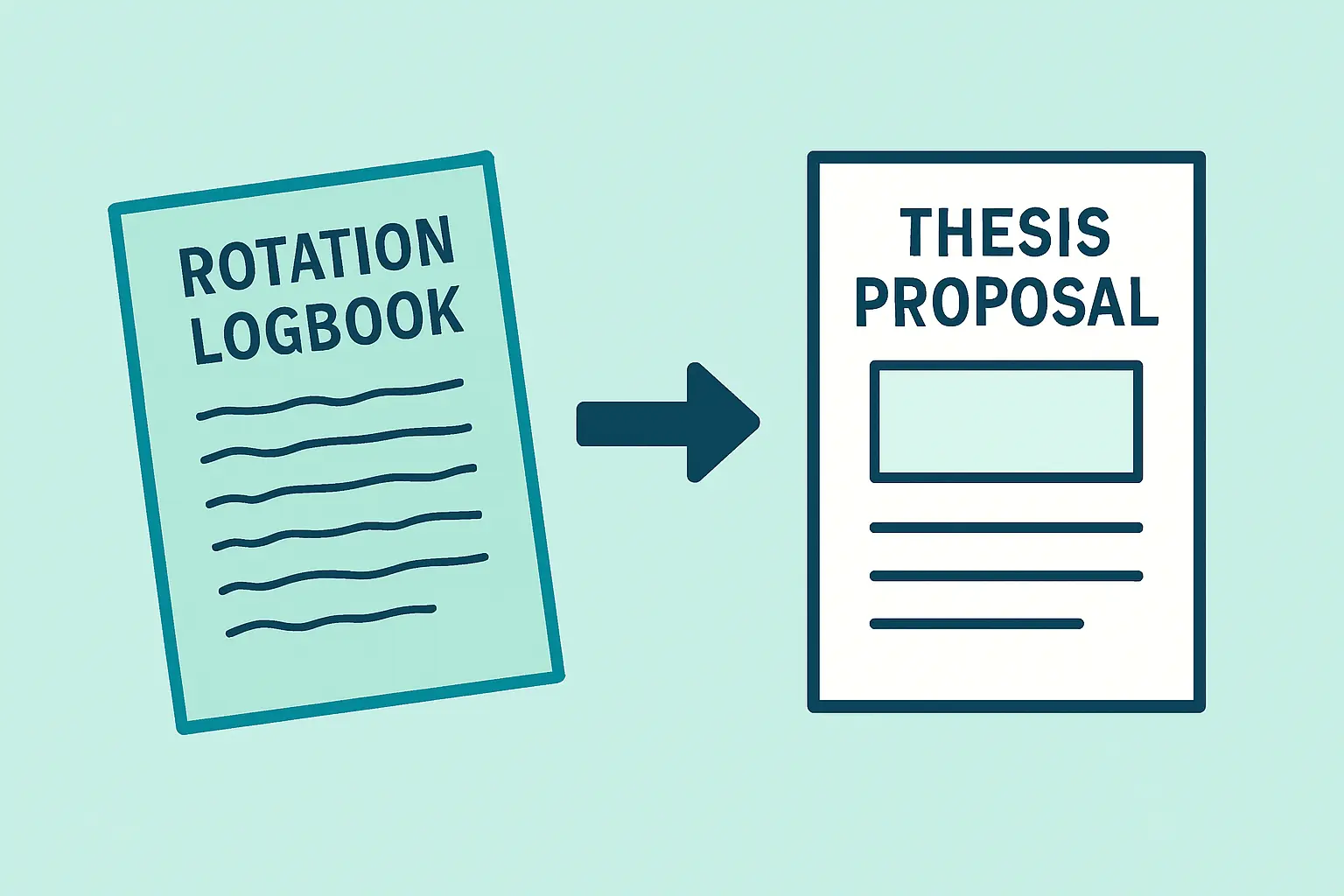
Your clinical OJT rotation just ended — hematology, microbiology, blood banking, clinical chemistry, parasitology, each section logged and signed off — and your adviser wants a thesis topic by next week. The instinct to lightly rewrite the OJT report into Chapter 1 costs groups more time than starting clean, because a rotation logbook and an empirical thesis are built to answer completely different questions, and a panel spots a repackaged logbook in the first two pages.
What an OJT Report and a Thesis Are Actually Built to Do
An OJT or internship report is a narrative record: what you did, in which section, under whose supervision, what you learned. A thesis is an argument: a stated problem, a method for investigating it, findings, and a conclusion that answers the problem. Submitting rotation-log content as Chapter 1 background reads immediately as description without a research question — the single fastest way to lose a week rewriting a “background” section a panel has already sent back once.
What Genuinely Transfers From Your OJT to Your Thesis

- Hospital access and staff relationships. The single most valuable asset your OJT built is not report content — it is a working relationship with a laboratory supervisor who already knows you and is far more likely to grant thesis-data access than a cold request from an unfamiliar student.
- A real, observed problem. If you noticed a recurring bottleneck during rotation — specimens rejected for hemolysis, a particular shift running consistently slower, a chain-of-custody step staff skip under pressure — that observation is a legitimate seed for a Chapter 1 statement of the problem, worked through in full for the pre-analytical-error topic family in this site’s BSMT research-proposal example.
- Procedural familiarity. Knowing the laboratory’s actual workflow, its information system, its shift patterns and its documentation habits shortens your Chapter 3 methodology-writing time considerably, since you are describing a setting you have already worked inside rather than one you have to learn from scratch.
What Does Not Transfer, No Matter How Well-Written the OJT Report Is
- The report’s own narrative structure. “Week 1, I was assigned to hematology” is a diary entry, not a Chapter 1 background — it has no statement of the problem, no research questions, no significance section, and restructuring it after the fact takes longer than starting from a blank page with the problem stated first.
- Any data you personally observed but were not authorized to collect for research purposes. Noticing a pattern during OJT is a legitimate reason to propose studying it formally — it is not the same as having permission to use informally observed OJT-period data as your actual Chapter 4 dataset, which still requires its own ethics clearance and a fresh, properly authorized data-collection window.
- Supervisor sign-off as a substitute for a thesis adviser’s approval. Your OJT clinical instructor’s evaluation and your thesis adviser’s approval are two separate academic processes; a strong OJT evaluation does not shortcut Chapter 3’s own instrument-validation and ethics-review steps.
A Worked Before-and-After Example
| OJT Report Content (Not Usable Directly) | Thesis-Ready Reframe | |
|---|---|---|
| Raw observation | “During my rotation in the hematology section, I noticed several specimens were rejected for hemolysis during the morning shift.” | Statement of the problem: What proportion of routine hematology specimens are rejected for pre-analytical error, and is rejection rate significantly associated with collection shift? |
| Reflection paragraph | “I learned the importance of proper phlebotomy technique and specimen handling.” | Significance of the study: findings support the laboratory’s own quality-management training priorities, addressed directly to that section rather than described in general terms. |
| Supervisor evaluation | Your clinical instructor’s OJT performance rating | Not usable as thesis validation — a separate, independent instrument-validation process is still required in Chapter 3 |
The pattern in every row is the same: an OJT observation becomes thesis-usable only once it is restated as a measurable question, never by editing the original sentence’s tone or adding academic-sounding words to it.
The Real Cost of Getting This Wrong
Groups that submit a lightly reworked OJT narrative as Chapter 1 typically get it back with a note to “add a research problem” — which, in practice, means starting the chapter over with weeks already spent on a draft that could not be salvaged. On a board-exam-track program where the thesis proposal has to clear before the semester’s data-collection window opens, that lost time routinely pushes data collection into a tighter window than the group planned for, or past it entirely into the following term.
The Faster Path: Turning One OJT Observation Into a Proposal This Week
Pick the single most concrete problem your rotation surfaced — not the broadest one, the most specific one you can state as a measurable question. Draft the statement of the problem first, before touching any OJT content. Then go back to your OJT supervisor, not as your evaluator this time but as your prospective thesis-site gatekeeper, and ask directly whether the facility would support a formally authorized study of that specific question. This is the same nine-step structure Tesify is built to move you through quickly — title, background, statement of the problem, objectives, significance, scope, literature outline, methodology outline, timeline — starting from your real observation instead of a rewritten logbook, with each section drafted and reviewed before you move to the next.
Once the Topic Is Confirmed, What Comes Next
With access confirmed and a statement of the problem drafted, the next decisions are the instrument and the analysis plan — which data source to request, what to measure, and which statistics package fits the design, covered in full in this site’s BSMT tool-stack comparison. Groups who move in this order — access, then problem, then instrument, then tools — consistently spend less total time than groups who pick software or worry about formatting before the research question itself is settled.
Why Groups Wait Too Long to Make This Decision
Most groups do not consciously decide to reuse the OJT report — they simply run out of momentum right after clinical rotation ends, at the exact moment their group chat should be turning an observation into a statement of the problem. Boards and clinical rotations already consume most of a semester’s energy; by the time a group sits down to actually draft Chapter 1, the easiest-looking option is whatever document already exists, which is the OJT report. Naming this pattern early — deciding at the end of rotation, not weeks later, which specific observation becomes the topic — is what separates groups that lose a week to a rejected Chapter 1 from groups that do not.
What a Group Should Do in the First 48 Hours After Rotation Ends
- List every recurring problem, delay or inconsistency any group member personally observed during rotation, across all sections.
- Rank them by how measurable each one is — a countable rejection rate or turnaround time beats a vague impression of “things felt slow.”
- Pick the single most measurable one and draft a one-sentence statement of the problem before doing anything else.
- Contact the OJT supervisor about formal thesis access for that specific question, while the relationship built during rotation is still fresh.
- Only after access is confirmed, begin drafting the full proposal around the confirmed topic and site.
An Illustrative Example: Building a Backup Topic From a Second Observation
The rotation and figures below are entirely fictional, used only to show how a group can protect itself if its first-choice hospital declines access. Suppose a fictional group’s primary observation — the hemolysis-rejection pattern from the worked example above — comes from Hospital A, but Hospital A’s laboratory director declines a formal study, citing an ongoing internal audit. Rather than losing the semester rebuilding a topic from nothing, the group returns to its rotation notes and finds a second, less-developed observation from a different section: microbiology turnaround times appeared to run longer on weekend shifts than weekday ones. This second observation was never the group’s first choice, but because every member had already logged it during the “first 48 hours” exercise above, it is ready to be restated the same way — as a measurable question about turnaround time by shift — and pitched to Hospital B, where a different member of the group completed part of their own rotation. Keeping a documented backup observation from the start, rather than treating the OJT report as a single-use source, is what lets a group pivot in days rather than starting the observation-gathering process over from zero.
Frequently Asked Questions
How much does Tesify cost for a BSMT group splitting the expense?
Tesify offers a free tier to start drafting immediately; current paid-plan pricing in pesos is shown on the site at signup and is designed to be split affordably across a thesis group rather than priced for a single individual — check the live pricing page for the current numbers before your group budgets for it.
Does using Tesify to help draft a proposal count as academic dishonesty?
No — Tesify is built to help you draft your own research faster and keep your own citations straight, not to write your thesis for you or fabricate content; whether and how AI assistance must be disclosed is set by your own school’s policy, and checking your program’s specific rule before you start is the safer first step regardless of which tool you use.
Is my OJT hospital’s data safe if I mention it while using an AI drafting tool?
Treat any real patient-identifiable or hospital-internal information the same way you would in any other drafting context — never paste actual patient data or confidential hospital records into any tool, AI or otherwise; your thesis itself should already be working from de-identified, aggregate or researcher-collected data, never raw hospital records.
Can I use my OJT clinical instructor as one of my three required instrument validators?
Check your program’s specific rule — many schools allow a clinical instructor with relevant subject-matter expertise to serve as one validator, but most also require validators independent of the data-collection site itself for at least part of the panel, so confirm this with your research coordinator before finalizing your validator list.
What if my OJT hospital says no to a formal thesis study after I already have a topic?
This happens, and the fix is the same one covered for a rejected topic in general: pivot the same problem to a different accessible hospital or laboratory rather than abandoning the topic, since the underlying research question — the pre-analytical error pattern, the workflow bottleneck — is rarely unique to one facility.
Can our group still pass if none of us had a directly relevant OJT observation?
Yes — an OJT-derived observation is the fastest starting point, not a requirement; a group without one simply starts from the other topic families covered in this site’s proposal example (specimen rejection by collection site, external quality assessment trends, point-of-care testing accuracy) and secures access the same way, just without the head start a rotation relationship provides.
How quickly can a group realistically go from OJT observation to an approved proposal?
Groups that move directly from a specific, measurable observation to a drafted statement of the problem — skipping the detour of trying to rewrite the OJT report first — typically clear a proposal review in one to two weeks; groups that spend that time trying to salvage OJT-report content usually take longer, not less, because the rewrite still has to happen eventually.
Should every group member keep their own separate list of OJT observations, or just one shared list?
A single shared list works better in practice — each member adds their own observations to it as rotation happens, rather than everyone keeping a private notebook that only surfaces once Chapter 1 is already due, and a shared list also makes it easier to spot when two members independently noticed the same pattern in different sections, which is often a sign the observation is genuinely common rather than a one-off.
Turning your OJT rotation’s real observations into a properly structured, adviser-approvable proposal — not a rewritten logbook — is exactly what Tesify is built to help a Medical Technology group do this week, not next month.