
Philippine research output has more than tripled in a decade: 5,688 works with a Philippine institutional affiliation were indexed for 2015, against 20,372 for 2024. The figures below were queried directly from the OpenAlex API on 16 August 2026, and they come with two verified defects that mean the institutional leaderboard cannot be cited exactly as it appears.
The national figures
| Publication year | Works with a Philippine institutional affiliation | Source and date read |
|---|---|---|
| 2015 | 5,688 | OpenAlex API, 16 Aug 2026 |
| 2016 | 5,563 | OpenAlex API, 16 Aug 2026 |
| 2017 | 6,762 | OpenAlex API, 16 Aug 2026 |
| 2018 | 7,866 | OpenAlex API, 16 Aug 2026 |
| 2019 | 9,185 | OpenAlex API, 16 Aug 2026 |
| 2020 | 10,960 | OpenAlex API, 16 Aug 2026 |
| 2021 | 13,023 | OpenAlex API, 16 Aug 2026 |
| 2022 | 15,256 | OpenAlex API, 16 Aug 2026 |
| 2023 | 19,037 | OpenAlex API, 16 Aug 2026 |
| 2024 | 20,372 | OpenAlex API, 16 Aug 2026 |
Two features of that series are worth stating carefully before anyone quotes it.
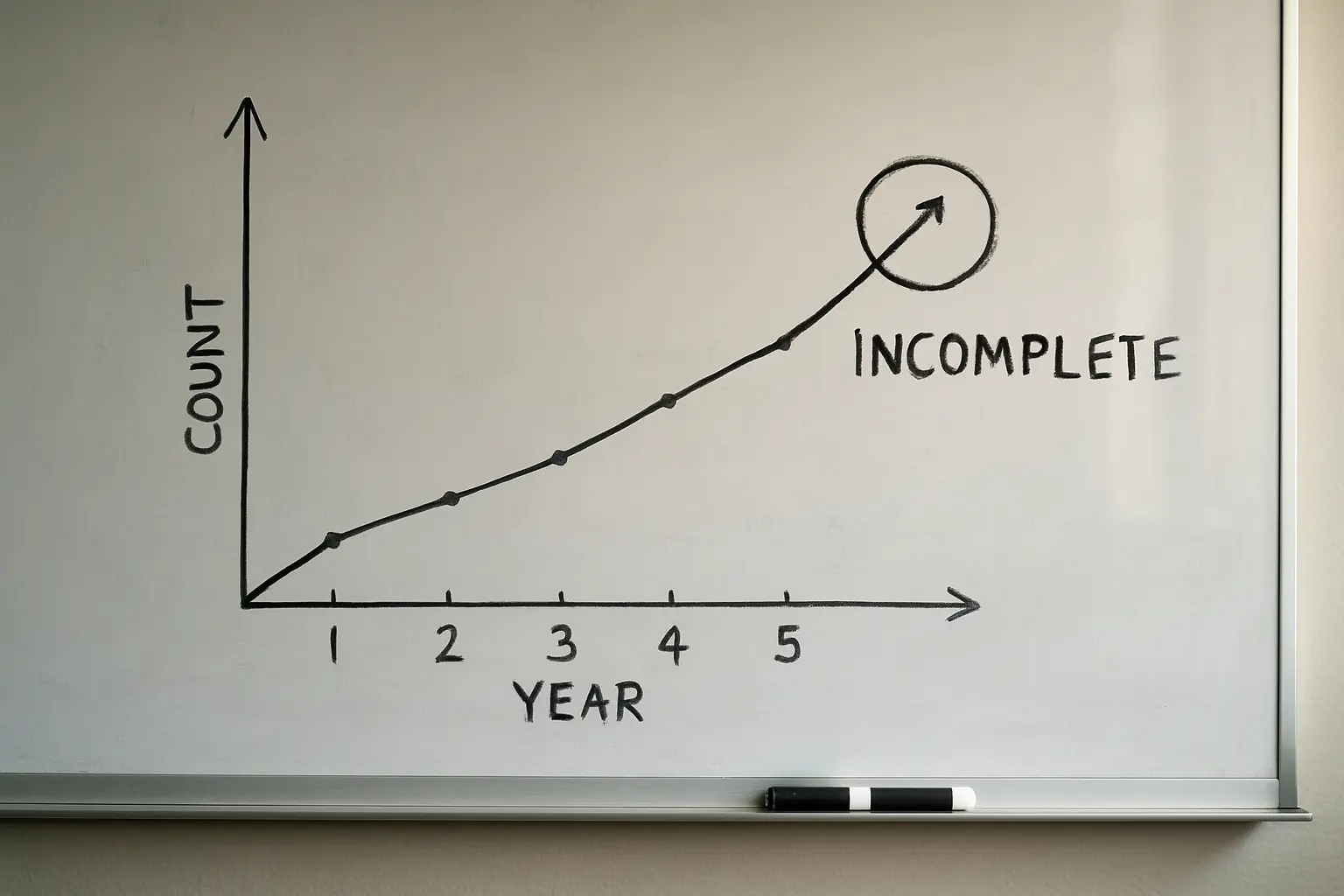
The growth is real and large. 2024 is 3.6 times the 2015 figure, and the only year in the series that fell was 2016. Whatever else is true about Philippine higher education, the volume of indexed scholarly output rose steeply and steadily across the decade.
The most recent years are not comparable to the settled ones. The same query returned 27,228 works for 2025 and 31,131 for 2026 — a year that was seven and a half months old when the query was run. A 2026 count that already exceeds 2025 in August is telling you about indexing behaviour, not about Philippine productivity. Use 2024 as your most recent settled year and say why.
Open access: three quarters of it, and that matters to you specifically
Of the 20,372 works indexed for 2024, 15,525 are marked open access — 76.2 per cent.
That figure has a direct, practical consequence for an undergraduate whose library subscription is thin: roughly three in four recent Philippine-affiliated papers should be readable without paying. It does not mean you will find every one of them through one search box, which is why the databases differ in what they surface — a comparison set out in the guide to where to find related literature for a Philippine thesis.
The institutional table, and the reason it needs a warning label
OpenAlex lists 280 Philippine institutions of type “education”. Ranked by the works count on each institution record:
| Institution | Works count | Citations | Citations per work |
|---|---|---|---|
| University of the Philippines Diliman | 15,581 | 361,077 | 23.2 |
| Cebu Doctors’ University | 15,222 | 2,505 | 0.2 |
| Northwestern University (Laoag) | 15,206 | 758,158 | 49.9 |
| De La Salle University | 12,114 | 244,351 | 20.2 |
| University of the Philippines Manila | 10,518 | 391,662 | 37.2 |
| University of the Philippines Los Baños | 9,609 | 200,124 | 20.8 |
| University of Santo Tomas | 6,678 | 137,374 | 20.6 |
| Ateneo de Manila University | 6,177 | 106,681 | 17.3 |
| Mindanao State University – Iligan Institute of Technology | 5,976 | 37,908 | 6.3 |
All figures read from the OpenAlex institutions endpoint on 16 August 2026. Citations-per-work computed from those two columns.
Read down the last column and two rows do not belong. Most Philippine universities cluster between 17 and 37 citations per work. Two do not, and both anomalies are checkable.
Defect 1: the leaderboard has a name collision at the top
Northwestern University appears in that table credited with 758,158 citations — more than twice UP Diliman’s. The ROR registry, the authoritative register of research organisation identifiers, confirms that the record in question is Northwestern University in Laoag, Ilocos Norte, established 1932.
Opening the two most-cited works attributed to it settles the question. Their raw author affiliation strings read “Department of Statistics, Northwestern University, Evanston, IL, USA” and “Northwestern University”. They are papers from the American institution of the same name, matched to the Philippine one.
Cebu Doctors’ University shows the mirror-image symptom: 15,222 works against 2,505 citations, a ratio a hundred times below its neighbours in the table.
What this means for you: never write “Northwestern University is the second most-cited university in the Philippines” or anything derived from an institutional row you have not checked. The check takes two minutes — open a handful of the works attributed to the institution and read the affiliation line on each.
Defect 2: an institution’s own works count can disagree with its works
The second defect is independent of the first and, if anything, more useful to know.
Every institution record carries a headline works count. You can also ask the works endpoint how many works it holds for that same institution. The two answers should broadly agree, and mostly they roughly do — UP Diliman’s record says 15,581 while the works endpoint returns 13,692, a twelve per cent gap consistent with ordinary indexing lag.
But the gap is not always small. Checking the same pair of figures for Edo State University Uzairue in Nigeria, chosen because its citations-per-work looked equally implausible, gives a record count of 31,676 against a works-endpoint count of 2,199 — a fourteenfold discrepancy that no indexing lag explains.
The rule that follows: an institutional works count is a starting point, not a citable figure. If your Chapter 1 needs to say how much a named university publishes, re-derive the number from the works themselves and state the date you did it.
How to cite these figures without overstating them
- Name the source and the date you read it. These are live indices, not annual publications. “OpenAlex, queried 16 August 2026” is the honest form.
- Stop at 2024. Say explicitly that later years are incomplete, and show the partial figure only if you label it.
- Prefer national and disciplinary counts over institutional ones. The country filter behaved consistently in every check above; the institution records did not.
- Do not turn a count into a quality claim. Volume of output says nothing about whether the research is good, and a panel will make that point if you do not.
- Never mix vintages. A 2024 count from one source and a 2019 count from another do not belong in the same sentence without both dates attached — the same discipline applied to the enrolment and attrition figures in Philippine higher education statistics for Chapter 1.
What this is actually useful for in your thesis
Two things, and neither is padding your background section with a big number.
First, a rationale. If Philippine output tripled in a decade while the literature on your specific topic stayed thin, that contrast is a real justification for your study, and it is stronger than an unsupported claim that “few studies have been conducted”.
Second, a gap statement with a number behind it. Counting the Philippine literature on your own topic is a reproducible procedure, and it converts the vaguest sentence in Chapter 2 into an evidenced one; the method is set out in has your thesis topic already been studied in the Philippines, and the synthesis it feeds is covered in the guide to writing a review of related literature.
What none of this replaces is reading the papers. A count tells you how much exists; only the reading tells you what it found, and that distinction is what a panel is testing when it asks what a source you cited actually concluded. The whole chain from problem to literature to method is summarised in the overview of Chapters 1 to 5.
Keep every figure attached to the source you read it from
Tesify holds your chapters in the structure your research manual expects and keeps each citation tied to the source you actually opened, so a figure in Chapter 1 can always be traced back at the defence. Over 9,000 students have used it to write more than 15,000 chapters, and every word is still written by you.
Frequently asked questions
How many research papers do Philippine institutions publish per year?
20,372 works with a Philippine institutional affiliation were indexed for 2024, according to an OpenAlex query run on 16 August 2026. The 2015 figure was 5,688, so output more than tripled across the decade.
Which Philippine university publishes the most research?
University of the Philippines Diliman leads on works with 15,581 on its OpenAlex record. Treat the rest of the leaderboard with care: at least one high-ranked row is inflated by a name collision with a same-named foreign institution.
Why does Northwestern University appear so high?
Because works from Northwestern University in Evanston, Illinois are being matched to Northwestern University in Laoag. The raw affiliation strings on its most-cited works name the American campus, and ROR confirms the record itself is the Philippine institution.
Can I cite OpenAlex in my thesis?
Yes, as a database, naming it and the date you queried it. What you should not do is cite an institutional figure you have not re-derived from the works endpoint.
What proportion of Philippine research is open access?
76.2 per cent of the 20,372 works indexed for 2024 are flagged open access — 15,525 of them. That is the practical reason a student with a thin library subscription can still build a current literature review.
Why is the 2026 figure higher than 2025?
Because indexing is not synchronised with the calendar and recent years keep changing. A partial-year count that already exceeds the previous full year is an artefact of how records enter the index, so use 2024 as your most recent settled figure.
Does a high publication count mean a university is better?
No. Count measures volume, not quality, and it is heavily influenced by institution size and discipline mix. Sliding from one to the other is the mistake a panel will pick up first.
How do I check an institutional figure myself?
Query the works endpoint for that institution and compare the total with the number on the institution record. If they disagree by more than a modest margin, use the works-endpoint figure and say so.
Is there an official CHED figure for university research output?
Government reporting on research output exists but is published on a different cycle and different definitions from a bibliographic index, so the two are not interchangeable. Whatever you use, name the source, the year and the definition in the same sentence.
Where do these numbers belong in my thesis?
In Chapter 1, as part of the background that establishes why the study matters, or in Chapter 2 as context for the state of the literature. They are not findings, and they do not belong in Chapter 4.