The Retraction Watch database, read on 18 August 2026, holds 132 records naming a Philippine-affiliated author out of 71,871 worldwide. That is the closest thing to a national research-integrity figure the Philippines has — and it is not a plagiarism count. Plagiarism is named in 15 of the 132.
Students look for “plagiarism cases in Philippine universities” because Chapter 1 needs a number and the topic feels like it must have one. It does not. No Philippine agency publishes a count of academic-integrity cases, and university disciplinary records are not public. What does exist, and what you can cite properly, is the record of published papers that were withdrawn after publication.
This article gives you those figures with the source and the read date, then the three caveats that stop you misusing them, then the practical part: how to check that a paper you are about to put in your review of related literature has not been retracted.
Where the figures come from
The Retraction Watch database is published in full and without a key through Crossref’s data service. It was downloaded complete on 18 August 2026 and contains 71,871 records covering 184 countries, with retraction notices dated up to May 2026. Every figure below was computed from that file, not quoted from secondary coverage.
One measurement note that matters more than it sounds. The first download attempt returned only 20,368 rows and reported success — a truncated file that would have produced a Philippine count of 66 instead of 132, exactly half. If you fetch a large open dataset for your own thesis, check the row count against the publisher’s stated size before you compute anything from it.
The counts
| Figure | Value | Source and date |
|---|---|---|
| Records naming a Philippine-affiliated author | 132 | Retraction Watch via Crossref, read 18 Aug 2026 |
| Of those, records where the Philippines is the only country listed | 22 | same |
| Philippine rank among the 184 countries listed | 53rd | same |
| Records worldwide | 71,871 | same |
| China / United States / India, for scale | 37,874 / 7,428 / 6,340 | same |
| Nature of the Philippine records | 130 retractions, 2 expressions of concern | same |
| Document types | 94 research articles, 15 book chapters, 10 conference papers | same |
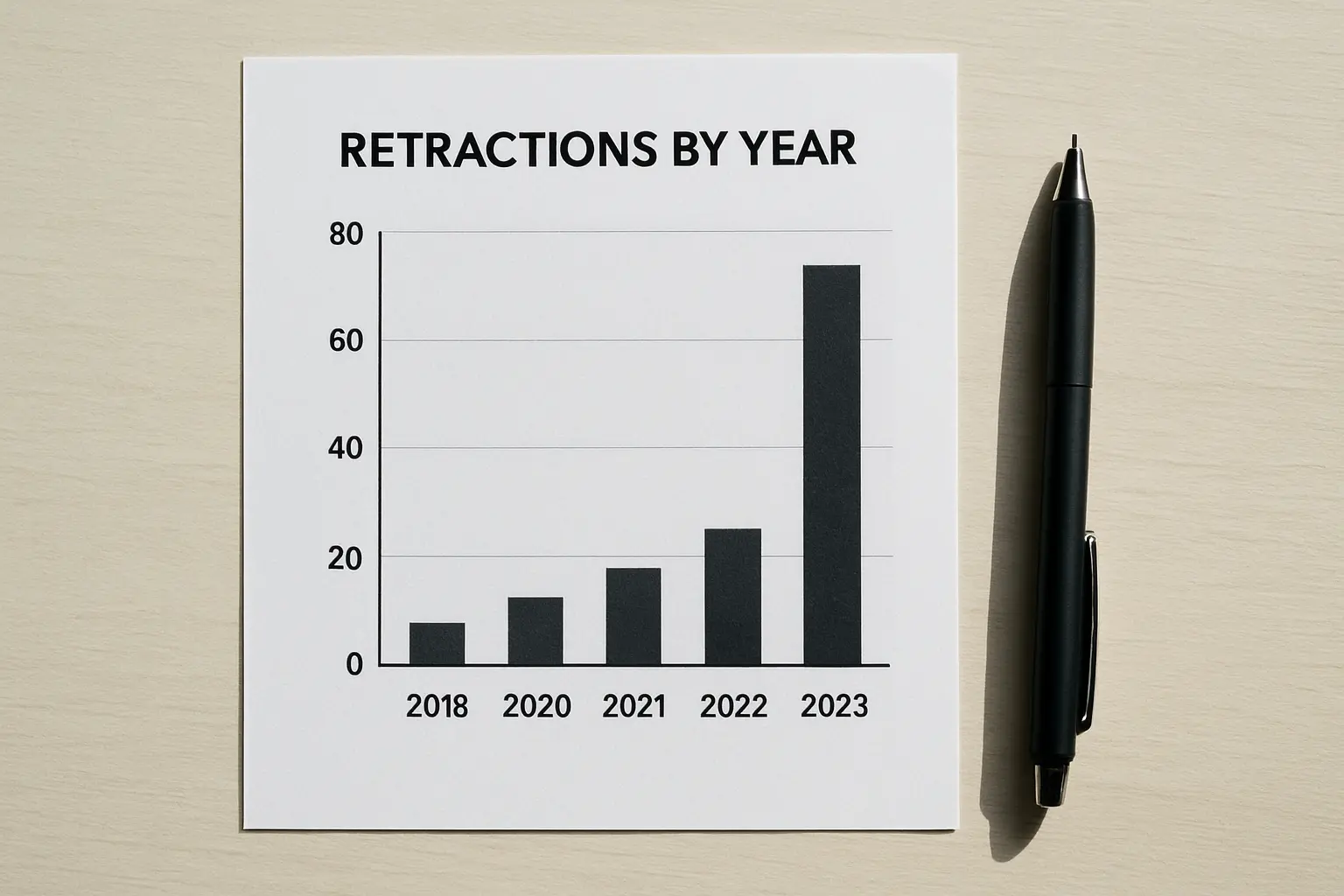
By year of the retraction notice, the Philippine records run: 2020 — 7 · 2021 — 23 · 2022 — 9 · 2023 — 53 · 2024 — 14 · 2025 — 9 · 2026 — 10 so far. The 2026 figure is a partial year and must be labelled as one if you quote it.
Caveat 1: the 2023 spike is one publisher, not a national trend
Fifty-three Philippine-affiliated retractions carry a 2023 notice date. Forty-nine of those 53 were published by Hindawi, and Hindawi accounts for 53 of the 132 records overall — forty per cent of the entire Philippine total from a single publisher. The original papers cluster on 2021 and 2022 (58 and 23 records respectively), which is the window of the compromised special issues that publisher later withdrew at scale.
So the correct sentence is not “Philippine retractions quadrupled in 2023”. It is “one publisher’s mass withdrawal of compromised special issues in 2023 accounts for 49 of the 53 Philippine-affiliated retractions notified that year”. A spike caused by a cleanup is evidence that the cleanup happened.
Caveat 2: the reasons are not what the search term assumes
Each record can carry several reasons. Across the 132 Philippine records:
| Reason recorded | Records |
|---|---|
| Investigation by journal or publisher | 91 |
| Unreliable results or conclusions | 77 |
| Concerns about referencing or attribution | 64 |
| Concerns about peer review | 53 |
| Paper mill | 45 |
| Computer-aided or computer-generated content | 40 |
| Compromised peer review | 31 |
| Plagiarism of or in the article | 15 |
Plagiarism is the eighth most common reason, not the first. The dominant story is paper mills and manipulated peer review — 38 of the 45 paper-mill records and 33 of the 40 computer-generated-content records carry a 2023 date, which is the same Hindawi cleanup seen from a different angle.
That distinction is worth carrying into your own writing. Copying text and buying a fabricated paper are different failures with different remedies, and a similarity checker only detects one of them — a limit set out plainly in the comparison of what a pre-check can and cannot see.
Caveat 3: the country field is author affiliation, not where the research happened
This is the caveat most likely to get you corrected at a defence. Retraction Watch lists every country appearing in the author affiliations, so a paper counts for the Philippines if any co-author was affiliated here. Only 22 of the 132 records list the Philippines alone; the other 110 are international collaborations in which a Philippine institution appears somewhere in the byline.
The same trap applies to every country-filtered bibliographic count, including the ones you would run in OpenAlex or Scopus for your Chapter 2 gap statement. Write “records naming an author affiliated in the Philippines”, which is what the data says, rather than “Philippine studies”, which it does not.
The subject spread reflects this: technology (38), data science (34), education (27) and computer science (27) dominate — fields where large international co-authorships and special issues are common — rather than the fields with the most Philippine fieldwork.
The part that affects your own thesis: do not cite a retracted paper
A retracted paper is still downloadable, still indexed, and still turns up in searches. Citing one is not misconduct on your part, but it is a hole in Chapter 2 that a panellist who happens to know the field will find, and it undermines every claim you built on it. Four checks, in the order of speed:
- Open the DOI, not the PDF you downloaded. Publishers place the retraction notice on the article landing page and usually stamp the PDF they now serve. A PDF saved months ago carries no such stamp. If the file came from a link somebody shared, resolve the DOI yourself.
- Look at what your database says. Google Scholar and most publisher platforms flag retracted items on the results page, so the warning is often visible before you click.
- Search the Retraction Watch database by DOI or title. It is the same source used above and it covers publishers whose own flagging is unreliable.
- Be sceptical of a paper in a mass-withdrawn special issue. If one paper from an issue was retracted, check the others you cited from it. That is exactly the shape of the 2023 cluster.
Run these while you are building the review, not at submission. The method for finding the literature in the first place is in the guide to writing the review of related literature; this is the screen you apply to what it returns.
What to do if you already cited one
Remove the citation and the claim it supported, then check whether the claim survives on your remaining sources. If it does, re-cite it. If it does not, the claim goes too — and if that claim was load-bearing for your research gap, you have found a Chapter 2 problem while there is still time to fix it. Do not cite a retracted paper “with a note”, unless your study is specifically about retractions.
If the removal changes your reference list, re-run the mechanical checks on the entries around it. A deletion is exactly when reference numbering and alphabetical order break, and those are the errors described in the guide to what to fix in generated APA references.
How to cite these figures
Name the database, the access route and the date you read it, because the file changes continuously — it grew by 27 records against a count published earlier the same week. A defensible sentence looks like this:
“As of 18 August 2026, the Retraction Watch database contained 132 records naming at least one author affiliated with a Philippine institution, out of 71,871 records worldwide (Retraction Watch, retrieved via Crossref, 18 August 2026).”
Do not write “132 Philippine papers have been retracted” without the affiliation qualifier, and do not present the 2023 figure without naming the publisher behind it. Both are the kind of overstatement that a single panel question dismantles — the same discipline the guide to Philippine higher education statistics applies to enrolment figures.
Keep every citation attached to the claim it supports
Tesify builds your chapters with each source tied to the sentence that uses it, so removing one paper shows you exactly which claims move with it instead of leaving a silent hole. Over 9,000 students have written more than 15,000 chapters with it, and every word is still written by you.
Frequently asked questions
Is there data on plagiarism cases in Philippine universities?
No national dataset exists. No Philippine agency publishes a count of academic-integrity cases and university disciplinary records are not public. The nearest citable figure is the retraction record: 132 records naming a Philippine-affiliated author as of 18 August 2026, of which 15 cite plagiarism.
How many papers with Philippine authors have been retracted?
132, out of 71,871 records worldwide, placing the Philippines 53rd among the 184 countries listed. Twenty-two of those records name the Philippines as the only country.
Why did Philippine retractions jump in 2023?
Because one publisher withdrew compromised special issues at scale. Forty-nine of the 53 Philippine-affiliated retractions notified in 2023 were Hindawi titles. It is a cleanup, not a change in national behaviour.
What is the most common reason for retraction?
An investigation by the journal or publisher, recorded on 91 of the 132 Philippine records, usually alongside unreliable results, peer-review concerns or paper-mill involvement. Plagiarism appears on 15.
What is a paper mill?
An operation that sells authorship on fabricated or recycled manuscripts. It is recorded on 45 of the Philippine records, 38 of them in 2023. A similarity checker does not detect it, because the text may be original.
Does a retraction mean the authors committed fraud?
Not necessarily. Papers are retracted for honest error, for problems introduced by a compromised peer-review process, and sometimes at the authors’ own request — objections by authors are recorded on 12 of the Philippine records. The database records the reason given; it does not assign blame.
Can I still cite a retracted paper?
Only if your study is about retractions. Otherwise remove it, and re-check whether the claim it supported survives without it.
How do I check whether a paper has been retracted?
Resolve the DOI and read the publisher’s landing page rather than a saved PDF, check whether your database flags it, and search the Retraction Watch database by DOI or title.
Is the Philippine figure high or low?
Neither, as stated. A raw count tracks how much a country publishes as well as how much is withdrawn, and it is inflated here by international co-authorships. Any comparison between countries needs a denominator, and this dataset does not supply one.
Where does this belong in my thesis?
In Chapter 1 as background if your study is about academic integrity, and in your own screening routine otherwise. If you also need counts of how much has been published on your topic, that is a different query with different pitfalls — see the comparison of the tools that produce those counts.
Does this dataset cover Philippine journals?
Only those indexed by the publishers Retraction Watch tracks. Local journals that issue no formal retraction notice will not appear, so the count is a floor, not a total.