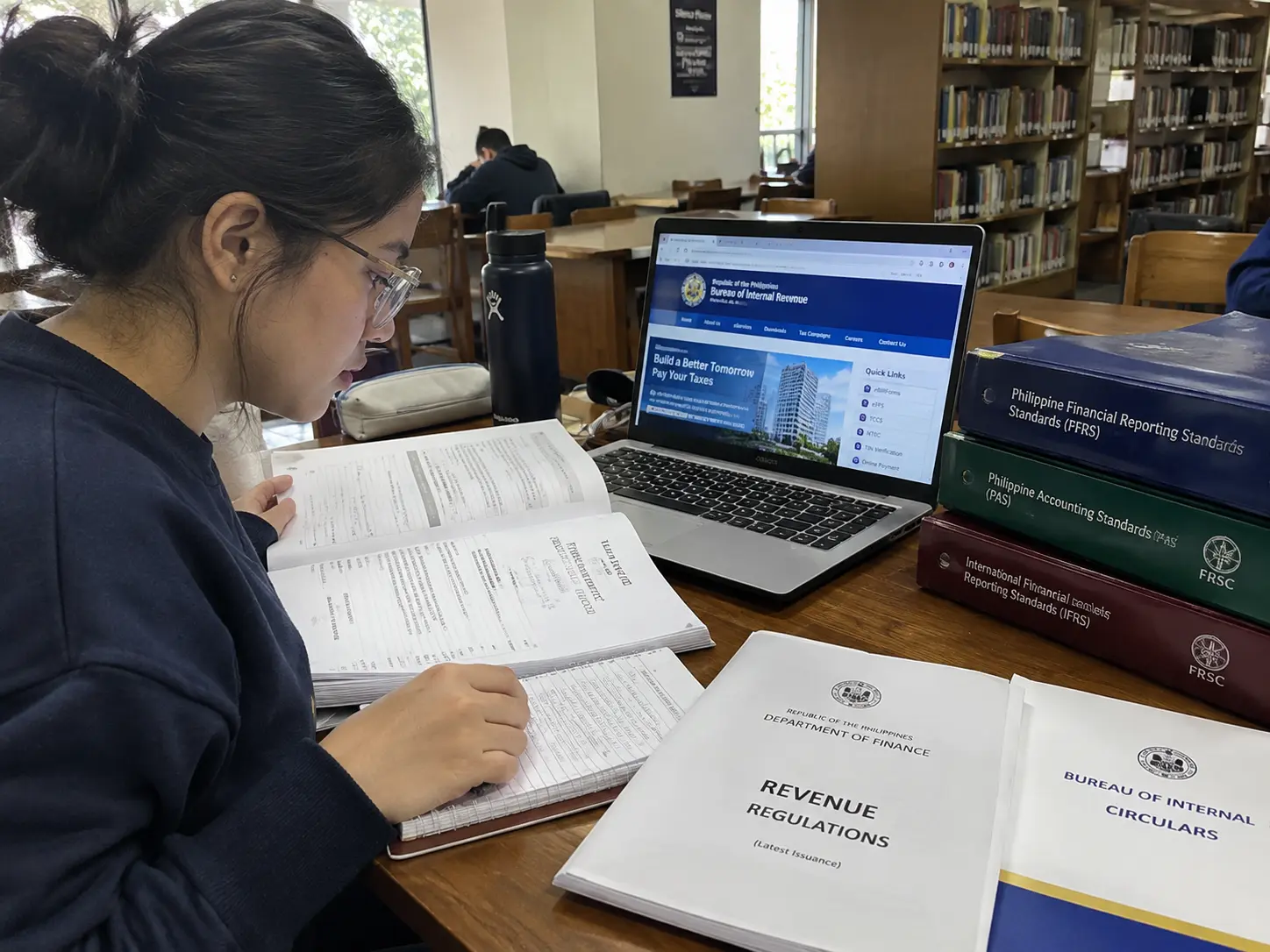
| Source | What it actually holds | Best for | The catch |
|---|---|---|---|
| BIR revenue issuances library (Revenue Regulations, Revenue Memorandum Circulars, Revenue Memorandum Orders, BIR Rulings) | The primary, binding interpretation of the Tax Code as amended — the actual rules a taxation thesis has to cite for any compliance or procedure claim | Any thesis on tax compliance, e-invoicing, VAT refund, withholding tax or an amnesty programme | Issuances are organized by year and number, not by topic — you search by keyword or browse the year you need, and a later issuance can quietly supersede an earlier one on the same subject |
| PICPA Journal of Accounting Theory and Practice | Philippine accounting and taxation research, published by the accountancy profession’s own national body | The literature review — Philippine-specific studies on tax compliance, tax morale, e-filing adoption | Issues are posted on PICPA’s own site as flipbooks; coverage of older issues varies, so check your school library for anything not online |
| Financial and Sustainability Reporting Standards Council (FSRSC) — PFRS/PAS standards | The Philippine Financial Reporting Standards (adopted from IFRS), including the deferred-tax and income-tax-accounting rules a tax-accounting thesis needs | Topics on book-tax differences, deferred tax assets and liabilities, or PFRS for SMEs tax-accounting treatment | Not a tax-law source — it governs how tax is reported in financial statements, not how much tax is owed |
| SEC Philippines company filings | Audited financial statements and general information sheets of registered corporations, which disclose income tax expense and effective tax rate | A case-study or comparative-firms taxation thesis that needs real (if aggregated) corporate tax figures | Individual filings are not always downloadable in full at no charge; some require a paid document request to the SEC |
| Philippine E-Journals and your own institutional repository | The general related-literature databases already used site-wide for locating Philippine studies across disciplines | Finding prior Philippine accountancy theses and journal articles on your specific taxation angle | Coverage is uneven by school and by year; a zero result does not mean no one has studied it — see the related-literature guide below |
Which source should a taxation thesis in accountancy actually use?
Start with the BIR’s own revenue issuances for any claim about what the law currently requires, use PICPA’s journal and the general Philippine literature databases for the review of related literature, and bring in FSRSC’s PFRS standards only when the thesis is really about tax-accounting treatment rather than tax law itself. The four sources are not interchangeable: the BIR tells you what taxpayers must do, PICPA and the literature databases tell you what has already been studied, FSRSC tells you how tax obligations are recorded in the books, and SEC filings give you real (if limited) numbers to work with in a comparative or case-study design. Mixing these up — citing a PFRS standard as if it were tax law, or citing a 2019 BIR issuance as current without checking for a later one — is the fastest way a Chapter 2 gets sent back.
1. The BIR’s revenue issuances: the primary source for tax-law claims
The National Internal Revenue Code, as amended by the TRAIN Law and the CREATE Act among others, is the statute. The Bureau of Internal Revenue then issues Revenue Regulations (implementing rules), Revenue Memorandum Circulars (clarifications and updates), Revenue Memorandum Orders (internal procedure that taxpayers still need to know, such as e-invoicing rollout schedules) and individual BIR Rulings (case-specific interpretations). For a thesis on any current compliance topic — VAT zero-rating documentation, withholding tax on professionals, the electronic invoicing system, estate tax amnesty extensions — the issuance is the citable source, not a summary you found on a tax preparer’s blog or a five-year-old forum post.
The practical habit: search the BIR’s own issuances by the specific topic and the most recent year first, then check whether an even more recent circular has updated or superseded it. A thesis that cites the original 2018 TRAIN Law implementing regulation without checking for the amendments since is citing an outdated rule, and a panel member who works in tax practice will know it.
2. PICPA’s journal and the general literature databases: for your review of related literature
The Philippine Institute of Certified Public Accountants publishes the PICPA Journal of Accounting Theory and Practice, the accountancy profession’s own research journal, alongside Accounting Times for professional news and commentary rather than research. For Philippine studies on taxpayer compliance behaviour, e-filing adoption or SME tax burden, this journal and the general Philippine literature databases — Philippine E-Journals and your own school’s repository — are where the prior studies your Chapter 2 needs actually live. How to search each of those databases, and what to do when a keyword returns nothing, is covered in the site’s general guide to where to find related literature for a Philippine thesis; this section adds only the taxation-specific starting point on top of that general method.
Once the related studies are gathered, they still have to be built into a Chapter 3 that a taxation panel can defend. The same discipline used in a worked internal-control matrix — the BSA accountancy consistency matrix, filled in — applies just as directly to a taxation variable such as compliance level or awareness score: every indicator has to trace to a real instrument item or a real BIR-defined category, not a plausible-sounding description. And once the instrument is built, matching the right test to a taxation sub-problem — level of awareness versus difference in compliance across firm sizes versus determinants of non-compliance — follows the same logic worked through in statistical treatment for a BSA accountancy thesis.
3. FSRSC and the PFRS standards: only for tax-accounting treatment
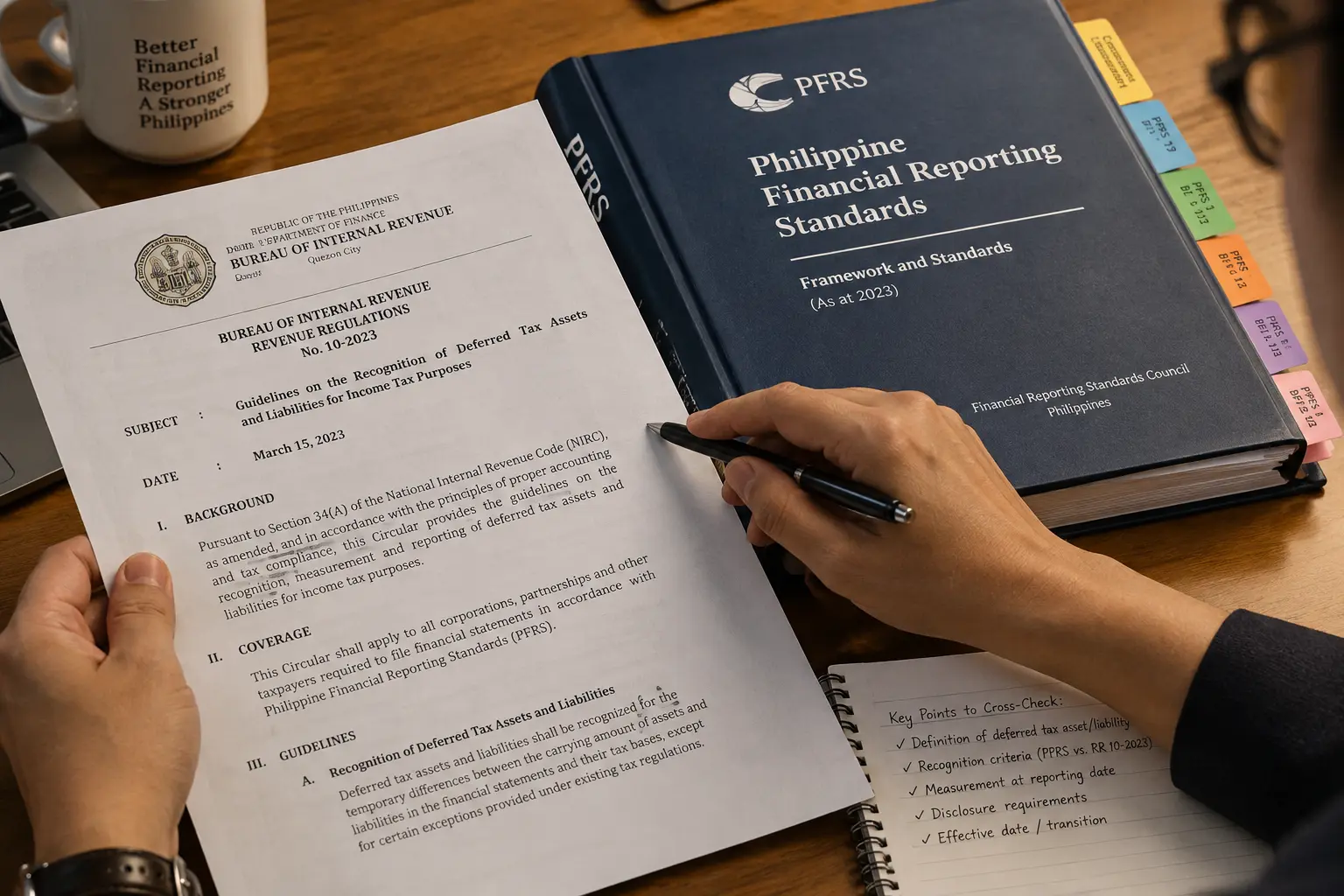
The Financial and Sustainability Reporting Standards Council — renamed from the Financial Reporting Standards Council in 2022 and operating under the authority of the Board of Accountancy — sets the Philippine Financial Reporting Standards: the Philippines’ adoption of International Financial Reporting Standards, plus a simplified PFRS for Small and Medium-sized Entities and a further-simplified PFRS for Small Entities. These standards govern how a business records its income tax expense, deferred tax assets and liabilities and the reconciliation between accounting profit and taxable income. A thesis asking how MSMEs in a locality account for deferred tax, or how PFRS for SMEs adoption affected reported tax expense, cites the FSRSC’s standards directly. A thesis asking whether a taxpayer is entitled to a deduction cites the BIR and the Tax Code instead — the two source types answer different questions and a panel will ask which one your research question actually needs.
4. SEC company filings: real numbers for a comparative design
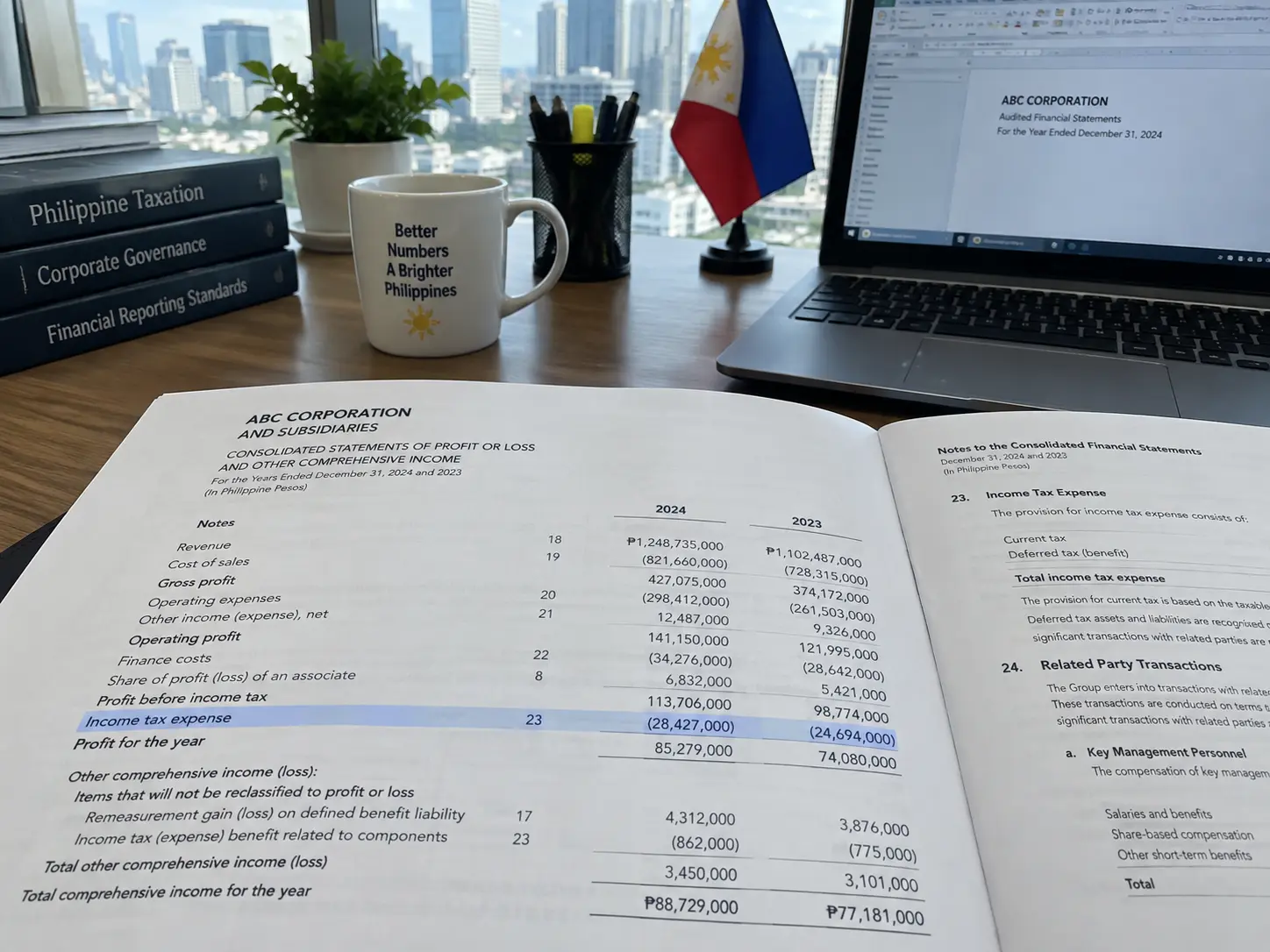
The Securities and Exchange Commission holds the audited financial statements and general information sheets that Philippine corporations are required to file, which disclose income tax expense, effective tax rate and, in the notes, the deferred tax position. For an undergraduate thesis comparing the effective tax rates of several listed or registered companies in one industry, SEC filings are the closest thing to open data this topic has — cite the specific company, the fiscal year and the exact statement (audited financial statements, not a press release) rather than an aggregated industry figure you cannot trace back to a filing.
What each source actually costs a thesis group to access
Reading a published BIR issuance or a PICPA journal issue online costs nothing, but real costs still show up along the way. The BIR’s own issuances library is openly searchable; the cost is time, since a topic-specific search across years of circulars is slower than a keyword search on a modern database. PICPA’s journal issues are posted on its own site, while older material and technical-standards resources are more readily reached through a school library than through an individual non-member account, so check with your research office before assuming you need your own membership. SEC company filings are openly browsable at a summary level, but a full certified copy of an individual company’s audited financial statements sometimes requires a paid request through the SEC’s own request channel — budget a small amount and a few working days’ lead time if your comparative design needs several companies’ full statements rather than just the headline figures already visible in a summary.
Five taxation thesis topics these sources can support
- Compliance costs of the electronic invoicing system among a sample of registered taxpayers. BIR issuances for the rollout schedule and requirements; a taxpayer survey for the primary data.
- Effective tax rate comparison of listed companies in one industry, before and after the CREATE Act. SEC audited financial statements for the figures; the CREATE Act’s own text for the rate change.
- Deferred tax reporting practices of MSMEs adopting PFRS for SMEs. The FSRSC’s PFRS for SMEs standard for the accounting rule; a survey or document review of MSME financial statements for the primary data.
- Taxpayer awareness and use of the estate tax amnesty among heirs in a selected locality. The amnesty law and its implementing BIR issuance for the rules; a respondent survey for awareness levels.
- Withholding tax compliance among self-employed professionals in a selected city. The relevant BIR revenue regulation on professional withholding; a survey of practising professionals.
How to cite these in APA 7th
Two patterns cover almost every citation a taxation thesis in this vertical needs. For the statute or a BIR issuance, cite the issuing body as author: Bureau of Internal Revenue. (Year). [Issuance type and number]: [subject]. For the accounting standard: Financial and Sustainability Reporting Standards Council. (Year). Philippine Financial Reporting Standard [number]: [title]. For the PICPA journal, cite it as you would any journal article, author and year first, with the journal name in the reference entry rather than the institute’s name. Whichever pattern applies, name the specific issuance number or standard number — “BIR issuances” alone, with no number, is not a citation your panel can verify.
Keep your tax-law and tax-accounting citations straight from the first draft
Tesify helps you structure the literature review around the taxation sources you actually use — BIR issuances, PICPA’s journal, the FSRSC’s standards, SEC filings — so tax-law claims and tax-accounting claims stay attributed to the right body throughout. Over 9,000 students have used it to write more than 15,000 chapters, and every word is still written by you.
Frequently asked questions
Can I use a tax preparer’s blog or YouTube explainer as a source?
Not as the citation for a rule itself — trace the claim back to the actual BIR issuance or the statute and cite that. A blog or video is fine as a pointer to where the rule lives, never as the reference entry.
How do I know if a BIR issuance I found is still current?
Search the BIR’s own issuances list for the same subject in more recent years before you finalize your citation; a later circular can clarify, amend or supersede an earlier one on the same topic without formally repealing it.
Is PFRS the same thing as the Tax Code?
No. PFRS governs financial reporting — how a company’s books present its results, including tax expense. The Tax Code, as amended, and the BIR’s issuances govern how much tax is actually owed. A thesis conflating the two will be asked to separate them.
Where do I find a company’s income tax expense for a comparative study?
In its audited financial statements filed with the SEC, specifically the income statement and the tax-related notes to the financial statements, not in a press release or a summary article.
Does PICPA’s journal require membership to access?
Check with your school library first — many Philippine university libraries carry accountancy journals through institutional subscriptions or repositories before you need an individual PICPA membership.
Can a taxation thesis use only secondary data, with no survey?
Yes, if the design is documentary or comparative — SEC filings and BIR issuances alone can support a documentary-analysis thesis. If the research question is about taxpayer behaviour or awareness, though, you need primary data from actual respondents.