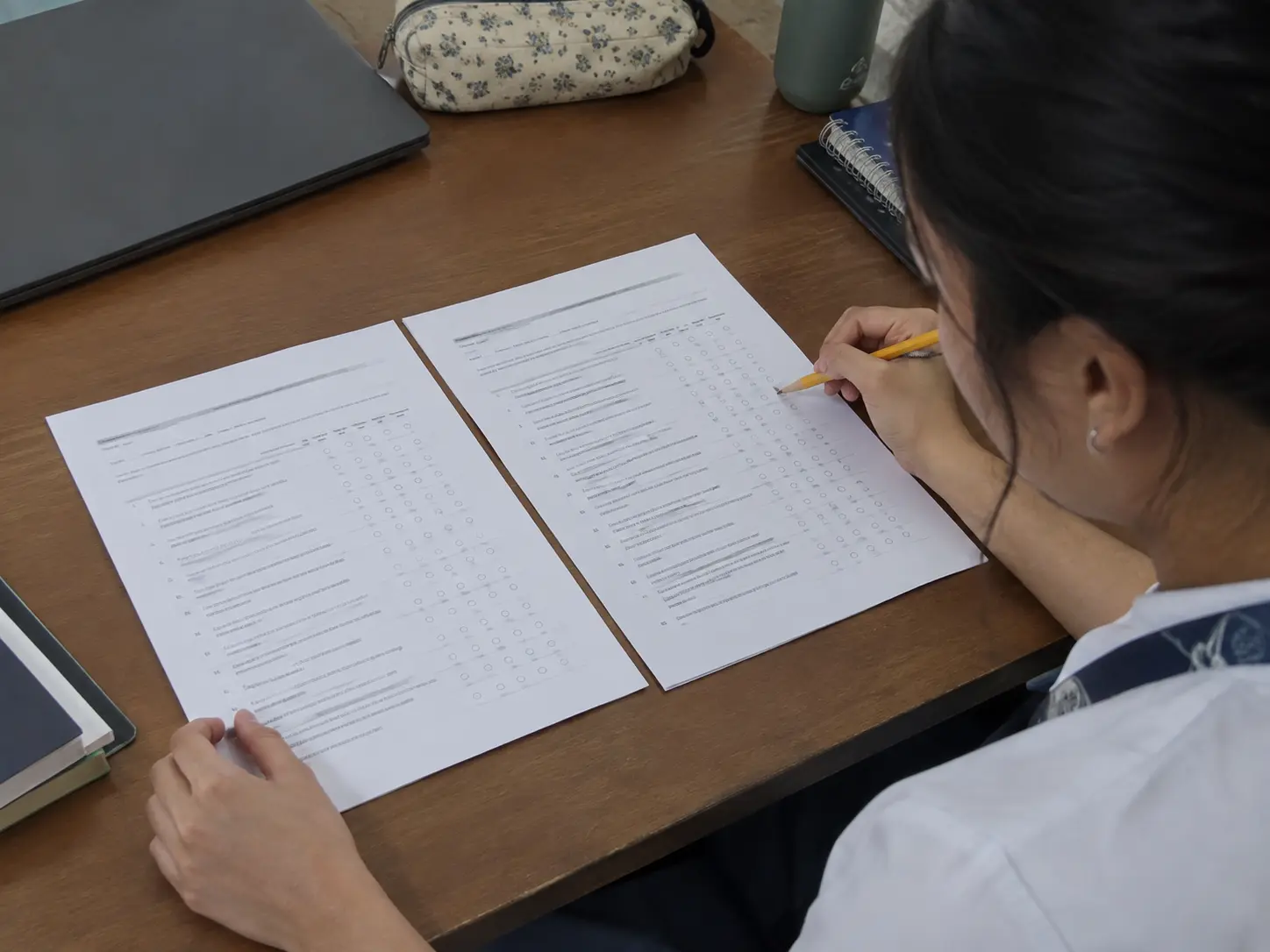
To translate a foreign scale for a Philippine psychology thesis, get the developer’s permission, have two translators produce independent Filipino versions, reconcile them, back-translate to English, review the result with experts, pretest on a few respondents, then run a pilot and report your own reliability coefficient. Each step leaves a document your panel can inspect.
Why does a translated scale need its own validation?
A scale validated in English, in another country, tells you nothing about how Filipino respondents will understand its words. Items can lose meaning, carry a different tone, or refer to experiences that are unfamiliar. So the validity and reliability evidence belongs to the version, not just to the original. If you simply translate the items and report the original authors’ alpha, a panelist will ask what evidence you have that your Filipino wording measures the same thing. This guide gives you that evidence, step by step.
The general steps of validating a researcher-made questionnaire are in research instrument validation for a Philippine thesis. This article covers what is different when the instrument already exists in another language, and you are adapting it. If you are still deciding which scale to adopt, start with choosing a standardized scale for a BS Psychology thesis.
Step 1: Check whether a Filipino version already exists
Do this: search Europe PMC, PubMed, Google Scholar and the Philippine E-Journals platform for the scale’s name plus “Filipino” or “Tagalog.” Also ask the scale’s publisher or corresponding author. Try strings such as “Filipino version” AND “[scale name]” and “translation” AND “validation” AND Philippines.
Expected output: a one-paragraph note in your RRL or Chapter 3: either “no validated Filipino version was found in the sources searched” or a citation to the existing version and its psychometric evidence. If one exists and fits your sample, using it is usually stronger than making your own, and the translation steps below can be reduced to a short pilot.
Step 2: Ask for permission and check the terms
Do this: email the developer or the publisher before translating. Say who you are, your school, your topic, that you plan a Filipino translation for a thesis, and whether the translated version may be shared or published. Keep the reply.
Expected output: a permission email or license page you can cite in an appendix. In the Philippine example used later in this guide, permission to translate was obtained from the tool’s developers before any translation began. Some scales are free for research, some need a fee, and some restrict translations. The terms differ, so never assume.
Step 3: Produce two independent forward translations
Do this: ask two bilingual translators to translate the scale from English into Filipino separately, without comparing. The standard guideline for adapting self-report measures, by Beaton, Bombardier, Guillemin and Ferraz (Spine, 2000, volume 25, issue 24, pages 3186 to 3191), uses this kind of independent forward translation. Ideally one translator knows the concept being measured and one does not. The second reflects the everyday language of ordinary respondents.
In the Philippine example, one forward translator was a licensed physical therapist and the other a university instructor and representative of the Sentro ng Wikang Filipino with no medical background. The first gave clinical equivalence, the second reflected the language the population actually uses. You can copy the idea: a psychology-trained translator plus a language specialist.
Expected output: translation version 1 and version 2, plus each translator’s notes on difficult items.

Step 4: Reconcile them in a synthesis meeting
Do this: meet with both translators and a person who records decisions. Go item by item. When the two versions differ, discuss why and choose one wording, or write a third. Use a table with four columns: original item, version 1, version 2, agreed version and reason.
Expected output: a single reconciled Filipino version and a record of every change and dispute. In the Philippine study, the translators and a recording observer met to synthesise their versions and documented the rationale for changes on translation and synthesis forms. The record is what makes your procedure auditable.
Step 5: Back-translate into English
Do this: give the reconciled Filipino version to two other translators who have not seen the original and ask them to translate it back into English. Back-translation is an old, widely used check in cross-cultural research, associated with Brislin’s 1970 paper “Back-Translation for Cross-Cultural Research” in the Journal of Cross-Cultural Psychology (volume 1, issue 3, pages 185 to 216).
Expected output: two English back-translations to compare against the original. They do not need to match word for word. What you are checking is whether the meaning survived. If a back-translation is far from the original item, the Filipino wording probably drifted. The Philippine team noted that its back-translators did not translate word for word in some items to keep them understandable, and that the back-translations were consistent with the original according to the consensus committee. A limit of the method is that a Filipino item can be poor and still back-translate well, which is why the next two steps are needed.
Step 6: Review with an expert committee
Do this: convene your adviser, a language expert, and one or two people with content knowledge, and give them the original, the Filipino version and the back-translations. Ask them to judge whether each item means the same thing in Filipino. The Beaton guideline asks this committee to consider semantic, idiomatic, experiential and conceptual equivalence. In plain terms: same meaning, same idiom or a fair substitute, same kind of everyday experience, and the same concept.
Expected output: a prefinal Filipino version and a list of items that were adapted rather than translated, for example an item about winter, a clock-in routine or an example that does not exist in the Philippines.
Step 7: Check content validity with experts
Do this: send the prefinal version to experts with a validation sheet. In the Philippine example, experts rated each item on a yes or no scale for clarity and a four-point scale for relevance, with a comment box. The study reported content validity indices from 0.80 to 0.97 at the scale level, and inter-rater agreement kappa values from 0.82 to 1.00.
Calculate the item-level content validity index as the share of experts who rate the item relevant, then average across items. Your school may set a cut-off, so check your research manual before you decide which items to keep.
Expected output: a content validity table, with item-level results and a short note on every revised item. The number of experts is not fixed. The Philippine example used six clinical experts. Use what your adviser and manual require.
Step 8: Pretest with a handful of respondents
Do this: give the prefinal version to a few people from your target population, then ask what each item meant to them in their own words and which words were hard. This is called cognitive debriefing. The Philippine study pretested with 12 participants. Note the findings: a few Tagalog words were a barrier for some respondents, which is a useful reminder to avoid formal or obscure vocabulary in your translation.
Expected output: a list of confusing words, with the replacements you chose.

Step 9: Run a pilot and report your own reliability
Do this: administer the final Filipino version to a pilot sample that is not part of your actual respondents, and compute Cronbach’s alpha for the scale and for each subscale. The Philippine study piloted with 47 participants from the same population and reported a Cronbach’s alpha of 0.87. That tool is a physiotherapy pictorial guide, not a psychology scale, so treat it as an example of procedure, not a benchmark for your coefficient.
Expected output: an alpha value for your version and an interpretation sentence. If it is low, inspect which items lower it, re-check their translation, and report what you changed.
Before piloting, secure the same permissions you would for the main study: a signed consent, a clear explanation, and compliance with the Data Privacy Act of 2012. The consent steps for sensitive topics are discussed in ethics and consent in a Philippine thesis.
Step 10: Write the methods paragraph
Here is a template. Fill every bracket with your own facts and delete what you did not do. It is a labelled fill-in, not a finished claim:
“The [scale name] by [author, year] was translated into Filipino with the developer’s written permission. Two bilingual translators independently produced forward translations, which were reconciled in a synthesis meeting. Two other translators, blind to the original, produced back-translations. An expert committee composed of [roles] reviewed the equivalence of the versions. [Number] experts rated content validity, and [number] respondents from the target population took part in a pretest. A pilot with [number] respondents showed a Cronbach’s alpha of [value]. The adaptation followed the procedure of Beaton et al. (2000).”
Then add the permission letter, the translation table, the back-translations, the validation sheet and the pilot data summary to your appendices. Your reference list should include the guideline you followed, for example Beaton et al. (2000), and the original scale’s publication. For how to fit this into the rest of your methods chapter, see the chapter guide on how to write Chapter 3.
What mistakes make panels reject a translated scale?
- Translating alone, with a single translator and no back-translation or expert review.
- Reporting the original authors’ reliability as if it belonged to your Filipino version.
- Writing the translation in a formal register that your respondents do not use.
- Dropping or rewording items without recording why.
- Skipping permission, then being unable to show the developer’s terms when the panel asks.
Frequently asked questions
Do I have to translate the scale at all?
Only if your respondents cannot answer the original language reliably and no validated Filipino version already exists. If a published Filipino version exists, cite it and report its reliability in your own sample.
Can I just use Google Translate and have a friend check it?
That is not a defensible procedure for a thesis. Panels expect independent forward translations, a back-translation and some form of expert review, and a record of what changed.
Is a translation the same as an adaptation?
No. Translation moves the words into Filipino. Adaptation also checks that the meaning, idioms and examples make sense in Philippine culture, which sometimes means changing an item.
Which language counts as Filipino: Tagalog or the national language?
Filipino is the national language and is based mainly on Tagalog. Choose the register your respondents actually read, and state it in your methods chapter. If respondents speak another language, say so.
How many expert validators do I need?
Your research manual or adviser decides. The Philippine example in this guide used six clinical experts for content validation, but that is one study’s choice, not a rule.
Do I need to run a factor analysis?
Not unless your objectives claim to test the factor structure. For most undergraduate theses, expert validation, a pretest and a reliability coefficient are the expected minimum. Ask your adviser.
What if my reliability coefficient is low?
Report it honestly, inspect the items that lower it, revisit the translation of those items, and say what you changed. Do not delete items silently.
Can I publish or share my Filipino version?
Only as far as the original developer’s terms allow. Ask in your permission request whether the translated version may be shared, and note the answer in your thesis.
Source of the Philippine example: Arboleda J, Ignacio S, Mojica JA, Leochico CF. Linguistic validation and cross-cultural adaptation of the Shoulder Telehealth Assessment Tool for Filipino patients with musculoskeletal shoulder condition. JMIR Rehabilitation and Assistive Technologies, 2026, e67974 (open access, PMC12818489).
Document your instrument steps as you go
Tesify helps you structure Chapter 3, including the instrument, validation and reliability paragraphs. Over 9,000 students have used Tesify across more than 15,000 chapters, and the thesis stays 100% written by you.