A social work thesis in the Philippines needs clearance from the school’s research ethics committee before data collection, a written informed consent form that discloses the study’s purpose and the respondent’s right to withdraw, and — because social work respondents are often children, survivors of abuse, indigenous community members or people in crisis — extra protocols on top of the standard consent form: parental or guardian consent for minors, Free and Prior Informed Consent (FPIC) through the National Commission on Indigenous Peoples for indigenous communities, and strict confidentiality on any case information covered by the Data Privacy Act of 2012 (RA 10173). Panels in social work programs treat the ethics section as seriously as the methodology itself, because the profession’s own licensure law and code of ethics make client protection non-negotiable.
This answer covers what the university ethics review actually checks, what an informed consent form needs, the added protections for minors and indigenous respondents, how the Data Privacy Act applies to case records and interview data, and the mistakes that most often send a social work proposal back to the ethics committee. The rationale for every safeguard you name here eventually feeds the significance of the study, in the structure described in what the significance of the study should contain.
What ethics review does a social work thesis go through before data collection?
Most Philippine social work programs route an undergraduate or graduate thesis through two layers before a single respondent is contacted. First, the adviser and panel review the proposal at Chapter 3, checking that the data-gathering procedure names an ethics safeguard for every vulnerable group in the sample. Second, many schools — particularly where the study touches minors, persons with disabilities, or clients of a partner agency such as a DSWD-accredited center — route the proposal through a formal research ethics committee (REC) or institutional review board separate from the thesis panel, which can request revisions to the consent form, the interview guide, or the sampling plan before issuing clearance.
Where the fieldwork happens inside a partner agency — a barangay social welfare office, a residential care facility, a court-referred program — the agency’s own gatekeeper approval sits alongside the school’s clearance; a letter from the agency head permitting access to clients or records is not optional, and reviewers ask for it explicitly. The ethics section belongs inside Chapter 3, following the structure covered in how to write Chapter 3 research methodology.
What must an informed consent form for a social work thesis include?
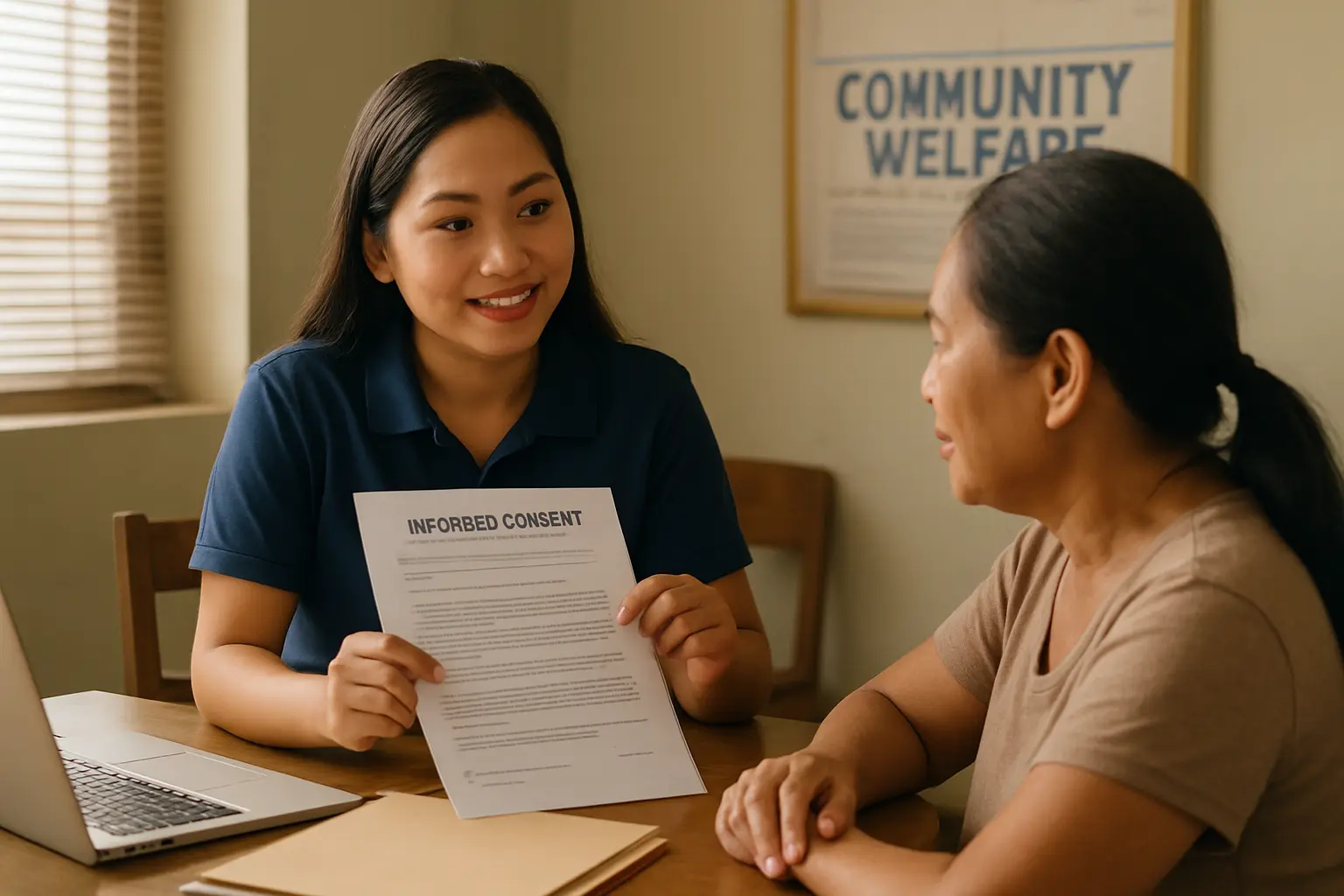
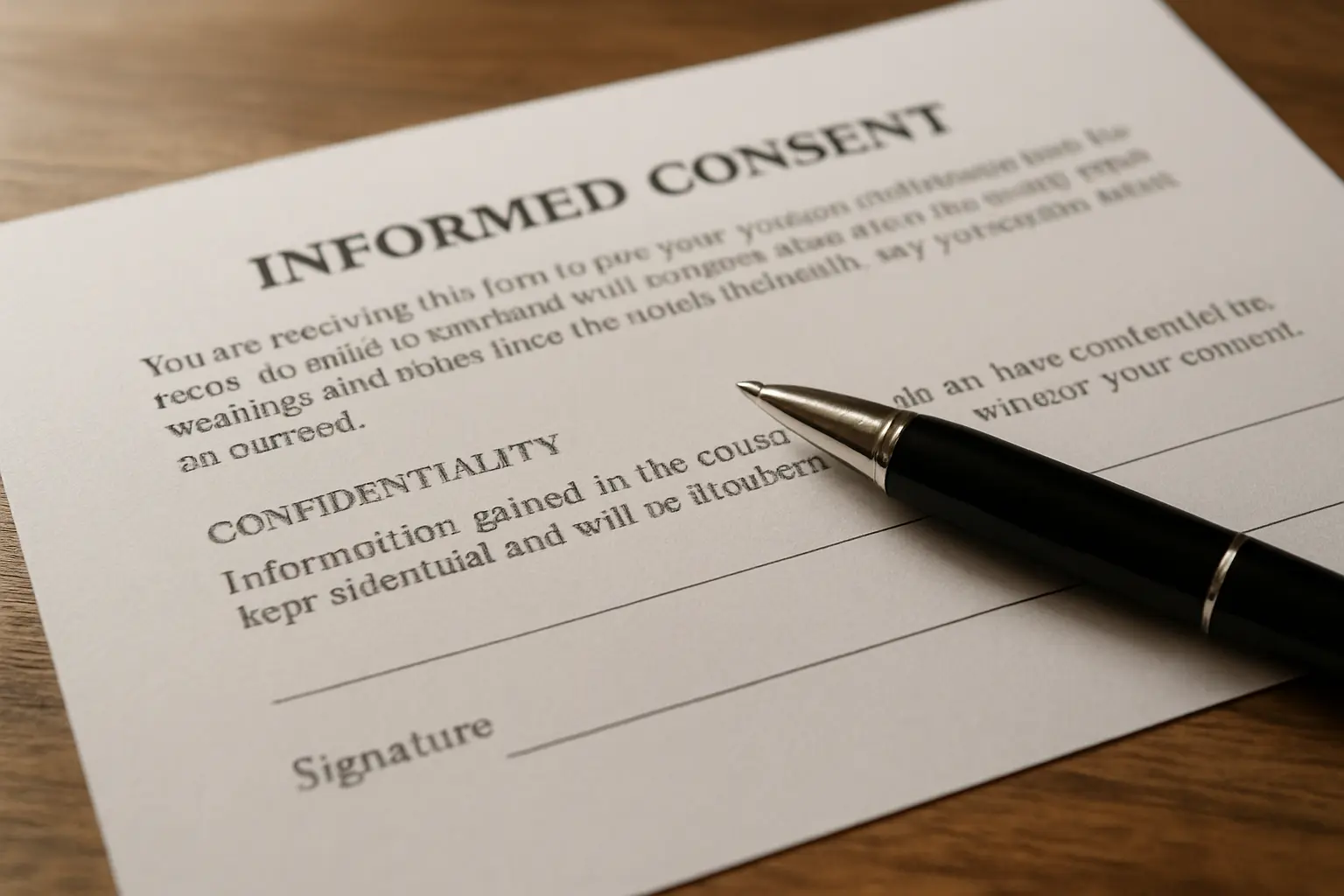
A consent form that satisfies a Philippine social work ethics committee states, in plain language the respondent can actually understand: the purpose of the study, what participation involves and how long it takes, that participation is voluntary and can be withdrawn at any point without penalty, how confidentiality will be protected (pseudonyms, locked or encrypted storage, who will and will not see the raw data), any foreseeable emotional risk from discussing sensitive experiences and where the respondent can seek support if the interview brings up distress, and the researcher’s and adviser’s contact details. A signature line, or a thumbprint with a witness where literacy is a barrier, closes the form.
Because much of social work research asks about family conflict, abuse, poverty or illness, the risk-disclosure clause is not boilerplate — reviewers expect the researcher to have thought through what happens if a respondent becomes distressed mid-interview, and to have a referral pathway ready (the agency’s own social worker, a hotline, a follow-up visit) rather than improvising on the spot.
What extra protections apply when respondents are children?
Republic Act No. 7610, the Special Protection of Children Against Abuse, Exploitation and Discrimination Act, is written to protect children from harm and exploitation rather than to lay out a research-consent procedure, but its confidentiality principle carries directly into thesis fieldwork: Section 29 allows the offended party’s name to be withheld from the public, and the law bars media-style sensationalised publicity of a child’s case. A social work thesis that discusses a minor’s abuse or welfare case should apply the same standard on its own initiative — no real name in the manuscript, no identifying photograph, and case details altered enough that the child cannot be recognised by someone who knows the family, even though the law does not spell out a thesis-specific rule.
On top of that self-applied confidentiality standard, minors need parental or guardian consent in addition to the child’s own assent, and the ethics committee typically asks to see both forms. Where the child is already under DSWD protective custody per Section 28 of RA 7610, the researcher needs the facility’s own clearance before any contact, on top of the school’s.
What is Free and Prior Informed Consent, and when does a social work thesis need it?
Free and Prior Informed Consent (FPIC) is defined under Section 3(g) of the Indigenous Peoples’ Rights Act of 1997 (RA 8371) as the consensus of the members of an indigenous cultural community or indigenous peoples’ group, reached through their own customary decision-making process, free of external pressure, after the researcher has fully disclosed the study’s intent and scope in a language and manner the community understands. Section 59 of the same law requires FPIC before any government agency issues a certificate or permit for an activity affecting an ancestral domain, and the National Commission on Indigenous Peoples (NCIP) is the body that certifies FPIC compliance.
A social work thesis studying an indigenous community — a tribal welfare program, an ancestral-domain resettlement case, a culturally specific family structure — needs FPIC obtained through the community’s recognised leadership, not a consent form signed by individual respondents alone, and should budget real time for it: FPIC is a community process, not a one-visit signature. Where the study only interviews individual members of an indigenous community outside any activity inside the ancestral domain itself, schools vary in whether they require full FPIC or accept community-leader endorsement plus individual consent — confirm this with the adviser and the school’s ethics committee before finalising the sampling plan, because scoping the wrong requirement in Chapter 3 costs weeks later.
How does the Data Privacy Act apply to a social work thesis?
The Data Privacy Act of 2012 (RA 10173) classifies information about a person’s health, education, or involvement in a case as sensitive personal information under Section 3(l), which by default needs the data subject’s specific consent before processing under Section 13(a). Section 19 gives a narrower exception for information used only for scientific and statistical research, where no decision is made about the individual and the data stays under strict confidentiality — a provision that supports a thesis using de-identified case-file data for pattern analysis, but does not remove the need for consent when the researcher is interviewing identifiable respondents directly. Section 16 also gives every respondent the right to know what data is held about them, to correct it, and to have it destroyed if it was collected unlawfully or is no longer needed — rights a consent form should mention in plain terms, not just cite by section number.
In practice this means: store transcripts and case notes with real names separated from the data as soon as possible (a coded participant list kept apart from the interview data), state a retention and disposal timeline for raw data in the consent form, and never quote a case file verbatim in the thesis text without the confidentiality treatment already applied to the interview data. Where consent itself has to be re-obtained mid-study because a respondent’s household could not be located again, the practical fallback follows the same logic used when questionnaires come back incomplete: document the gap, do not fabricate the missing response, and disclose the limitation in Chapter 5.
What common ethics mistakes get a social work proposal sent back?
A consent form written in academic English for respondents who are more comfortable in Filipino or a regional language — reviewers ask for a translated version, not just an English one with a verbal explanation promised. A study that names a partner agency’s clients as a sampling frame without a signed gatekeeper letter from the agency head. An interview guide that asks about abuse, trauma or family conflict with no stated referral pathway if a respondent becomes distressed. A sample that includes minors with no separate parental consent form on file. And a proposal that treats FPIC as a formality rather than a community process, underestimating how long it takes and scheduling data collection before it is realistically obtainable. Each of these is exactly the kind of gap a panel raises at the defense, and each is far cheaper to fix in Chapter 3 than after fieldwork has already started.
Where the design is a small number of in-depth case studies rather than a survey — common in social work — the sample-size logic follows how many respondents a qualitative thesis needs, and the same access-and-ethics planning that governs interviews with officials in a neighbouring social science, described in which research design a criminology thesis should use, transfers directly to interviews with vulnerable individuals.
Draft your ethics section without missing a required clause
Tesify drafts the data-gathering procedure and ethics section of Chapter 3 from the population you describe, prompting for the consent-form clauses, gatekeeper letters and vulnerable-group protocols your specific respondents require, in the structure Philippine social work programs expect. Over 9,000 students have used it to write more than 15,000 chapters, and every word is still written by you.
Frequently asked questions
Does every social work thesis need a separate ethics committee, or is the panel enough?
It depends on the school. Some route every proposal touching human respondents through a dedicated research ethics committee separate from the thesis panel; others fold ethics review into the Chapter 3 panel defense itself. Confirm which applies with the adviser before finalising the data-gathering timeline, since a separate committee adds real weeks.
Can I interview minors without their parents’ consent if the child agrees?
No. A minor’s own assent to participate does not replace parental or guardian consent; Philippine ethics committees require both forms on file before any interview with a child proceeds.
What if my respondents are inside a DSWD-run facility?
You need the facility’s own written clearance in addition to the school’s ethics approval, and the facility will typically set its own conditions — a staff member present during interviews, no recording of certain sessions, or restricted access to residents’ full case histories.
Is Free and Prior Informed Consent the same as individual informed consent?
No. FPIC under RA 8371 is a community-level process reached through the indigenous community’s own customary decision-making structure, obtained through the National Commission on Indigenous Peoples; it does not replace the individual consent form each respondent still signs.
Can I use real case files from my internship agency for my thesis?
Only with the agency’s written permission and, in most cases, with identifying details removed or altered before the data leaves the agency’s premises, consistent with the confidentiality expectations of the Data Privacy Act and standard social work practice.
What happens if a respondent becomes upset during an interview?
Stop the interview, check on the respondent’s wellbeing, and use the referral pathway named in your ethics protocol — typically the partner agency’s own social worker or a crisis line. Ethics committees expect this plan to be written into the proposal in advance, not improvised.
Do I need consent from the barangay if my study is conducted there?
Most schools require a courtesy letter to the barangay captain or council in addition to individual respondent consent, especially where the study involves door-to-door data collection or identifies specific households, even though barangay consent does not substitute for the respondents’ own.
How long should I keep my raw interview data after the thesis is submitted?
State a specific retention period and disposal method in your consent form and follow it; a common practice is to keep de-identified data for a fixed period the school specifies and to securely delete audio recordings and identifying information once the thesis has been graded and archived.