Your OJT or practicum report and your design thesis are two different documents that get graded by two different standards, and submitting one in place of the other is the single fastest way to fail a title defense — but the months you spent at a firm are not wasted, because the case studies, the building type exposure, and the site you got to know all convert into real thesis material. Here is what actually carries over, and what does not.
Why “I already wrote 200 hours of reports” does not mean your thesis is halfway done
An OJT or practicum report is a narrative of what you did and observed at the firm — the drawings you helped produce, the site visits you assisted on, the software you learned, the office workflow you were part of. A design thesis is a self-authored design proposal: your own site, your own building program, your own design concept, argued and defended across a Chapter 1 to 5 manuscript paired with a design output, the structure the site’s own architecture thesis structure guide covers in full. A panel reading a manuscript that reads like an extended OJT journal — heavy on what the firm did, light on your own original design reasoning — will send it back regardless of how many hours went into the writing, because authorship is the entire point of a design thesis in a way it is not for a practicum report.
What from your OJT genuinely transfers
Four things carry over cleanly, and none of them is the report text itself. Building-type exposure — if your firm specialized in a typology (hospitality, healthcare, mixed-use residential), you now have working knowledge of that typology’s spatial program, code requirements and common design problems that most classmates choosing the same typology cold do not have. Case-study material — a project you observed being designed, documented or built is a legitimate case study for your thesis’s related-literature or precedent-study section, cited properly rather than presented as your own design. Site familiarity — if your firm’s project sites are in an area you now know well, that local knowledge (access, zoning quirks, community context) is a real head start on site selection and site analysis. Professional contacts — a supervisor or architect willing to be a key-informant interview, or to grant access to a site or building for documentation, is often easier to arrange through an OJT relationship than cold. None of these four require the OJT report document itself to survive into the thesis — they are knowledge and relationships you carry in your own head and your own contacts list, which is exactly why they transfer even though the report text cannot.

What does not transfer, and where students get this wrong
The firm’s own design work is not your design work, even if you drafted it, rendered it, or sat in the client meetings — presenting a project you assisted on as your own original thesis design proposal is an authorship problem a licensed architect on your panel will recognize immediately, because they have seen the same drawing style and program logic in professional practice before. Confidential client information — budgets, unreleased floor plans, internal cost breakdowns — stays confidential regardless of how directly it would strengthen your case study; if your OJT agreement or your supervisor has not explicitly cleared a piece of information for academic use, leave it out or ask first. And the OJT report’s own narrative voice — first-person, chronological, week-by-week account of daily tasks — does not belong in a thesis manuscript, which is written in the structure and register a Chapter 1 to 5 format expects, not as a work log.
Turning a firm case study into your Chapter 2
A case study cited properly names the project, the firm or architect of record, the location, and the specific design lesson your thesis is drawing from it — how the building solved a circulation problem your own site shares, for instance, or how a particular material or system responded to a climate condition relevant to your own design. Ask your supervisor, in writing if possible, whether the firm is comfortable being named as the source and whether any photographs you took on-site can be used in an academic manuscript; most firms say yes to general design-lesson citation and say no only to reproducing actual construction documents or unreleased renders. Where permission is unclear or declined, describe the lesson from published or publicly visible material instead — the exterior form, the site relationship, anything observable from the street — rather than using material you were not cleared to share. Treat every case study the way the site’s related-literature guide treats a secondary source: named, dated, and clearly separated from your own original contribution.
Starting the actual design thesis, now that OJT is behind you
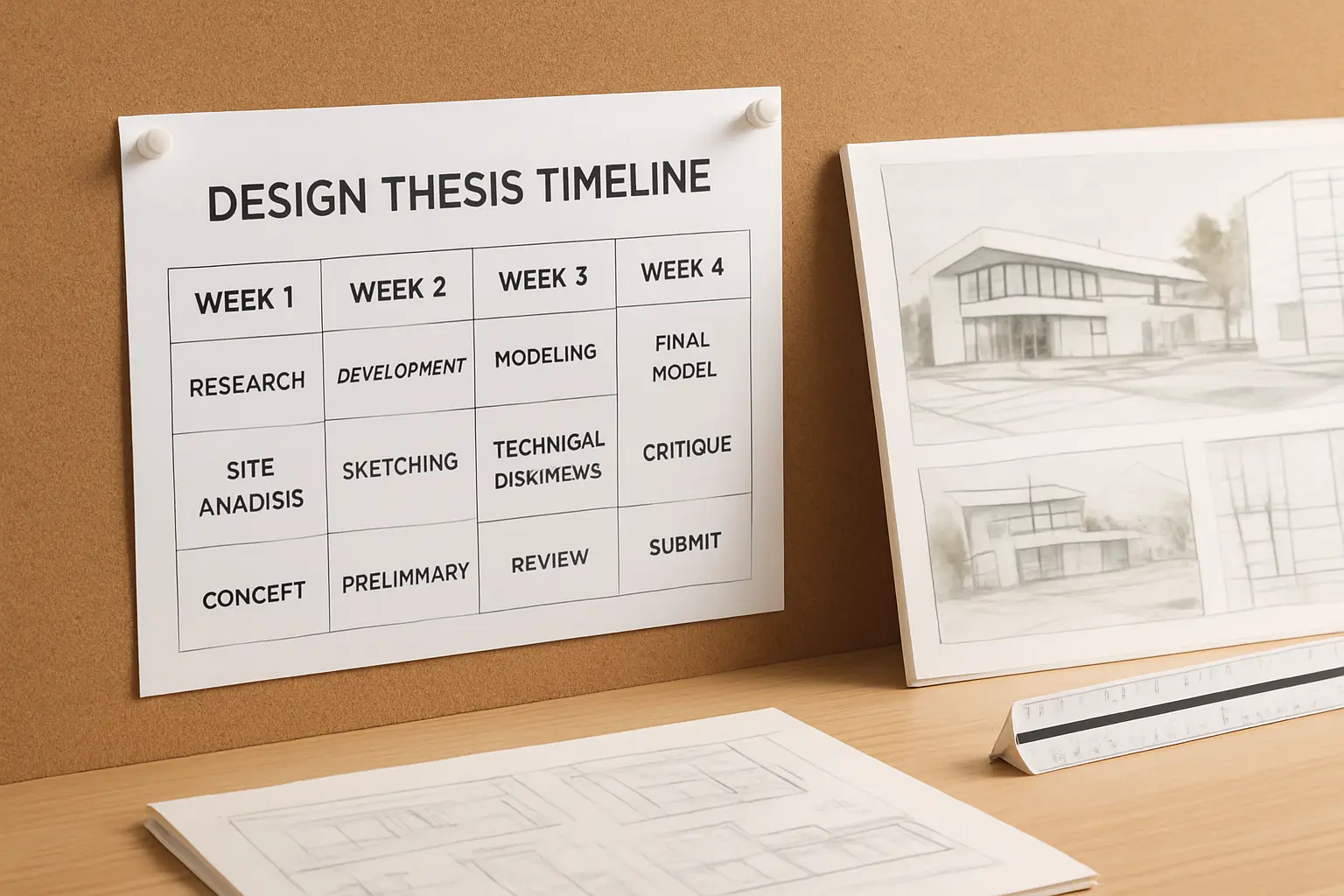
Choose your building type and site while the OJT-derived familiarity is still fresh — six months out, the specific zoning quirks or access details you picked up on-site fade fast. Confirm your title early: a title that leans on your OJT typology experience, phrased as your own original proposal rather than an extension of the firm’s project, tends to survive title defense more easily than a topic chosen cold, the same faults covered in the site’s thesis title rejection guide. Build the conceptual framework and design brief following the site’s own conceptual framework guide, adapted for a design-output thesis rather than a purely quantitative one, and open Chapter 1 with your own rationale for the site and program — not a restatement of why the firm chose its own projects.
What to say when the panel asks about your OJT firm at title defense
A panel that knows you did OJT at a firm working in the same typology as your thesis will usually ask directly how the two relate, and the honest, well-prepared answer is a strength, not a risk to manage defensively. State plainly that the firm exposed you to the typology and, where relevant, to one specific case study you are citing by name, and then pivot immediately to what is different about your own site, program and design concept. Panels are not looking to catch you reusing firm knowledge — that is expected and normal — they are checking that you can tell the difference between what you learned and what you are proposing, out loud, without hesitation. Rehearsing that one distinction ahead of the defense is worth more preparation time than almost any other single question you might anticipate, and it is worth writing that rehearsed distinction down as a single sentence you can say without notes, since a hesitant answer to this exact question is what actually triggers a panel’s closer scrutiny, not the OJT connection itself.
The licensure experience requirement is a separate clock, and it does not wait for your thesis
It’s worth naming a confusion that costs real time: the diversified architectural experience required before the licensure exam under RA 9266 — at least two years, or its equivalent, certified by a registered and licensed architect — is a separate, longer track from the practicum or OJT course credit most BS Architecture curricula require before the design thesis year. Finishing a practicum course does not by itself satisfy that experience requirement, and finishing your design thesis does not either — keep the two timelines mentally and administratively separate so neither one gets assumed complete by mistake when your adviser or the PRC checks it later.
Using a Second Firm as an Additional Key Informant
Your OJT supervisor is not the only architect your thesis can legitimately draw on. A related-literature or precedent section that relies entirely on the perspective of one firm — the one you happened to intern at — risks reading as a single office’s house philosophy rather than an independent design argument, and a panel will notice if every case study and every quoted opinion traces back to the same source. Approaching a second, unrelated architect as an additional key informant is common practice and often strengthens the thesis: it lets you triangulate whether a design approach you observed at your OJT firm is a genuinely accepted standard in the typology or specific to that office’s own preferences. Any second interview still needs the same consent and citation standard already described above for the OJT firm — a named source, a stated context for how you approached them, and a clear line in Chapter 3 between which finding came from your own OJT connection and which came from an independent source, since a panel that spots the distinction on its own will ask why it was not stated plainly in the first place.
Turn what you learned on OJT into your own thesis chapters
Tesify drafts your background, statement of the problem and case-study synthesis from your own site, typology and design brief — built around what you’re actually proposing, not a rewrite of your OJT report. Over 9,000 students have used it to write more than 15,000 chapters, and every word is still written by you, with academic integrity that keeps the research genuinely yours.
If the deadline is tighter than the transition allows
Where a defense date is already set and the design thesis has barely started, triage in this order: lock the site and building type first (everything else depends on it), draft the background and problem statement using your OJT-derived rationale second, and treat the design output itself — plates, model, renders — as the item that needs the largest single block of dedicated time, not something squeezed in around the manuscript. Students who try to finish the manuscript first and the design last consistently run out of time on the part a panel actually spends the most defense time discussing. If groupmates or an adviser have gone quiet at exactly this stage, the same triage discipline covered in the site’s guide to what thesis help you can legitimately pay for applies here too — transcription, statistical or design-consulting help and language editing are fine; someone else designing your building for you is not.
Frequently asked questions
Can I just submit my OJT report as my design thesis?
No. An OJT or practicum report documents what you observed and assisted with at a firm; a design thesis is your own original design proposal with a Chapter 1 to 5 manuscript and a design output. They are graded by different criteria and by different panels.
How much does Tesify cost, and is there a free way to try it?
Check the current plans and any free tier on the Tesify site directly, since pricing changes; what stays constant is that every chapter is drafted from your own site, case studies and data, and you write and defend every word yourself.
Is it plagiarism to base my case study on a project I worked on during OJT?
No, as long as you cite the firm’s project as your source, do not present the firm’s own design work as your own original design proposal, and have the firm’s permission to reference and photograph the project if that permission was not already covered in your OJT agreement.
What if my firm’s project files are confidential?
Ask your supervisor directly what can be shared before you build your thesis around it; most firms are comfortable with a student citing general design lessons, typology and publicly visible site conditions, but not with reproducing confidential construction documents or client-specific financial details.
Can I use my OJT supervisor as a panel member or adviser?
Usually not directly — most schools require the thesis panel and adviser to be faculty or accredited outside professionals appointed through the school’s own process, not the student’s own OJT supervisor by default; your supervisor can still serve as a cited key-informant or a reference, which is a different role from sitting on the panel.
Can I approach an architect from a different firm as an additional interview source?
Yes, and doing so can strengthen the thesis by checking whether a design approach from your OJT firm reflects a wider standard in the typology or just that office’s own preference; follow the same consent and citation standard as any other key-informant interview, and state clearly in Chapter 3 which finding came from the OJT connection and which came from the independent source.