Your defense date is set, Chapter 4 is a folder of unanalysed responses, and somebody in a group chat has just sent you a link to a service that will “do the whole thing” for a price you can almost afford. Before you click it, there is a line you need to be able to see, because some paid help is completely ordinary academic practice and some of it ends your degree.
The line is not about money. Statisticians, transcriptionists, editors and printers all get paid, and none of that is cheating. The line is authorship — whether the intellectual work is yours.
Draft your chapters yourself, faster, in Tesify
What it costs to get this wrong
A commissioned chapter does not simply sit there. It creates three separate problems, and they compound.
You cannot defend it. A Philippine panel asks you to explain your own decisions — why this design, why this sample, what Table 4 shows, why a finding contradicts a source you cited. A student presenting work they did not do fails the very first “explain this to me” question, and panels ask that question early. The full range is set out in the guide to what questions are asked during a thesis defense.
The text has a history you cannot see. A service that sells you a chapter has very often sold something close to it before. Your research office compares submissions against a corpus of other students’ work that no consumer tool can see, which is precisely why a clean free pre-check proves nothing — as explained in the comparison of plagiarism checkers for Filipino students.
The penalty is institutional, not commercial. If it goes wrong, the service keeps your money and you keep the consequence, which your handbook defines and which can reach as far as your degree. There is no refund for a failed defense.
Where the line actually sits
You do not have to invent this boundary. The most widely used international statement of it is the ICMJE’s authorship criteria, which requires an author to meet all four of the following:
- Substantial contributions to the conception or design of the work, or the acquisition, analysis or interpretation of data for the work; and
- Drafting the work or reviewing it critically for important intellectual content; and
- Final approval of the version to be published; and
- Agreement to be accountable for all aspects of the work.
Now read what ICMJE says about people who do not meet all four. Its list of activities that “alone (without other contributions) do not qualify a contributor for authorship” names, verbatim: acquisition of funding; general supervision or general administrative support; and “writing assistance, technical editing, language editing, and proofreading”. Its instruction for those people is not that they are forbidden — it is that they “should be acknowledged”.
That is the whole distinction, stated by a standards body rather than by anyone selling you something. Editing, proofreading and technical help are recognised contributions that get acknowledged. Producing the intellectual content is authorship, and authorship has to be yours.
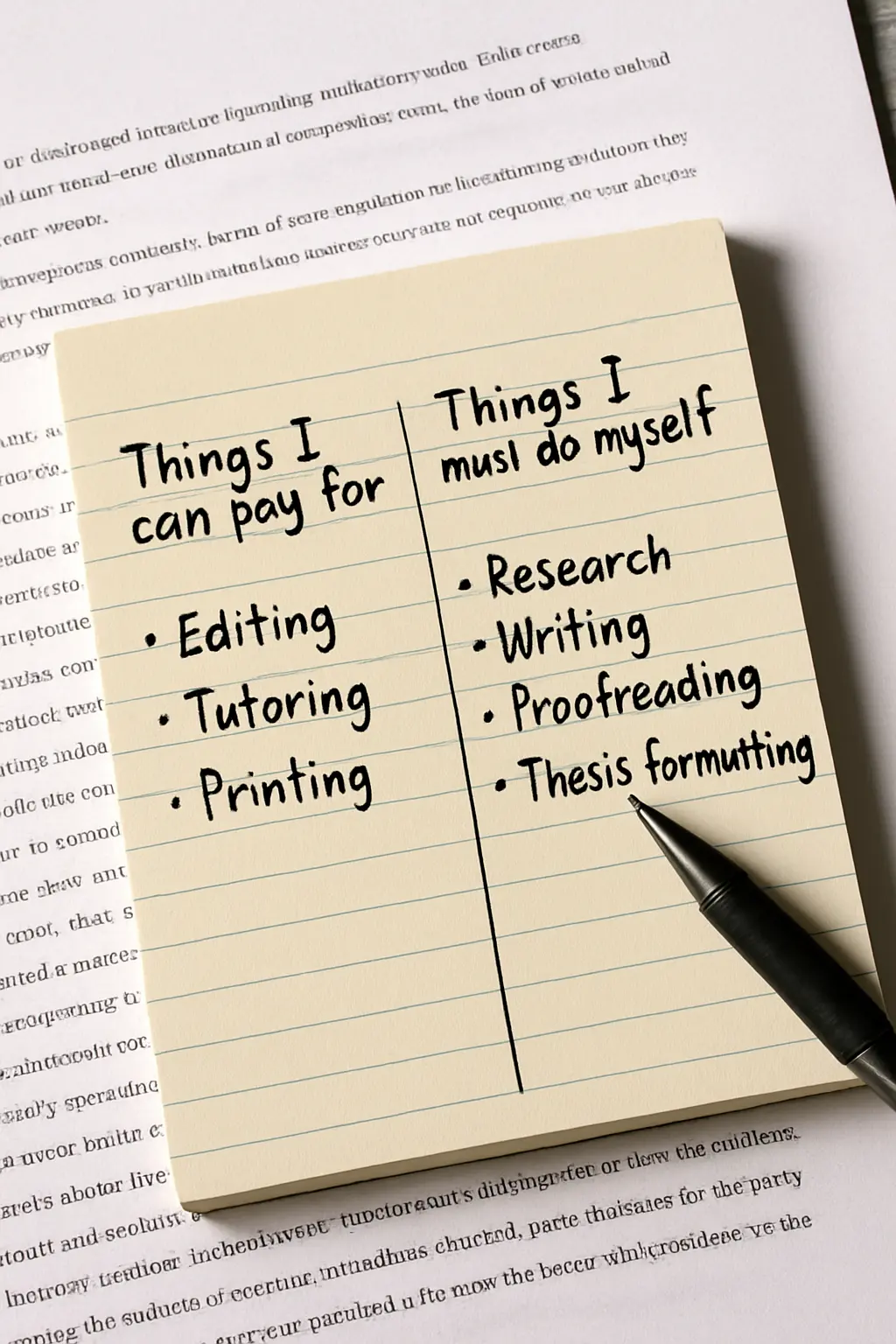
The two columns, filled in
| Ordinarily legitimate (acknowledge it) | Not yours to buy |
|---|---|
| Transcription of your recorded interviews | Someone conducting the interviews for you |
| Statistical consulting — advice on which test and how to run it | Someone analysing your data and writing your interpretation |
| Language editing and proofreading of text you wrote | Rewriting that changes what the text argues |
| Formatting, layout, pagination and binding | Producing chapters to your outline |
| Graphic redrawing of a framework diagram you designed | Designing your framework |
| Printing, photocopying and reproduction of questionnaires | Buying a completed study or dataset |
Three cautions on the left column, because “legitimate” is not the same as “unconditional”.
Your handbook governs, not this table. Philippine institutions set their own academic integrity policies and they differ sharply — some require a declaration of any assistance received, some prohibit categories this table treats as ordinary. Read yours and ask your adviser. Where the two conflict, the institution wins.
Disclose it. The safest position on anything in the left column is a line in your acknowledgements naming what was done and by whom. Volunteering it is almost always better than being asked about it in the defense room.
A statistician advising you is different from a statistician replacing you. If you cannot explain, in your own words, why the test was chosen and what the output means, you have crossed the line regardless of who typed what — because you will be asked. The reasoning you need is in the guide to writing Chapter 3.
How to tell a service apart in ninety seconds
You rarely need to investigate. The marketing tells you.
- Does it sell an outcome or a service? “Complete thesis, 5 chapters” is an outcome. “Transcription, per audio hour” is a service. Outcomes are the problem.
- Does it promise a grade, approval or a similarity percentage? Nobody outside your panel can promise any of those. A guarantee is a signal that the seller is not describing reality.
- Does it want your topic or your text? A service that starts by asking for your topic is preparing to write. One that starts by asking for your draft is preparing to edit.
- Would you be comfortable naming it in your acknowledgements? This is the sharpest test there is. If writing “Chapter 2 was drafted by X” is unthinkable, that is your answer.
- Is it asking for your raw data? Then a data-protection question arises as well as an integrity one, and your ethics approval may restrict where participant data may be stored or sent.
The free help you have not used yet
Before paying anyone, there are three sources of assistance most students under-use, all of which are unambiguously legitimate.
Your adviser. Consultations are the one form of help that is designed into the process, and groups routinely arrive with a finished chapter instead of a specific question. Bring one question and one page; you will get more from twenty minutes than from a week of guessing.
Your librarian. Philippine university librarians are consistently the most under-consulted resource on campus, and database access, referencing conventions and locating local studies are exactly their work.
A pre-submission institutional check. Many departments allow one draft submission before the final one specifically so students can act on the report. Ask; it is worth more than any consumer tool.
The fix when the deadline is the real problem
Most students looking at these services are not trying to cheat. They are behind, and buying a chapter looks like the only lever left. It is worth naming what the actual constraint usually is: not ability, but the time cost of structure, referencing and rewriting.
That is the part a tool can take off you without taking your authorship with it. Here is the honest version of the workflow, in the order it works.
- Put your approved topic and your specific problems in first. Everything downstream is checked against them, and misalignment here is what produces the rewrite you cannot afford.
- Build the chapter structure your research manual expects before writing prose, so you are filling a shape rather than inventing one at midnight.
- Bring the sources you actually opened. Tesify keeps each citation attached to its source, which is the single most time-consuming thing to reconstruct at the end and the thing advisers check first.
- Draft chapter by chapter, from your own notes and your own data. The decisions — design, sample, interpretation — stay with you, which is exactly why the result survives a defense.
- Run your own reconciliation check. Respondent counts identical in Chapter 3, Chapter 4 and the abstract; every recommendation traceable to a finding.
- Ask your adviser and disclose your tools. Some departments require a declaration of AI assistance, some do not. What an AI tool can and cannot legitimately do is set out in the article on what an AI thesis maker can and cannot do.
On that last point, ICMJE is again useful and again unambiguous: it says chatbots “should not be listed as authors because they cannot be responsible for the accuracy, integrity, and originality of the work”, and that “humans are responsible for any submitted material that included the use of AI-assisted technologies”. A tool is something you use. It is not a co-author and it is not a defence.
Move faster on work that stays yours
Tesify structures your thesis or capstone chapter by chapter around your own topic, sources and data, and keeps every citation attached to a source you actually opened — so you arrive at the defense able to explain every decision in the document, because you made them. Over 9,000 students have used it to write more than 15,000 chapters, and 100 per cent of the work is still written by you. Current pricing, including what you can do before paying anything, is listed on the Tesify site.
Frequently asked questions
Is it allowed to pay for thesis help in the Philippines?
It depends entirely on what you are paying for and what your institution’s handbook says. Transcription, statistical consulting, language editing, formatting and printing are ordinarily accepted services that should be acknowledged. Paying someone to produce your chapters is not help; it transfers authorship, which is the thing being assessed. Read your own handbook, because Philippine institutions set their own policies and they differ.
How much does this cost in pesos?
Rates for transcription, statistical consulting and editing vary widely by provider and turnaround, and no figure quoted in an article would be reliable by the time you read it. Ask for a written quote per unit — per audio hour, per thousand words — rather than per chapter, because per-chapter pricing is itself a signal of what is being sold. For Tesify, current pricing and what you can do before paying anything are listed on the Tesify site.
Can I pay a statistician to run my data?
In most Philippine departments, consulting a statistician is ordinary and expected, particularly where the analysis exceeds what an undergraduate course covered. The condition is that you must be able to explain the choice of test, the assumptions behind it and what the output means. If you cannot, the analysis is not yours to present regardless of who paid for it.
Is paying for editing considered cheating?
Language editing and proofreading of text you wrote are named by the ICMJE as contributions that do not qualify for authorship and should instead be acknowledged — which is the clearest possible statement that they are legitimate but disclosable. Editing that changes what your text argues is a different activity and crosses into content.
What if my whole batch is using these services?
The consequence is individual, and it is applied by your institution rather than by consensus. A widely shared practice is still a practice your handbook may prohibit, and research offices notice patterns across a batch more easily than a single case.
Will my school find out?
The two mechanisms are the similarity check against a corpus that includes other students’ submissions, and the defense itself, where you are asked to account for decisions in the document. The second catches more people than the first, because it needs no software.
What about my respondents’ data — can I send it to a service?
Treat this as a separate question from integrity, and a serious one. Your ethics approval and your own consent statement may restrict who may access participant data and where it may be stored. Sending raw responses to a third party you have not named to your participants is a problem even if the analysis itself would have been permissible.
Can I use AI instead?
Only within your school’s policy, and only in a way that leaves the decisions with you. ICMJE states that chatbots cannot be listed as authors because they cannot be accountable for the work, and that humans remain responsible for any submitted material produced with AI assistance. Ask your adviser, and write the answer down.
Do I have to declare that I used a writing tool?
Some Philippine departments require a declaration, some ask informally, and some have no policy. Where a declaration is required, ICMJE’s convention is to describe writing assistance in the acknowledgements and any use in data collection or analysis in the methods. Volunteering it is nearly always safer than being asked.
What is the fastest legitimate way to catch up?
Fix the structure first, then the citations, then the prose — in that order, because a well-structured chapter with rough sentences is far closer to done than polished prose in the wrong shape. If Chapter 2 is the blockage specifically, the recovery sequence is in the article on what to do when Chapter 2 is empty and the deadline is next week.
My qualitative study needs transcription. Is paying for that fine?
It is one of the clearest cases on the legitimate side, provided your ethics approval permits a third party to hear the recordings and your consent statement did not promise otherwise. The analysis of those transcripts, including how you determined your sample size, has to be yours — that reasoning is set out in the guide to how many respondents a qualitative thesis needs.