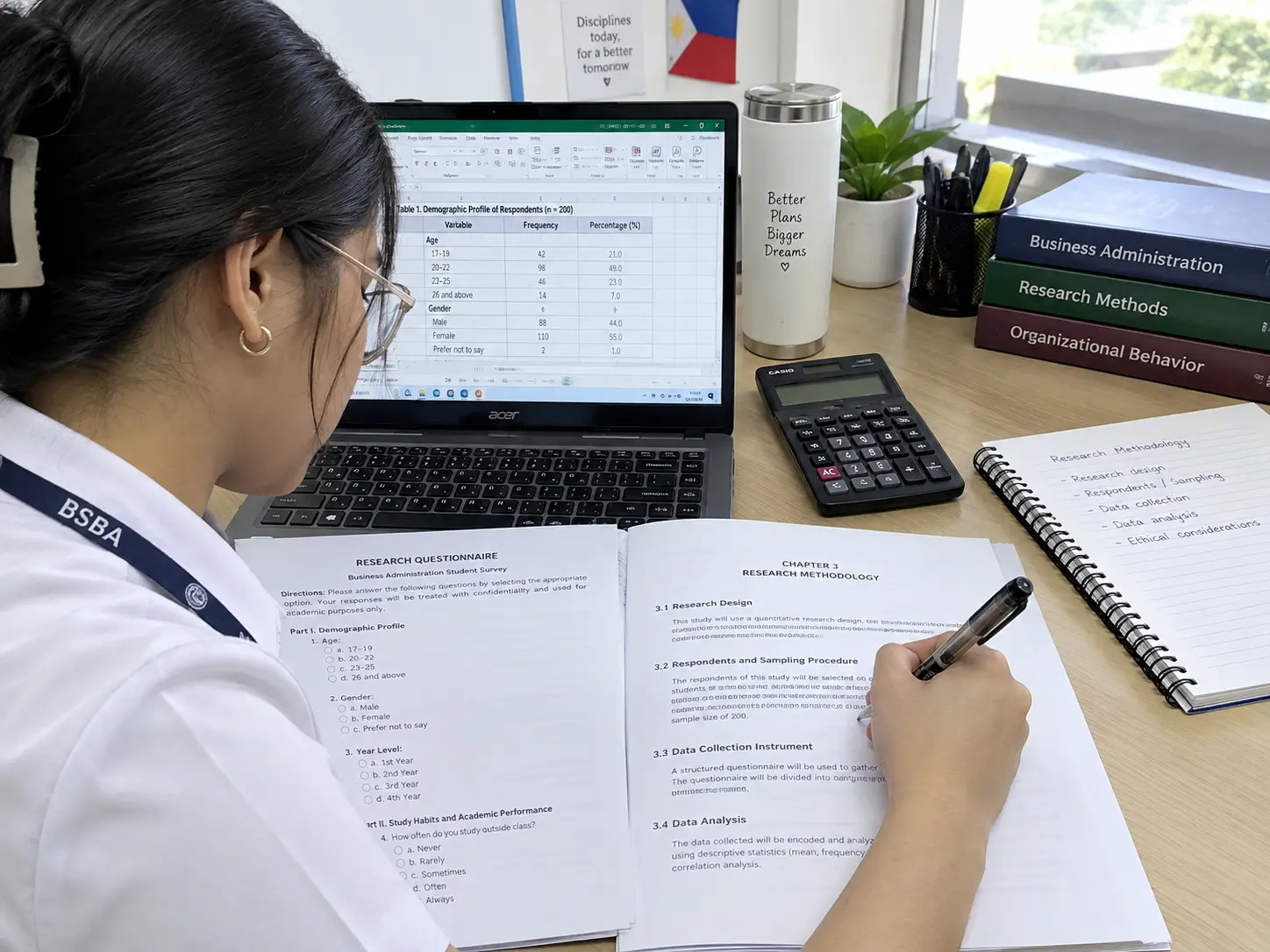
Chapter 3 of a Business Administration (BSBA) thesis is where a panel checks whether your study can actually be run — not just whether the idea is interesting. Unlike Nursing, Education or Criminology, BSBA covers marketing, human resource management, financial management and operations under one umbrella, so there is no single “BSBA methodology” template the way there is for a lab-based science thesis. What follows is the structure Philippine business schools consistently expect, filled in with a fictional, illustrative example so you can see exactly how each section should read.
The Fictional Study Used Throughout This Guide
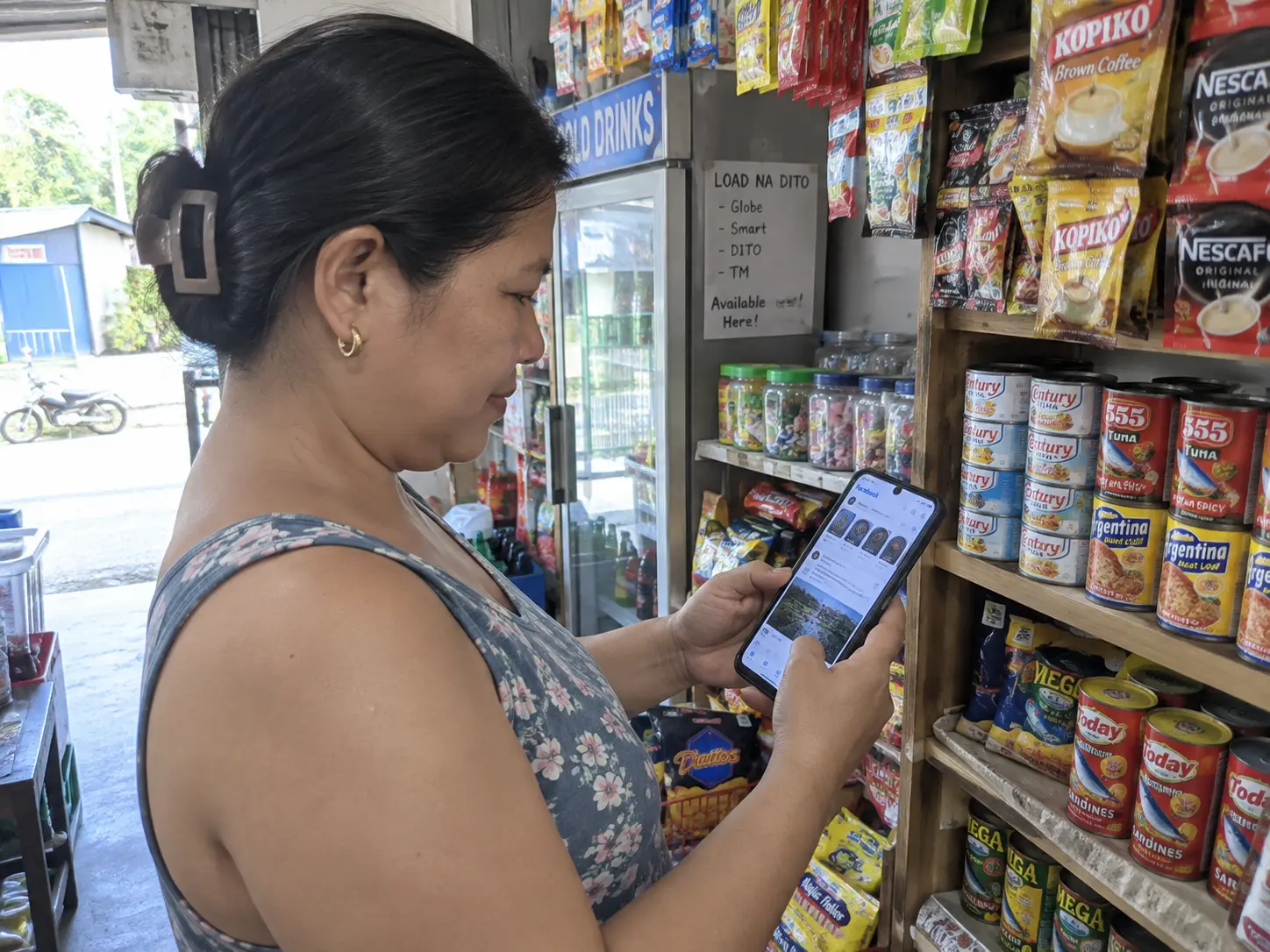
To keep every worked example concrete, this guide follows one illustrative BSBA marketing thesis: “Social Media Marketing Practices and Customer Purchase Intention Among Small Retail Businesses in a Philippine City.” Every number, respondent count and statistic below is invented for demonstration only — treat the structure as the lesson, never the figures.
Step 1: State the Research Design
Most BSBA theses use a descriptive-correlational design: descriptive because it profiles a business practice or respondent group as it currently exists, correlational because it tests whether two or more variables move together. Chapter 3 should name the design in its first paragraph, in one sentence, before anything else.
Worked example: “This study used a descriptive-correlational research design to describe the social media marketing practices of small retail businesses and determine their relationship with customer purchase intention.”
Step 2: Define the Population and Sampling Technique
State who qualifies as a respondent (the population), how many exist if a sampling frame is available, and which sampling technique narrows that population into an actual respondent list. BSBA theses typically use simple random sampling or purposive sampling for a defined business population, and stratified sampling when respondents fall into clearly different groups (owners versus employees, or businesses of different sizes).
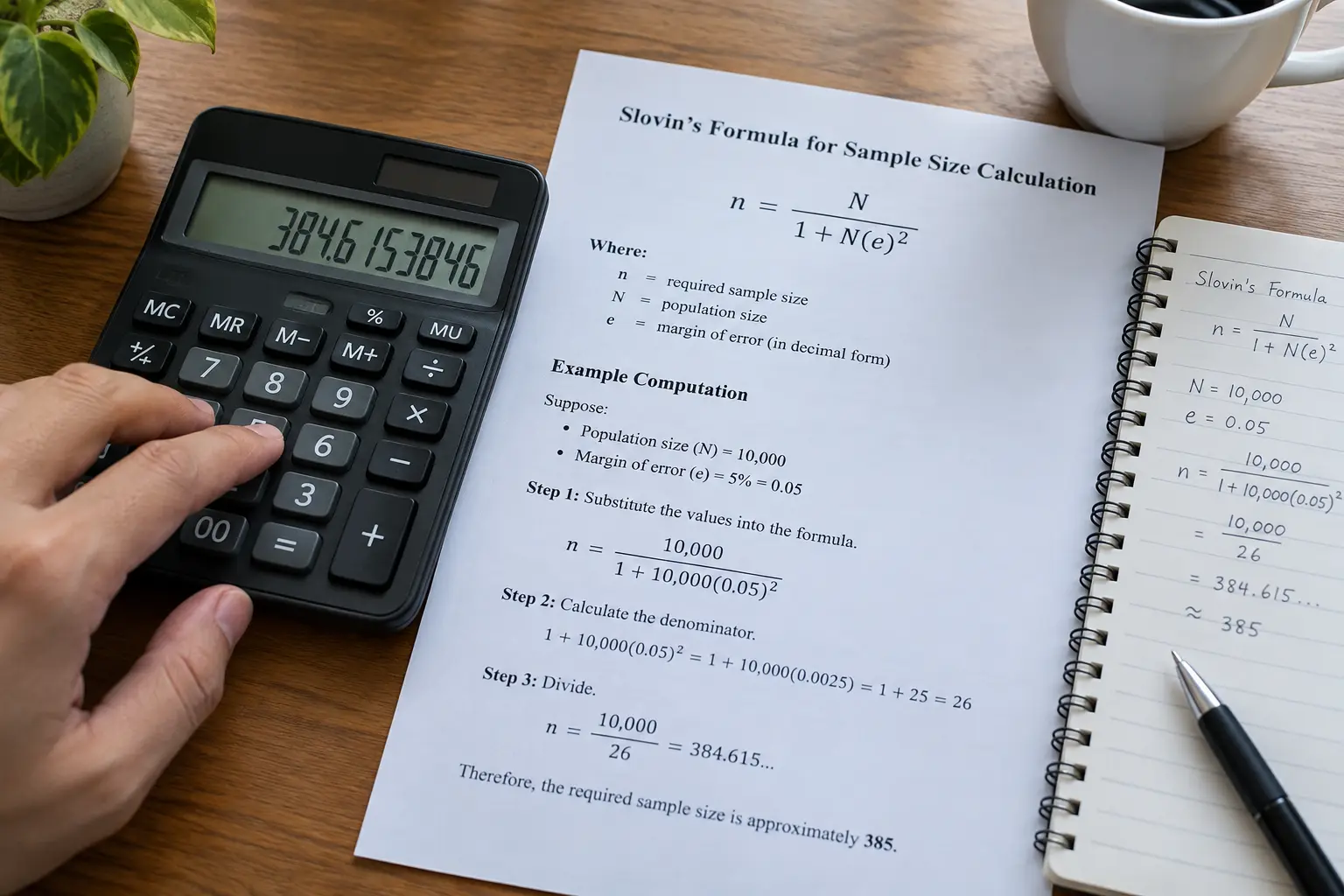
When a full population count is known, Slovin’s formula — n = N / (1 + Ne²) — is the standard way Philippine undergraduate theses justify a sample size from a finite population, using a margin of error your adviser assigns (commonly 5%). Show the full computation in Chapter 3, not just the final number.
Worked example (illustrative numbers): “With a population of 220 registered small retail businesses in the study locale (N = 220) and a 5% margin of error, Slovin’s formula yields a sample size of n = 220 / (1 + 220 × 0.05²) = 220 / 1.55 = 142 respondents.” Every figure here is invented for demonstration; substitute your own locale’s actual registered-business count and recompute.
Step 3: Describe the Research Instrument
Most BSBA quantitative theses use a structured survey questionnaire, usually a five-point Likert scale, either adapted from a validated instrument in a published study (with permission or proper citation) or researcher-made and pilot-tested. State clearly which of the two you used, and if adapted, name the original author and year.
Worked example: “The questionnaire adapted items from Kotler and Keller’s (2016) marketing-mix framework and a purchase-intention scale used in prior consumer-behavior research, modified for a social-media retail context and validated through a pilot test with 20 respondents outside the main sample.”
Step 4: Establish Validity and Reliability
Content validity is typically established through expert review (two or three faculty members or industry practitioners rate each item for relevance and clarity) before the pilot test. Reliability is usually reported as Cronbach’s alpha from the pilot-test data, with 0.70 as the commonly cited minimum acceptable threshold in social-science research.
Worked example (illustrative): “The pilot test yielded a Cronbach’s alpha of 0.86 for the social media marketing practices scale and 0.81 for the purchase intention scale, both exceeding the 0.70 threshold for acceptable internal consistency.”
Step 5: Write the Data Gathering Procedure
Narrate the process in the order it actually happened: securing a letter of permission from the business owners or an association, distributing the questionnaire (in person, online, or both), the data collection window, and any ethical safeguards such as informed consent and voluntary participation. This section should read as a procedure someone else could replicate, not a summary.
Step 6: Specify the Statistical Treatment
List every statistical tool by name against the specific question or hypothesis it answers — not a generic “data was analyzed using SPSS.” Common BSBA choices: weighted mean or frequency and percentage for descriptive profiling, and Pearson’s r or simple/multiple linear regression for a correlational hypothesis between two continuous variables.
| Research question | Statistical tool | Why it fits |
|---|---|---|
| Profile of respondents’ business characteristics | Frequency and percentage distribution | Describes categorical data (business size, years of operation) |
| Extent of social media marketing practices | Weighted mean | Summarizes Likert-scale responses into an interpretable average |
| Relationship between practices and purchase intention | Pearson’s r | Tests the strength and direction of a linear relationship between two continuous variables |
| Predictive effect of specific practices on purchase intention | Multiple linear regression | Tests whether several predictor variables jointly explain variance in the outcome variable |
Step 7: Address Ethical Considerations
State how you obtained informed consent, protected respondent confidentiality (no business or individual named without permission), and handled data storage. If your university requires an ethics review board clearance for studies involving human respondents, note the clearance in this section, and check your own school’s specific policy before assuming it applies or does not apply to a business survey.
Where a study involves an identifiable single business (a named store, a specific family enterprise), add an explicit statement on how the business’s own consent to be identified — or its preference to remain anonymized — was obtained and documented, separate from individual respondent consent. Business owners sometimes agree to participate but do not want their enterprise named in a publicly archived thesis, and Chapter 3 should show that this distinction was actually asked about, not assumed either way.
Step 8: Write the Conceptual or Theoretical Framework Connection
Chapter 3 should open by reminding the reader which framework or model from Chapter 2 the design is built to test, rather than presenting the design as if it appeared from nowhere. If the illustrative study above draws on the marketing-mix framework and a stimulus-organism-response model of consumer behavior, Chapter 3’s opening paragraph should say so directly: the independent variable (social media marketing practices) maps to the stimulus, and the dependent variable (purchase intention) maps to the response. This single connecting sentence is one of the most common things a panel checks first, because it shows the methodology was designed around a theory rather than bolted onto results after the fact.
Step 9: Plan for Common Threats to Your Design
A BSBA panel increasingly expects a short, honest paragraph naming the design’s own limitations before anyone in the room has to ask: common threats include self-report bias (respondents may answer in a socially desirable way about their own business practices), a convenience-heavy sample if random sampling could not be fully implemented in practice, and a single point-in-time survey that cannot establish that one variable actually causes the other, only that they are related. Naming these threats in Chapter 3 itself, rather than only in a limitations section in Chapter 5, signals that the design choices were made with full awareness of their trade-offs.
A Note on Qualitative and Mixed-Methods BSBA Theses
Not every BSBA thesis is a quantitative survey. A case study of a single company’s HR practices, a qualitative exploration of entrepreneurial decision-making, or a mixed-methods study combining a survey with follow-up interviews all appear regularly in Philippine business programs. If your design is qualitative, replace Steps 2 through 6 above with a description of your case or key informants, your interview guide, and your analysis approach (thematic analysis is common here — see our six-phase thematic analysis worked example for the same coding logic applied to a communication study, transferable to a qualitative BSBA case study).
Where This Fits With the Rest of Your Thesis
Chapter 3’s variables should trace directly back to the hypotheses stated earlier in your paper — our guide on BSBA thesis hypotheses and variables walks through four worked examples before a title defense, and if your thesis specifically sits inside marketing, the sub-field-specific variables and hypotheses examples for a marketing management thesis go one level deeper. For the general mechanics of a Chapter 3 that any Philippine program expects regardless of major, the site’s how to write Chapter 3 research methodology guide covers the shared skeleton this BSBA-specific version builds on, and the worked operationalization of variables table examples show the format your own variables table should follow once your instrument is finalized. If you are still choosing your exact topic, 40 titled examples with research questions are in thesis title examples for BSBA and HRM students.
Where Tesify Fits
Once your design, population, instrument and statistical treatment are decided, Tesify turns those decisions into a properly structured, APA 7th-formatted Chapter 3 — the sentences above, written around your own numbers rather than the illustrative ones used here.
Turn your BSBA methodology decisions into a written Chapter 3
Tesify drafts your research design, sampling, instrument, validity and reliability, and statistical treatment sections in proper APA 7th format once you tell it what you decided — over 9,000 students have used it to write more than 15,000 chapters, and every word is still written by you.
Frequently Asked Questions
- Is a descriptive-correlational design the only option for a BSBA thesis?
- No. It is the most common design for quantitative BSBA theses testing a relationship between two business variables, but experimental, case-study, and qualitative or mixed-methods designs are all accepted depending on your research question and your adviser’s guidance.
- Do I have to use Slovin’s formula for my sample size?
- Only if your population is finite and known. If your population is unknown or very large, a different sampling approach (such as Cochran’s formula or a purposive sample with a stated rationale) may be more appropriate — confirm with your adviser which your program expects.
- Can I use a questionnaire I found online without citing it?
- No. Any adapted instrument must credit its original author and year, and ideally note whether permission was sought, especially if the instrument is from a copyrighted published study rather than an openly licensed source.
- What Cronbach’s alpha value is acceptable for a BSBA thesis questionnaire?
- 0.70 is the most commonly cited minimum threshold in social-science research for acceptable internal consistency, though some programs prefer 0.60 for newly developed scales in an exploratory study. Check your own department’s specific requirement.
- Do all BSBA majors (marketing, HRM, financial management, operations) use the same Chapter 3 structure?
- The overall structure (design, population, instrument, validity, procedure, statistical treatment, ethics) is shared across BSBA majors, but the specific instrument, variables and statistical tools will differ depending on whether the study is about consumer behavior, employee outcomes, financial ratios, or process efficiency.
- How is Chapter 3 different for a qualitative BSBA thesis, such as a company case study?
- A qualitative Chapter 3 replaces population and sampling with a description of the case or key informants, replaces the survey instrument with an interview guide or document-analysis protocol, and replaces statistical treatment with a qualitative analysis method such as thematic analysis.
- Does my Chapter 3 need ethics board clearance for a business survey?
- Requirements vary by school. Many Philippine business programs require at least a basic informed-consent process for any study involving human respondents; some require formal ethics review board clearance. Confirm your own university’s specific policy rather than assuming either answer.
- What is the difference between validity and reliability in this context?
- Validity asks whether the instrument actually measures what it claims to measure (commonly checked through expert or content review). Reliability asks whether the instrument produces consistent results, commonly measured through Cronbach’s alpha from pilot-test data.