
The strongest civil engineering thesis topics in the Philippines in 2026 pair a named design standard — the National Structural Code of the Philippines (NSCP) 2015 edition, a specific ASTM or ACI test method, or a DPWH specification item — with a locally available material, site or structure the student can actually test or survey within one semester. A topic that names its governing standard by edition and year gives the panel something concrete to check the thesis against, and gives the student a fixed target to design or test toward instead of an open-ended exploration.
This answer lists eighteen topics across the sub-fields BSCE programs cover, each with the research question written out in one line and the standard that anchors it, then answers the questions students ask most often about choosing and scoping one. Once a topic is chosen, the variables it implies still need to be written up in the same statement-of-the-problem structure covered in what Chapters 1 to 5 in a thesis are.
Which standards give a civil engineering thesis its technical basis?
Philippine civil engineering theses are expected to name the exact edition of every code or test method they design or evaluate against, because provisions change between editions and a panel checking a table against an outdated edition will catch the mismatch immediately.
| Standard | What it governs | Sub-field it anchors |
|---|---|---|
| National Structural Code of the Philippines (NSCP), 2015 edition | Structural design loads, seismic design provisions, and material-specific design chapters for concrete, steel and timber structures | Structural engineering topics |
| ASTM C39 / C78 / C143 / C192 | Compressive strength testing, flexural strength testing, slump testing, and laboratory specimen preparation for concrete | Materials and concrete mix-design topics |
| ACI 211.1 | Standard practice for selecting proportions for normal, heavyweight and mass concrete | Concrete mix-design topics, including alternative-material studies |
| DPWH Standard Specifications (Blue Book), Items 311 and 405 | Portland cement concrete pavement and structural concrete acceptance criteria for public works | Pavement and structural acceptance topics |
| ASTM D1586 / D2487 | Standard penetration test procedure and the Unified Soil Classification System | Geotechnical engineering topics |
A topic that cites a standard without naming its edition — “this study follows NSCP” rather than “this study follows NSCP 2015” — invites a panel question the student cannot easily answer at defense; naming the edition up front removes that opening.
What are eighteen civil engineering thesis topics with research questions?
Structural engineering
1. Seismic performance of a low-rise reinforced concrete building designed to NSCP 2015. Does a three-storey reinforced concrete building designed under the NSCP 2015 seismic provisions meet the code’s inter-storey drift limit under the design earthquake load for its assigned seismic zone?
2. Structural adequacy of an existing school building against current NSCP provisions. Does the structural framing of a pre-2015 public school building, evaluated against the current NSCP 2015 load combinations, meet today’s minimum capacity requirements, and what retrofit would close any gap found?
3. Comparative structural efficiency of steel versus reinforced concrete framing for a mid-rise commercial building. For a fixed floor plan and occupancy load under NSCP 2015, which framing system produces a lower total structural steel-or-concrete tonnage while still satisfying the code’s strength and serviceability limits?
Materials and concrete mix design
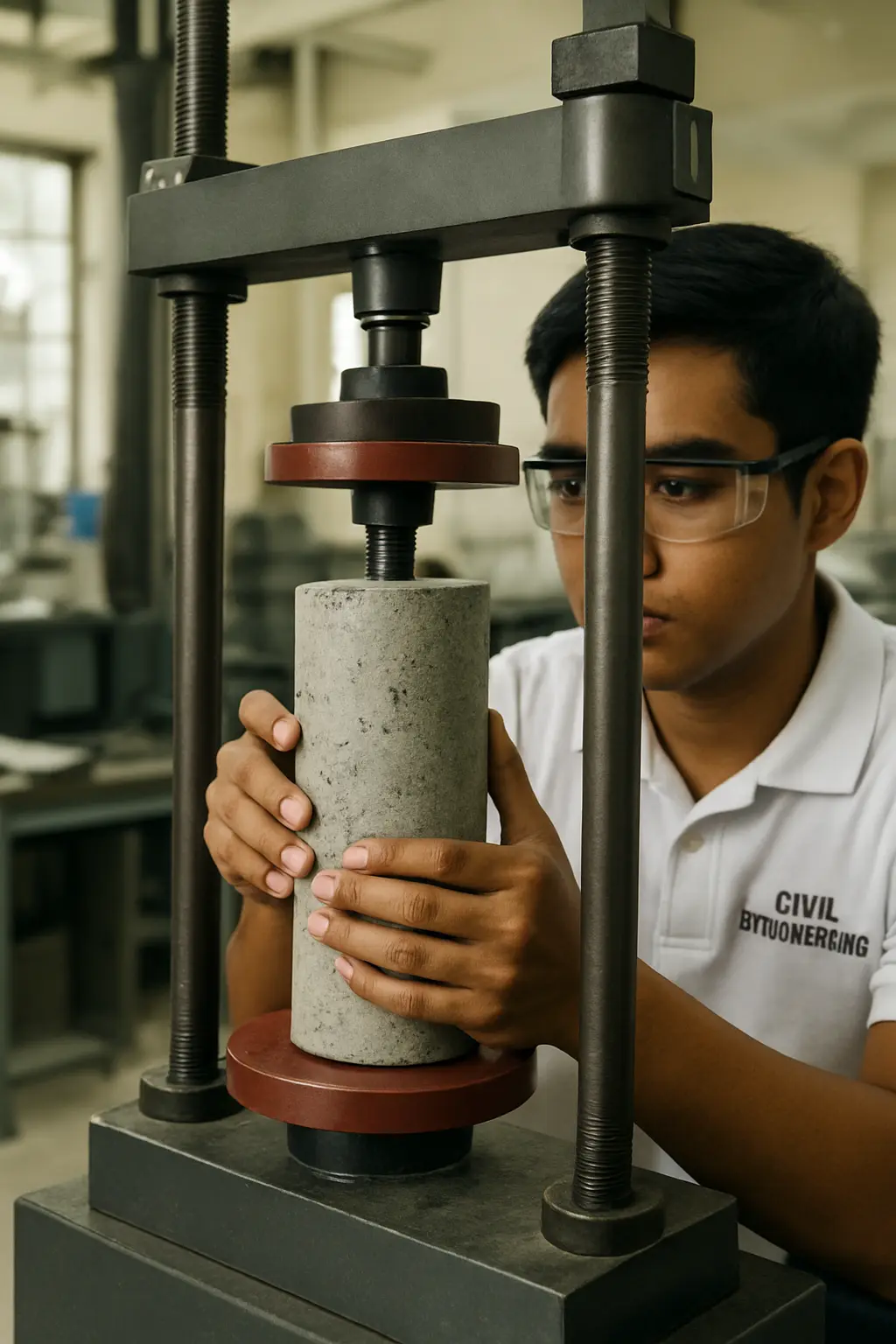
4. Compressive strength of concrete with a locally sourced pozzolanic material as partial cement replacement. How does the 28-day compressive strength, tested per ASTM C39, of concrete with 10, 20 and 30 percent replacement of cement by a locally available pozzolan compare to a control mix designed per ACI 211.1?
5. Flexural strength of concrete incorporating recycled coarse aggregate. Does replacing natural coarse aggregate with recycled concrete aggregate at increasing replacement ratios significantly affect flexural strength measured per ASTM C78?
6. Workability and strength trade-off of a self-compacting concrete mix using local materials. What replacement ratio of a locally available mineral admixture achieves DPWH Item 405 strength acceptance while maintaining slump-flow within the self-compacting range?
Geotechnical engineering
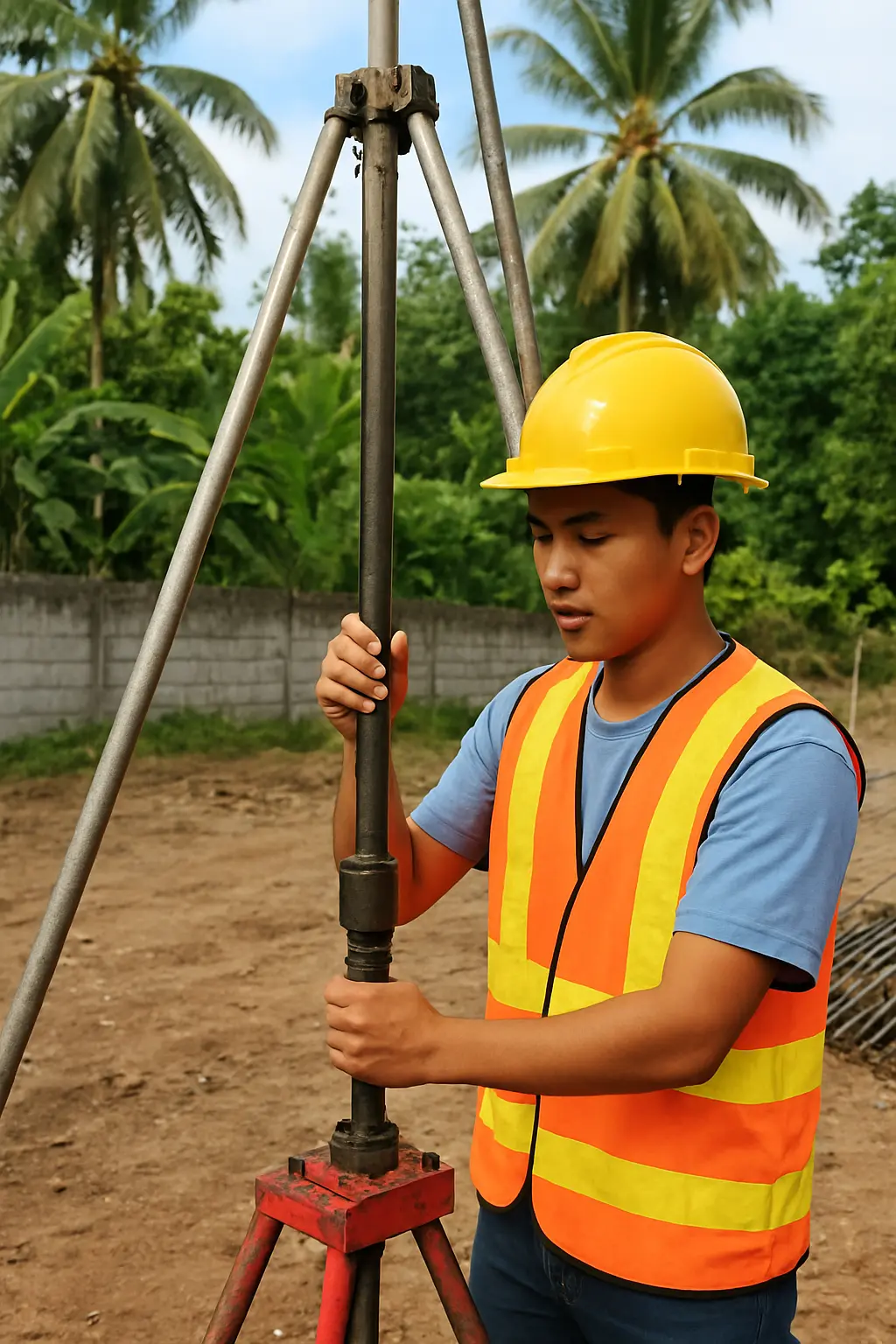
7. Soil bearing capacity variation across a barangay’s building sites. How does the standard penetration test (ASTM D1586) blow count, and the resulting allowable bearing capacity, vary across five sampled sites within one barangay with visibly different soil conditions?
8. Soil classification and foundation type suitability for a specific subdivision site. What soil types, classified per ASTM D2487, are present across a proposed subdivision site, and which shallow or deep foundation type does the classification support at each location?
9. Slope stability of an at-risk barangay road cut. What is the calculated factor of safety against slope failure for a specific road cut identified as at-risk, and what stabilisation measure would raise it to an acceptable margin?
Transportation engineering
10. Pavement condition assessment of a specific municipal road network. What is the pavement condition index of a defined stretch of municipal road, and which distress types (cracking, rutting, potholing) dominate the observed deterioration?
11. Traffic signal timing optimisation at a congested intersection. Does a re-timed signal cycle, modelled against observed peak-hour traffic counts at a specific intersection, reduce average vehicle delay compared to the existing timing plan?
12. Pedestrian facility adequacy near a school zone. Does the existing pedestrian infrastructure (sidewalk width, crossing points, signage) near a specific school meet the geometric design guidance civil engineering practice applies for school-zone pedestrian safety, and where are the gaps?
Water resources and hydraulics
13. Flood-prone drainage capacity assessment for a specific subdivision. Does the existing storm drainage system of a defined subdivision have sufficient hydraulic capacity for a design storm of a stated return period, and where does it fall short?
14. Rainwater harvesting system sizing for a public school building. What storage tank capacity would meet a defined fraction of a specific school building’s non-potable water demand, based on the site’s rainfall record and roof catchment area?
15. Culvert adequacy assessment along a flood-prone municipal road. Are the existing culverts along a defined stretch of municipal road hydraulically adequate for the design discharge of their contributing watershed, and which culverts are undersized?
Construction management and sustainability
16. Cost comparison of conventional versus precast construction for a low-rise public building. For a fixed building program, how does the total direct cost of a conventional cast-in-place structural system compare to a precast alternative, using current local material and labour rates?
17. Construction waste generation and diversion potential on a local building project. What volume and composition of construction waste is generated on a monitored local building project, and what proportion could realistically be diverted through on-site sorting?
18. Life-cycle cost comparison of a green roof versus a conventional roof for a public building. Over a defined evaluation period, how does the life-cycle cost of a green roof system compare to a conventional roofing system for a specific public building, accounting for installation, maintenance and stormwater-management savings?
How do you scope a civil engineering topic so the panel accepts it?
Name the exact standard and its edition, name the specific site, structure or material sample the study will use, and state the test method that will produce the data — not “the compressive strength will be tested” but “compressive strength will be tested per ASTM C39 at 7, 14 and 28 days.” A topic that reads “concrete strength with alternative materials” fails all three; “28-day compressive strength of concrete with 20 percent rice husk ash replacement, tested per ASTM C39 against an ACI 211.1 control mix” passes all three and gives Chapter 3 a ready-made procedure to describe.
Laboratory-access and site-access planning belongs in the same conversation as topic selection, not after it — a mix-design topic needs a materials laboratory with a compression testing machine, and a geotechnical topic needs either drilling access or a cooperating soils laboratory. Confirm equipment access with the department before committing to a topic that assumes it, and write the significance of the study around the specific local government unit, school or barangay the data will actually come from, in the structure described in what the significance of the study should contain.
How does topic choice affect the methodology chapter?
Every topic in this list implies a specific Chapter 3 shape: a materials topic needs a mix-design procedure and a specimen-testing schedule, a structural topic needs a load-analysis and code-check procedure, a geotechnical topic needs a field-sampling and laboratory-testing plan, and a hydraulics topic needs a rainfall-and-catchment data source plus a design-storm assumption. Working through the methodology structure described in how to write the methodology of a civil engineering thesis before finalising the topic prevents choosing a topic whose data collection turns out to be impractical within one semester.
Before committing, check what has already been studied on the exact combination of material, site and standard using the approach in has your thesis topic already been studied — mix-design studies in particular cluster around a small set of popular pozzolanic materials, and a different local material is often the whole gap needed.
Turn a standard and a site into a scoped Chapter 1
Tesify drafts the background, statement of the problem and significance of the study from the topic and standard you choose, in the Chapter 1 structure Philippine civil engineering programs require, and helps build the APA 7th or IEEE reference entry for a code or test method as you write. Over 9,000 students have used it to write more than 15,000 chapters, and every word is still written by you.
Frequently asked questions
What is the most common civil engineering thesis topic in the Philippines?
Concrete mix-design studies using a locally available alternative material as partial cement or aggregate replacement are the most common, largely because the materials laboratory equipment they need is already available in most BSCE programs.
Do I need to name the exact NSCP edition in my thesis?
Yes. Provisions change between editions, and citing “NSCP” without a year leaves the panel unable to verify your load combinations or design checks against the correct version.
Can a civil engineering thesis be purely a design exercise with no lab testing?
Yes, structural design and evaluation topics (items 1 through 3 above) are analysis-based rather than laboratory-based, provided the design follows a named code edition and the analysis method is fully documented.
How many concrete specimens do I need for a mix-design thesis?
Enough to test at each required age (commonly 7, 14 and 28 days) with at least three specimens per age per mix variation, so a comparison of a control mix against two or three replacement ratios typically needs well over twenty specimens; confirm the exact count with your adviser and laboratory capacity.
Is a geotechnical thesis harder to complete than a materials thesis?
It depends more on site and drilling-equipment access than on inherent difficulty; a geotechnical topic scoped to existing borehole data or a cooperating site is not harder than a materials topic, but one that requires new drilling without confirmed access can stall the whole timeline.
Can I study a road or drainage system without a survey team?
Yes, pavement condition and culvert adequacy assessments can often be done by a small group with a measuring tape, a camera and rainfall records from a public source, without needing full survey equipment, though larger hydraulic-modelling studies may need more.
What statistical test fits a concrete-strength comparison study?
A comparison of mean strength across two or more mix variations typically uses a t-test for two groups or one-way ANOVA for three or more, the same logic covered in what statistical treatment of data a thesis needs.