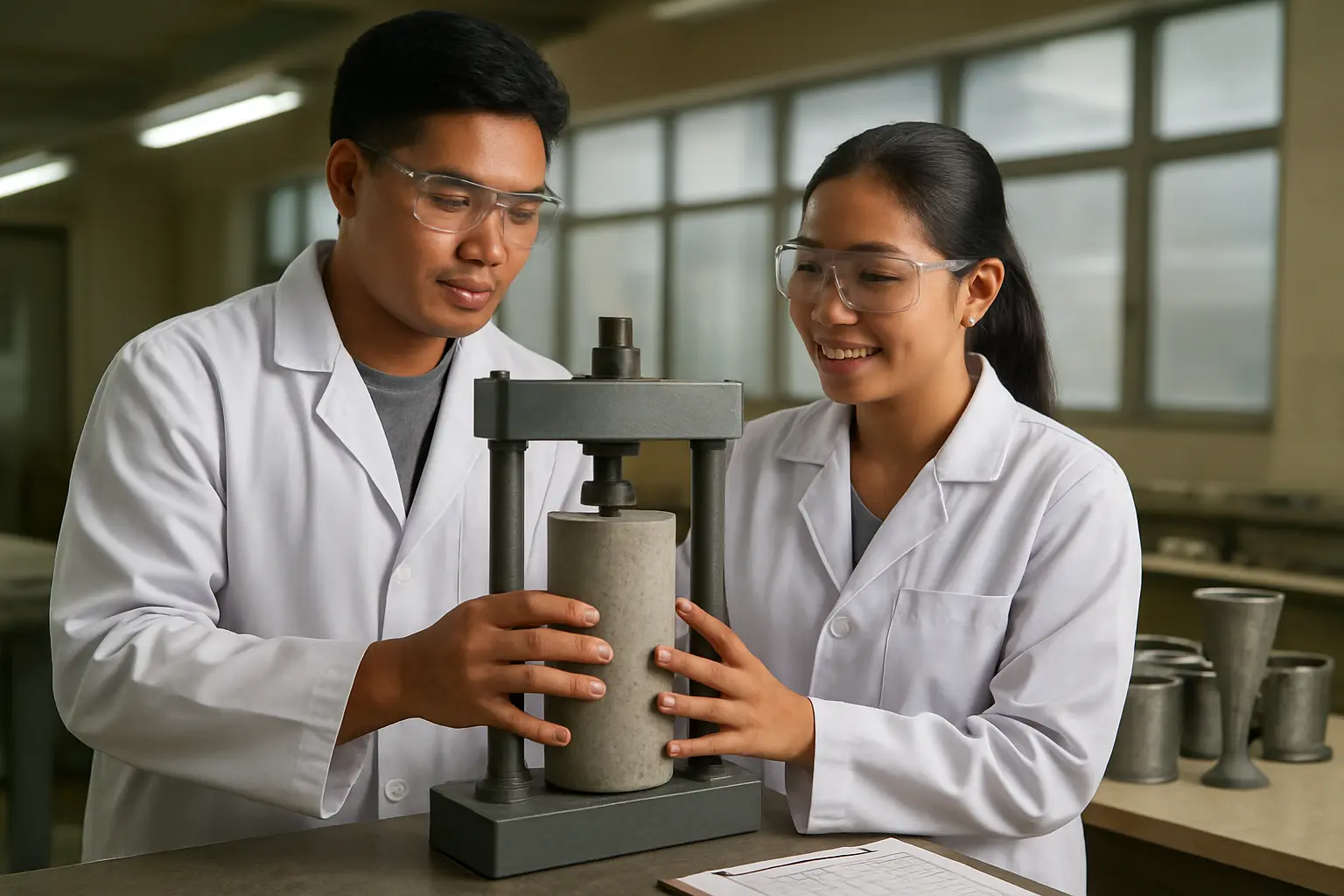
A civil engineering thesis in the Philippines is almost never a survey. It is an experiment: a concrete mix with something replaced or added — rice husk ash, fly ash, crushed glass, plastic fibres, recycled aggregate — cast into cylinders and beams, cured, and broken at 7, 14 and 28 days. That means the Chapter 3 template your school’s research manual gives you, written for questionnaires and respondents, fits badly. There are no respondents. There is a mix design, a specimen count, a curing regime and a set of ASTM test methods, and the panel expects each of them to be stated precisely enough that another group could repeat the study.
This guide writes the methodology chapter of a BSCE thesis in eight steps, each with the output you should have before moving on, using a rice husk ash partial cement replacement study as the running example. Your department’s research manual and your adviser outrank anything here; some programs also require the Chapter 3 sections in a fixed order, so check the most recently approved thesis on your shelf before you rearrange.
Step 1: State the research design in one sentence, and name the variables
Expected output: a design sentence and a variables paragraph.
The design is experimental. Say so, and say what kind: a true experimental design with a control mix and treatment mixes at fixed replacement levels, tested at fixed ages. Then name the variables the way an engineer names them. Independent variable: the percentage of cement replaced by rice husk ash, at 0, 5, 10 and 15 per cent by mass. Dependent variables: slump of the fresh concrete, compressive strength at 7, 14 and 28 days, and flexural strength at 28 days. Controlled variables: water-cement ratio, aggregate source and gradation, cement type and brand, curing method and temperature. A panel that sees controlled variables listed knows the group understands what an experiment is.
The design sentence is the only part of the chapter that resembles a survey-based Chapter 3; the generic section anatomy, and the reason each section exists, is set out in the guide to writing Chapter 3 section by section. Everything after this step is where a civil engineering methodology diverges from it.
Step 2: Specify the materials to the standard that governs them
Expected output: a materials table with source, type and governing standard per row.
Each material gets a row: cement (type and brand, conforming to ASTM C150 for portland cement, or the Philippine National Standard your adviser specifies), fine aggregate (source river or quarry, sieve analysis per ASTM C136, specific gravity and absorption per ASTM C128), coarse aggregate (source, nominal maximum size, specific gravity and absorption per ASTM C127), water (potable), and the replacement material (rice husk ash — source mill, burning condition, sieve passing). State the property tests you actually ran on the aggregates and report the results in Chapter 4, because the mix design in the next step depends on them.
Step 3: Design the mix and show the computation
Expected output: a mix design table per replacement level, in kilograms per cubic metre, plus the worked computation in an appendix.
Most Philippine BSCE theses proportion the control mix by the absolute volume method of ACI 211.1, targeting a specified 28-day compressive strength and a slump range, then derive the treatment mixes by replacing cement by mass at each level. Show the target strength, the water-cement ratio chosen, the aggregate quantities from the property tests in Step 2, and the resulting batch weights. The panel wants to see that the treatment mixes differ from the control in one variable only — the replacement percentage — and that water content and the water-cement ratio were held constant, or that any adjustment for the ash’s water demand is stated and justified.
| Mix | Cement (kg/m³) | Rice husk ash (kg/m³) | Fine aggregate (kg/m³) | Coarse aggregate (kg/m³) | Water (kg/m³) | w/c ratio |
|---|---|---|---|---|---|---|
| Control, 0 per cent | from ACI 211.1 computation | 0 | from computation | from computation | from computation | fixed |
| 5 per cent | 95 per cent of control cement | 5 per cent of control cement | same | same | same | same |
| 10 per cent | 90 per cent | 10 per cent | same | same | same | same |
| 15 per cent | 85 per cent | 15 per cent | same | same | same | same |
Fill the table with your own computed values; the shape of the table, with one variable changing down the rows, is what the panel is checking.
Step 4: Fix the specimen count and justify it
Expected output: a specimen matrix — mixes × tests × ages × replicates — with the total.
This is the civil engineering equivalent of sample size, and the panel will compute it with you. A common and defensible matrix for the running example: four mixes, compressive strength at three ages with three cylinders each, and flexural strength at one age with three beams each. That is 4 × 3 × 3 = 36 cylinders and 4 × 1 × 3 = 12 beams, 48 specimens in total. Three replicates per cell is the minimum that lets you report a mean and a standard deviation and run an analysis of variance; if your laboratory schedule allows it, cast a spare per cell for the one that fails outside the acceptable range.
State the specimen sizes: 150 by 300 millimetre cylinders, or 100 by 200 millimetre if your laboratory’s moulds and testing machine capacity dictate it, and 150 by 150 by 500 millimetre beams for third-point loading. State which you used and why, because the size affects the measured strength and the panel knows it.
Step 5: Describe casting and curing to ASTM C192
Expected output: a procedure paragraph that names the standard practice and states every deviation from it.
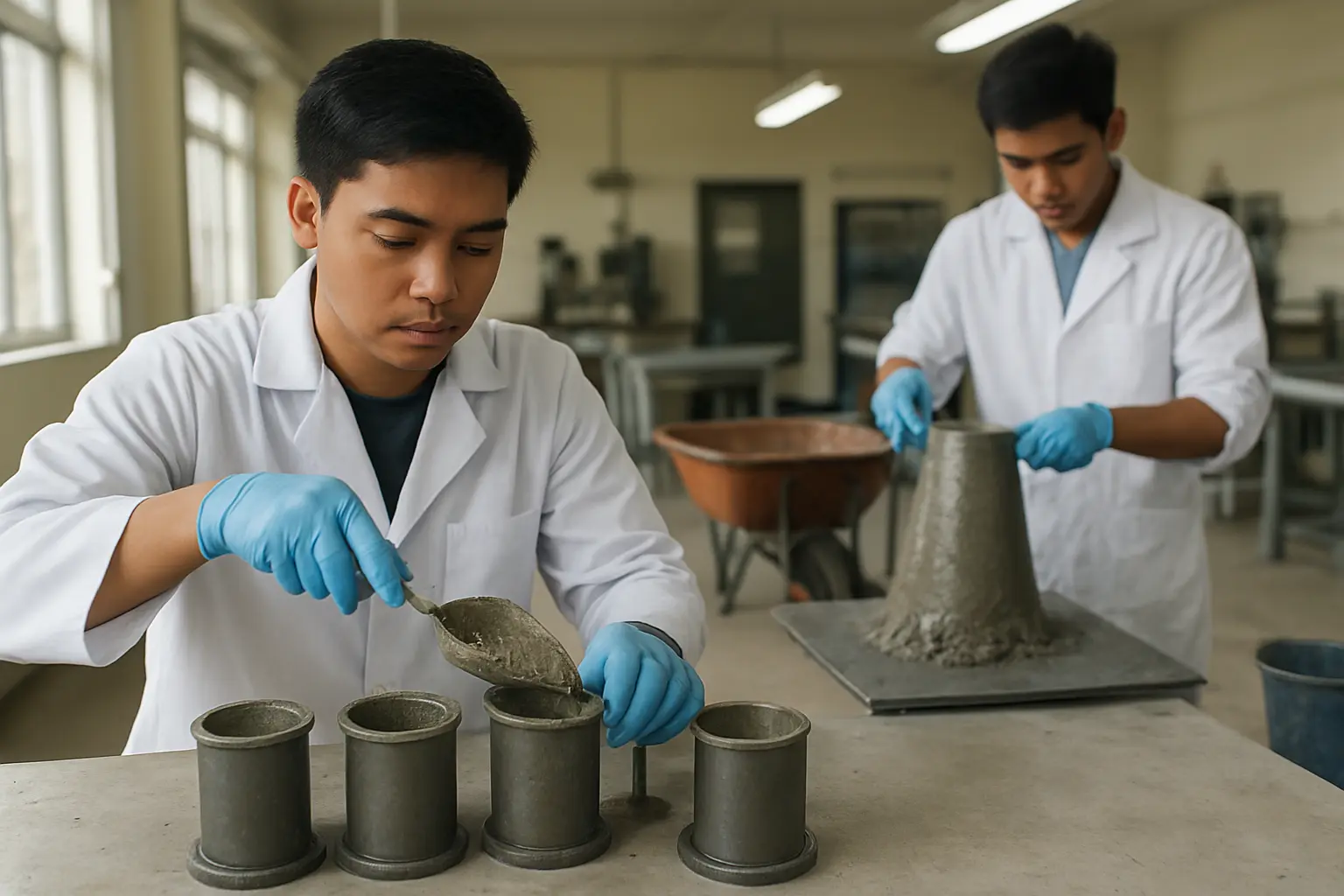
ASTM C192/C192M, the standard practice for making and curing concrete test specimens in the laboratory, governs mixing sequence, consolidation, mould filling and initial and final curing. Describe your batching (by mass), mixing (machine or hand, and the sequence), the slump test on the fresh concrete per ASTM C143/C143M immediately after mixing, consolidation of the moulds (rodding or vibration, layers and strokes), demoulding at 24 hours, and curing in water or a moist room until the test age. Where you deviated — a curing tank at ambient temperature rather than a controlled room, for example — say so, and note it as a limitation. A methodology that pretends to a laboratory it did not have is the first thing an engineer on the panel catches.
Step 6: Name the test methods, the ages and the reporting units
Expected output: a test methods table.
| Property | Test method | Specimen | Ages | Reported as |
|---|---|---|---|---|
| Workability | ASTM C143/C143M, slump of hydraulic-cement concrete | Fresh concrete, slump cone | At mixing | Slump in millimetres |
| Compressive strength | ASTM C39/C39M, compressive strength of cylindrical concrete specimens | Cylinders | 7, 14 and 28 days | Megapascals, mean of three |
| Flexural strength | ASTM C78/C78M, flexural strength of concrete using simple beam with third-point loading | Beams | 28 days | Modulus of rupture in megapascals, mean of three |
State the testing machine, its capacity and its calibration, and the loading rate you used, because C39 specifies one. If you also measured density, water absorption or a durability property, add the row and its standard. Do not cite a standard you did not follow; a panel will ask what clause you applied.
Step 7: Tie the acceptance criteria to the DPWH specification
Expected output: one paragraph stating which specification item your results will be judged against, and the criterion.
A Philippine concrete study is usually justified by an intended application — pavement, structural members, non-structural blocks — and the specification that governs the application supplies the acceptance criterion. For public works that is the DPWH Standard Specifications for Highways, Bridges and Airports, Volume II: Item 311 for portland cement concrete pavement and Item 405 for structural concrete. State the item, quote its minimum strength requirement for your class of concrete from the edition and revision your adviser uses — Item 405 has been revised by department order, so name the revision — and say that mixes meeting it will be considered acceptable for the application. That single paragraph converts a laboratory exercise into an engineering study, and it is the paragraph most BSCE methodologies omit.
Step 8: State the data analysis for an experiment, not a survey
Expected output: an analysis paragraph naming the descriptive statistics, the inferential test and the software.
Report the mean and standard deviation per mix per age. Test the differences among replacement levels with a one-way analysis of variance at each age, followed by a post-hoc comparison to identify which levels differ from the control, and state the significance level. If the group has the data, fit a regression of 28-day strength on replacement percentage to locate the optimum level. Name the software — the menu path for ANOVA and the post-hoc test is in the walkthrough on analysing thesis data in SPSS step by step — and say in advance what you will do if the three replicates in a cell are not consistent, such as discarding a specimen whose result falls outside the range C39 permits and reporting the mean of the remaining two. How the strength tables and the strength-versus-age plots are then presented is covered in the guide to writing Chapter 4 table by table.
A filled-in methodology paragraph
The compressive strength paragraph of the running example, written the way a panel expects to read it:
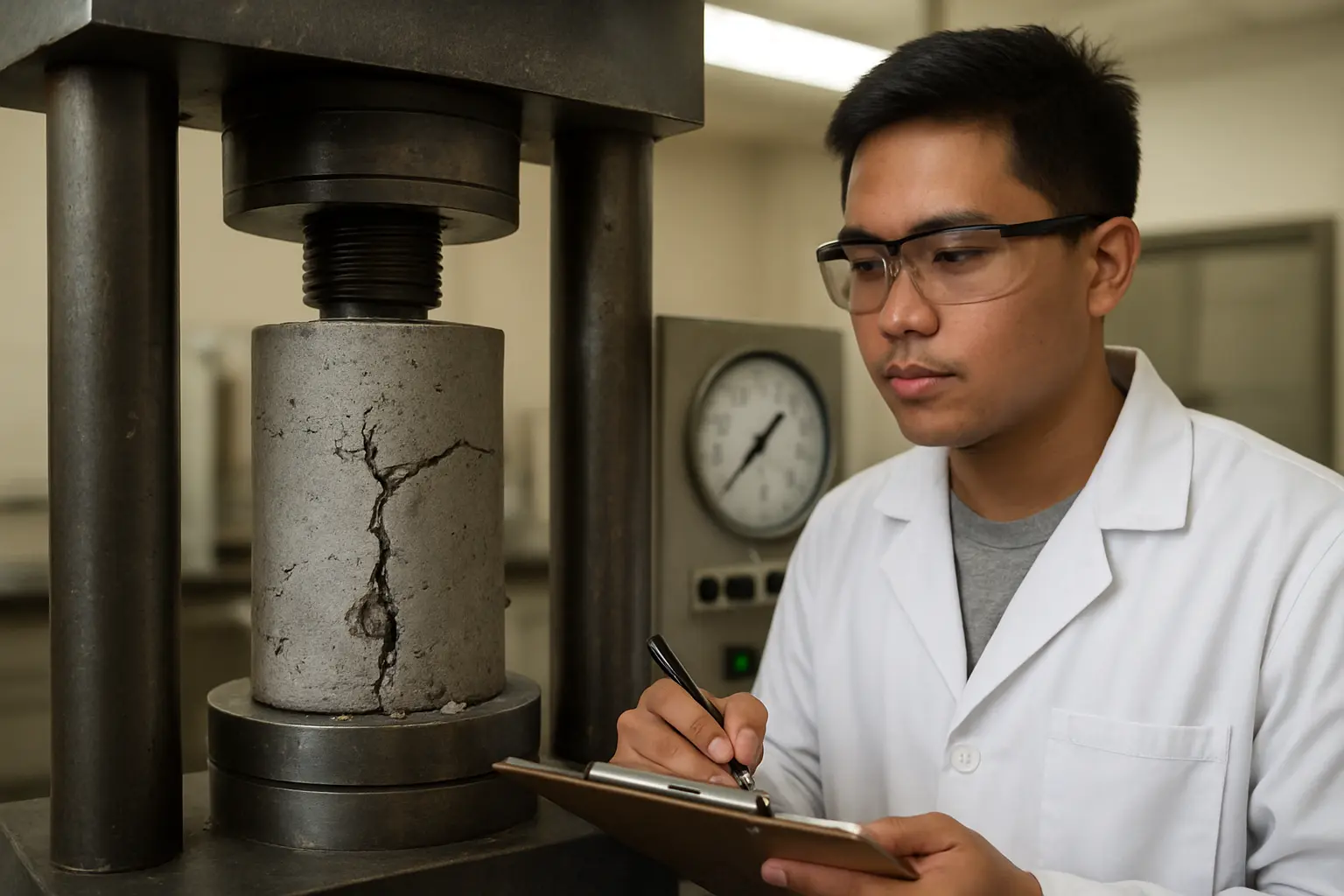
Compressive strength was determined in accordance with ASTM C39/C39M on 150 by 300 millimetre cylindrical specimens at 7, 14 and 28 days of water curing. Three specimens per mix were tested at each age, for a total of thirty-six cylinders across the control and the 5, 10 and 15 per cent rice husk ash mixes. Specimens were capped and loaded to failure in a 2,000 kilonewton universal testing machine at the university materials laboratory, calibrated in the semester of testing, at the loading rate specified in the standard. The compressive strength of each mix at each age was reported as the mean of the three specimens in megapascals, with the standard deviation, and compared with the minimum strength required for Class A structural concrete under Item 405 of the DPWH Standard Specifications, Volume II, in the revision current at the time of the study.
Citing the standards
Cite each standard as a work by the organisation that publishes it, with the designation and year of the edition you used, whether your program requires APA 7th or IEEE. Two APA 7th patterns cover all of them:
ASTM International. (2021). Standard test method for compressive strength of cylindrical concrete specimens (ASTM C39/C39M-21).
Department of Public Works and Highways. (2013). Standard specifications for highways, bridges and airports (Vol. II).
Use the designation year printed on the copy in your laboratory, and the same rule for the DPWH revision. Civil engineering programs that require IEEE follow a different pattern for standards, and the differences that cost marks are compared in the guide to APA versus IEEE for Philippine engineering documentation.
Draft the eight sections from your mix design
Tesify drafts the civil engineering methodology chapter from the details you supply — replacement levels, specimen matrix, the ASTM methods and ages, the DPWH item — in the Chapter 3 structure your program requires, and builds the reference entry for every standard as you write. Over 9,000 students have used it to write more than 15,000 chapters, and every word is still written by you.
Start your civil engineering thesis on Tesify · Build the standards references with the automatic bibliography
Frequently asked questions
What research design does a civil engineering thesis use?
Most BSCE theses in the Philippines use an experimental design: a control mix and treatment mixes that differ in one variable, tested at fixed ages with three replicate specimens per condition. State the design in one sentence and list the independent, dependent and controlled variables.
How many specimens do I need for a concrete thesis?
Multiply mixes by tests by ages by replicates. Three replicates per condition is the minimum that supports a mean, a standard deviation and an analysis of variance; four mixes tested for compressive strength at three ages and flexural strength at one age gives 48 specimens.
Which ASTM standards should a concrete thesis cite?
At minimum ASTM C192 for making and curing specimens, C143 for slump, C39 for compressive strength and C78 for flexural strength, plus the aggregate property standards you actually ran. Cite the designation and year of the edition you used, and only standards you followed.
Do I need to cite DPWH specifications?
If your study is justified by a public works application, yes. Item 311 covers portland cement concrete pavement and Item 405 covers structural concrete; quote the minimum strength criterion from the edition and revision your adviser uses and judge your mixes against it.
What statistical test do I use for a concrete strength study?
One-way analysis of variance across replacement levels at each test age, followed by a post-hoc comparison against the control, and a regression of strength on replacement percentage if you want to locate an optimum. Report means and standard deviations per mix per age.
Can I use 100 by 200 millimetre cylinders instead of 150 by 300?
Yes, if your moulds and testing machine dictate it, but state the size in the methodology and be consistent across all mixes and ages, because specimen size affects the measured strength and a panel will ask.