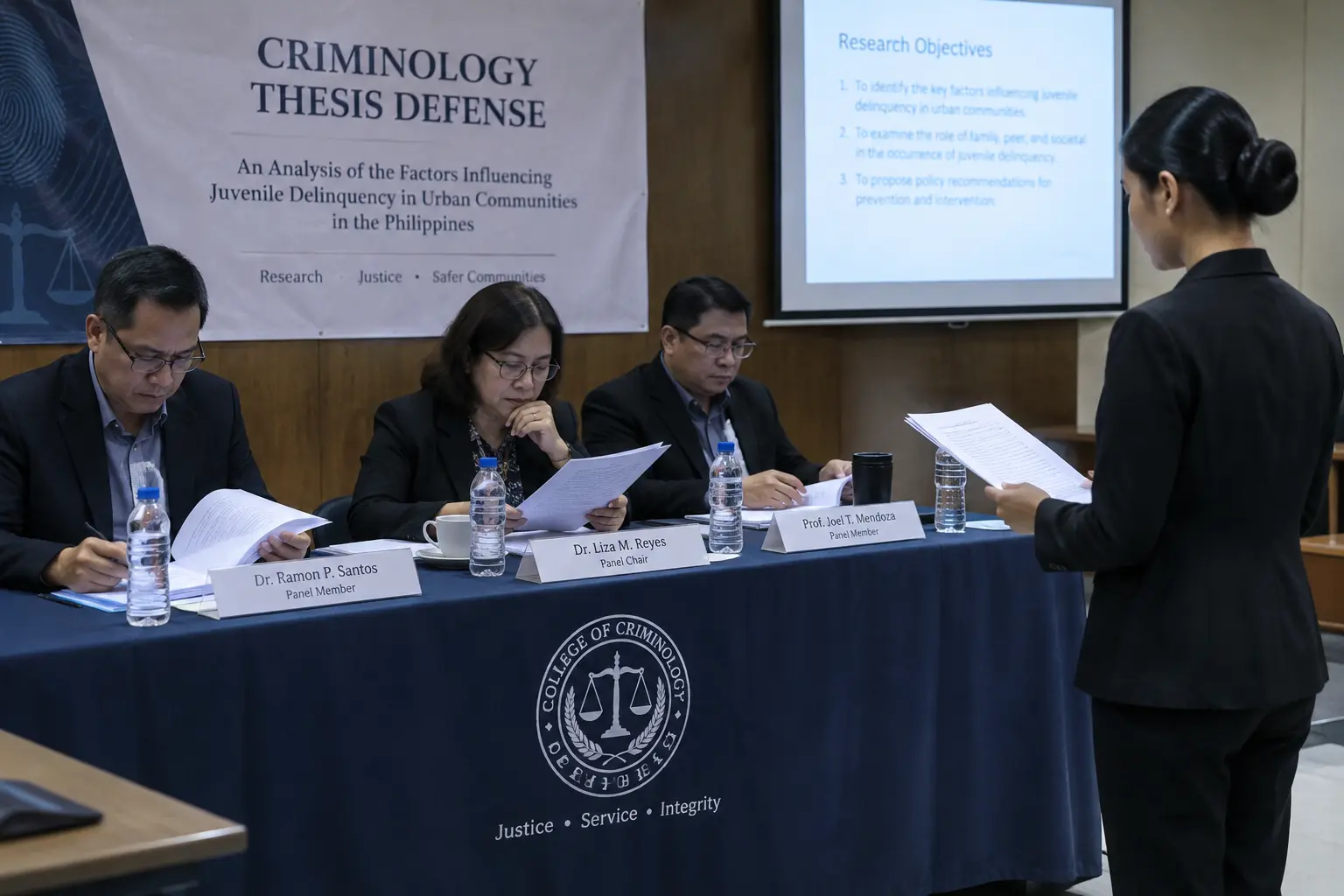
Your criminology thesis title passed. Your full manuscript might not, and the reason is rarely the topic itself. Panels flag criminology theses for a specific, recurring set of objections — a sampling method that cannot reach the population it claims to describe, a data-access plan that assumes cooperation no agency actually promised, an ethics section that skips what a justice-adjacent study specifically requires. Catch these before your final defense and the meeting becomes a formality instead of a rewrite order.
Start your criminology thesis on Tesify
The first objection to check: an unreachable population
A title promising insight into “offenders,” “victims” or “law enforcement personnel” broadly, backed by a convenience sample of whoever agreed to answer a survey, is one of the most common criminology objections. Justice-system populations are hard to reach for real reasons — incarcerated individuals need institutional clearance, victims of crime raise ethical and safety concerns, active police officers need command approval before speaking to researchers on the record. A panel does not object to a small or narrow sample; it objects to a title that promises more population than the study’s actual access can support.
The fix is narrowing before you commit, not explaining afterward: “college students’ perception of police visibility in [barangay]” is a defensible, reachable population; “the effectiveness of police visibility” implies data from police operations and outcomes you likely cannot obtain as an undergraduate. Topics already scoped to a reachable population and anchored in PNP crime-category data are listed in criminology thesis topics for 2026, if your own title still needs narrowing along these lines.
The objection that follows close behind: assumed data access
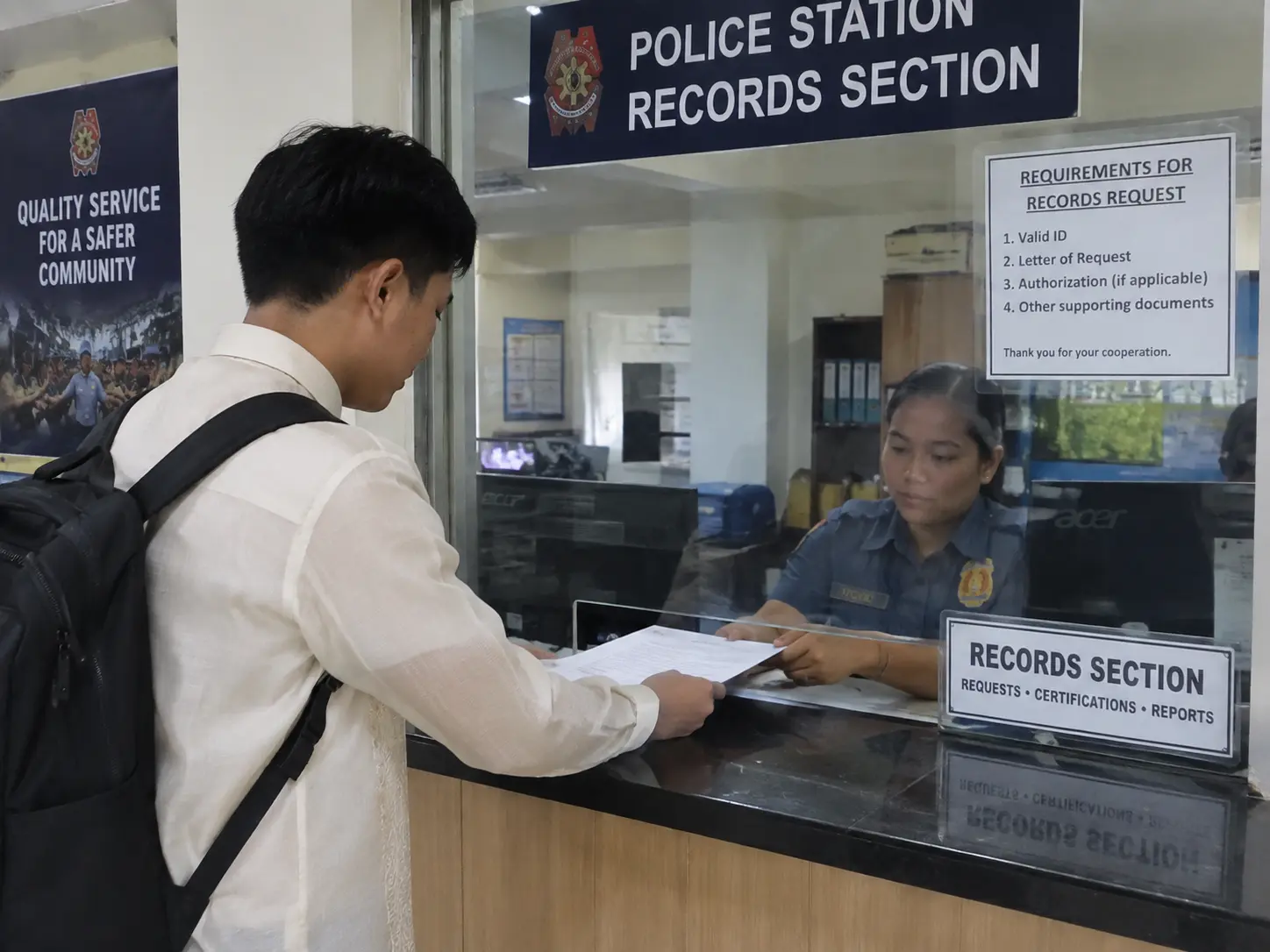
A methodology chapter that states data will come from PNP blotter records, BJMP files or court records, with no letter, no named contact and no fallback plan, is presenting an assumption as a procedure. These agencies have real, and reasonable, gatekeeping around case records, and a request that arrives without warning in week 10 of a one-semester timeline routinely fails simply on timing, whatever its merits. State in Chapter 3 exactly which office you contacted, when, and what was actually granted — and build a fallback population (a survey-based design instead of records access) into your proposal from the start rather than discovering the need for one after a request stalls. A week-by-week timeline that builds in the lead time a records request or ethics clearance genuinely needs is worked through in the criminology thesis timeline and budget guide, and once you are past proposal stage and closer to the final defense, the specific questions a criminology panel asks about access and confidentiality are rehearsed in what the criminology defense panel will ask — that piece covers the live defense conversation; this one covers the manuscript objections that lead to it.
What a delay here actually costs you
Criminology data-collection delays compound in a specific way: an agency access request that stalls does not just cost the weeks spent waiting, it often forces a late redesign — from records-based to survey-based, or from one respondent group to another — and a late redesign means re-doing the instrument, re-running the ethics review, and re-writing Chapter 3 with weeks left rather than months. Groups that build the fallback design into their original proposal lose none of that time if the primary access plan stalls; groups that assume access will come through are the ones who lose a full semester to a single unanswered request letter.
The ethics-section objection specific to criminology
Criminology research routinely touches populations a school’s general ethics template was not written for: minors in conflict with the law, victims of violence, active offenders, law enforcement personnel discussing operational matters. A named ethics committee with no description of what it actually reviewed reads as a formality, and a panel expects the section to state the specific safeguards for the specific population — how a minor respondent’s parent or guardian consented, how a victim-respondent’s safety and re-traumatization risk was addressed, how a law enforcement respondent’s operational disclosures were handled if the topic touches active cases. Generic language borrowed from a template built for a classroom survey does not answer any of these, and a criminology-trained panelist will ask the specific question the generic language avoided.
The statistical-treatment objection: design and test mismatch
A criminology thesis calling itself “descriptive” while reporting a correlation coefficient, or calling itself “correlational” while never running a correlation test, has the same core problem examiners flag across other disciplines: the design named in Chapter 1 does not match what Chapter 4 actually did. Criminology-specific variants of this include treating crime-rate or incident data as continuous when it is really a rate computed from small counts (which behaves differently statistically), and comparing categories (offense type, barangay, precinct) with a t-test when three or more categories call for ANOVA or its non-parametric equivalent. Name the design, run the matching test, and if your data forces a change mid-thesis, update the design language in Chapter 1 and Chapter 3 to match rather than leaving the original claim standing.
The discussion-chapter objection: overreaching a small or narrow sample
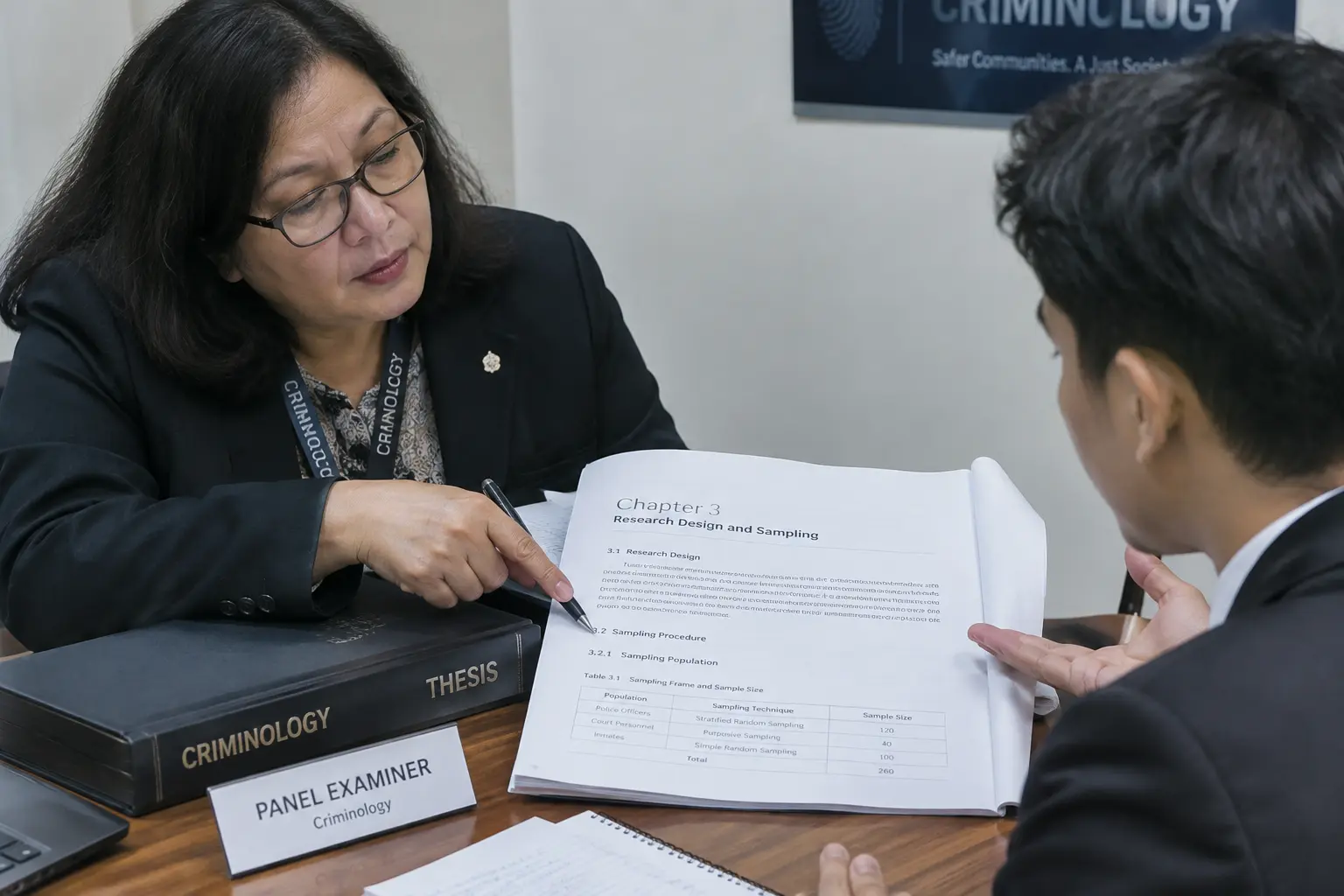
A finding from thirty respondents in one barangay, followed by a Chapter 5 recommendation for national policy change, is a scale mismatch a panel flags immediately. Criminology topics invite this more than most fields, because the subject matter (crime, justice, policy) feels naturally large-scale even when the actual sample is small and local. Scale every recommendation to what your sample and design genuinely support: a pilot-level or barangay-level recommendation, or a call for further research at a larger scale, rather than a claim your data cannot carry.
The citation and related-literature objection specific to criminology
Criminology theses lean heavily on official statistics and government reports, and two related-literature objections show up more here than in most fields. The first is citing a crime statistic or agency report without checking whether a more recent release supersedes it — Philippine crime data is republished periodically, and a figure from three releases ago cited as current is an objection a panel with access to the same public data will catch immediately. The second is citing a criminological theory’s application without checking that the underlying theory (Routine Activity Theory, General Strain Theory, Social Disorganization Theory, Rational Choice Theory) is applied correctly to the specific crime type or context the thesis studies — a theory developed for street-level property crime does not automatically transfer to cybercrime or white-collar offenses without the thesis explaining why the mechanism still applies.
How to check your own manuscript before the defense
- Does your title’s population match what your actual access plan can reach?
- Is your data-access procedure documented with a named contact, a date and what was granted — not assumed?
- Does your ethics section name the specific safeguards for your specific population (minors, victims, offenders, law enforcement)?
- Does your Chapter 4 statistical test match the design named in Chapter 1?
- Do your Chapter 5 recommendations stay within the scale your sample actually supports?
A group that can point to a page number for each of these five walks into the final defense with the panel’s most predictable objections already closed. Run the check at the same points a criminology timeline naturally pauses — after the proposal defense, after ethics clearance, and again a week before the final defense — rather than only once at the very end, since a gap caught early costs an afternoon and the same gap caught late costs a rewrite.
Frequently asked questions
Can a criminology thesis use a convenience sample of college students instead of actual offenders or victims?
Yes, and it is often the more realistic choice for an undergraduate timeline — a title about perceptions, awareness or attitudes among a reachable population (students, residents, employees) is defensible where a title implying direct access to justice-system populations is not, provided the title itself names the population you actually studied.
What if the PNP or BJMP denies our records request?
Have a fallback design ready before you submit the request, not after a denial — a survey-based or perception-based design using a reachable population lets you continue without a semester-long stall, and you can note the denied request as a limitation in Chapter 5 rather than as a crisis that derails the whole study.
Does our school’s standard ethics template cover a study involving minors in conflict with the law?
Check explicitly rather than assuming — many general templates do not, and a study involving minors typically needs additional safeguards (parental or guardian consent, assent from the minor, extra confidentiality measures) beyond what a standard adult-respondent template covers.
Is it true that criminology theses get rejected more often than other courses?
There is no reliable figure to cite either way, and a claim like that should not appear in your own thesis without a verified source. What can be said is that a specific set of objections — population access, data access, ethics specificity — recur often enough to be worth checking systematically before any defense.
Can we name the specific precinct, barangay or facility in our thesis?
Only with that office’s or facility’s consent, ideally documented the same way a company access agreement would be; many law enforcement and detention facilities prefer to be referred to generically (“a selected police station in [city]”) specifically to avoid identifying details in a published document.
What if our adviser approved a data-access plan the panel then questions?
Raise the discrepancy with your adviser directly rather than resolving it yourselves — advisers and panels occasionally read an access plan’s feasibility differently, and your adviser is the one positioned to either defend the plan to the panel or agree that it needs the revision the panel is asking for.
Do these objections differ between the title defense and the final defense?
Population and access objections usually surface first, at the title or proposal stage, since a panel can spot an unreachable population before any data is collected. Ethics-specificity and statistical-treatment objections more often surface at the final defense, once the actual ethics process, instrument and Chapter 4 results are on the table for the panel to check against what the proposal promised.
Can we use a purely documentary or secondary-data design to avoid the access problem entirely?
Yes, where the research question fits it — a documentary analysis of published crime statistics, case law or policy documents avoids the human-respondent access chain described above, though it trades that access problem for its own: the sources have to be genuinely public and citable, and the analysis still needs a clear method rather than a loose narrative summary of what you read.
Close the gaps a criminology panel checks first
Tesify helps you structure your population scope, data-access procedure and ethics section around the objections criminology panels raise, and keep your statistical treatment aligned with the design you name in Chapter 1. Over 9,000 students have used it to write more than 15,000 chapters, and every word is still written by you.