
The best sources for previous Philippine nursing theses and local studies are HERDIN (which indexes theses and dissertations), the nursing journals that HERDIN and Philippine E-Journals carry, Europe PMC for open-access full text, and your own college’s thesis room. No single source is enough. Use all four, in a set order, and record what you find.
Which sources should a nursing student compare first?
| Source | What it gives a nursing student | Cost and access | Weakness | Best used for |
|---|---|---|---|---|
| HERDIN | Philippine health research records, with a document-type filter that includes Thesis/Dissertations | Open search; some full texts on request | Many records are abstract only | Local studies and previous theses |
| Europe PMC | Free-to-search biomedical and nursing literature with an open-access filter and affiliation search | Free; many full texts open | Not Philippines-only; you must filter | Foreign studies and open full text |
| Philippine E-Journals | Journals published by Philippine institutions, browsable by subject category, including Nursing | Abstracts open; full text often for subscribers | Thinner than health databases for clinical topics | Local nursing education and school-based studies |
| Nursing and health journals | Philippine Journal of Nursing, Acta Medica Philippina and the Philippine Journal of Health Research and Development | Varies by journal | Small number of nursing issues per year | Peer-reviewed local nursing studies |
| Your college thesis room | Approved nursing theses from your own college | Usually on campus | Weaker as citations; often no photocopying | Format, scope and instruments precedent |
This guide is nursing-specific. For the general ranking of sources for any course, including how Google Scholar and OpenAlex compare, read where to find related literature for a Philippine thesis. For turning what you find into Chapter 2, use how to write a review of related literature.
1. HERDIN: the first stop for local nursing studies
HERDIN, the Health Research and Development Information Network, is run from the Philippine Council for Health Research and Development. Its search form lets you search by title, abstract, MeSH terms, non-MeSH keywords, researcher or publication title, and it supports the operators AND, OR and NOT between lines. It also has filters for publication year, for “Show only results with free full-text availability,” for “Abstract only” and “Full Text (Upon request),” and for publication type, where the list includes Journal, Proceedings, Resident Research Output and Thesis/Dissertations.
For a nursing student the thesis filter matters most. Tick Thesis/Dissertations, then search your variable. A search for postoperative pain may bring up previous master’s theses done in Philippine hospitals, which also tell you which wards and instruments are workable. HERDIN also indexes the Philippine Journal of Nursing as a peer-reviewed source.
Search strings to try:
- Title: “nurses” AND “burnout” — then filter to the last ten years.
- Abstract: “patient satisfaction” AND “Philippines.”
- Keywords: “nursing students” AND “clinical competence.”
Where it falls short: many records are abstract only, so you may need to request the full text or ask the thesis’s home school. Plan this early, because requests take time.
2. Europe PMC: free full text and foreign studies
Europe PMC is free and lets you filter for open-access records and search by affiliation. For nursing it works well as a second pass: use it to find foreign studies on your variable and any Philippine ones that are published in international journals. Try this string in the search box:
(nurses OR nursing) AND AFF:"Philippines" AND OPEN_ACCESS:y
As of October 2026, a search of that kind with a 2021 to 2026 date range returns well over a thousand open-access records, so add your own variable, for example AND "patient safety", to narrow it. A Philippine affiliation does not guarantee a Philippine sample, so open the abstract to check where participants were recruited before you label a study “local.”
Where it falls short: it does not index most Philippine thesis repositories and it mixes in foreign studies, so you must filter and read.
3. Philippine E-Journals: local nursing education and school studies
Philippine E-Journals (PEJ) hosts journals from Philippine universities and professional organisations. Its journal pages show subject categories, and Nursing is one of the categories used, including on a student research journal from a Laguna school (Binhi: Letran-Calamba Student Research Journal). Browse by category, then search within a journal, instead of relying on keywords alone. It is best for local studies on nursing education, student experiences and school-based interventions. Abstracts are open, but full text is often limited to subscribing institutions, so check your library before you plan around any paper. The comparison with other general sources is in the pillar linked above.
4. Nursing and health journals worth browsing by hand
- Philippine Journal of Nursing. The journal of the Philippine Nurses Association, described on HERDIN’s journal page as peer reviewed. Browse its issues by hand for local clinical, community, administration and education studies.
- Acta Medica Philippina. Published by the University of the Philippines Manila, with print and online ISSNs (0001-6071 and 2094-9278). It carries health research relevant to nursing, especially on public health and clinical topics.
- Philippine Journal of Health Research and Development. A peer-reviewed journal of the University of the Philippines Manila, formerly the UP Manila Journal, and listed in HERDIN as peer reviewed. Good for community health and health systems topics.
When you cite from a journal, record author, year, title, journal, volume, issue and pages in your notes at the moment you read it. Reconstructing a reference later is how wrong page numbers get into a thesis.
5. Your own college’s thesis room
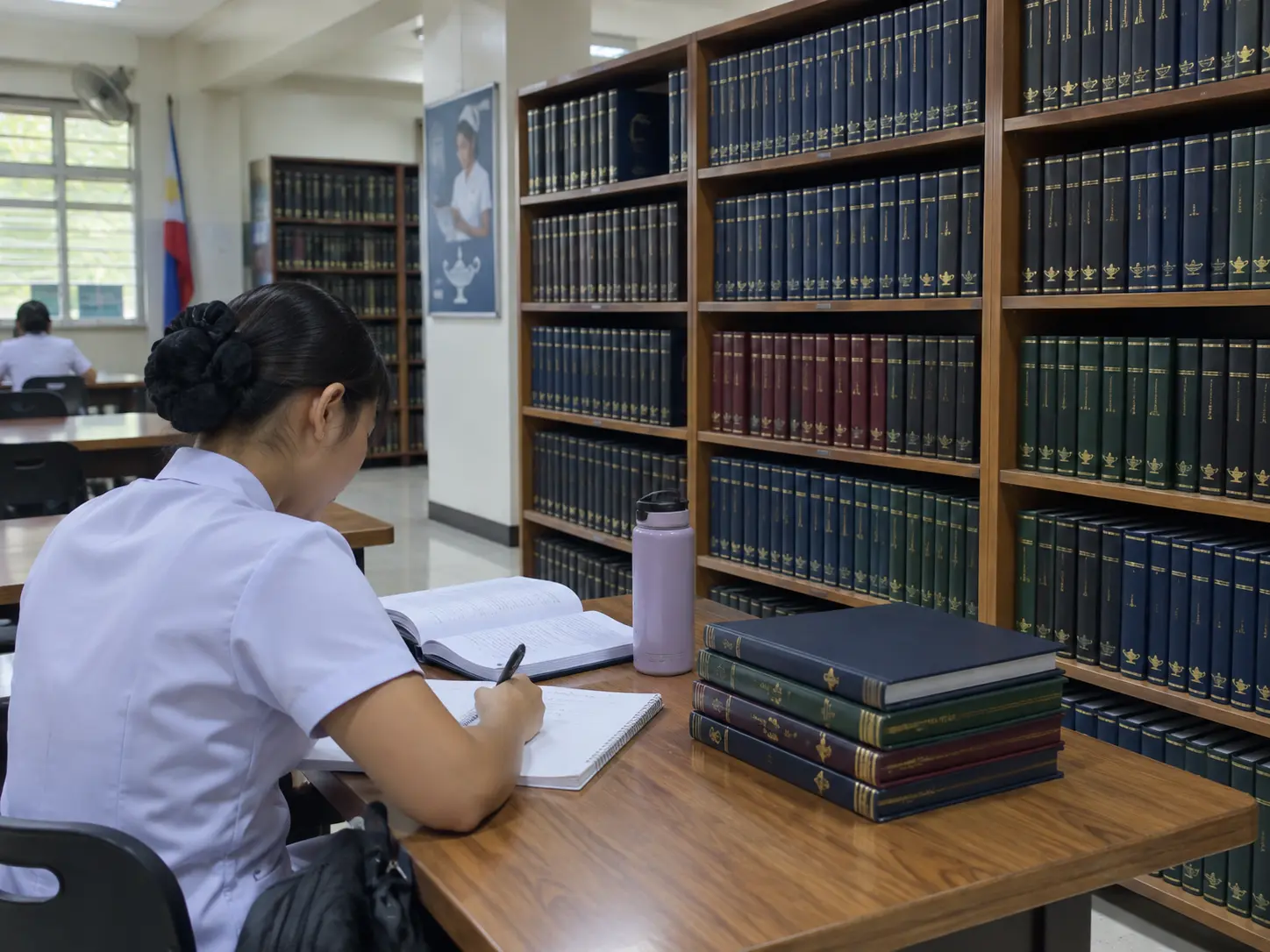
Go here in week one, before you lock your title. Previous theses from your college show the section names your adviser expects, a scope that was acceptable for one semester, and instruments already approved by your own panel. They also tell you whether your topic has been done in your college. If it has, change the setting or population, not just the year. A related check is in how to check whether your thesis topic is already studied.
Take notes, not photocopies, if the rules forbid copying. For each thesis, write down the title, year, design, population, sample size, instrument, statistical tests and recommendations. A table like that becomes your “gap” argument in Chapter 2.

What is the recommended search order for a nursing RRL?
- Week 1: your college thesis room, to learn format and avoid duplicate topics.
- Week 1 to 2: HERDIN with the thesis filter, then without it, for local studies.
- Week 2: Philippine E-Journals browsing by Nursing category.
- Week 2 to 3: Europe PMC for foreign studies and open-access full text.
- Week 3: hand-browse the Philippine Journal of Nursing and Acta Medica Philippina for recent issues on your variable.
- Throughout: a source log with a local or foreign tag.
A worked search for one nursing topic
Take an illustrative topic: “work stress among staff nurses in public hospitals.” Here is how the search runs, with the thinking at each step.
- Break the topic into terms. “Work stress” can also appear as “occupational stress,” “burnout” or “job strain.” “Staff nurses” can be “nurses,” “hospital nurses” or “nursing personnel.” List the synonyms before you open any database.
- Search HERDIN with the thesis filter. Use the title field and try each synonym with “nurses.” Expected output: a short list of previous Philippine theses and their home institutions, which tells you whether a similar topic exists locally.
- Repeat without the thesis filter. Now journal articles appear too. Note the year, setting and instrument of each one.
- Move to Europe PMC. Combine the synonyms with OR in brackets, add the nurses term, and use the open-access filter. Expected output: foreign studies with full text you can actually read.
- Tag and decide. Mark each source local or foreign, quantitative or qualitative. If you have eight local and four foreign sources on the first variable and none that combine your two variables, you have found your gap.
A source log you can copy
Keep this table open from the first day. It turns a messy search into material you can write from, and it makes your related-literature section honest, because every claim has a row behind it.
| No. | Author and year | Local or foreign | Design and sample | Instrument | Main finding | Where found |
|---|---|---|---|---|---|---|
| 1 | (fill in) | Local | (fill in) | (fill in) | (fill in) | HERDIN |
| 2 | (fill in) | Foreign | (fill in) | (fill in) | (fill in) | Europe PMC |
When you reach about ten local and ten foreign rows, check that each of your objectives is supported by at least a few of them. A gap is not an empty log. It is a pattern across rows: the same population, the same setting or the same variable pair is missing.
Which topics and variables should you search for?
Search each variable on its own, then in pairs, because a study that has both of your variables together is rarer than studies on each one. For example, search “nurse burnout,” then “nurse burnout” AND “staffing,” then add the setting. If a pair returns nothing locally, that gap is a legitimate statement for Chapter 1, and the foreign studies you found carry the argument. Topic ideas anchored in national data are listed in nursing thesis topics for 2026, and an instrument bank with sources opened is in the patient satisfaction survey item bank.
How do you use previous theses without plagiarising?
- Cite them like any other source, with author, year, title, degree, institution and place.
- Paraphrase the findings in your own words, and attribute them.
- Never copy tables, instruments or Chapter 3 wording. Trace instruments to the original author and ask permission.
- Use the thesis to see what was missing, then say in your own words what your study adds.
What panels object to in manuscripts is explained in why nursing theses get sent back. A weak related-literature section, with only foreign studies or old ones, is one of the easiest objections to prevent.
Frequently asked questions
Can I cite a previous undergraduate nursing thesis in my RRL?
Usually yes, if it is accessible and properly cited, but panels prefer peer-reviewed articles for the core argument. Use theses for precedent in format, scope and instruments.
Is HERDIN only for medical research?
HERDIN is a national health research repository, so it covers nursing and other health fields, including theses and dissertations indexed from institutions.
What counts as a local study in a nursing RRL?
A study conducted in the Philippines, with Filipino participants or settings. A foreign study was conducted elsewhere. Your school’s manual may define the split, so check it.
How recent should the studies be?
Follow your research manual. Many schools prefer the last five to ten years for the main body, with older seminal works allowed when they are the original source of a theory or instrument.
Can I copy the instrument from a previous thesis?
Do not copy it as if it were yours. Trace it back to the original author, cite that source, ask permission where needed, and report your own validity and reliability.
Why can I not download the full text?
Many records are abstract only or full text on request, and many journals sit behind institutional subscriptions. Ask your librarian, request the full text, or look for an open-access version on Europe PMC.
Do I need CINAHL?
It is a common nursing database, but it is subscription based, so access depends on your school library. Free options such as Europe PMC cover a lot of ground.
How do I avoid plagiarism when I use previous theses?
Paraphrase with attribution, cite every source, and use previous theses to learn structure and gaps, not to lift paragraphs or tables.
Turn your sources into a clear Chapter 2
Tesify helps you structure your review of related literature into local and foreign sections once you have your sources. Over 9,000 students have used Tesify across more than 15,000 chapters, and the thesis stays 100% written by you.