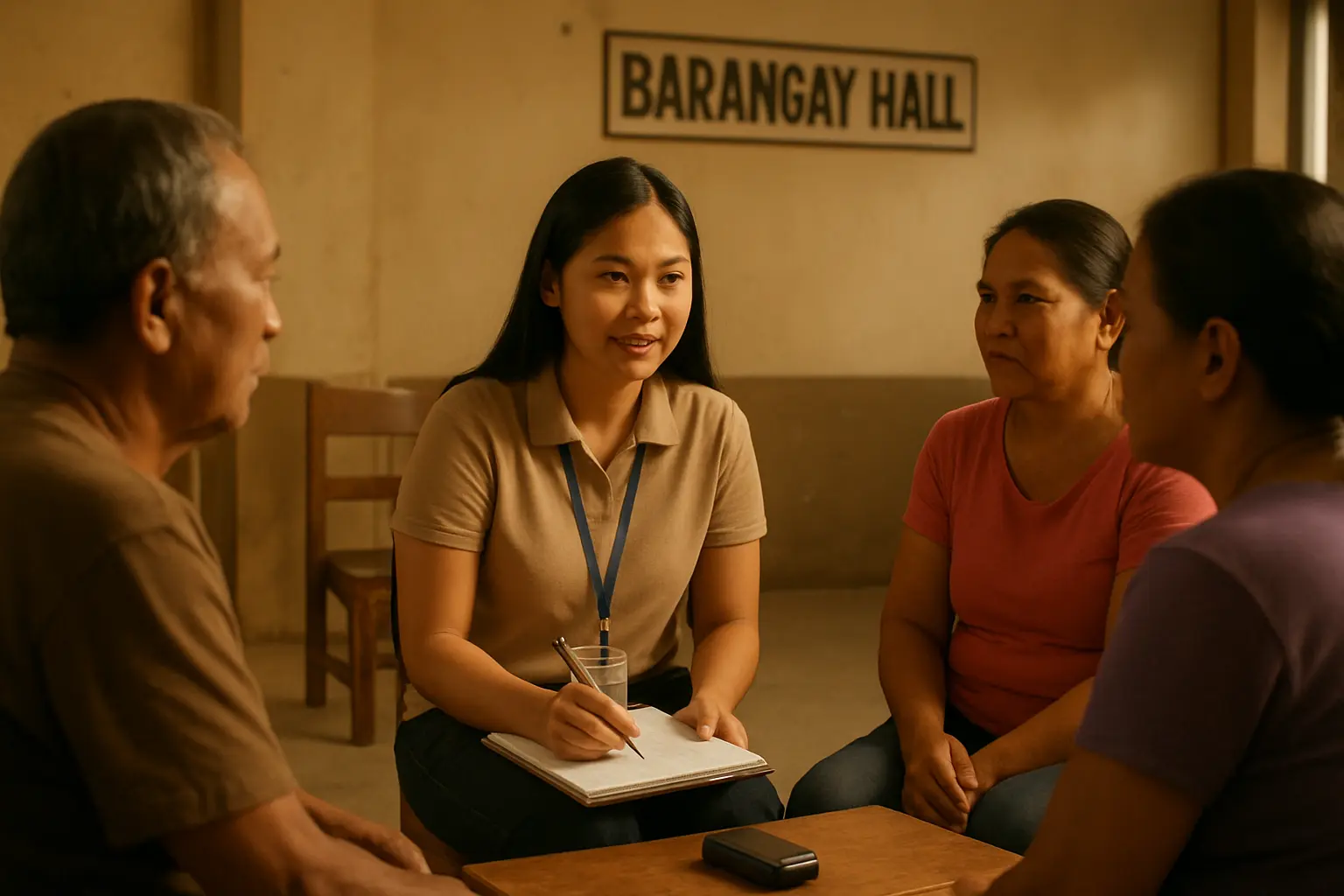
A focus-group or interview guide for a Philippine social work thesis has four parts: an opening that builds rapport and states the ground rules, main questions that map directly to your specific research questions, probes that go deeper without leading the respondent, and a closing that leaves the door open for anything unsaid. Below is that structure filled in, the difference between a focus group and a one-on-one interview for social work topics specifically, and what happens to the guide after the session ends.
What goes in the opening section?
The opening is not small talk — it does three jobs a panel expects to see accounted for. First, it restates the purpose of the study in plain language, even though the respondent already read the consent form, because people forget details under the mild pressure of being recorded. Second, it states the ground rules explicitly: there are no wrong answers, participation is voluntary and can stop at any point, and — for a focus group specifically — what is said by other participants stays in the room. Third, it confirms consent to record one more time, verbally, even after the written form was signed, because a verbal confirmation on the recording itself is what most Philippine ethics committees actually check for when reviewing a transcript. A short icebreaker question follows — something low-stakes and easy to answer, such as how long the respondent has lived in the community or worked with the agency — before the guide moves into the substantive questions.
How do main questions map to the research questions?
Every main question should trace back to one of the specific questions in your statement of the problem, the same one-to-one mapping the site’s Chapter 3 methodology guide requires for a quantitative instrument. A worked example makes the mapping concrete. Take a study on community coping strategies among households a year after a typhoon: the four specific questions in Chapter 1 might ask what changed in daily routines immediately after the event, what formal and informal help the household received, what the household did when formal assistance was delayed, and what the respondent believes would have helped most but did not happen. The main-question bank follows those four in order:
- Opening/icebreaker: “Can you tell me a little about your household and how long you’ve lived here?”
- Main question 1 (routine change): “Walk me through what a typical day looked like for your household right after the typhoon, compared to before.”
- Main question 2 (formal and informal help): “What kinds of help did your household receive in the weeks after — from the barangay, from relief agencies, from neighbors or relatives?”
- Main question 3 (delayed assistance): “Was there a point where help you expected did not come, or came later than you needed it? What did your household do in that situation?”
- Main question 4 (unmet needs): “Looking back, what do you think would have helped your household most that did not happen?”
- Closing: “Is there anything about this experience we haven’t talked about that you think is important for me to know?”
Each main question in this bank carries two or three planned probes underneath it in the actual guide document — the example above shows the main-question spine only, which is what a panel reviews first when checking the mapping to Chapter 1.

What is a probe, and how is it different from a leading question?
A probe is a planned follow-up that asks the respondent to go deeper into their own answer without introducing new content of your own — “Can you tell me more about that?”, “What happened next?”, “How did that make you feel?” — as opposed to a leading question that supplies the answer inside the question itself, such as “Did that make you feel abandoned by the agency?” The second form plants a word the respondent had not used and risks producing data that reflects the researcher’s framing rather than the respondent’s own experience, which is a validity problem a qualitative methods adviser will flag on sight. Write two or three planned probes under each main question so the interviewer or moderator is not inventing follow-ups on the spot mid-session, while staying flexible enough to follow a genuinely unexpected but relevant direction the respondent takes.
What is different about running a focus group versus a one-on-one interview?
A focus group needs a moderator and, ideally, a separate note-taker or co-facilitator whose job is watching group dynamics — who is dominating, who has not spoken, whether a sensitive disclosure from one participant is making others visibly uncomfortable — while the moderator keeps asking questions. Group size of six to ten participants is the common range for a manageable Philippine community-based FGD; fewer than six risks a thin discussion, and more than ten makes it hard for everyone to speak within a reasonable session length. Seating in a circle rather than rows, and a stated house rule that only one person speaks at a time, are small logistics a guide should note explicitly rather than leaving to the moderator’s improvisation on the day. A one-on-one interview trades the group-dynamic richness for privacy, and is the safer and often the required choice whenever the topic touches abuse, trauma, a specific family conflict, or any content a respondent would reasonably not want other community members to hear — the ethics and vulnerable-group protocol behind that choice is covered in the site’s own social work ethics and consent guide, and should be settled before the format decision, not after.
Who should moderate, and does the interviewer’s own role matter?
A social work student who already has a helping relationship with prospective respondents — a practicum supervisor’s own caseload, for instance — should generally not be the one interviewing them for the thesis, because the existing power dynamic can make a respondent feel obligated to answer in a way that pleases the interviewer rather than honestly. Where the researcher does have an existing relationship with the community, name that relationship explicitly in Chapter 3 as a potential source of bias and describe what was done to manage it — a neutral co-facilitator taking the lead on the most sensitive questions, for example. Neutrality also shows up in small, practical habits during the session itself: acknowledging every answer with a neutral “thank you” or “I see” rather than visible approval or disapproval, resisting the urge to fill a silence immediately (a pause often means the respondent is still thinking, not that the question failed), and writing brief observational notes on tone or body language immediately after the session while the memory is fresh, since a transcript alone cannot capture that context.
How many respondents or groups are enough?
There is no Slovin’s-formula equivalent for qualitative work; the site’s qualitative sample-size guide covers what the published evidence says about reaching saturation and how to justify the number in Chapter 3. For a focus-group design specifically, three to five groups across the sampling frame (for example, across different sitios or age brackets within one barangay) is a common undergraduate scope, run until new sessions stop producing genuinely new themes rather than against a fixed target number decided in advance.
Should I pilot the guide before using it?
Yes, and a Philippine social work ethics committee typically expects it: a small pilot session with one or two people similar to, but not part of, the actual sample surfaces questions that are confusing, too sensitive to ask this early, or oddly ordered — a question about a traumatic event asked before rapport has been built, for instance, tends to get a guarded, thin answer in the pilot, which is exactly the kind of thing a full session cannot afford to discover for the first time. Revise the guide based on the pilot, note the revision in Chapter 3, and do not count the pilot session itself as part of the analyzed data unless the proposal explicitly planned to include it.
What happens to the guide and the recording after the session?
The recording gets transcribed — verbatim, including filler words and pauses where they carry meaning, not cleaned up into polished prose — and the transcript, not the raw audio, becomes the unit that gets coded. The site’s own qualitative data analysis software guide compares the free tools available for that coding step. The guide itself, along with the pilot notes and any revision made to it, goes into the appendix of the finished manuscript as evidence of the instrument’s development, the same standard the site’s instrument validation guide holds a quantitative questionnaire to.
Common mistakes a guide like this should avoid
A main-question list with no probes underneath it, leaving the interviewer to improvise follow-ups on sensitive material in real time. Questions ordered so the hardest, most sensitive question comes first rather than after rapport has built. A closing question that is skipped for time, which cuts off exactly the moment respondents sometimes volunteer their most candid remark. And a guide that was never actually piloted, submitted to the ethics committee as a first draft — reviewers can usually tell, because an unpiloted guide tends to have at least one question that is confusing on first read.
Draft your own interview guide from your own research questions
Tesify drafts the focus-group or interview guide from your own specific questions — the opening, the main questions mapped one to one, the probes, and the closing — worded for the population your social work thesis actually studies. Over 9,000 students have used it to write more than 15,000 chapters, and every word is still written by you.
Frequently asked questions
How many questions should a focus-group guide have?
Usually five to eight main questions is enough for a 60-to-90-minute session once probes are included; more than that and a group discussion runs out of time before reaching the closing question, and a panel will ask how the session was paced.
Should I use Filipino, English, or both in the guide?
Write the guide in the language your respondents are most comfortable discussing sensitive topics in, which for most community-based Philippine social work studies is Filipino or the local language, even if the thesis itself is written in English; translate the final guide and note the translation in Chapter 3.
What is the difference between a focus group and a one-on-one interview for this purpose?
A focus group is better for topics where hearing how respondents react to each other adds information, such as shared community norms; a one-on-one interview is the safer and usually required choice for anything involving personal trauma, abuse or a sensitive individual case, where group disclosure could cause harm or discomfort.
Do I need to submit the guide itself to the ethics committee?
Yes. Most Philippine ethics committees expect the full guide, not just a description of the topics, attached to the proposal, so it can be checked against the consent form and any protocol required for a vulnerable group.