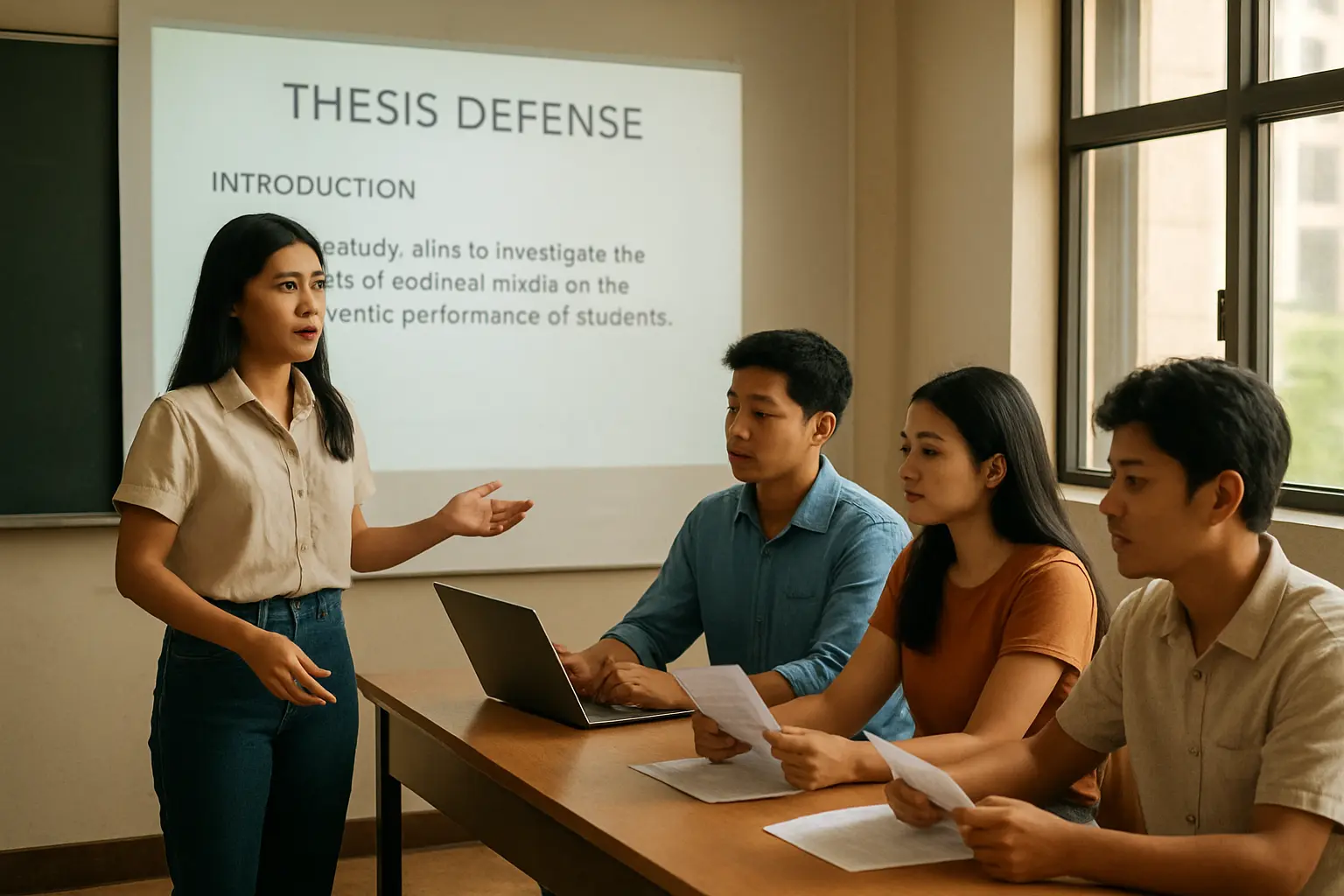
Your defense presentation is not your thesis in slide form. It is a fifteen-to-twenty minute argument that you did what you said you would do and found something worth reporting. Build ten to fourteen slides, put one table on each results slide with its finding written underneath, and rehearse against a clock until you finish inside your time limit twice in a row.
Most Filipino thesis groups build the deck the night before, copy paragraphs out of the manuscript, and arrive with thirty-two slides and no idea how long they run. The panel then spends the first ten minutes watching you read, which is ten minutes it is not spending on the parts you actually did well.
This is the procedure, in the order you should do it. Each step produces something concrete, and you can stop after any of them and still be better off than you were.
Step 1: Get the three facts that govern everything else
Before you open any presentation software, find out three things from your adviser or your research coordinator. Everything in this guide bends to these answers.
- How many minutes do you get? Philippine undergraduate defenses commonly allot fifteen to twenty minutes for the presentation, with the questioning taking the longer half of the session. A twenty-minute allowance and a twelve-minute allowance are different documents, not the same document delivered faster.
- Is there a required template? Some departments issue one, with a fixed title slide and a fixed running order. If yours does, that template overrides every layout suggestion below.
- Who presents, and does everyone speak? Many panels require every group member to speak, and some assign sections without warning. Plan for the strict version.
Expected output: three written answers, in your group chat, before anyone builds a slide.
Step 2: Build the slide spine first, empty
Create the slides as blank titled placeholders before you write a single word of content. This stops the deck growing sideways, which is the failure mode that produces thirty-two slides.
- Title
- Background and the problem, in one sentence
- Statement of the problem — your specific questions
- Scope and delimitation
- Related literature — the gap only
- Conceptual framework
- Methodology — one slide
- Results — one slide per table
- Conclusions
- Recommendations
- References
- Thank you and questions
With three or four results tables, that lands you at thirteen or fourteen slides. That is the right size. If your framework needs its own diagram slide, take one from the literature section rather than adding one.
Expected output: an empty deck of twelve to fourteen titled slides. How the chapters relate to each other, which is the logic the running order follows, is set out in the overview of Chapters 1 to 5.
Step 3: Write the problem in one sentence and put it on slide 2
The single most useful sentence in your whole presentation is the one that says what problem exists and for whom. Write it out longhand, then cut it until it fits on one line at 28 point.
A workable pattern: “[Population] at [locale] experience [problem], but no local study has measured [the specific gap], so [decision-maker] has no basis for [the action].”
Say this sentence out loud without reading it. If you cannot, it is too long. The panel forms its first judgement here, and a group that cannot state its own problem plainly has told the panel something before slide 3.
Expected output: one sentence, on one line, memorised. If your significance section is vague, that is usually the cause — the fix is in the guide to the significance of the study.
Step 4: Compress Chapters 1 and 2 into three slides, not eight
This is where decks bloat, because Chapter 2 is long and it feels wasteful not to use it. Resist it. The panel has read your manuscript.
Slide 3 carries your specific problems as a numbered list, worded exactly as they appear in Chapter 1 — not paraphrased, because a panellist checking against the document will notice the difference. Slide 4 carries scope and delimitation as two short bullets. Slide 5 carries the literature gap only: two or three sentences on what has been studied and one on what has not.
Nobody has ever been asked why their literature review slide was short. Groups are regularly asked why they spent four minutes on it. The synthesis behind that one gap sentence comes from the method in the guide to writing a review of related literature.
Expected output: three slides covering two chapters.
Step 5: Put your entire methodology on one slide
One slide, laid out as a small table. This is the slide a methodologically minded panellist photographs, and having it all in one frame works in your favour.
| Item | What you write |
|---|---|
| Design | Descriptive-correlational |
| Locale | College of Business, [University], A.Y. 2026–2027 |
| Population | 2,450 enrolled students |
| Sample | 344 (Slovin, e = 0.05); 326 retrieved (94.8%) |
| Sampling | Stratified random by year level |
| Instrument | Researcher-made, 24 items, 4-point scale |
| Validity | Content-validated by three experts |
| Reliability | Cronbach’s alpha = 0.87 (pilot, n = 30) |
| Statistics | Frequency, weighted mean, Pearson r |
Two warnings about this slide, because both get caught. Your retrieved count here must be identical to the count in Chapter 3, Chapter 4 and your abstract — a number that drifts between them is the most frequently caught defect in Philippine manuscripts. And never put a reliability coefficient on this slide that you did not compute yourself; the immediate follow-up is on what software, how many items and what pilot sample. Everything that belongs in this table is set out section by section in the guide to writing Chapter 3.
Expected output: one methodology slide whose every number matches your manuscript.
Step 6: One table per slide, with the finding written on the slide
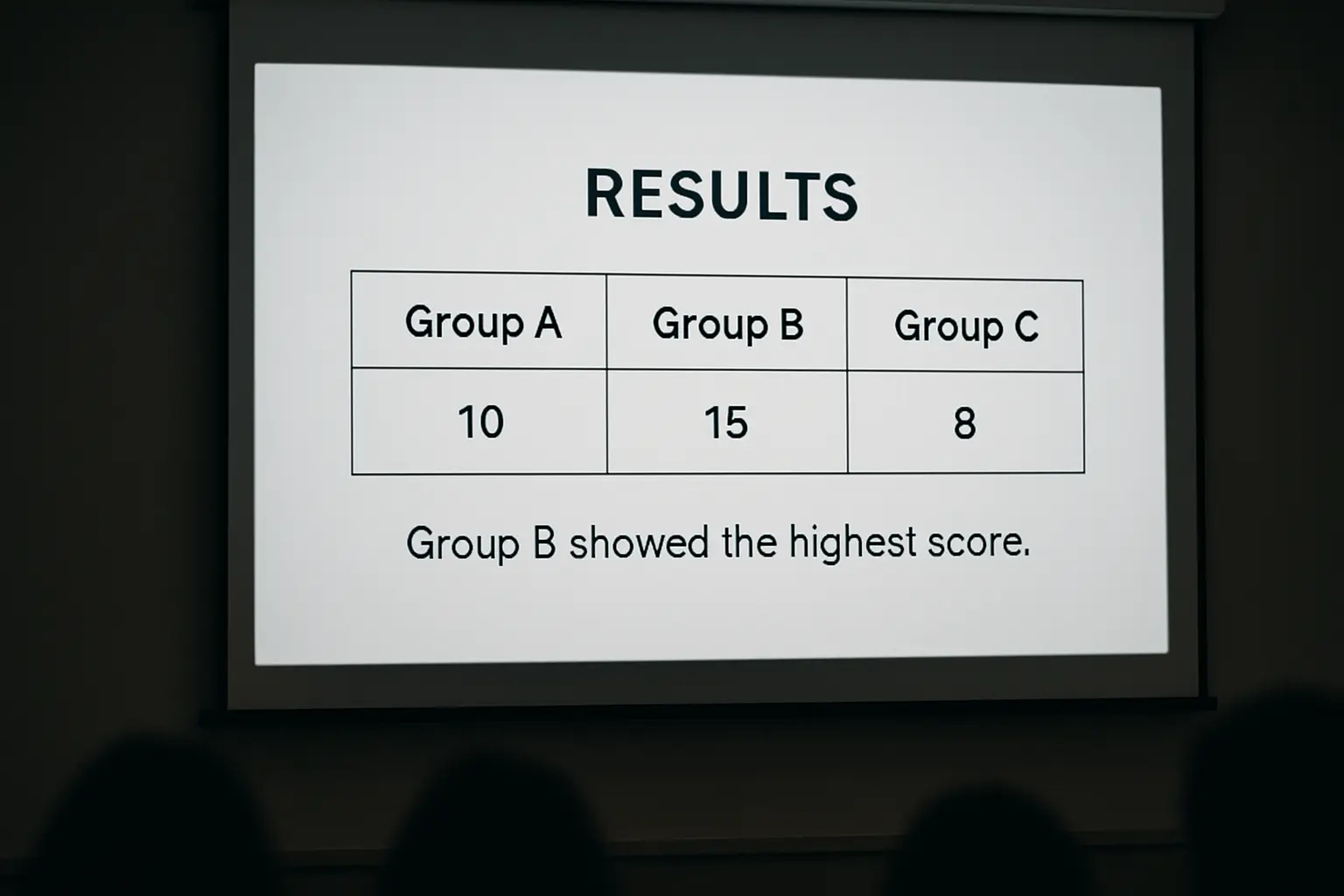
Do not paste a table from Word and hope. Rebuild each one with only the columns you will actually talk about, and put a single interpretation sentence directly underneath it in a larger font than the table.
That sentence is what the panel remembers. “Respondents rated system reliability lowest, with a weighted mean of 2.61 against a criterion mean of 2.50” is a finding. A table on its own is data, and it makes the panel do your work.
Three practical rules. Cut any column the panel does not need to see the finding. Never shrink the font to fit — split the table across two slides instead. And keep the full table in your manuscript, so when a panellist asks for the column you removed, you turn to the page. Which statistic belongs with which kind of problem, if that is still unsettled, is covered in the guide to the statistical treatment of data.
Expected output: one slide per table, each carrying its own finding sentence.
Step 7: Make every recommendation trace to a finding
Your conclusions slide restates what your data supports, in the order of your specific problems. Your recommendations slide names who should do what.
Run one check before you finalise it: for each recommendation, point at the finding it comes from. If you cannot, delete the recommendation. A recommendation that appears from nowhere is the most common failure at final defense, because it tells the panel you wrote Chapter 5 from expectation rather than from data.
Naming the beneficiary helps here — “the College may use the reliability finding to prioritise the scheduling module” is defensible; “the school should improve its systems” is not.
Expected output: a recommendations slide where every line has a finding behind it.
Step 8: Format the references slide correctly, because it is checked
Three to five key sources, formatted in the style your manual requires. If that is APA 7th, three details separate a correct entry from a generated one.
APA’s own reference guide states plainly that you should not include the publisher location, that you should use an en dash in a page range with no spaces around it, and that you should not put a period after the DOI. Free generators routinely get all three wrong.
A correct APA 7th journal reference looks like this:
Guest, G., Bunce, A., & Johnson, L. (2006). How many interviews are enough? Field Methods, 18(1), 59–82. https://doi.org/10.1177/1525822X05279903
Note the en dash in 59–82 and the absence of a full stop at the end. The other errors free tools introduce, and how to catch them before submission, are listed in the guide to APA citation generators and what to fix before you submit.
Expected output: a references slide you have checked by hand.
Step 9: Rehearse against a clock, twice
This is the step groups skip and the one that changes the outcome most. Rehearsing silently in your head does not count; you speak roughly half as fast out loud as you read.
A workable plan for a fifteen-minute allowance:
- Assign sections by chapter owner. Whoever wrote it presents it.
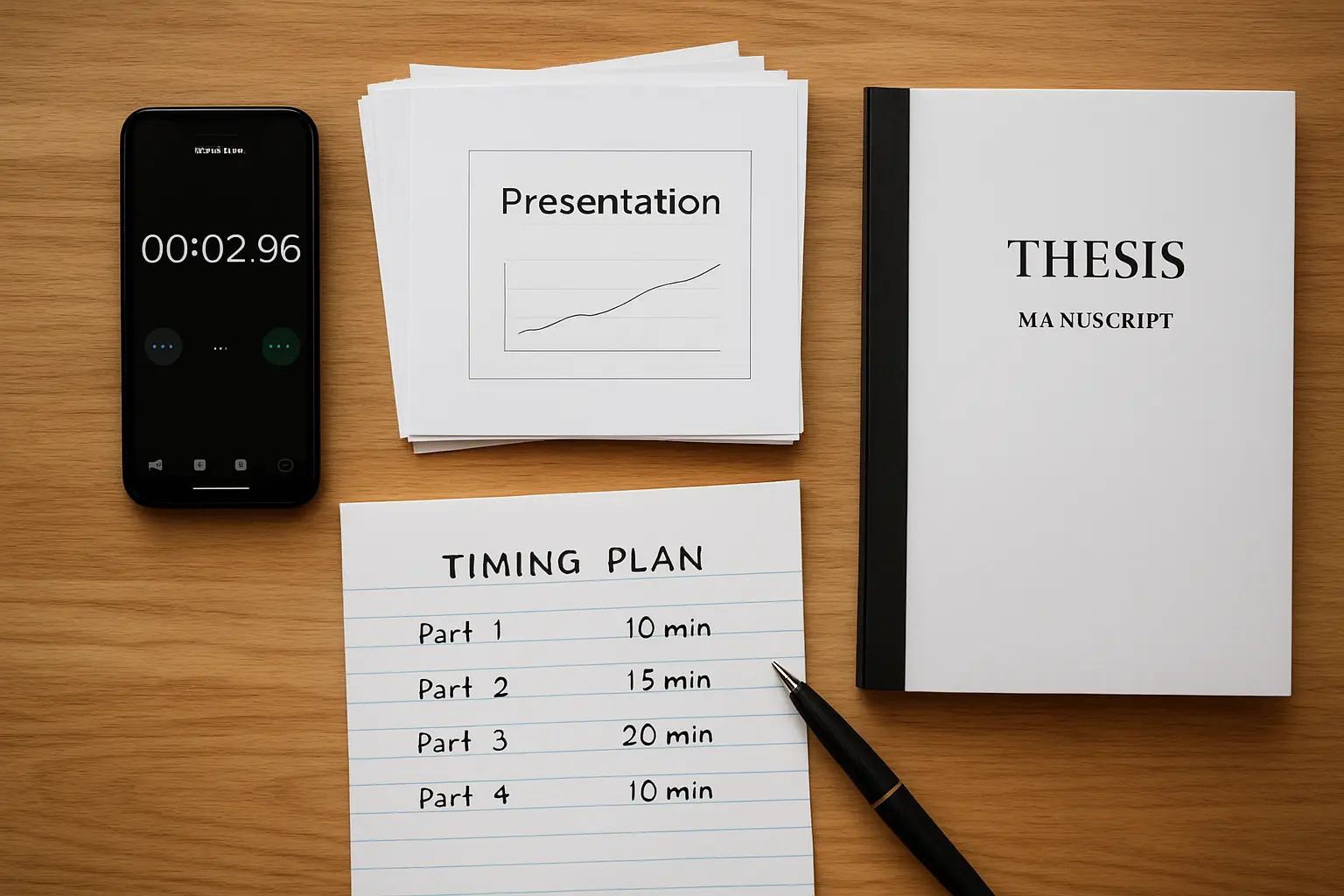
- Write a per-slide time budget. Title 15 seconds, problem 90, specific problems 60, scope 30, gap 60, framework 60, methodology 120, each results slide 120, conclusions 60, recommendations 60, close 30.
- Run it once with a stopwatch and do not stop, even when someone stumbles. Record the total.
- Cut, do not talk faster. If you ran nineteen minutes on a fifteen-minute budget, remove a slide.
- Run it a second time. You are ready when you land inside the limit twice in a row.
- Rehearse the handover sentences. The joins between speakers are where groups lose thirty seconds each time.
Expected output: two timed runs inside your limit, and a deck one slide shorter than when you started.
Step 10: Pack the room kit the night before
Assume the equipment will not cooperate, because often it does not.
- The file on a flash drive and emailed to yourself and in cloud storage.
- A PDF export as well as the editable file — PDFs do not reflow fonts on an unfamiliar machine.
- Printed handouts if your department expects them, one per panellist.
- Your bound manuscript, tabbed at each results table.
- An HDMI adapter if your laptop needs one. Nobody else will have yours.
- One notebook, and one person assigned to write down every revision verbatim with the panellist’s name attached.
That last item matters more than the deck. The list you leave the room with is the deadline you are actually working to, and panels contradict each other often enough that the record is what lets your adviser arbitrate afterwards.
What advisers send decks back for
Four things, in order of frequency. Paragraphs pasted from the manuscript instead of phrases. Tables shrunk to eight point so they fit. Numbers on the methodology slide that do not match Chapter 3. And a running order that does not follow the specific problems, so the results arrive in a different sequence from the questions that produced them.
All four are fixable in an evening, and all four are visible to your adviser in one pass, so send the deck before you rehearse rather than after. If your title itself was contested earlier, the panel will remember, and the faults that get Philippine titles sent back are covered in the guide to getting a rejected thesis title approved.
Get the manuscript settled so the deck is just a summary
A defense presentation is easy to build when the chapters underneath it are consistent. Tesify keeps your thesis or capstone in the structure your research manual expects and every citation attached to a source you actually opened, so the numbers on your methodology slide match the ones in Chapter 3. Over 9,000 students have used it to write more than 15,000 chapters, and every word is still written by you.
Frequently asked questions
How many slides should a thesis defense presentation have?
Twelve to fourteen for a fifteen-to-twenty minute allowance, including the title and closing slides. That works out to roughly one slide per minute of speaking, which is a sustainable pace. Thirty slides cannot be presented in fifteen minutes at any speed a panel will tolerate.
How long is a thesis defense presentation in the Philippines?
Commonly fifteen to twenty minutes for the presentation itself, with the whole session running considerably longer because the questioning takes the larger share. Confirm your own allowance with your adviser, because departments differ and the number changes the deck.
Should I read from my slides?
No, and this is the single most damaging habit. Slides carry phrases and numbers; you supply the sentences. A panel that can read your slide faster than you can say it has stopped listening.
What font size should I use?
Nothing below 24 point for body text and nothing below 18 point inside a table. If your content does not fit at those sizes, you have too much content on the slide, not a font problem.
Do I need to present all my tables?
Present the tables that answer your specific problems. Supporting tables can stay in the manuscript, and saying “that breakdown is in Table 7 on page 48” is a perfectly strong answer when asked.
Who should present which part?
Whoever wrote the chapter, with one exception: every member must be able to explain the methodology. Panels deliberately ask the quiet member, and a group where only one person can explain Chapter 3 has told the panel something it will act on.
Should the framework diagram go on a slide?
Yes, if your study has one, and redraw it rather than screenshotting it from Word. It is one of the few slides where a diagram genuinely beats text, and panellists refer back to it while asking about variables.
What do I do if the projector fails?
Present from your printed handouts and your bound manuscript, and keep going. Panels are unbothered by equipment failure and quite unimpressed by a group that stops. This is why the handouts are on the packing list.
Can I use a template I found online?
If your department has not issued one, yes, but strip the animation and use a light background. Dark templates that look striking on a laptop are frequently unreadable on an old projector in a bright room.
How early should the deck be finished?
Finished three days before, sent to your adviser two days before, and rehearsed twice the day before. The evening before the defense should be spent reading your own manuscript, not building slides.
Do capstone projects present differently?
Usually yes — a live system demonstration replaces some of the results slides, and it needs its own rehearsal because demonstrations fail in ways slides do not. Record a short screen capture as a fallback. What else differs between the two formats is set out in the comparison of a thesis and a capstone project.