Chapter 5 has three sections and they do different jobs. The summary of findings restates what you found, with no new interpretation. The conclusions answer the questions in your statement of the problem, one conclusion per question. The recommendations say what should be done and by whom, and every one of them must trace back to a finding.
Chapter 5 is the shortest chapter in a Philippine thesis and the one most groups write in a single panicked evening. It is also where misalignment becomes impossible to hide: four research questions, three sets of results and five conclusions is a contradiction a panellist can see without reading your analysis. What follows is the procedure, section by section, with the template text filled in. It assumes Chapter 4 is finished, because Chapter 5 is assembled almost entirely from material Chapter 4 already contains.
Step 1: Confirm what your manual calls the three sections
Expected output: the exact section headings your school requires, written down before you draft anything.
The near-universal pattern is Summary of Findings, Conclusions, and Recommendations, often preceded by a short restatement of the problem and the methodology. Some manuals merge the first two. Some add a separate Summary of the Study before the findings. Some engineering and capstone programs replace the whole chapter with a Summary, Conclusion and Future Work section.
Your school’s research manual is the binding document, exactly as it is for the five-chapter structure as a whole. Get it, note its edition, and take the headings from it verbatim. Rewriting headings after the fact is a needless correction.
Step 2: Build the summary of findings straight from your Chapter 4 tables
Expected output: one short paragraph per research question, in the same order as your statement of the problem, containing numbers and nothing else.
The summary of findings is a reporting exercise, not a writing exercise. Open Chapter 4, take each table in order, and write one sentence that states the headline number and what it describes. Then stop. No causes, no explanations, no references to other studies.
The discipline is easier to keep if you know what the failure looks like. “Respondents reported a high level of engagement (WM = 3.42) because the intervention gave them autonomy” is not a finding — the first half is, and the second half is interpretation that belongs in the conclusions or in Chapter 4’s discussion. Cut everything after the comma.
Two conventions catch people out. Findings are written in the past tense, because the study is finished. And every number must be identical to the Chapter 4 table it came from, to the same decimal places — a weighted mean reading 3.42 in one chapter and 3.4 in another is exactly the inconsistency a panellist notices while flipping between pages.
Step 3: Write one conclusion per research question
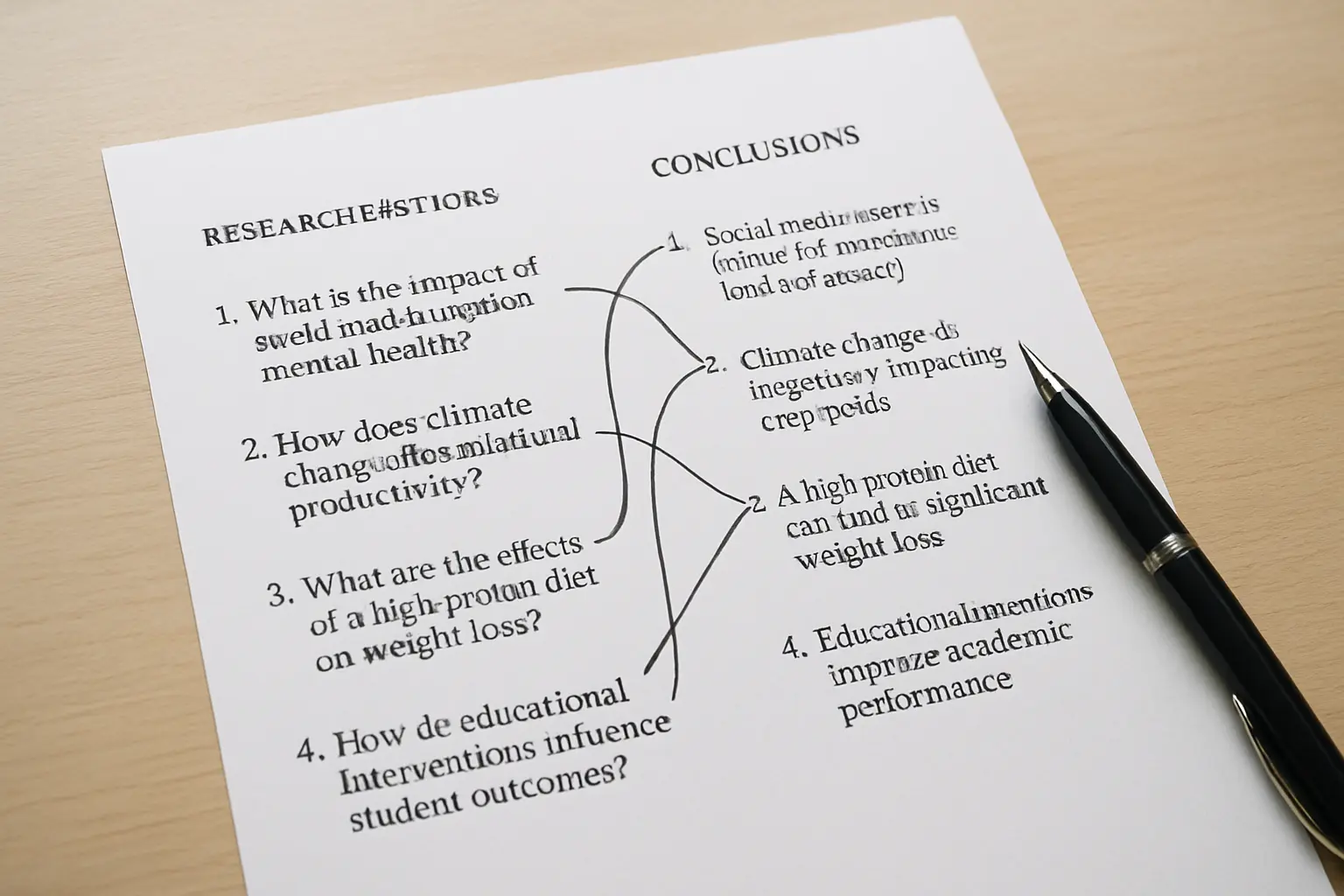
Expected output: the same number of conclusions as you have research questions, in the same order, each one answering its question directly.
A conclusion is the answer to a question you asked in Chapter 1. That is the whole definition, and it makes the section mechanical to structure. Copy your statement of the problem out of Chapter 1, paste it into a blank page, and write one conclusion underneath each question.
The difference between a finding and a conclusion is the level of generality. The finding is about your respondents; the conclusion is about the variable.
- Finding: “The respondents obtained a weighted mean of 3.42 on the time-management subscale, interpreted as High.”
- Conclusion: “Senior high school students in the locale of the study practise time management at a high level.”
Notice that the conclusion drops the statistic. Numbers live in the summary of findings; the conclusions are written in prose and in the present tense, because you are now stating what is true rather than what happened during data collection.
Two things do not belong here. A conclusion that generalises past your sample — “Filipino students practise time management at a high level” — is claiming a national result from a sample your Chapter 3 defined narrowly, and it is one of the easiest questions for a panel to ask. And a conclusion for a hypothesis test must state the decision: “The null hypothesis is rejected; a significant difference exists between the two groups.”
Step 4: Derive each recommendation from a named finding and address it to a named group
Expected output: a recommendation list in which every entry names who should act and cites the conclusion that justifies it.
This is where most Chapter 5s fail, and the fault has a name: a recommendation with no evidentiary parent. If you recommend a seminar programme, some finding must show that a skills gap exists. If nothing in your data points at it, it is an opinion you formed before the study and it should not be in the chapter.
The efficient way to build the list is to reuse the beneficiary groups you already named in the significance of the study. Those two sections are supposed to close a loop: Chapter 1 promises who will benefit, Chapter 5 tells each of them what to do. A significance section listing school administrators, teachers, students and future researchers, followed by recommendations addressed to nobody in particular, is a loop left open.
Use a fixed sentence shape and the section writes itself:
“Since the study found that [finding], it is recommended that [named group] [specific action].”
Worked example, following the same study used above:
“Since the study found that respondents scored lowest on the goal-setting subscale (WM = 2.61, interpreted as Low) while scoring High on all other subscales, it is recommended that the Senior High School guidance office integrate a goal-setting module into the existing homeroom guidance programme rather than into a separate seminar.”
The specificity in that second clause is what separates a recommendation a school could act on from one it cannot. “It is recommended that the school improve time management” names no actor and no action.
Step 5: Write the recommendations for further study last, and make them narrow
Expected output: two to four suggestions, each tied to a limitation you actually had.
Almost every Philippine manual expects a closing set of recommendations for future researchers, and almost every student writes the same three: a larger sample, a longer period, and other variables. They are not wrong, but they are generic enough that a panel reads them as filler.
The better source is your own scope and delimitation. Every boundary you declared in Chapter 1 is a study somebody could run: a different locale, the respondent group you deliberately excluded, the qualitative follow-up that would explain a result your numbers only describe. If a finding surprised you and your design cannot say why, say so and hand the question on. That is a real recommendation for further study, and it also demonstrates that you understand the limits of your own design — which is a question the panel will ask anyway.
Step 6: Keep new material out
Expected output: a chapter containing no table, no citation and no variable that did not appear earlier.
Chapter 5 introduces nothing. No new tables, because every number came from Chapter 4. No new literature, because the comparison to other studies happened in the Chapter 4 discussion and rests on the review of related literature in Chapter 2. No new variable, because a variable that appears for the first time in the final chapter was never measured.
The one exception some manuals allow is a brief restatement of the problem and methodology at the top of the chapter, for readers who open at the end. Two or three sentences is enough — this is a signpost, not a rerun of Chapter 3.
Step 7: Run the three-list alignment check before you submit
Expected output: three lists of equal length, matching in order and in subject.
This takes about fifteen minutes and prevents the most common Chapter 5 correction there is. On one page, write out:
- the research questions from your statement of the problem, numbered;
- the tables in Chapter 4, in the order they appear;
- the conclusions in Chapter 5, numbered.
The three lists should be the same length and describe the same things in the same sequence. Where they do not, one of three things is true: you answered a question you never asked, you asked a question you never answered, or you reordered something halfway through and did not propagate it. All three are cheap to fix now and expensive to fix after a panel finds them.
If your study ran hypothesis tests, add a fourth column for the decision on each, and confirm it matches what the statistical treatment section promised. A conclusion rejecting a null hypothesis the chapter never tested is the single fastest way to lose a defence.
What advisers send Chapter 5 back for
- Findings that interpret. Anything after “because” in a summary sentence belongs elsewhere.
- Conclusions that restate numbers. If the sentence contains a weighted mean, it is still a finding.
- Recommendations with no parent finding. The most common single correction on this chapter.
- Recommendations addressed to nobody. Name the office, the year level, the department.
- Generalisation past the sample. Your locale is in Chapter 3; keep the conclusion inside it.
- Count mismatches. Four questions, five conclusions. Run Step 7.
- Tense drift. Findings past, conclusions present. Manuals differ, so follow yours, but be consistent within the chapter.
A filled-in template you can adapt
Written for a descriptive-correlational study with three research questions, using the section headings most Philippine manuals expect:
Summary of Findings
1. The respondents were predominantly female (62.4%) and aged 17 to 18 (78.1%).
2. The respondents’ level of time-management practice was High (WM = 3.42), with the goal-setting subscale rated Low (WM = 2.61).
3. A significant moderate positive relationship was found between time-management practice and academic performance (r = .48, p < .001).Conclusions
1. The respondent group is predominantly female and concentrated in the standard senior high school age band.
2. Senior high school students in the locale of the study practise time management at a high level overall, but set goals at a low level.
3. Time-management practice and academic performance are significantly related; the null hypothesis of no relationship is rejected.Recommendations
1. Since goal setting was the only subscale rated Low, it is recommended that the guidance office integrate a goal-setting module into the existing homeroom guidance programme.
2. Since time-management practice is significantly related to academic performance, it is recommended that subject teachers require a written weekly plan for long-form outputs.
3. It is recommended that future researchers replicate the study in a public school locale, since this study was delimited to one private senior high school.
Every number in the findings comes from a Chapter 4 table. Every conclusion answers a numbered question. Every recommendation names a group and cites the finding above it. That is the whole test.
Finish the last chapter without rebuilding the first four
Tesify keeps your statement of the problem, your results and your conclusions in one connected document, so the alignment check is something you can see rather than something you have to reconstruct the night before submission. Over 9,000 students have written more than 15,000 chapters with it, and every word is still written by you.
Frequently asked questions
How do you write Chapter 5 of a thesis?
Take the summary of findings from your Chapter 4 tables in order, write one conclusion for each question in your statement of the problem, then write recommendations that each name a group to act and a finding that justifies the action. Add recommendations for further study drawn from your own delimitations.
What is the difference between findings and conclusions?
Findings are about your respondents and contain the numbers. Conclusions are about the variables and contain no statistics. “Respondents obtained a weighted mean of 3.42” is a finding; “students practise time management at a high level” is the conclusion drawn from it.
How long should Chapter 5 be?
There is no national page count, and any figure you see quoted is somebody’s school rule presented as universal. It is normally the shortest chapter in the thesis because it contains no tables and no citations. Check your own research manual.
How many conclusions should I have?
The same number as your research questions, answered in the same order. That mapping is the clearest structure and it is what a panel checks first.
What tense is Chapter 5 written in?
Findings in the past tense, because data collection is finished. Conclusions in the present tense, because you are stating what is now known. Recommendations in the present or imperative. Manuals vary, so follow yours and stay consistent inside the chapter.
Can I put new tables in Chapter 5?
No. Every number in Chapter 5 must already appear in a Chapter 4 table. A table that appears for the first time in the final chapter raises the question of where the data came from.
What if a recommendation does not come from a finding?
Delete it or find the finding. A recommendation with no evidentiary parent is the easiest thing on the page for a panellist to attack, and the answer “it seemed sensible” does not survive the question.
Do I need recommendations for further study?
Most Philippine manuals require them. Draw them from your scope and delimitation rather than defaulting to “a larger sample and a longer period”, which every panel has read hundreds of times.
My study is qualitative. Does the same structure apply?
Yes, with themes in place of statistics. The summary reports the themes that emerged, the conclusions answer the research questions, and the recommendations follow from the themes. If you are still deciding how many participants that requires, see the guide to sample size for a qualitative thesis.
Is Chapter 5 discussed at the defence?
Heavily. Panels commonly work backwards from a recommendation to the finding behind it. Build the defence deck so the mapping is visible on one slide — the defence presentation guide sets out where it belongs in the sequence.